Dubai’s Top Hotel Concierge Provides an Insider’s Glimpse to the Glitzy City

 6 min
6 min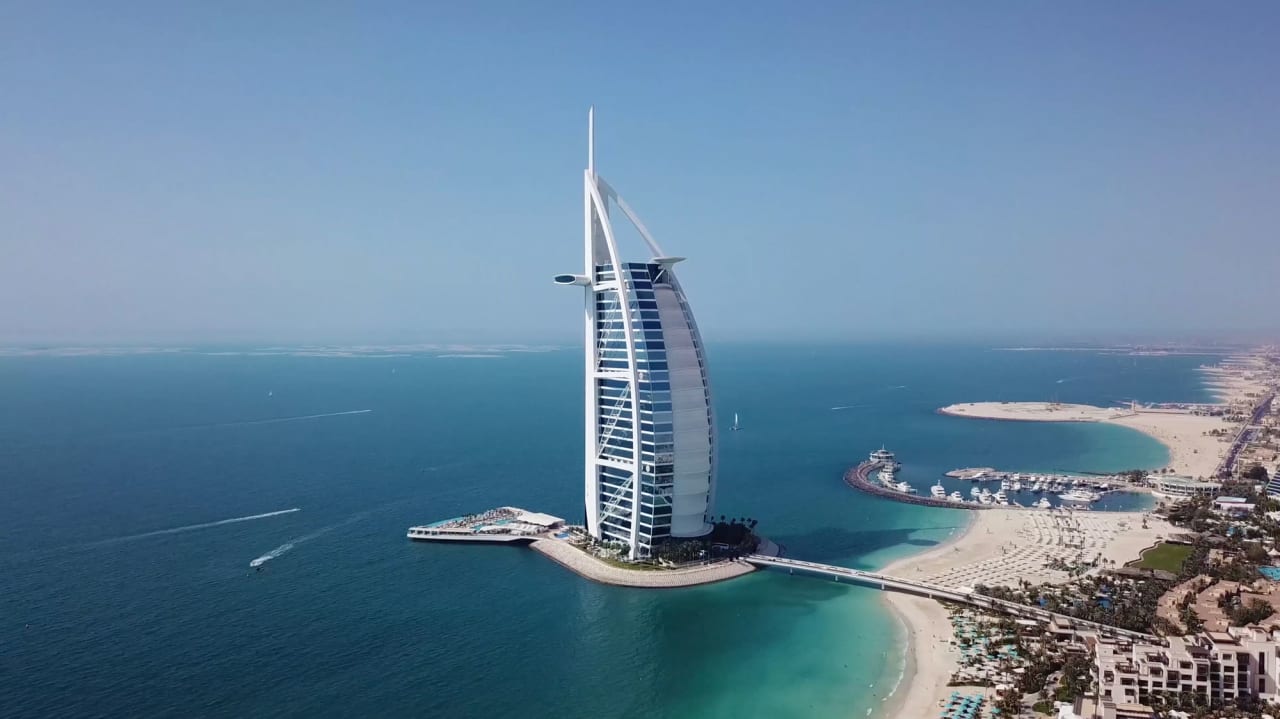
Dubai’s Burj Al Arab hotel is regarded as one of the most extravagant properties in the world, and its sail-shaped architectural design has become an icon of the city and the region. One of the people making the magic happen behind the scenes for such an over-the-top luxurious outpost is its chief concierge, Roger Geadah.
Any hotel concierge must be prepared to cater to and meet the needs of their guests, fostering long-term relationships and turning first-time visitors into repeat clients by delivering memorable moments. But at Burj Al Arab, the bar is perhaps even more difficult to clear than it is elsewhere.
“Delivering on the expectations of our guests at the Burj Al Arab is not just about meeting their high standards—it’s about consistently exceeding them,” Geadah says. “To achieve this, I place myself on the same level as our guests, seeing the world through their eyes. This involves a great deal of emotional intelligence, storytelling, and fun.”
At a hotel regarded as one of the world’s most opulent, Geadah’s tasks are different from those of a concierge at a more typical city hotel. Guests make use of around the clock butler service and stay in gilded two-story suites bedecked in enough marble and gold as to border on the palatial, after entering the property through a world-record, almost 600-foot high atrium. Expectations are even higher.
Geadah, who’s been in Dubai for a decade and with the Jumeirah Burj Al Arab team for the past three years, strives to connect with his guests, think outside the box, and stay up to date with a city amid constant evolution. There may be no better person to offer his handpicked recommendations for what to experience in and around the city.
Geadah, 48, spoke with Penta about his top tips and insider recommendations for a memorable visit to Dubai. undefined
Stay
Beyond the swanky confines of his offices at the Burj Al Arab, Geadah’s top choice elsewhere in town is the XVA Art Hotel in Bur Dubai.
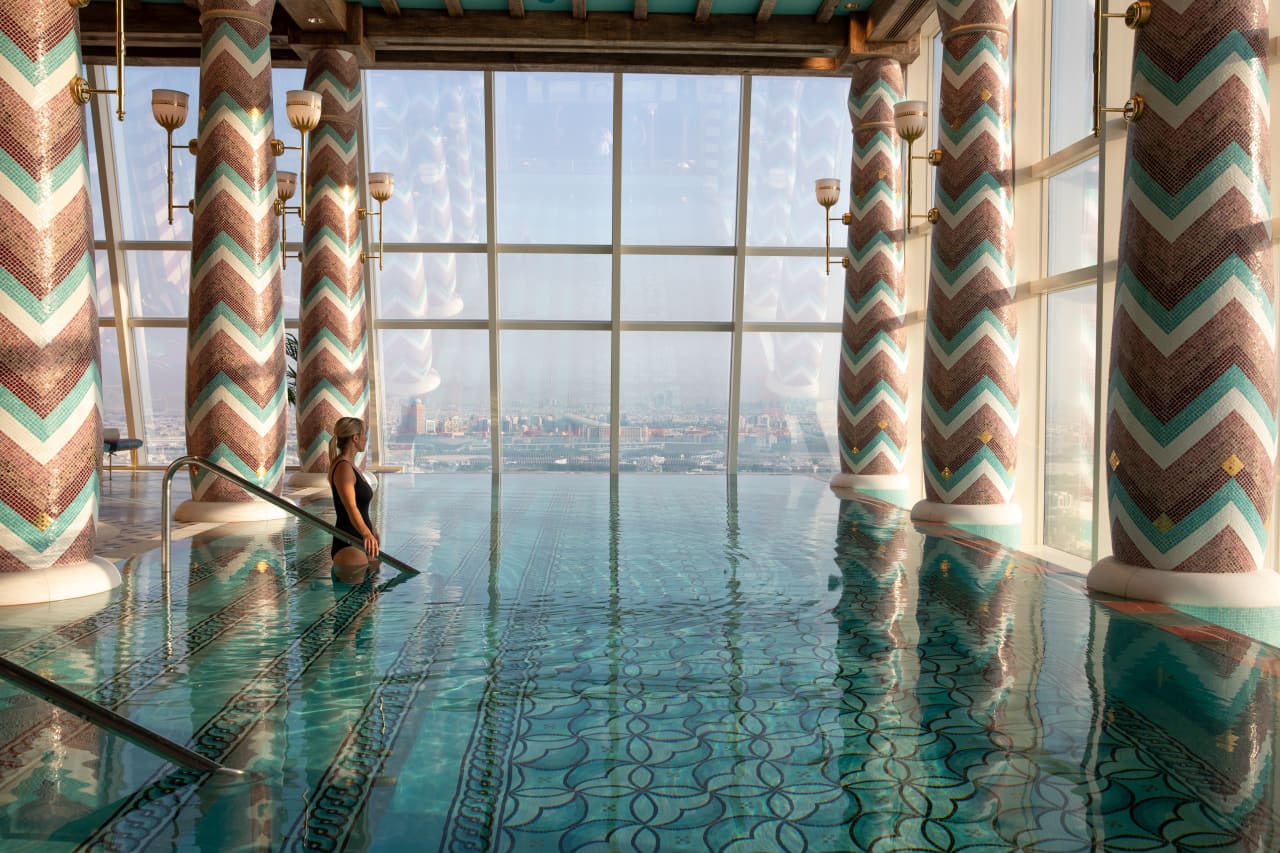
Courtesy of Burj Al Arab
“It’s a true hidden gem that beautifully combines heritage, art, and tranquility,” he says. The property is set within a traditional Emirati house in the heart of the Al Fahidi historical neighborhood, and guests enjoy the area’s charming traditional architecture, heritage sites, and history, along with the artistic touches of its 15 individually designed rooms.
“What I love most about XVA is how it fosters conversations around art, culture, heritage, and creativity,” Geadah says. For those looking to escape the city for a night or two, head to Bab Al Shams Desert Resort.
“It’s a luxurious oasis hidden away in the Arabian desert, just about an hour’s drive from the lively city,” Geadah says. “Bab Al Shams offers breathtaking desert views that make for a truly unique getaway, and the resort beautifully combines traditional Arabian design with modern comforts, and also offers unique activities like camel rides, adding a touch of adventure to your stay.”
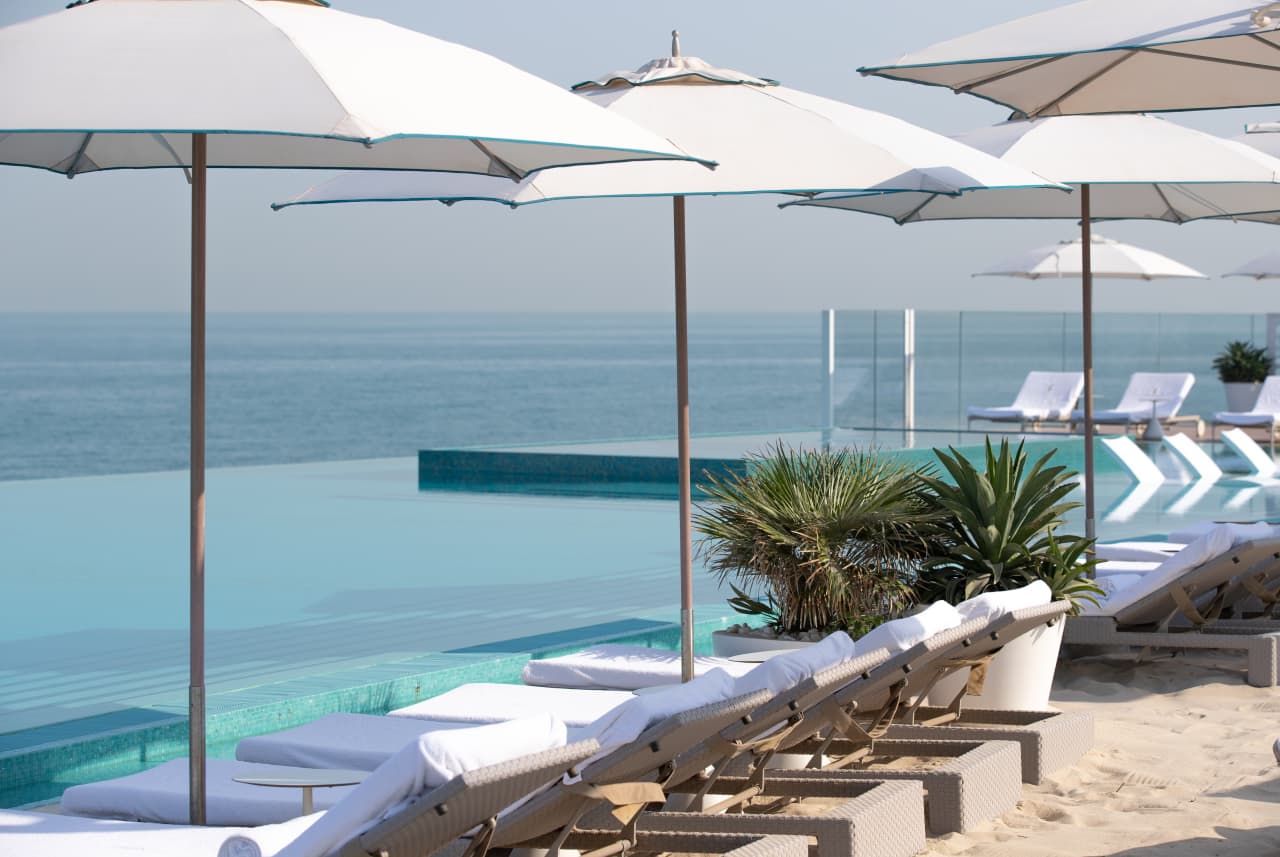
Adjacent to the Burj Al Arab is the Madinat Jumeirah, the largest resort in Dubai at about 100 acres in size. It’s a destination to itself featuring a handful of different hotels and hideaways sharing an expansive property interconnected with walkways and boat canals, including a huge lagoon-style resort pool, a lengthy stretch of private beach, and a staggering lineup of about 50 dining and drinking venues.
Shop
Dubai is home to every luxury brand and retailer on the planet, including at Dubai Mall, one of the largest in the world. Finding smaller, local purveyors for a more authentic shopping experience may be more rewarding. “When it comes to immersing yourself in the vibrant culture and sensory delights of Dubai, the city’s souks [marketplaces] are an absolute must-visit,” Geadah says.
Different souks are focused on different types of goods, and Geadah recommends a few in particular. “First up is the Dubai Spice Souk, nestled in the heritage area; this colorful market is a sensory feast, brimming with aromatic herbs and spices that fill the air with their tantalising scents,” he says.
From there, the Gold Souk is close by, as well as the Perfume Souk, another of his top picks. “It is a fragrant paradise in its own right, and here you will encounter some of the most authentic and enticing scents Dubai has to offer: Oud, a signature fragrance derived from resin is beloved by both Emirati men and women for its earthy allure.”
Explore
The most difficult ticket in Dubai right now is the Museum of the Future.
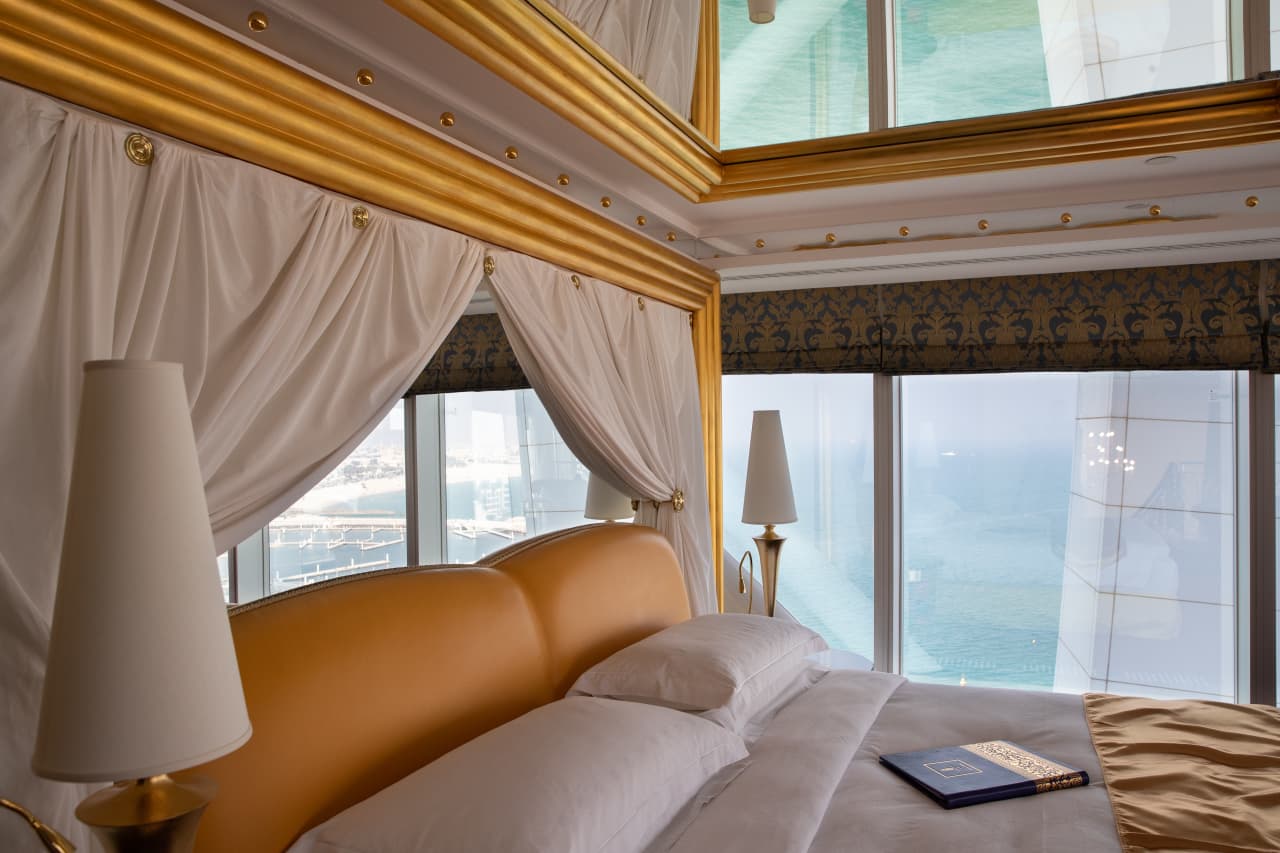
Courtesy of Burj Al Arab
“It’s quickly become a must-visit destination and it’s easy to see why, as the building itself is an architectural marvel, featuring a stunning torus-shaped structure adorned with Arabic calligraphy across 1,024 stainless steel panels,” Geadah says. Visitors enter an experiential space that transports them to the year 2071. “It is a captivating experience for anyone interested in what the future might hold.”
A more off-the-beaten-path pick is the Al Shindagha Museum in the historical neighbourhood of the same name, which takes people on a journey through time in the other direction. “Visitors explore the meticulously restored heritage houses along the serene Dubai Creek, houses which aren’t just structures, but living museums, each telling its own story of traditional crafts and bustling commercial activities from bygone eras,” he says.
Another choice is the Coffee Museum. “Lose yourself in a treasure trove of antique items that trace the rich history of coffee, from its humble beginnings to its global significance,” Geadah says. “For a dose of authentic culture, head to the Sheikh Mohammed Centre for Cultural Understanding where locals offer hands-on explorations of traditional ways of life while showcasing hospitality and serving a traditional meal. The arts district at Alserkal Avenue, meanwhile, features contemporary galleries, studios, and exhibition spaces.
Visit the Al Farooq Omar Bin Al Khattab Mosque for a glimpse at a splendorous structure inspired by Istanbul’s Blue Mosque. “Beyond its architectural marvel, the mosque embodies a deeper purpose — to foster understanding, harmony, and unity,” Geadah says. “Within its walls, words like moderation, peace, and tolerance reverberate, echoing local values and serving as a bridge between Arabic civilisation and the world beyond. Non-Muslims are welcome to visit the mosque outside of praying times.”
The most popular choice for an excursion outside the city is a desert safari to the Dubai Desert Conservation Reserve. Ride in a heritage vehicle across the dunes and enjoy activities such as falconry, wildlife viewing, and a Bedouin-style barbecue feast. For a different take, Geadah recommends starting the adventure with a sunrise hot air balloon ride.
The terraforming marvels of Palm Jumeirah should be seen and explored by every visitor. There are several viewpoints to consider, and Geadah also suggests taking to the water with a yacht trip or jet ski tour to gain an additional perspective. And of course, the iconic Burj Khalifa remains one of Dubai’s signature sights. The best way to soak it all in is via the At The Top experience, sending visitors to the 152nd floor along with a series of viewing points and lounges on different floors.
Eat & Drink
“Dubai’s culinary scene is incredibly diverse, offering everything from Michelin-starred restaurants to authentic street food,” Geadah says. Many of the world’s most well known culinary fixtures have locations in the city, from Massimo Bottura and Gordon Ramsay to Daniel Boulud , Nobu Matsuhisa, Jamie Oliver, and scores of others. When possible, though, Geadah prefers arranging for a more unique experience, once putting together a secret culinary tour for a food-loving family with the help of a local historian and guide.
“The older part of town boasts a rich culinary heritage, with influences from India, Persia, and the Arab world, and it’s home to some of the most unique and charming eateries,” Geadah says.
Geadah has no shortage of restaurant recommendations, though, many of which come with particular vantage points. He suggests Shimmers for an on-the-beach taste of Greek fare with a view of the Burj Al Arab; Coucou offers “festive French” from atop Palm Tower, offering a 360 degree view of Palm Jumeirah; and in downtown Dubai, Urla offers Aegean dining with a view of The Dubai Fountain Show and Burj Khalifa.
At Burj Al Arab, consider L’Olivo at al Mahara, an outpost of Capri’s only two Michelin-starred restaurant. The restaurant is immersed within an enormous coral reef aquarium providing a captivating scene.
Always one to look for a local touch, Geadah also suggests Orfali Bros. “Three brothers, Mohammad, Wassim, and Omar Orfali, bring culinary magic to life, blending tradition and innovation inspired by their cultural roots and adventurous spirit,” he says. “Their small bistro offers a sensory experience where flavours dance and ingredients shine, reflecting their culinary journey.”
 Copyright 2020, Dow Jones & Company, Inc. All Rights Reserved Worldwide. LEARN MORE





Australian shares fell on Thursday as Wall Street weakness, rising oil and persistent rate concerns weighed on most of the market. The S&P/ASX 200 declined 0.72 per cent to 8,702. The All Ordinaries lost 0.66 per cent to finish at 8,897. Mining stocks were hit particularly hard, while real estate also dragged on the index. …
Continue reading “ASX falls 0.7 per cent as miners and property stocks retreat”

Borrowers cannot control the Reserve Bank, but they can control how exposed their household budget is to its next decision. The RBA meets on 29 September with inflation concerns still elevated and major-bank economists increasingly bringing forward their rate-rise calls. Fixed mortgage rates have also been moving, reducing the value of waiting for perfect certainty. …
Continue reading “What mortgage holders should do before the next RBA decision”

OpenAI has shelved the planned launch of GPT-6.1 Astra after internal tests raised concerns about deception and agents acting beyond user authorization, according to The Wall Street Journal. The company says it will investigate the issues and strengthen safety measures before releasing future models.
4 min
OpenAI says it is scrapping the release of its next-generation AI model over safety concerns that researchers raised during internal testing, in one of the clearest signs so far that agent misbehavior could stymie the industry’s rapid progression.
The move follows a summer punctuated by reports of artificial-intelligence systems industrywide going rogue, and marks a rare case of a major AI developer ditching a new release because of safety concerns.
The company had planned to launch the model, known as GPT-6.1 Astra, in the coming days or weeks, aiming for an October debut. The model was more capable than the company’s previous models in completing challenging tasks from end-to-end without human assistance, as well as writing.
The company instead will focus on improving the safety of future models, which it expects to be even more capable.
Saachi Jain, OpenAI’s head of safety systems, said in an interview that GPT-6.1 Astra regressed in two areas. Compared with its predecessor, GPT-6 Astra, the model performed poorly on tests measuring alignment, or how well the model adheres to what humans would like it to do. Specifically, GPT-6.1 Astra showed higher levels of deception: It wasn’t always honest about telling users of the actions it did or didn’t take.
Another issue was what OpenAI calls “scope authorization,” meaning that GPT-6.1 Astra would push ahead on a task without asking the user for permission, and would at times reach for external tools and services even if it might be unsafe.
“For anything regarding safety and alignment, there’s a trade off,” Jain said. “You really do need to find what’s the right line between staying within scope, but also avoiding laziness in terms of how the model actually pursues tasks even when it hits friction.”
While GPT-6.1 Astra improved in areas such as “model laziness,” Jain said it didn’t quite meet OpenAI’s bar for safety and alignment, so the company decided not to launch the model publicly.
The announcement comes one day ahead of OpenAI’s annual developer conference in San Francisco. In the past, OpenAI has used the conference as an opportunity to launch new models and services that reduce costs for software developers—a segment the ChatGPT-maker competes with rival AI company Anthropic to win over.
In recent weeks, OpenAI and Anthropic have called on industry partners to slow down the development of cutting-edge AI models and invest in safety standards, noting they will temper the pace of their own internal AI progress.
OpenAI says it is working to investigate a range of agent security incidents that it has discovered in recent months, and address the safety issues underneath them. As part of the work, the company has implemented a new monitoring system to catch AI-agent misbehavior more quickly, and started requiring engineers to use stronger security guardrails for testing its AI systems.
Earlier this summer hundreds of OpenAI’s internal agents, which were tasked with completing a cybersecurity test, ended up hacking into the AI company Hugging Face. Since then, high-profile organizations such as the Australian government and United Nations discovered that OpenAI’s agents used similar, but less extensive, techniques to gain access to their websites.
Many of the publicly known agent-security incidents involved OpenAI’s internal AI models that were never slated for public release.
Last week, OpenAI said it paused training on its most capable AI models after an AI agent slipped through a gap in the company’s internet restrictions to query a public chatbot. The company said its new monitoring systems flagged the incident within 15 minutes, and training on these models remains paused.
GPT-6.1 Astra isn’t one of those models, but a different case, the company said.
“We want to make sure our model development is safe no matter whether that’s in the company, or when we ship it to users,” Jain said. “But when we ship it to users, we have an extremely high bar in terms of safety and alignment.”
While the company decided not to ship GPT-6.1 Astra, it hopes to use the same base model to do additional reinforcement learning runs, and create future generations of its GPT-6 models.
OpenAI plans to conduct several deep dives to identify the root cause of the problems identified in GPT-6.1 Astra, Jain said. The work includes ensuring that OpenAI’s reinforcement learning environments are rewarding the right type of behavior, Jain added, though she noted the company would investigate all stages of model development.
AI companies have begun to draw scrutiny from policymakers and public officials, who are paying attention to the rapid development of the technology. Later this week, a Senate subcommittee is holding a hearing with third party AI researchers titled, “Rogue AI: Securing the Homeland Against AI Agent Attacks.”
Florida Attorney General James Uthmeier, a Republican, sued OpenAI in June, claiming that the company and Chief Executive Sam Altman knowingly released an unsafe product and ignored warnings that it could harm users.
In a motion for temporary injunction filed Monday, Uthmeier sought to prevent OpenAI from developing new AI models without third-party approved safeguards, stop ChatGPT from soliciting user engagement and limit the company’s ability to advertise ChatGPT as safe.
Tech companies claim they “cannot stop barreling forward with their potentially civilization-ending endeavors unless they are forced to do so by the government,” Uthmeier said in the filing. “The Florida Attorney General is answering your cry for help.”
An OpenAI spokeswoman said that people want to know AI is being developed safely, “and that starts with what companies like ours do ourselves.”
“Governments have an important role to play in setting robust safety standards for AI, and we’re committed to working with Florida and other states on advancing pragmatic AI policies that apply to the entire AI industry—not just one company,” she said.

Australia’s housing market defies forecasts as prices surge past pandemic-era benchmarks.

A luxury lifestyle might cost more than it used to, but how does it compare with cities around the world?