Wednesday’s Other Central Bank Meeting Might Be the One to Watch
The Bank of Japan will announce an interest-rate decision on the same day as the Fed, with big consequences

 3 min
3 min
All eyes will rightly be on the Federal Reserve’s interest-rate decision Wednesday. But the meeting of another central bank across the Pacific will be quite consequential too.
While Jerome Powell is pondering whether to cut rates now for the first time in more than four years or perhaps wait a couple more months, Kazuo Ueda , his counterpart in Japan, is considering whether to do the opposite . After the Bank of Japan exited its negative-interest-rate regime in March, investors are looking for more tightening to come.
The Bank of Japan raised its short-term interest rate from minus 0.1% to a range of around 0% to 0.1% in March, the first increase in 17 years. Japan’s consumer prices rose 2.8% year-on-year in June, which was off from inflation’s peak pace last year, but still well higher than Japan is accustomed to.
In a possible preview of what awaits markets if the Bank of Japan leans hawkish, the Japanese yen has risen sharply in the past few weeks, appreciating 5.2% against the dollar this month from a multi-decade low. That has likely contributed to market turmoil in other markets around the world over the past couple of weeks, including the selloff in global technology stocks, as the yen, with its low interest rates, is a favourite funding currency for traders .
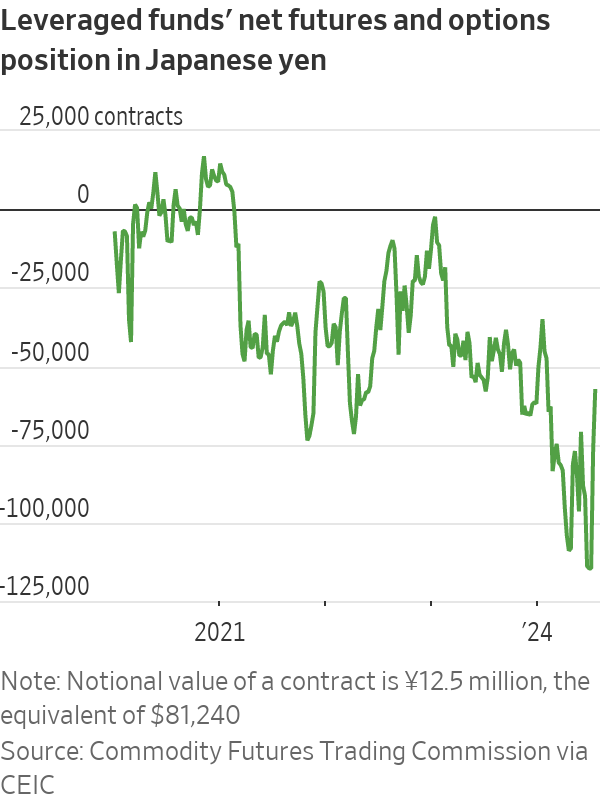
Hedge funds have ramped up their short bets on the yen in the past two years but could exit their positions pretty abruptly. Leveraged funds have slashed their net short position in options and futures against the yen by half in the two weeks ended July 23, according to data from Commodity Futures Trading Commission via CEIC. That is equal to a nominal value of $4.6 billion.
But the market is divided over whether a Japanese rate increase could come as soon as this week. There is a 41% probability that the Bank of Japan could raise rates by 0.15 percentage point, inferred from pricing of overnight indexed swaps, according to Bank of America.
At the meeting this Wednesday, the Bank of Japan is also expected to outline plans to unwind its portfolio of $3.8 trillion in Japanese government bonds, likely giving a further boost to long-term rates. Japan’s 10-year government bond yields have gone up 0.44 percentage point to around 1.06% this year as investors expected higher rates.
The country was swimming against the tide over the past few years by staying put on its ultra-easy monetary policies when most major central banks were raising rates. The Bank of Japan will likely be more cautious going in the opposite direction: A sharply higher yen could be punishing to exporters , and policymakers in Japan live in perpetual fear of returning to deflation. Any surprises in the BOJ’s pace as it normalises policy could still rattle financial markets.
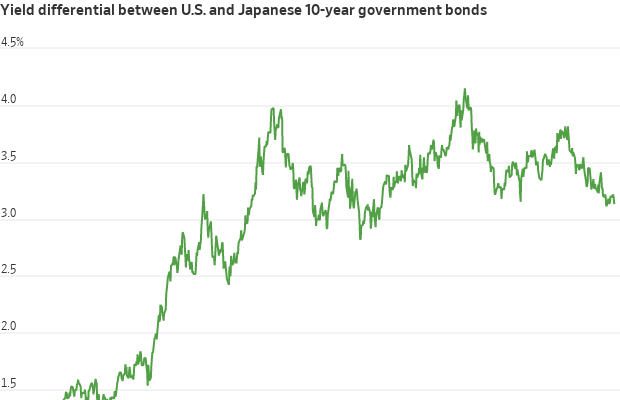
Over the longer term, a narrowing interest-rate differential between the U.S. and Japan could shift the pattern of investment flows. Japan had the equivalent of $4 trillion in foreign portfolio investments at the end of 2023, according to official data. That includes both companies and individuals which are scouring the globe for higher returns. Some of them might bring their money back to Japan if assets at home are generating higher yields, especially if the yen is getting stronger.
U.S. 10-year government bonds still yield around 3.1 percentage points more than Japanese ones, but that is already down from a 4.2-percentage-point gap in October. If that gap keeps narrowing, it could mean tighter financing conditions in markets around the world, which have long looked to Japan as a steady buyer.
It is rare for two of the world’s largest central banks to be at major turning points in their long-term policy settings at the same time, and rarer still for them to be moving in opposite directions. The consequences could be far-ranging and unpredictable. Investors around the world will have to get used to paying more attention to what is happening in Tokyo, not just Washington, D.C.
 Copyright 2020, Dow Jones & Company, Inc. All Rights Reserved Worldwide. LEARN MORE





A record-breaking $11 million sale at The Centennial Collection has set a new benchmark for luxury apartment living in Bondi Junction.

As interest rates, inflation and market sentiment fluctuate, investors are being urged to focus on data, not panic.


The Federal Budget may have softened some of its proposed tax reforms, but it has exposed a bigger issue: too many families are relying on wealth structures that no longer reflect the realities of modern life.
3 min
For many Australians, the 2026 Federal Budget initially felt like a direct challenge to the way wealth is created, held and transferred between generations.
The headlines were immediate: changes to capital gains tax, reforms to discretionary trusts, restrictions on negative gearing and increased scrutiny of investment structures. Unsurprisingly, affluent families, business owners and investors began asking the same question:
Is the way we hold our wealth still fit for purpose?
In recent days, the government has announced several significant amendments following industry consultation and public feedback, including exempting testamentary trusts from the proposed 30 per cent minimum tax and expanding capital gains tax concessions for small businesses.
The backdown is welcome. But it also highlights something much bigger.
This Budget has accelerated a conversation that many Australian families have been postponing for years.
The conversation is not really about tax. It is about wealth stewardship.
For decades, Australians have built wealth through businesses, property, investments and careful long-term planning. Yet many families have not revisited the legal structures surrounding those assets in years, sometimes decades.
We often see clients who have spent years building significant wealth, only to discover their legal arrangements no longer reflect their current circumstances.
Their children are now adults. They may own multiple properties.
They may have sold a business, entered a second marriage, become grandparents or accumulated digital assets that did not exist when their original estate plans were prepared.
The trust that distributes income may need to be reconsidered. The bucket company may no longer be so attractive.
The Budget has simply exposed a reality that already existed: wealth structures cannot remain static while life continues to evolve.
Importantly, trusts themselves are not the issue.
Trusts are legitimate planning tools that provide flexibility, protection and continuity. When used appropriately, they allow families to adapt to changing circumstances over time.
And neither is tax the issue, really. Getting the fundamentals right is more important for long-term, sustainable wealth than a few favourable tax treatments around the edges.

The real issue is complacency.
Too often, families create structures and assume the job is done. It isn’t.
Estate planning is no longer a document you sign once and file away in a drawer. It is an ongoing process that should evolve alongside your life.
We are also seeing a broader shift in how Australians define wealth itself. It is no longer just the family home and an investment portfolio.
Modern wealth includes businesses, digital assets, cryptocurrency, intellectual property, frequent flyer points and increasingly complex family arrangements.
At the same time, Australians are living longer than ever before, meaning wealth may need to support multiple generations simultaneously. This creates new responsibilities and new risks.
How do you help your children enter the property market without exposing family wealth to relationship breakdowns?
How do you structure wealth so that it remains a source of opportunity rather than future conflict?
These are the questions families should be asking now.
The recent debate surrounding testamentary trusts also serves as an important reminder that policy decisions can have unintended consequences for vulnerable Australians. It is encouraging that the government has listened to feedback and clarified its position.
But the lesson remains: the wealth landscape is changing.
Increasingly, governments, regulators and tax authorities are paying closer attention to how wealth is held and transferred. That means families cannot afford to adopt a “set-and-forget” approach to their structures.
The families who will be best placed for the future are not necessarily those with the greatest wealth.
They are the families with the greatest clarity. Clarity around ownership, succession and governance. And clarity around how wealth will transition from one generation to the next.
Ultimately, preserving wealth is not about avoiding change.
It is about preparing for it.
Because the greatest risk is not change itself.
It is losing the ability to respond to it.
Anthony Hunt is Co-Founder of Wealth Lawyers and former COO of Westpac Private Bank. He advises business owners, investors and affluent Australian families on wealth protection, succession planning and intergenerational wealth transfer

Sydney Children’s Hospitals Foundation CEO Kristina Keneally says Australia’s culture of large-scale philanthropy is becoming more sophisticated as Gold Dinner raises $75.5 million for children’s health, research and innovation.

Limited to 630 units, Lamborghini’s latest Urus Capsule pushes personalisation further than ever, blending hybrid performance with over 70 bespoke design combinations.