


Can Innovation Curb AI’s Hunger for Power?
Nvidia says its machine-learning chips have become 45,000 times more energy efficient, with further improvements in the pipeline

 6 min

Artificial intelligence is known for its seemingly insatiable appetite for energy. But some tech leaders and analysts are questioning the extent of AI’s footprint going forward, saying innovations in the sector could help offset rising energy demand.
There is certainly no shortage of forecasts detailing the ominous rise in AI’s energy consumption. One commonly-cited report by Climate Action against Disinformation, an association of environmental groups, suggests that AI could drive up global emissions by 80%.
Another estimate by researcher Alex de Vries—which he described as a worst-case scenario—suggests that Google’s AI alone could eventually rack up as much annual electricity demand as the country of Ireland.
Such predictions present a substantial challenge for the relationship between computing and the climate in the coming years.
However, others see reason for optimism. In a Salesforce survey of about 500 corporate sustainability professionals, published Wednesday, nearly half were concerned about AI’s potential negative impacts on sustainability efforts. Meanwhile, almost 60% thought the benefits of AI would offset its risks in addressing the climate crisis.
Microsoft founder Bill Gates recently weighed in on the subject, urging governments not to go “overboard” on concerns about AI’s energy footprint, and suggesting that the technology could actually drive a reduction in global energy demands.
Putting the AI boom in context
The rise of AI should be considered in a broader perspective, according to Charles Boakye, U.S. sustainability analyst at Jefferies. He noted that relative to other industries, the technology still makes up only a fraction of global power demands.
“Data centers—the engines powering everything from AI to traditional computing to cryptocurrency—currently account for about 2% of global electricity consumption. Of this, AI accounts for roughly 0.5%,” Boakye said.
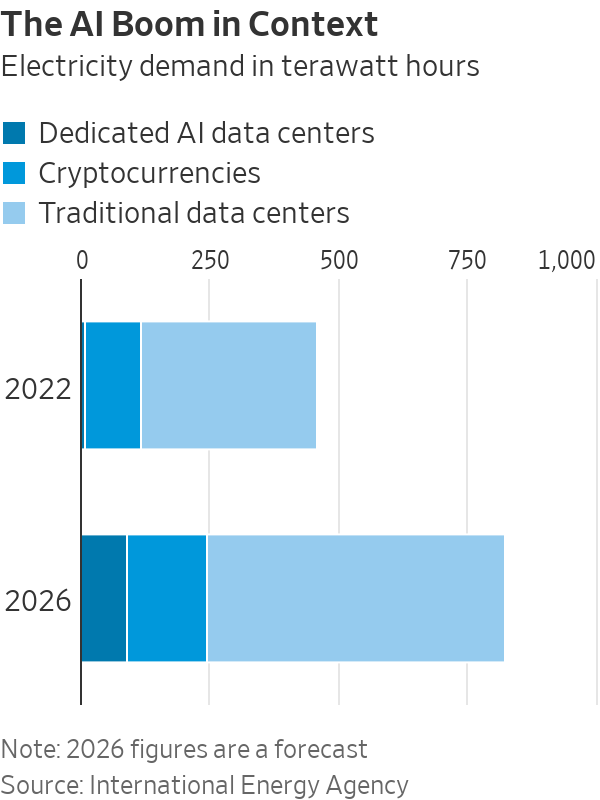
In terms of emissions, statistics last year from the International Energy Agency showed in total, data centers and transmission networks are responsible for 1% of energy-related greenhouse gases. For comparison, the oil-and-gas industry contributed just under 15% of emissions in 2022.
Looking ahead, the intergovernmental organisation said that by 2026, demand for AI is expected to increase ten fold compared with 2023. Even so, IEA data showed that it will still only account for roughly an eighth of total data-center electricity consumption.
“So in terms of AI demand, we’re talking about a small piece of a small piece,” Boakye said, noting that other areas of electrification, such as electric mobility, traditional data center growth and the industrial transition, will ask much greater questions of the power sector.
Charting efficiency trends
Demand is difficult to predict. But recent trends show that in practice, a rise in demand for computing power rarely correlates one for one with a rise in energy consumption, according to climate researcher Jonathan Koomey.
“Between 2010 and 2018, global data centres saw a 550% increase in compute instances and a 2,500% increase in storage capacity. This compares with just a 6% rise in electricity use,” he said.
Koomey, previously a visiting professor at Stanford, Yale and Berkeley, is best known for his work studying long-term trends in the energy-efficiency—now known as Koomey’s Law—highlighting the propensity of computing technologies to become more efficient over time.
AI may be a different animal, with some estimates suggesting large models such as ChatGPT use 10 times more energy than a Google search. But this is unsurprising for a relatively new technology, Koomey noted. In most areas of computing, energy demand tends to spike before levelling off as efficiencies gather pace, he said, noting that forecasts based on this inflection point will often be misguided.
Koomey cited a brief moment in the mid 1990s when internet data flows doubled every hundred days—a statistic that led to overinvestment in networks in the following years and 97% of fibre capacity sitting unused.
Similar efficiency trends can be seen in the development of AI, Jefferies analyst Boakye said. Google’s new TPU processors, for example, are more than 67% more efficient than in 2022, and the energy used to train OpenAI’s ChatGPT models has gone down by 350 times since 2016, he noted.
“It’s in their best interest, and in the interest of their business models, to increase that efficiency,” the analyst said.
Going for gold in the AI Olympics
If any company will have a say in the future of AI, it’s Nvidia . The U.S. technology company designs roughly 80% of the world’s specialized AI chips. Its next-generation GPUs, known as Blackwell, are touted to be 25 times more energy efficient than current iteration Hopper, while offering 30 times more computing power. Blackwell chips are slated for release later this year.
So far, the progress appears consistent, with Hopper 25 to 30 times more efficient than Nvidia’s previous generation of chips. Overall, the company said it has experienced a 45,000 times improvement in GPU energy efficiency over the last eight years.
Nvidia added that software optimisation also plays a big role in increasing the energy efficiency of its products.
“Once a platform has been launched, we will make it more efficient in a single year,” the company said. In the year following its launch in 2022, Hopper became two times more efficient after taking part in MLPerf, otherwise known as the Olympics of AI, in which tech companies compete and collaborate to drive improvements in the speed and efficiency of their models.
Part of this optimization involves taking large, energy-intensive AI models—such as ChatGPT—and refining them to perform more specific tasks. On July 18, for example, OpenAI launched a smaller, smarter and more energy efficient version of its previous GPT model, known as GPT-4o mini. Koomey sees these more “lightweight” models driving demand in the future .
“I’m not convinced large-scale AI has a good business model at this point, despite them driving all the investment. The slam dunk machine learning usually involves smaller, more efficient models, focused on a specific task. For me, this is where most of the business value lies,” he said.
Training and education will be essential for getting a more targeted and efficient experience with AI, helping to narrow the gap between businesses and their sustainability goals, said Suzanne DiBianca, Salesforce’s chief impact officer.
According to Nvidia, another way of alleviating AI’s impact is directing workloads—particularly the more energy-intensive jobs of training AI models—to regions with more abundant resources, ideally renewables which are set to keep a lid on electricity emissions in the coming years.
One company making strides in this space is NexGen Cloud, which builds renewable-powered data centers in areas with untapped energy resources.
According to co-founder and CSO Youlian Tzanev, a large portion of AI workloads don’t need to be performed close to traditional logistical hubs like London or New York, and can be powered from more remote areas in countries like Canada and Norway with excess hydropower.
“We have significantly more power than people believe. The power just isn’t reaching the grid in many cases and is going to waste, and so that is where we focus our efforts,” Tzanev said.
In the U.S., Crusoe Energy Systems offers another example of startups finding innovative ways to power the AI boom. Crusoe’s modular data centers are designed to run on excess natural gas produced at oil wells, achieving a 99.9% methane reduction in the process.
Common forecasting pitfalls
Projecting an outlook for AI’s energy demands is far from straightforward. In its midyear electricity update, the IEA noted that estimates exhibit a wide range of uncertainty, with some analyses following overly “simplistic” extrapolations.
For instance, the organization said certain studies make the mistake of assuming data center operators build all the facilities for which they apply to utilities. Given that several applications can be made for each new data center, this can lead to a multiplication of estimates.
Within data centers themselves, it is tempting for forecasters to imagine computers working flat out around the clock, Koomey said. In practice, GPUs usually operate on much less than their full power capacity, he added.
Based on modeling carried out by Nvidia, GPUs on average tend to run on less than 70% of their potential power. One particular function, known as Multi-Instance GPU, enables workloads—and therefore energy consumption—to be split into seven distinct components, with each able to function independently.
In addition, the company noted the role of substitution effects, in which traditional computing workloads are transferred onto AI platforms and subsequently performed more efficiently—an aspect that can be easily overlooked.
Forecasts can also conflate local data-centre developments with broader energy demands , Koomey added, noting that the most common estimates for electricity demand come from local utility companies.
In the U.S. as a whole, electricity use actually fell in 2023 compared with the previous year, according to the U.S. Energy Information Administration. In March 2024—the most recent month of available data—total demand reached 306 billion kilowatt-hours, down from 317 billion kWh in the year-prior period.
“I worry that people are jumping on the explosive demand-growth train before really understanding what’s going on,” Koomey said. “If you cluster data centers in certain places you’re going to see some local power constraints, but that doesn’t necessarily mean that AI will be a key driver of electricity use more broadly.”
Corrections & Amplifications undefined Nvidia said it has experienced a 45,000 times improvement in GPU energy efficiency over the last eight years. An earlier version of this article incorrectly said the company developed its first GPU eight years ago. (Corrected on July 24)
 Copyright 2020, Dow Jones & Company, Inc. All Rights Reserved Worldwide. LEARN MORE



Unemployment hit 4.9% in October, but with inflation at 4.3% the big four aren’t tipping a February RBA cut. Here’s what CBA, Westpac and NAB say.

Dutch studio Vripack took cues from a Shirley Temple song for Lollipop, a 37.4-metre Moonen superyacht built for long-range cruising.

Bitcoin has fallen more than 50% from its record high. Analysts assess ETF outflows, interest rates and what could support a lasting recovery.
3 min
Bitcoin’s latest slide has brought a familiar question back into focus for investors: is this an opportunity to buy, or does the cryptocurrency market have further to fall?
The world’s largest cryptocurrency fell to around US$55,000 on November 21, its lowest level in more than two years, before recovering towards US$60,000. Exchange Bitfinex’s November 23 research report identified the trough as Bitcoin’s weakest price since September 2024.
The scale of the retreat is substantial. CoinGlass records an all-time high of approximately US$126,198, putting the November low about 56 per cent below that peak. Bitcoin’s January 2026 high was approximately US$97,861; by the latest November 24 reading available during research, it was trading around US$59,700.
That left Bitcoin down roughly 32 per cent for the year and 23 per cent in November alone, following a 7.3 per cent decline in October. The reversal has also erased the momentum of August and September, when monthly gains of approximately 25 per cent and 6.4 per cent briefly revived confidence.
Why is Bitcoin falling?
Australian exchange BTC Markets sees higher interest rates as an important part of the explanation.
In a November 16 briefing published on the exchange’s website, Eric Makoski argued that Bitcoin was adjusting to a more demanding environment for assets that generate no income.
“Bitcoin is repricing for a world where cash pays 4% and rising,” he wrote.
The underlying argument is straightforward: when investors can earn more from cash and government debt, the case for holding a volatile asset depends more heavily on expectations of future price growth.
Makoski also highlighted thinner weekend trading conditions. With traditional markets largely closed, forced sellers can encounter fewer buyers, amplifying price moves.
Bitfinex’s subsequent November 23 analysis placed greater emphasis on deteriorating equity sentiment as the immediate driver of the latest leg down. Its analysts noted that Bitcoin weakened alongside technology shares even as bond yields fell, while identifying the prospect of higher US interest rates as an additional obstacle.
Investors are pulling money from funds
US investment flows offer another measure of the pressure.
Adding the daily totals published by Farside Investors shows approximately US$4.71 billion in net withdrawals from US spot Bitcoin exchange-traded funds between November 2 and November 23. Fourteen of those 16 trading sessions recorded net outflows.
On November 23 alone, investors withdrew a net US$569.7 million, including US$509.3 million from BlackRock’s iShares Bitcoin Trust. These figures measure net fund flows, rather than losses caused by falling Bitcoin prices.
However, Makoski cautioned against interpreting every withdrawal as a rejection of Bitcoin. Some selling, he argued, reflects investors unwinding strategies that pair ETF holdings with offsetting futures positions as the returns available from those trades diminish.
What would signal a recovery?
For Bitfinex, a price bounce alone is insufficient evidence that the decline has ended. Its analysts attributed much of the initial rebound to traders closing bearish positions.
The firm identified approximately US$53,200 as a level to watch, representing Bitcoin’s “realised price”, an estimate of the aggregate cost basis of its supply. It said sustained trading above US$61,300, accompanied by three consecutive days of ETF inflows, would challenge its cautious near-term outlook.
Its historical indicators offered mixed signals, with some pointing to further short-term weakness and others suggesting recovery over a longer horizon.
Locally, BTC Markets’ Rachael Lucas also put the emphasis on demand. In her November 23 update, she argued that the durability of buying, investment flows and upcoming US economic releases would provide more useful clues than the rebound alone.
For investors assessing where crypto heads next, the immediate test is whether buyers return consistently enough to absorb the selling. A recovery towards US$60,000 has offered some relief; establishing a lasting recovery will require stronger evidence.

A Sydney couple has paid $15.5 million for the Grand Penthouse at Marquee’s $285 million La Belle Residences beachfront development which is nearing completion at Palm Beach, eclipsing the record for an off-the-plan apartment sale on the southern Gold Coast. The sprawling single level 640 sqm beachfront residence, with sweeping views of the Gold Coast …
Continue reading “$15.5m La Belle Penthouse eclipses southern Gold Coast record”

A Vaucluse masterpiece by MHNDU with interiors by Poco Designs brings architectural ambition and breathtaking ocean outlook to the auction block.