From French Chateau to Rugged Coastal Farmhouse: The Unexpected Transformation of a South Australian Home
A 17th century Dutch painting was the unlikely inspiration for a classic Australian farmhouse that defies expectations
 4 min
4 min


There’s a scene at the end of the 2023 hit film Saltburn where the lead character, Oliver, dances naked through the house that gives the film its name, moving from room to room via a series of perfectly aligned doorways.
It’s an arresting sequence choreographed to Sophie Eliis-Bextor’s Murder on the Dancefloor. You wouldn’t think that a house like that, first built in the 1300s and modified in the 1700s, would not have anything in common with a newly completed farmhouse on the rugged coastal landscape outside the town of Carrickalinga on the Fleurieu Peninsula in South Australia.
But you’d be wrong.
It’s true, says architect Mladen Zujic from Architects Ink, that the owners of this modest-looking farmhouse initially had their hearts set on something grander and more recognisably European when they first approached his firm.
“The first few images they gave us were of a French neo classical chateau,” he says. “We said maybe we weren’t the best architects for this, so in the beginning, we declined it.”
However, they kept talking, about their past, their family backgrounds and their experience of being on this piece of land characterised by sandstone outcrops and strong winds.
“One of the owners was from the Blue Mountains in NSW and she had memories from that time of living in the landscape,” Zujic says. “They had camped on this site quite a bit and they came to realise they wanted something more permanent.”
It was easy to see the attraction of a site with such untamed beauty, even if it did present significant barriers to creating a permanent, welcoming home.

“The site is defined by soft high hills adjacent to the beach and there are deep valleys and crevices which create these wind tunnels,” he says. “As much as the site is amazing, you feel like you are above the clouds, where, over hundreds and thousands of years, the winds have blown away a lot of the soil and it’s very rocky.”
Designing a house that would be able to manage the unforgiving conditions without feeling — or looking — like a bunker became the main focus. Which is where the Saltburn references start making more sense.
In pitching the design concept to the owners, Zujic turned to a painting by 17th century Dutch artist Emanuel de Witte, Interior with a Woman Playing a Virginal. The artist, renowned for his architectural interiors, captures a space, much like the manor house in Saltburn, where rooms are connected directly by a series of doorways, without the use of corridors. It was exactly what Zujic intended for the Carrickalinga house, where no space was wasted and connectivity reigned.
“Even though there are rooms and the division of space is apparent, there is a sequence to it, like in the Dutch painting,” he says. “The house also gets more private as you get away from the public areas like the dining room and kitchen space.
“On the right, there’s a library and maybe a kids’ room and then the master suite at the bottom. It is an economical and efficient type of construction.”
Rather than the typical farmhouse design, which involves a long, thin, dwelling facing north, this house is a perfect square — with the centre removed. It solved a problem common to homes trying to manage heat and light in the harsh Australian climate which often suffer from a lack of light at the centre.
“We took a typical pitched roof and we took the dark heart out of it,” Zujic says. “The winds there are up to 220km an hour so we created a central courtyard, inverted the house and put the veranda on the inside.
“It fortified the house against the wind.”
An inverted roofline helps control access to natural light throughout the year, shading the house from the worst in summer and letting the light and heat in during winter.
Given its location, bushfire prevention is also a key consideration. A series of sliding steel shutters allows the house to be locked down when needed while the simplified roofline hinders the accumulation of leaf litter, which would provide fuel for ember attacks.
The design means that the occupants live on the perimeter and in constant connection to the natural environment, whether it is the rugged, uncompromising coastline, or the protected micro climate of the internal courtyard.
“Ninety percent of the year the owners circulate from room to room from the inside courtyard,” he says. “The dining room has glazing that can slide back and open up to the view if they want to pull the breeze in. It acts a bit like the lungs of the courtyard.”
Instead of assigning purposes to each room, Zujic says they have been deliberately designed to be as flexible as possible, with the bare minimum of fittings and fixtures.
“The owners were keen on a commercial kitchen but we talked them out of fixing almost anything to the wall,” he says. “The bookshelves are freestanding and we put everything we could on castors.

“It’s more like a gallery approach than a traditional house so that if you change your ideas on how you can use the space, you can move it around.”
The simplified style also suited the owners’ decision to build the house themselves.
“We tried to keep it as simple as possible because the owner was building it himself,” he says. “It’s not the best built house — it has a certain roughness. It’s built from the heart, not from the ruler.”
In a house like this, even apparent mishaps become part of the story.
“When they poured the slab, they had a kangaroo hop across it and they asked me: ‘what do we do now?’,” says Zujic.
“I said: ‘you leave it there and accept the things that happen.’
Credits: Photographer Thurston Empson Aerial Photographer Corey Roberts

Australian shares fell on Thursday as Wall Street weakness, rising oil and persistent rate concerns weighed on most of the market. The S&P/ASX 200 declined 0.72 per cent to 8,702. The All Ordinaries lost 0.66 per cent to finish at 8,897. Mining stocks were hit particularly hard, while real estate also dragged on the index. …
Continue reading “ASX falls 0.7 per cent as miners and property stocks retreat”

Borrowers cannot control the Reserve Bank, but they can control how exposed their household budget is to its next decision. The RBA meets on 29 September with inflation concerns still elevated and major-bank economists increasingly bringing forward their rate-rise calls. Fixed mortgage rates have also been moving, reducing the value of waiting for perfect certainty. …
Continue reading “What mortgage holders should do before the next RBA decision”

A five-bedroom Palo Alto home designed by Steven Ehrlich is listed for $44 million, making it the city’s most expensive listing. Built around a dramatic concrete spine, the home features four courtyards and a pool.
3 min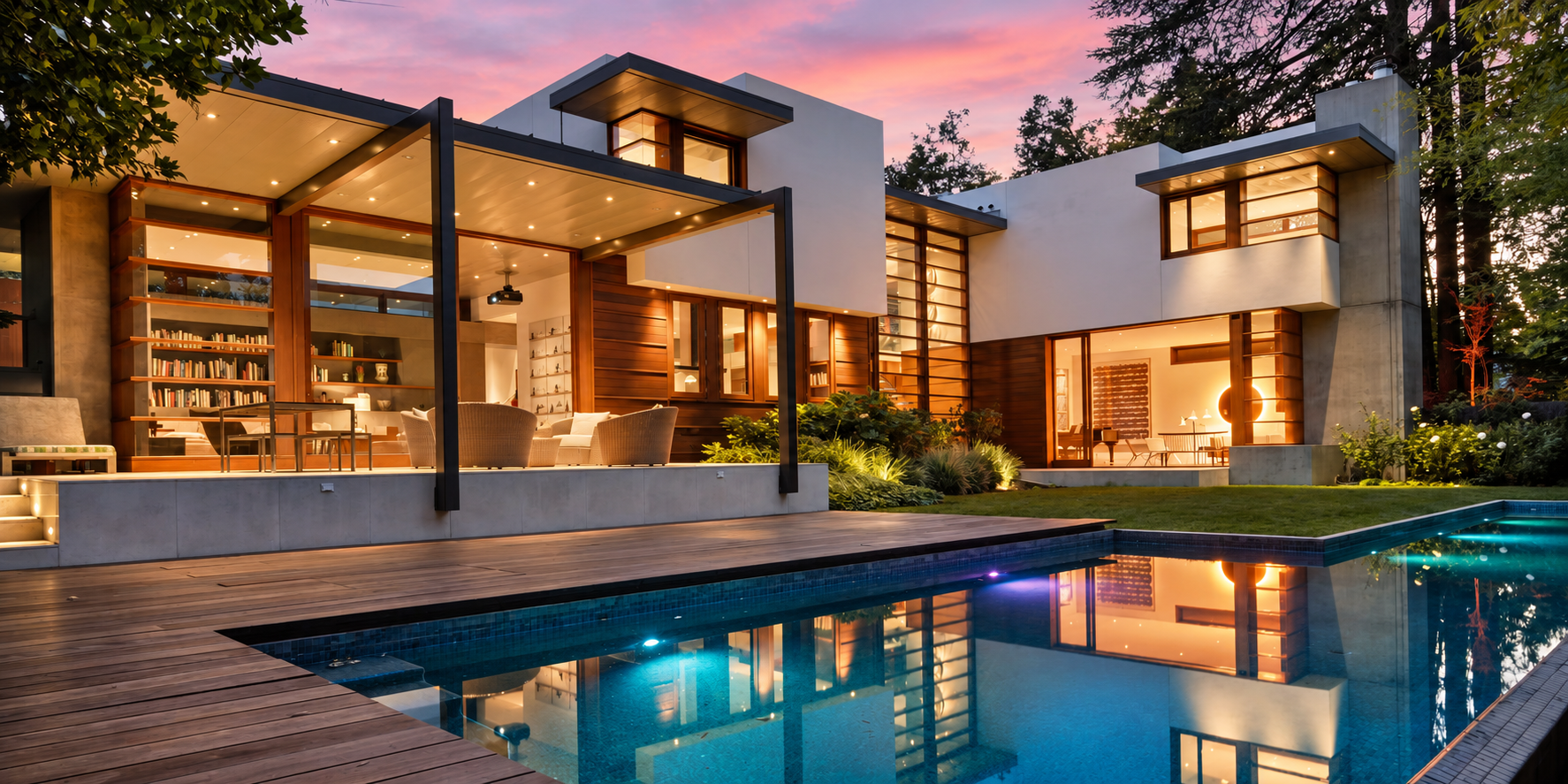
For years, tech entrepreneur Asher Waldfogel and his wife, Helyn MacLean, dreamed of building a modern house in Palo Alto, Calif.
The couple, however, worried about clashing with the Mediterranean-style architecture typically associated with their neighborhood of Old Palo Alto.
So they tapped architect Steven Ehrlich to create a design that paid homage to its surroundings with stucco, mahogany and titanium zinc cladding. They spent $20 million over several years building the house, completed in 2005.
Now looking to be closer to their adult daughter on the East Coast, they are putting the five-bedroom home on the market for $44 million—the most expensive listing in Palo Alto.
Waldfogel is an angel investor who co-founded Redback Networks, a telecommunications-equipment company. MacLean previously had a career in fundraising.
The couple purchased the roughly 0.4-acre site for $7.1 million in 2000 and demolished a circa-1930s Spanish Colonial home. The house they built pinwheels around a central staircase. It has 7,900 square feet of livable space, with four distinct courtyards and a pool.
A key feature of the home is a cast-in-place concrete wall, or spine, that is two stories high and about 80 feet long. “There’s a little bit of controlled chaos in what comes out of the form,” unlike a perfectly uniform surface, Waldfogel said. “If you want that, you do it in plastic.”
Waldfogel said he and his wife are thinking about the next phase of life now that their daughter is grown, although they have not decided where they will move. They also have a home in Sun Valley, Idaho.
“Right now we’re just trying to emotionally let go and decide what to do next,” he said.
Palo Alto, an epicenter of venture capital and tech startups in Silicon Valley, is home to some of the country’s biggest tech titans. Sales volume and prices are rising, with a median sale price of $3.5 million for the three months ending in August, up 5.8% year-over-year, according to real-estate brokerage Redfin.
Arthur Sharif of Sotheby’s International Realty—San Francisco Brokerage has the listing.

Formula 1 may be the world’s most glamorous sport, but for Oscar Piastri, it’s also one of the most lucrative. At just 24, Australia’s highest-paid athlete is earning more than US$40 million a year.

The Swiss watchmaker’s first collaboration with Atlassian Williams F1 Team produces two sporting Laureato models inspired by the team’s 2026 racing car.