





Why pyjamas are not appropriate for the office – but relaxed workwear is
COVID, cost of living and a shift towards more sustainable fashion have changed the norms around appropriate workwear
 5 min
5 min
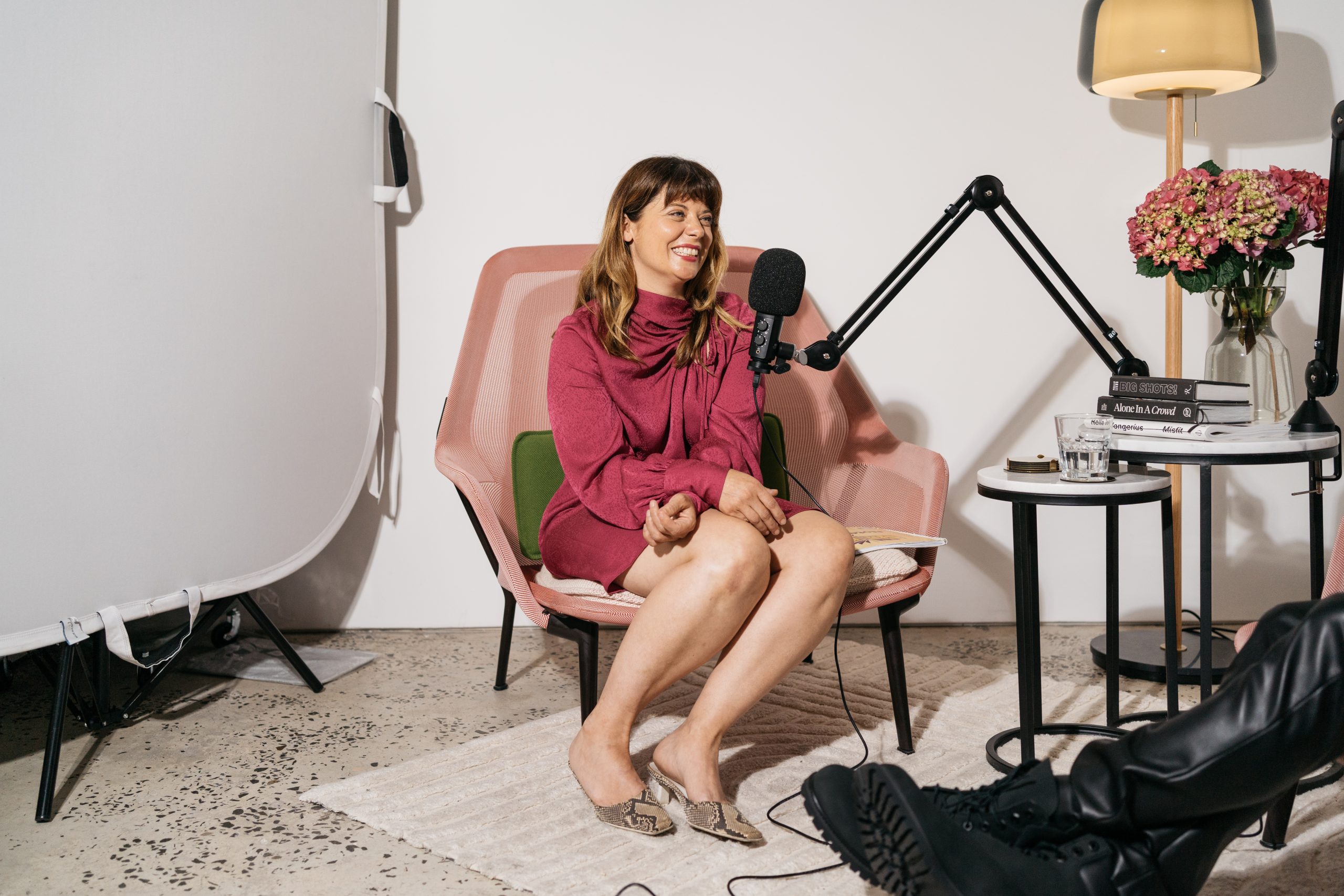
The past few years have seen a radical shift in what many would consider appropriate workwear. After months working from home, office workers have adapted to a hybrid model defined by ‘anchor days’ and flexible working hours. For International Women’s Day, stylist and sustainable fashion advocate Madeleine Park has partnered with Dress for Success, a not-for-profit organisation designed to empower women to gain financial independence by enabling them to face the job market with confidence. Here, Ms Park addresses the challenges of dressing for the new workplace amid cost of living pressures and hybrid work environments.
What is appropriate office wear in a hybrid workplace? How did COVID change what we wear to work?
Anything that says you’re ready for work (i.e. not your pyjamas!) is appropriate, but COVID certainly softened and eased the rules on what’s acceptable. People want a level of comfort not only in what they wear but how they interact with others and this is interfacing with how things are being designed. So whilst suiting has had a moment in fashion for some time now, it’s a deconstructed and softer version of the traditional suit. The modern suit is often seen in fashion-forward colours and in relaxed and oversized fits, carrying the ideas of comfort, ease and adaptability. There is also a trend towards the high-low. So, mixing high-impact items with low-key staples and comfort pieces. An example of this could be a very fashion-forward pink suit with pleated wide-legged pants and an oversized blazer paired back with sneakers, cotton t-shirt and a cross-body bag but this is subverted into a weekend look. Once this suit is deconstructed, the pants on their own offer a lovely sophisticated silhouette that can be paired back to a more traditional fitted business shirt providing a classic silhouette more appropriate for corporate environments.
How are we shopping for workwear now when more people are working from home at least part of the week?
From a consumer perspective, individuals are requiring more adaptability in their wardrobes as well as trying to understand their wardrobes in more sustainable ways. Their clothes need to be chic while driving more functionality across different environments, and as things get tighter financially, this will continue as individuals seek maximum cost per wear out of their garments. So, those pieces that look smart but are comfortable and can translate across different contexts e.g collared t-shirts, a knit midi skirt or tailored pants in natural fibres such as linen, or silk. Consumers are also shifting towards repurposed pieces and investment pieces so there is more longevity to their wardrobes.
Women are now being encouraged to be more assertive in business environments, whether that’s asking for a promotion or getting their point across in meetings. How can you dress for that kind of success?
You only get one chance to make a first impression so it is important to present yourself in a way that is contextually appropriate, resonates with your audience but offers an insight into who you are. While that can feel like a lot of pressure on one outfit, finding that look that makes you feel assertive, is a great way to enter into a confident mindset. Combining that confidence with a sense of self is a very individual thing, but you can fall back on some straightforward styling principles to guide your look. For example, choosing shapes and silhouettes that provide a stronger presence, finding your look in a colour that suits you but in a shade that makes impact and, lastly, accessories – whether it’s the right shoe height, a piece of jewellery that shines a light to who you are or a belt or scarf that adds interest to an otherwise straightforward suit – accessories are a great way to add individuality and lift your look.
Is it possible for women to look professional and feel comfortable in the workplace?
Absolutely! As there is a shift in the fashion industry to design with purpose, we are seeing more and more styles that are adaptable to various environments. As a result, more traditional workwear pieces are being produced in softer, more free-flowing fabrics and in more relaxed silhouettes. Not only is this a more modern way to conceive of workwear, considering the various hybrid work environments a lot of people are operating in, but generally, this translates to looks that offer style and comfort whilst having multiple purposes.
Does the ‘dress for the job you want, not the one you have’ rule still have relevance?
You can think about using your wardrobe as one of the tools in your kit to give you impact. However, as we see more inclusivity across job roles and changing work environments, the rules around dressing for the job you want have changed. Just take the example of Melanie Perkins, the CEO of Canva and billionaire – she has broken the mould in so many ways, not only with a female-founded start-up but she presents as approachable and relatively casual and is fairly vocal about anti-materialist sentiments. So we are seeing a shift in the expectations of appearance and relying more on a focus of an entrepreneurial spirit. Across the board, that sense of entrepreneurialism is associated with more casual looks that wouldn’t have traditionally been associated with negotiating multi-million dollar deals.
Are there different rules around work wear for women and men? What are they?
There are definitely still environments that lend themselves to more traditional gender rules for corporate dressing like a suit and tie for men, blouse, skirt and blazer for women, however these protocols are specific to the individual workplace. As concepts of gender become less polarised and we embrace more size inclusivity, the way fashion is constructed, and trends are evolving, we see more styles designed to fit any body shape. The world is changing so whilst this sentiment might not be as overt in more traditional environments, there are definitely signs that what men and women wear to work is not necessarily defined by gender.
Is it still worthwhile for men to invest in a suit? What about investment clothing for women?
Investing in classic items that stand the test of the time is always worthwhile, whether it be a tailored suit or a classic cut blazer. Made-to-measure pieces tend not to be transient pieces in your wardrobe, they feel better to wear, and they stand the test of time. Interestingly, there has been a surge in women’s bespoke suiting services and I think this is because women are seeking out that same tailored service that traditionally has been the placeholder for men. Corporate environments are shifting in terms of formality around workwear but suiting shapes are also softening and becoming more relaxed to adapt to the changing work trends.
If you had to name one failsafe work wear outfit for women, what would it look like?
As a general rule, something that is a classic style, well constructed and made from natural fibres is always going to be a winner in terms of feeling good and carrying you through your day. As we are all different body shapes, express ourselves differently and have different priorities, I can only speak to my one failsafe look, which would be a waisted midi dress in cotton or silk. The conservative but fashionable length carries me into various contexts and the natural fibres are breathable and comfortable. By changing shoes and adding/taking off an unstructured blazer, I can easily get myself from school drop-off to work meetings (on or offline) to, if I’m lucky, a date night with my partner!
From making unpopular decisions to learning when to listen, leaders from five businesses reveal what nobody prepared them for — and how running a company has challenged their expectations.

Technology and semiconductor shares fell sharply as investors questioned the debt financing the AI infrastructure boom and confronted higher rates and Chinese competition.

Elon Musk is exploring a potential merger between Tesla and SpaceX, a deal that could reshape the future of AI, robotics, autonomous vehicles and space technology. With a combined valuation potentially reaching $3.5 trillion, the move could bring Musk’s vision of an interconnected technology ecosystem closer to reality, although a deal remains uncertain.
5 min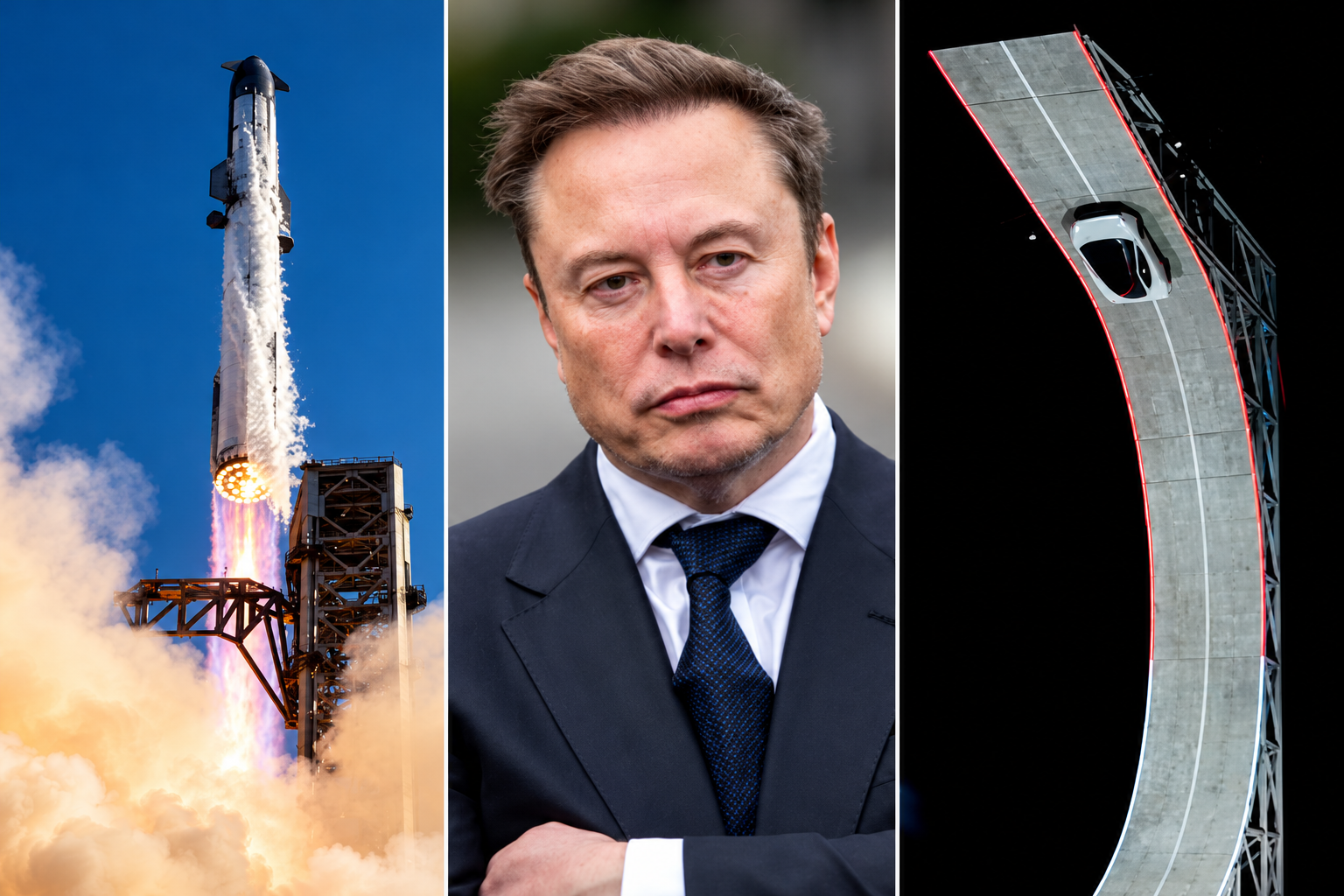
Elon Musk has engineered ties between Tesla TSLA 3.41%increase; up pointing triangle and SpaceX SPCX 7.79%increase; up pointing triangle that are hard to break, and now he wants to fuse them together permanently.
Musk has run both Tesla and SpaceX concurrently over the past two decades, using a schedule that dictated which days he spent focused on each business.
The companies have often shared resources and personnel, signaling their close ties. Last year, SpaceX looked into creating a spacesuit for Tesla’s humanoid robot Optimus, a person familiar with the matter said. Tesla last week showed off its new Roadster, a vehicle featuring SpaceX rocket thrusters that it hopes to soon bring to market.
And in recent months, Musk has repositioned both companies by expanding beyond their core operations toward a shared mission centered on artificial intelligence.
The world’s richest man on Tuesday signaled his interest in tying up SpaceX and Tesla, marking what would be the biggest corporate merger of all time. Because he serves as chief executive of SpaceX and Tesla, Musk said committees of independent directors at both companies are evaluating a possible deal, adding that a transaction might not come to fruition.
The committees will likely evaluate, with lawyers and bankers, how each company would fare in a potential deal and how a deal might best be structured. They then present their conclusions to their respective boards, who typically vote on whether to proceed.
“It’s an odd Kabuki dance where two groups of people are talking and I can’t be in the conversation,” Musk told SpaceX investors on Tuesday in response to an analyst’s question about a potential deal.
For Musk, the merger supports his vision of a world full of autonomous cars, humanoid robots and weekly rocket launches, as well as the data centers and satellites required to keep the whole thing running.
Some investors and analysts said they expect a transaction would be structured as an all-stock deal, with SpaceX potentially paying a modest premium for Tesla shares.
SpaceX, which has a market value of about $2 trillion, said it is seeing sharp growth in revenue across its businesses, which include operating data centers, launching rockets and operating satellite networks such as the internet service Starlink. Tesla is valued at about $1.5 trillion and is expanding its operations beyond its automotive and energy business. Shares in both companies traded higher following the news Tuesday.
Musk’s substantial ownership stakes in both companies, along with voting control at SpaceX, has enabled him to set the deal in motion. Analysts and investors said the deal will probably face regulatory scrutiny internationally, though some see Musk’s close relationship with the Trump administration as an asset to getting approval.
Blurred lines
The companies haven’t said which directors are on the special committees evaluating a potential deal. Several SpaceX and Tesla board members have either personal or business ties to Musk. And like Musk, venture capitalist Ira Ehrenpreis sits on both boards.
In a filing this week, Tesla outlined millions of dollars in business agreements with SpaceX and its subsidiaries last year, including $143 million in car sales to SpaceX, $3.3 million in advertising that it bought on the social-media platform X and $430 million in revenue from the sale of Megapack batteries for SpaceX’s data centers.
The companies also split the cost of resources including the use of Musk’s SpaceX jet and the bill for his personal security, which he runs through a private company.
Employees at both companies routinely move between companies to work on special projects, and some executives have dual roles, including Charles Kuehmann, vice president of materials engineering at both SpaceX and Tesla, and Ashok Elluswamy, the vice president of AI software at Tesla who runs a joint venture with SpaceX called Digital Optimus.
Over the years, Musk has launched new startups within his empire, including brain-implant company Neuralink, underground-tunnel developer the Boring Company and xAI, the AI startup that merged with SpaceX in February.
It is that AI business that Musk thinks can serve a market worth tens of trillions of dollars, justifying the need for a merger.
The business case goes like this: Tesla is developing robotaxis and robots, which it calls “physical AI.” SpaceX is working on the back end of physical AI: the data-center capacity and internet connection required for those robotaxis and robots to operate continuously.
“I don’t see what the value of Tesla is if it’s not merged with SpaceX,” said investment adviser Ross Gerber, a former Tesla bull turned critic invested in both companies. “If they don’t merge, the brains of everything that runs Tesla is owned by another company.”
On top of it all, both companies face constraints on the supply chains they need to make this world a reality, particularly when it comes to chips. To address this, Musk earlier this year announced a joint venture between Tesla, SpaceX and Intel to design and manufacture chips in Texas. “The most epic chip-building exercise by far,” he has said.
Musk at the wheel
For Musk, a merger would also solve two problems: demands on his attention and his lack of control at Tesla.
Tesla for years was Musk’s only public company, a status that came with greater scrutiny. There, Musk reports to a public board, as well as individual investors who make up around 30% of Tesla’s voting power, according to FactSet.
The question of Musk’s attention became a particular focus for investors and the board in recent years after he acquired Twitter in 2022 and launched xAI in 2023, and again in 2025 as he spent time in Washington, D.C., running the Department of Government Efficiency in the early months of President Trump’s second term.
As Tesla’s car business suffered in 2025, Musk threatened to take his AI ambitions outside the company if he wasn’t granted 25% voting control. Last November, Tesla shareholders approved a new pay package for Musk, which created a path for him to vastly expand his stake.
As of Sept. 30, Musk owned a roughly 20% stake in Tesla, according to the company’s proxy filing.
The SpaceX IPO gave Musk a different path. When SpaceX went public in June, the deal’s structure enabled him to have more than 80% voting power at the company—so much that he can’t be fired and decisions can’t be made without his support.
If SpaceX acquires Tesla, he will likely stay in control.

Advertising legend John Singleton unveils an exclusive 16-residence Caroline Bay development, marking his latest high-end property play on the Central Coast.

MAISON de SABRÉ’s new Spring Harvest Collection turns everyday produce into collectible leather charms and introduces fresh silhouettes in its cult Bucket bag family.


