‘Thrifting’ Extends to Holiday Shopping Too
Kanebridge News
    HOUSE MEDIAN ASKING PRICES AND WEEKLY CHANGE     Sydney $1,682,703 (+0.16%)       Melbourne $1,032,974 (+0.32%)       Brisbane $1,149,503 (-0.48%)       Adelaide $1,044,873 (+0.57%)       Perth $1,087,323 (+0.79%)       Hobart $838,358 (-0.10%)       Darwin $820,666 (-0.12%)       Canberra $979,872 (-0.24%)       National Capitals $1,138,269 (+0.14%)                UNIT MEDIAN ASKING PRICES AND WEEKLY CHANGE     Sydney $797,157 (-0.14%)       Melbourne $549,523 (-0.11%)       Brisbane $755,150 (-0.64%)       Adelaide $578,247 (+0.68%)       Perth $644,099 (+3.57%)       Hobart $571,049 (+0.07%)       Darwin $463,594 (-5.35%)       Canberra $477,768 (-0.27%)       National Capitals $625,689 (+0.06%)                HOUSES FOR SALE AND WEEKLY CHANGE     Sydney 14,358 (+213)       Melbourne 15,978 (-7)       Brisbane 11,458 (+121)       Adelaide 3,654 (+71)       Perth 8,904 (+103)       Hobart 691 (+10)       Darwin 180 (+11)       Canberra 1,209 (+48)       National Capitals 56,432 (+570)                UNITS FOR SALE AND WEEKLY CHANGE     Sydney 9,553 (+66)       Melbourne 6,618 (-48)       Brisbane 2,337 (+34)       Adelaide 604 (-6)       Perth 1,701 (+90)       Hobart 150 (-5)       Darwin 217 (-4)       Canberra 1,213 (+23)       National Capitals 22,393 (+150)                HOUSE MEDIAN ASKING RENTS AND WEEKLY CHANGE     Sydney $870 ($0)       Melbourne $600 ($0)       Brisbane $700 ($0)       Adelaide $660 (+$3)       Perth $750 ($0)       Hobart $628 (-$13)       Darwin $850 ($0)       Canberra $710 (+$10)       National Capitals $733 (+$)                UNIT MEDIAN ASKING RENTS AND WEEKLY CHANGE     Sydney $820 (-$5)       Melbourne $620 ($0)       Brisbane $620 (-$3)       Adelaide $550 (+$10)       Perth $700 (-$20)       Hobart $500 (-$30)       Darwin $675 ($0)       Canberra $590 (+$5)       National Capitals $648 (-$5)                HOUSES FOR RENT AND WEEKLY CHANGE     Sydney 6,676 (+151)       Melbourne 6,952 (+89)       Brisbane 3,472 (+4)       Adelaide 1,309 (+41)       Perth 2,174 (+11)       Hobart 210 (-11)       Darwin 61 (+5)       Canberra 431 (+4)       National Capitals 21,285 (+294)                UNITS FOR RENT AND WEEKLY CHANGE     Sydney 10,090 (-12)       Melbourne 6,145 (+91)       Brisbane 3,338 (+49)       Adelaide 409 (+12)       Perth 701 (+21)       Hobart 75 (0)       Darwin 102 (+4)       Canberra 717 (+47)       National Capitals 21,577 (+212)                HOUSE ANNUAL GROSS YIELDS AND TREND         Sydney 2.69% (↓)       Melbourne 3.02% (↓)     Brisbane 3.17% (↑)        Adelaide 3.28% (↓)       Perth 3.59% (↓)       Hobart 3.89% (↓)     Darwin 5.39% (↑)      Canberra 3.77% (↑)        National Capitals 3.35% (↓)            UNIT ANNUAL GROSS YIELDS AND TREND         Sydney 5.35% (↓)     Melbourne 5.87% (↑)      Brisbane 4.27% (↑)      Adelaide 4.95% (↑)        Perth 5.65% (↓)       Hobart 4.55% (↓)     Darwin 7.57% (↑)      Canberra 6.42% (↑)        National Capitals 5.38% (↓)            HOUSE RENTAL VACANCY RATES AND TREND       Sydney 1.4% (↑)      Melbourne 1.5% (↑)      Brisbane 1.2% (↑)      Adelaide 1.2% (↑)      Perth 1.0% (↑)        Hobart 0.5% (↓)       Darwin 0.7% (↓)     Canberra 1.6% (↑)      National Capitals $1.1% (↑)             UNIT RENTAL VACANCY RATES AND TREND       Sydney 1.4% (↑)      Melbourne 2.4% (↑)      Brisbane 1.5% (↑)      Adelaide 0.8% (↑)      Perth 0.9% (↑)      Hobart 1.2% (↑)        Darwin 1.4% (↓)     Canberra 2.7% (↑)      National Capitals $1.5% (↑)             AVERAGE DAYS TO SELL HOUSES AND TREND         Sydney 34.7 (↓)       Melbourne 33.6 (↓)     Brisbane 39.0 (↑)      Adelaide 32.0 (↑)        Perth 42.6 (↓)       Hobart 30.0 (↓)       Darwin 21.9 (↓)       Canberra 33.2 (↓)       National Capitals 33.4 (↓)            AVERAGE DAYS TO SELL UNITS AND TREND         Sydney 33.6 (↓)       Melbourne 31.2 (↓)     Brisbane 40.9 (↑)      Adelaide 32.6 (↑)        Perth 41.8 (↓)     Hobart 31.3 (↑)        Darwin 43.1 (↓)     Canberra 40.5 (↑)        National Capitals 36.9 (↓)           
Share Button

‘Thrifting’ Extends to Holiday Shopping Too

Roughly 17% of gifts this holiday season will be a resold item, according to Salesforce data

By JOSHUA KIRBY
Fri, Dec 22, 2023 7:00amGrey Clock 4 min

A new kind of present is gaining acceptance this holiday season. More consumers are picking secondhand items to gift each other, finding it to be an environmentally and budget-friendly option.

Thrift stores that sell used clothes and goods are springing up online and on street corners. Goodwill Industries International, the nonprofit behind the familiar chain of thrift stores, is ramping up its online efforts. Fashion brands are developing their own resale offering to keep up with clothing-reseller sites such as Depop and Poshmark. Roughly 17% of gifts this holiday season will be a resold item, according to software firm Salesforce.

“Consumers are choosing resale first because of the incredible value, the unique merchandise, and the incredible sustainability benefit,” said Matt Kaness, chief executive of GoodwillFinds, the nonprofit’s online e-commerce platform run in partnership with Salesforce.
Secondhand clothes, once seen as frumpy and embarrassing, are now keenly sought out by the fashion conscious. A popular vintage aesthetic dovetails with consumer calls for goods that do less harm to the world. About 85% of American shoppers have bought or sold preowned items over the past year, nearly a third for the first time, according to online marketplace OfferUp’s Recommerce report. In apparel alone, some 10% of the global market will be secondhand by next year.

GoodwillFinds is the only major nonprofit player in resale.

GoodwillFinds’ online platform allows a smarter operation than the traditional bricks-and-mortar store, said Kaness, formerly an executive with retailers including Walmart and Urban Outfitters. The platform uses artificial intelligence and large data sets to more accurately price and categorise items, creating a much more efficient system, Kaness said.

“In a store, it’s a human looking at the item. They have paper sticker tickets for the price and they have to process such a volume that it is somewhat random,” he said. In contrast, the company’s online system uses computer vision to take a picture, identify the item, create a listing and price it.

Moving online is the logical choice for secondhand sellers, said 25-year-old Brooke Bowlin, who runs lifestyle blog Nuance Required. “Secondhand stores just can’t sell enough,” said Bowlin, who started her own thrift store in Siloam Springs, Ark. “By moving online and expanding the audience, there is an opportunity to re-home more clothes,” she said.

Major fashion brands are also increasingly recognising that secondhand is as much a necessity as it is an opportunity. The fashion industry is responsible for up to 8% of global emissions, relying on resource-intensive raw materials and fast-moving trends that have contributed large amounts of waste. Around 11.3 million tons of textile waste go to landfills in the U.S. every year, according to environmental organisation Earth.Org.

Outdoor-clothing retailer Patagonia established its Worn Wear platform in 2017, one of the first resale channels by a major brand.

As much as adapting to trends, Patagonia Worn Wear aims to change consumer behaviour, said Asha Agrawal, managing director of the Patagonia venture fund that runs the platform.

“A lot of our messaging is around—‘you don’t need to buy something new,’” she said.

Worn Wear buys back used brand gear from consumers by paying higher prices than peer-to-peer apps or other marketplaces, Agrawal said. This strategy contributes to the bulk of the platform’s costs but also boosted its inventory fourfold this year alone, she said, adding Worn Wear has been profitable for the last two years.
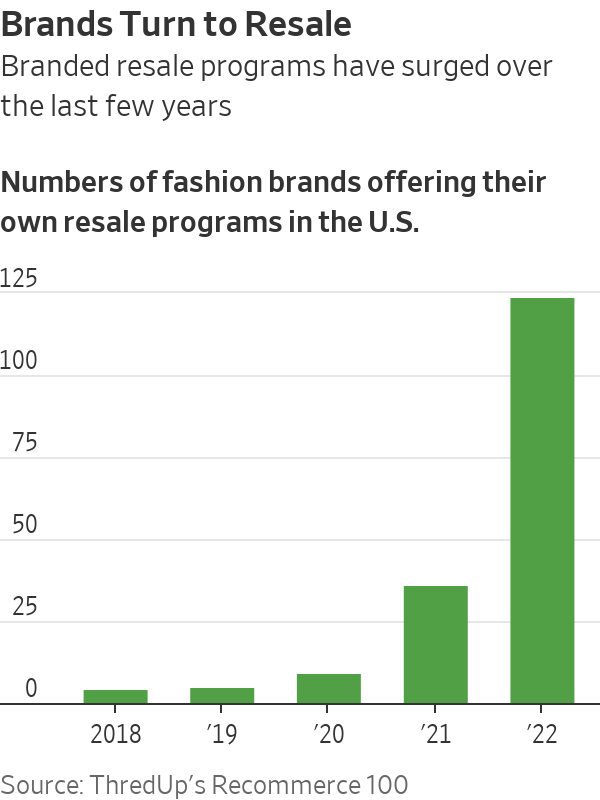
Worn Wear is now integrated into the Patagonia brand. “You can now do your main shopping with Patagonia with our resale business in the U.S.,” she said. “That’s a huge evolution for us.”

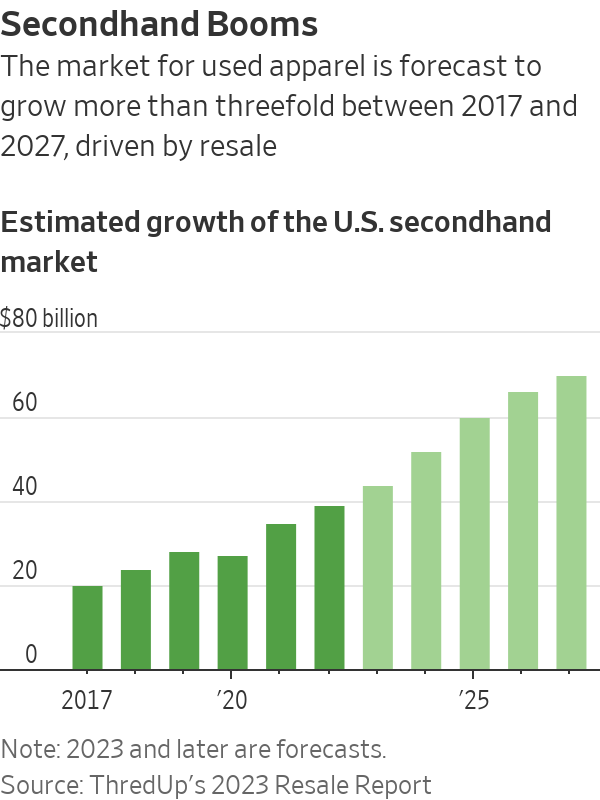
Resale by brands and third parties is expected to outpace traditional thrift sales and donations in the U.S., rising to 60% of a $70 billion total by 2027 from 15% of the $20 billion secondhand market in 2017, according to online thrift store ThredUp’s recent resale report.

Other fashion players have their versions. Sweden’s Hennes & Mauritz launched H&M Pre-Loved in the U.S. this year, in partnership with ThredUp. Inditex-owned Zara has launched a preowned platform that offers repair services, customer-to-customer sales and donations of used garments in the U.K. and France, with plans for a U.S. rollout by 2025.

Resale remains an imperative for fashion brands as a way to control distribution and retain the trust of shoppers increasingly alert to the fate of their old clothes. However, scaling up resale generates a raft of operational challenges such as authentication, returns and ensuring that secondhand doesn’t look like an afterthought, said Anita Balchandani, fashion lead at consultant firm McKinsey & Co.

Unlike nonprofits, such as Goodwill, that get their inventory from donations and don’t have to be accountable to shareholders, retailers are struggling to make business sense of resales, Balchandani said.

“No one has proven the path to scaling this up profitably,” she said. “You almost have to create a whole new end-to-end supply chain…. The retailer who cracks that journey is going to make a real difference in this space.”


MOST POPULAR

For Central Element, the start of work at Pearl represents another step in the company’s growing eastern suburbs pipeline.

All three vehicles will form part of a broader charitable initiative benefiting Big Brothers Big Sisters of America, the American Red Cross and Starlight Children’s Foundation

Related Stories
Money
ASX Reporting Season 2026: 5 Biggest Winners and Losers So Far
By Ruba Jaajaa 10/09/2026
Money
The Stock Market’s Breezy Summer Is Over. Investors Beware.
By Hannah Erin Lang 08/09/2026
Prestige
Girard-Perregaux Gives The 39mm Laureato Fifty A Tourbillon
By Ruba Jaajaa 07/09/2026
ASX Reporting Season 2026: 5 Biggest Winners and Losers So Far

Overall, the season showed that share prices react less to whether profits rose or fell than to the gap between results and expectations

By Ruba Jaajaa
Thu, Sep 10, 2026 5 min

Reporting season has once again reminded investors that a strong profit does not guarantee a rising share price, and a large loss does not always trigger a sell-off. What matters most is how each result compares with expectations and, increasingly, what management says about the year ahead. During the August 2026 season, companies offering credible turnarounds or unexpectedly strong guidance were rewarded handsomely, while those flagging weaker margins, slowing demand or greater uncertainty were punished.

The following ranking draws on Morningstar’s review of 164 ASX-listed companies and measures each company’s share-price movement on the day it reported. This captures the market’s immediate response to the earnings announcement, before subsequent economic developments, dividends and company-specific news cloud the picture. Here are the five biggest winners, and the five hardest-hit losers, of the season so far.

The five winners

1. Bapcor (ASX:BAP): +41.0%

Bapcor delivered reporting season’s largest relief rally after presenting early evidence that its troubled automotive-parts business was stabilising. Although underlying revenue fell 1.8% to $1.92 billion and underlying NPAT collapsed 85% to $10.8 million, underlying EBITDA of $152.5 million exceeded guidance.

More importantly, working-capital initiatives released $68.5 million in the second half, lifting cash conversion to 109.4% and reducing net debt by 63% to $135 million. The statutory loss was $431.6 million, largely because of non-cash impairments. Investors focused on improving operational momentum, stronger liquidity and management’s expectation of modest FY27 revenue growth.

2. Zip Co (ASX:ZIP): +18.2%

Zip comfortably surpassed its FY26 targets, sending the buy-now-pay-later provider’s shares sharply higher. Transaction volume rose 23% to $16.7 billion, while cash earnings before tax, depreciation and amortisation jumped 58% to a record $268.9 million. Statutory profit climbed 46% to $116.4 million, and the cash operating margin expanded by 4.2 percentage points to 20%.

The strongest signal was guidance for FY27 cash earnings of $340 million—around 26% growth and above analysts’ forecasts. US transaction volume increased 42.5% and now represents three-quarters of group volume, offsetting weaker customer activity in Australia.

3. CSL (ASX:CSL): +17.3%

CSL’s result was hardly spectacular in isolation, but it cleared a market bar that had fallen dramatically following earlier downgrades and restructuring announcements. Underlying NPATA was US$3.1 billion, down 2% in constant-currency terms, while operating cash flow reached US$3.51 billion.

CSL maintained its full-year dividend at US$2.92 per share and completed a A$1 billion buyback. The real catalyst was FY27 guidance for approximately 5% underlying profit growth, compared with market expectations closer to 2%. After an extended period of earnings disappointments, investors interpreted the outlook as evidence that CSL’s core plasma business was approaching a sustainable recovery.

4. Judo Capital (ASX:JDO): +16.9%

Judo Capital demonstrated strong operating leverage as its specialist business-lending franchise expanded. Full-year profit before tax rose 34% to $168.1 million, while pre-provision profit increased 42%. Gross loans and advances grew 18% to $14.7 billion, reaching the top of the bank’s guidance range and comfortably exceeding broader system growth.

Deposits increased 24% to $12.2 billion, return on equity improved by 1.1 percentage points to 6.4%, and earnings per share rose 29% to 9.9 cents. Reaffirmation of the FY27 outlook gave investors confidence that loan growth could continue without sacrificing margins or credit quality.

5. Super Retail Group (ASX:SUL): +15.8%

The owner of Supercheap Auto, rebel, BCF and Macpac reported record sales of $4.2 billion, up 3.2%, despite cautious discretionary spending. Profitability went backwards: normalised profit before tax fell 7% to $306 million and normalised NPAT declined 2.8% to $226 million as transformation spending weighed on margins. Nevertheless, the result exceeded subdued expectations, online sales grew 5.3% and membership across the group’s loyalty programs reached 13.1 million. Investors were also encouraged by positive early FY27 trading, stable gross margins and continued market-share gains. A fully franked 33-cent final dividend added to the appeal.

The five losers

1. Hansen Technologies (ASX:HSN): –21.2%

Hansen’s historic result met expectations, but investors recoiled from its outlook. The utility and communications software provider achieved an underlying EBITDA margin of 31%, exceeding its 30% target, while generating strong cash flow. However, management designated FY27 an “investment and transition year”, signalling a roughly five-percentage-point margin contraction as spending on products, sales capabilities and organisational changes increased.

Revenue had already been broadly flat, leaving investors concerned that the investment program would depress earnings before new growth appeared. Leadership changes, including the chief executive’s departure, added uncertainty. Management expects revenue growth and margins above 30% to return in FY28, but the market was unwilling to wait.

2. Life360 (ASX:360): –19.4%

Life360’s headline growth was impressive: quarterly revenue rose 38% to US$159 million, subscription revenue increased 31%, and adjusted EBITDA climbed 53% to US$31.1 million. Monthly active users reached 102.4 million and paying circles grew 27% to 3.2 million. The sell-off reflected expectations rather than a collapsing business.

Net income fell 18%, the net margin contracted from 6% to 3%, hardware shipments dropped 18%, and full-year EBITDA guidance was merely maintained. After a strong valuation run, investors wanted a larger upgrade and clearer evidence that heavy investment in advertising, international expansion and artificial intelligence would generate additional earnings.

3. PEXA Group (ASX:PXA): –17.0%

PEXA reported a 7% increase in continuing-operations revenue and 12% EBITDA growth to $152 million, accompanied by a two-percentage-point margin expansion. Free cash flow increased 39%, suggesting the core Australian electronic-conveyancing platform remained highly profitable. Investors instead concentrated on management’s warning that property-transfer volumes could decline, alongside regulatory uncertainty surrounding the fees PEXA can charge.

The company is also continuing to invest heavily in its loss-making international expansion. Morningstar considered the market reaction excessive, arguing that structural transfer-volume assumptions had not materially changed, but the combination of softer near-term activity and regulatory risk overwhelmed the respectable headline numbers.

4. SEEK (ASX:SEK): –14.3%

SEEK produced solid FY26 figures, including 10% revenue growth to $1.20 billion, a 15% rise in EBITDA and 28% growth in adjusted earnings per share. It also lifted its fully franked annual dividend by 13% to a record 52 cents. Those achievements were overshadowed by falling paid job-ad volumes and cautious FY27 assumptions.

The statutory accounts included a $201 million loss from the SEEK Growth Fund and $377 million of significant items, making the headline result considerably less attractive. Investors were particularly concerned that economic weakness could limit volumes while the company continued investing in platform integration and artificial-intelligence products.

5. JB Hi-Fi (ASX:JBH): –12.3%

JB Hi-Fi’s full-year result was broadly respectable, with group sales rising 5% to $11.1 billion and underlying earnings per share increasing 6% to $4.48. The damage came from its current-trading update. Australian sales were almost flat during the June quarter and deteriorated further in July, while earnings in the core Australian electronics business fell 3.6%.

Housing-related categories were particularly weak as higher living costs and interest rates constrained household budgets. With JB Hi-Fi entering the season on a demanding valuation, an in-line historic result was not sufficient: the loss of sales momentum prompted investors to rapidly reduce their expectations for FY27.

Overall, the season showed that share prices react less to whether profits rose or fell than to the gap between results and expectations. Bapcor was rewarded for being less troubled than feared, while several fundamentally profitable companies were punished because their outlooks failed to justify elevated valuations.

MOST POPULAR

Rising rates, construction inflation and shrinking investor confidence are pushing Australia deeper into a dangerous housing spiral that monetary policy alone cannot fix.

Margot Robbie may have travelled from a Queensland farm to the highest reaches of Hollywood, but a reported $28 million property deal suggests the Gold Coast has never lost its hold on her. The Australian actor and producer is believed to be the mystery buyer of Redwood, a seven-acre Currumbin Valley estate transformed into the …

Related Stories
Money
Saudi Arabia Sees a Spike to $180 Oil if Energy Shock Persists Past April
By SUMMER SAID, RYAN DEZEMBER AND DAVID UBERTI 20/03/2026
Property
Australia Joins Global Surge in Branded Residences
By Jeni O'Dowd 18/09/2025
Travel
MICHELIN-STARRED ALAJMO BROTHERS HOST EXCLUSIVE CRYSTAL CULINARY VOYAGE
By Jeni O'Dowd 26/02/2026
0
Your Cart
Your cart is emptyReturn to Shop