


Get Ready for the Richcession
Well-off Americans could get hurt more than usual in the next downturn

 3 min

Economic downturns are usually horrible for poor people, bad for the middle class and an inconvenience for the rich. But if the economy enters a recession in 2023, or even if it manages to narrowly evade one, it might be the well-heeled who take a bigger hit than usual.
Call it the richcession.
Other than a small number of ascetics, nobody likes being poor. Doing without, living with so little savings that setbacks such as illness or job loss can be debilitating, is an ever-present source of stress. But for many poorer people, the years since the Covid crisis struck have been a bit easier financially than the years that preceded it. Several rounds of government relief helped them weather the early stages of the pandemic, and now a tight job market is providing them with wage gains that are reducing inflation’s bite. Federal Reserve figures show that the net worth of households in the bottom fifth by income was 42% higher in the third quarter than at the end of 2019, and up 17% from the end of 2021.A wage tracker developed by the Federal Reserve Bank of Atlanta shows that the 12-month moving average of annualised monthly wage growth for workers in the bottom quartile by income was 7.4% as of November.
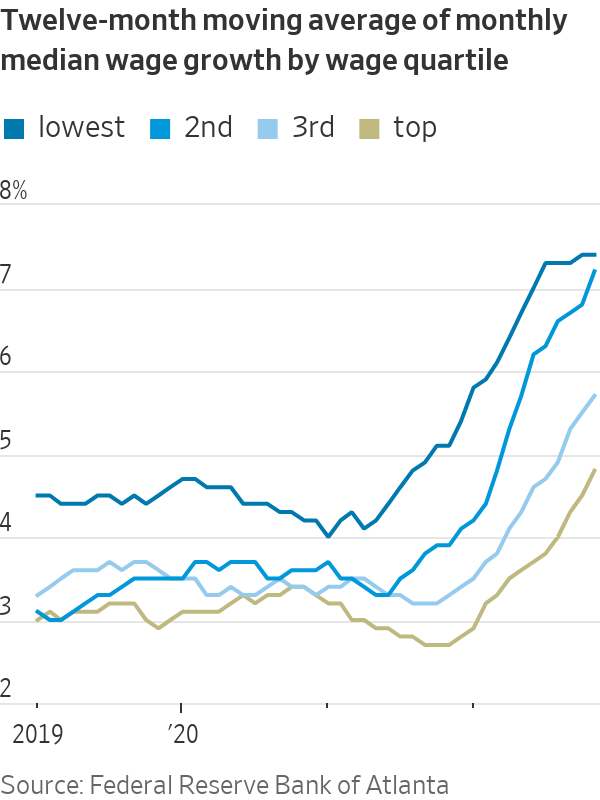
With the important caveat that they were starting off from much higher bases, percentage gains for the rich have been more muted. Household net worth for the top fifth was 22% higher in the third quarter than before the pandemic, and was down 7.1% from the end of 2021—a consequence of the falling stock market. Paychecks haven’t risen as much, either, with the Atlanta Fed measure showing average annualized monthly wage growth for workers in the top quartile was 4.8%.
Recent layoffs have also inordinately affected higher-income workers. Many of the tech companies that have made headlines with layoff announcements pay extremely well. Securities filings show that the median worker at Facebook parent Meta Platforms made $295,785 in 2021, for example, while the median worker at Twitter made $232,626. And layoffs at those places where the typical worker is less well paid, such as Amazon.com, have largely been aimed at white-collar workers.
The consolation for higher-income workers who are laid off is that it should be relatively easier for them to find new work than it is for poorer people who lose their jobs. That is because the job skills of the more highly educated are generally more transferable than the skills of other workers. But they will still be in for a period of belt tightening, and they might not get paid quite so well at their new jobs as they were at their old ones.
Meanwhile, even though big-company layoffs have been making headlines, so far they haven’t made much of a dent in overall employment statistics. This is in part because industries that aren’t as well-represented in the stock market, and that typically employ more lower- and middle-income workers, are still straining to hire workers. In November the leisure and hospitality sector was 980,000 jobs short of its February 2020 employment level. Employment in healthcare and social assistance only recovered to its prepandemic levels in September. This is a job category that, in part because of the needs of an ageing population, grew even when overall U.S. unemployment shot higher after the 2008 financial crisis. To return to its growth trend over the decade preceding the pandemic, it would need to add about 1.1 million jobs.
That need for workers—especially as more Americans engage in services such as dining out—is part of why even among those economists expecting a recession in the coming year, many don’t think the job market will take a severe hit. This makes poorer Americans better positioned than usual to handle a weak economy. Not only are their finances in relatively good condition, they might be less likely to experience severe job losses.
Heading into the new year, businesses that cater to the well-off might be in for disappointment, while those that favour the hoi polloi over the hoity-toity might do better. And if there is a recession, the economy could be on much more equal footing as it begins to recover than is usually the case.
 Copyright 2020, Dow Jones & Company, Inc. All Rights Reserved Worldwide. LEARN MORE



From making unpopular decisions to learning when to listen, leaders from five businesses reveal what nobody prepared them for — and how running a company has challenged their expectations.

Technology and semiconductor shares fell sharply as investors questioned the debt financing the AI infrastructure boom and confronted higher rates and Chinese competition.

Technology and semiconductor shares fell sharply as investors questioned the debt financing the AI infrastructure boom and confronted higher rates and Chinese competition.
4 minA sharp technology sell-off has exposed a new anxiety on global markets: whether the enormous borrowing behind the artificial-intelligence infrastructure boom can generate sufficient returns as interest rates rise and Chinese competition intensifies.
The artificial-intelligence investment boom has powered technology shares, semiconductor manufacturers and data-centre operators to extraordinary heights. Last week, investors were given a reminder that much of this expansion is being built with borrowed money.
The technology-heavy Nasdaq Composite fell 4.5 per cent over the week ended October 16, its weakest performance since late June. Semiconductor shares suffered an even deeper correction, with the Philadelphia Semiconductor Index losing about 11.4 per cent.
The selling spread quickly through global markets. Micron Technology fell 14.6 per cent over the week, while South Korea’s Samsung Electronics and SK Hynix dropped approximately 18 per cent and 24 per cent respectively.
This was more than a routine bout of profit-taking. Investors were reassessing three interconnected risks: higher interest rates, the rapidly expanding debt burden attached to AI infrastructure and the prospect of stronger competition from Chinese memory-chip manufacturers.
The debt behind the AI build-out
Artificial intelligence requires a physical infrastructure network of enormous scale. Data centres must be built, advanced processors purchased, power supplies secured and cooling systems installed before customers begin generating meaningful revenue from them.
Technology companies are increasingly supplementing their own cash with corporate bonds, syndicated loans, equipment leases, private credit and project-level financing.
JPMorgan describes the emerging funding model as a combination of conventional corporate borrowing and project finance tied to individual data-centre assets. In Australia, the Reserve Bank estimates that syndicated loans accounted for approximately three-quarters of data-centre financing during 2025 and 2026 to date.
The numbers are becoming large enough to affect broader credit markets. The Federal Reserve Bank of Dallas has cited Wall Street estimates suggesting AI-related investment-grade bond issuance could approach US$300 billion in 2026 alone.
That borrowing is not automatically problematic. Debt can be an efficient way to finance long-lived infrastructure when future revenue is sufficiently predictable. The concern is that AI technology, customer demand and computing economics are changing much faster than the repayment schedules attached to the assets.
A data centre financed today may carry debt for years. Investors must therefore make assumptions about future utilisation rates, electricity prices, chip performance, customer concentration and the amount businesses will ultimately pay for AI computing.
When interest rates rise, those assumptions become less forgiving.
Inflation changes the calculation
September’s US inflation data intensified the pressure. Consumer prices increased 3.7 per cent over the year, ahead of market expectations and up from 3.4 per cent in August.
The hotter reading reduced confidence that interest rates would fall quickly and pushed bond yields higher. That matters particularly for companies whose valuations depend on profits expected well into the future, as well as highly leveraged infrastructure operators that may need to refinance.
CoreWeave has emerged as a closely watched test case. The specialist cloud-computing company has accumulated substantial debt and lease obligations to build AI capacity, while relying on a concentrated group of large technology customers.
Its shares fell sharply during the sell-off, while the cost of insuring its debt against default climbed. CoreWeave has argued that its contracted backlog more than covers its obligations and that financial markets do not always understand its business model. Nevertheless, its securities have become a proxy for investor confidence in debt-funded AI infrastructure.
Oracle, another major investor in AI computing capacity, fell 8.8 per cent in Friday trading, while CoreWeave dropped 15.5 per cent.
The question is shifting from how much AI infrastructure can be built to how profitably it can be operated.
China adds another source of pressure
Interest rates were not the only catalyst. Reports of advances by Chinese memory-chip producer ChangXin Memory Technologies raised concerns that lower-cost Chinese products could increase competition across the global semiconductor industry.
Memory chips are essential to AI systems, but the industry is historically cyclical. Periods of tight supply and high pricing can encourage rapid investment, eventually producing oversupply and falling margins.
The prospect of a well-funded Chinese competitor expanding its technological capabilities unsettled investors in Samsung, SK Hynix and Micron. It also demonstrated that AI-related demand does not insulate chipmakers from conventional competitive pressures.
That combination—slower rate cuts, more expensive financing and potentially cheaper supply—challenged the assumption that every company exposed to AI would enjoy continually expanding margins.
A reset rather than the end of the boom
The sell-off does not establish that the AI boom is ending. Demand for computing power remains strong, the largest technology companies continue to generate formidable cash flows and many infrastructure projects are backed by long-term customer contracts.
What has changed is the market’s willingness to overlook the price and financing structure of that growth.
The most resilient companies are likely to be those able to fund investment from operating cash flow, secure long-duration customers and demonstrate that new capacity will earn returns comfortably above its financing costs.
More speculative operators may face greater scrutiny, particularly where debt is expensive, customers are concentrated or expected revenue depends on demand that has not yet materialised.
For Australian investors, the lesson extends beyond US technology shares. Local data-centre operators, infrastructure funds, electricity suppliers and property groups are increasingly exposed to the same investment cycle.
Artificial intelligence may remain one of the defining growth themes of the decade. But last week’s correction showed that enthusiasm for the technology does not eliminate financial discipline.
The next stage of the AI boom will be judged not only by computing power, model performance or demand for chips, but by something more traditional: whether the assets being financed can generate enough cash to repay the money borrowed to build them.
Fact box
Nasdaq Composite: Down 4.5 per cent for the week ended October 16, 2026
Philadelphia Semiconductor Index: Down approximately 11.4 per cent
Micron Technology: Down approximately 14.6 per cent
Samsung Electronics: Down approximately 18 per cent
SK Hynix: Down approximately 24 per cent
US September inflation: 3.7 per cent annually
Estimated 2026 AI-related investment-grade issuance: Approximately US$300 billion

Pure Amazon has begun journeys deep into Peru’s Pacaya-Samiria National Reserve, combining contemporary design, Indigenous craftsmanship and intimate wildlife encounters in one of the richest ecosystems on Earth.

Travellers are swapping traditional sightseeing for immersive experiences, with Africa emerging as a must-visit destination.