The Complete Guide to Haggling in This Economy
From cars to hotels to medical bills, the cost of things we purchase every day is more negotiable than you might think. Here are strategies for asking for a discount.

 11 min
Just thinking about haggling makes some people cringe. But things are way too expensive now to let an uncomfortable feeling stand in the way of a discount.
More is negotiable than you realise. Everything from your mortgage rate to your hotel room and medical bills is fair game. When you speak up, ask open-ended questions and do a little research, and you can save hundreds if not thousands of dollars.
To get in the right mind-set, think about what you might be able to offer the other party in your negotiation, perhaps in terms of future business. Humanise yourself (are you a poor student buying a present for Father’s Day?), practice with a script and always show respect, said Richard Shell, a professor at the Wharton School of the University of Pennsylvania who teaches negotiation.
Be strategic about timing. Getting the best deal for a car might be easier at the end of the month instead of the beginning if the salesperson has to meet a monthly quota.
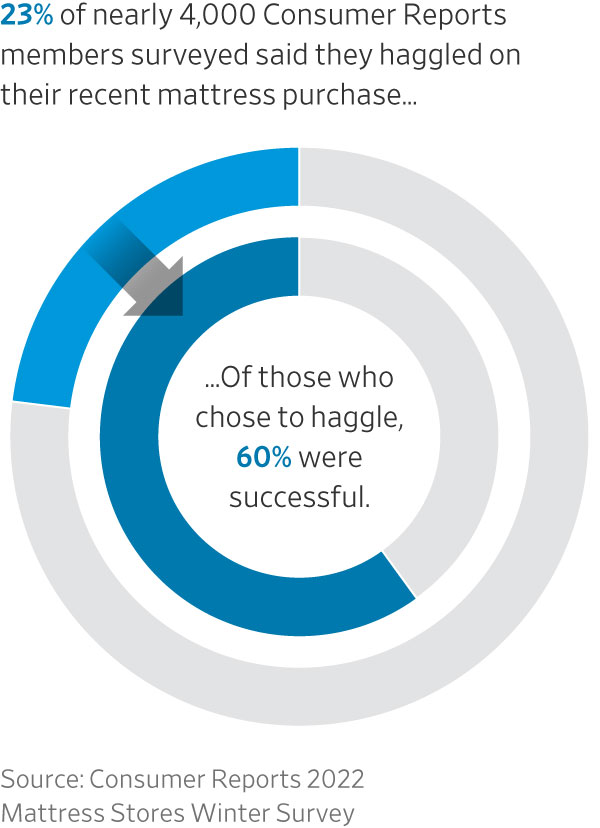
Haggling—an ancient practice among people in almost every culture—remains one of the best ways to save money. Take mattresses. Sixty percent of people who choose to haggle for a mattress succeeded—and saved a median of $245, according to a recent study by Consumer Reports.
Savvy shoppers such as Cameron Huddleston and her husband Alex Lebedinsky have been haggling for years, using a version of good cop, bad cop to score a deal.
When the Bowling Green, Ky., couple saw a $3,000 cream coloured sectional at a local home furnishing store, Lebedinsky said within earshot of the owner that it was nice but he didn’t want to spend that much money. Huddleston tried to “plead” her case (also so the owner would hear.) She said it was smart to invest in a high quality sofa that would last. But Lebedinsky wouldn’t budge.
Eventually, Huddleston asked the owner to help her out and the price came down quickly: $2,400.
“My husband is always my wingman when I buy furniture or anything expensive,” said Huddleston.
While it may not be possible to score a discount on everything (i.e. a grocery store clerk probably doesn’t have the authority to give you a better price on those eggs), it is viable in more places you would think, including big box stores that will often match a competitor’s advertised lower price.
“I tell people if they never hear no it means they haven’t been assertive enough,” said Linda Babcock, a professor at Carnegie Mellon University, who teaches negotiation.
Here are areas where you can haggle, rated on their return on haggling, or ROH. When it comes to haggling, there are only two questions to ask: How hard is this going to be and how much money can it save me? The ROH score is a number from one (it isn’t worth it) to 10 (you’re crazy not to try).
Each also has a degree of bargaining difficulty—beginner, intermediate and pro.
Hotels
ROH Score: 5 most of the time, 3 this summer (It doesn’t take much time, aside from possibly having to interact with the concierge desk. The savings may be slim, especially during peak summer season.)
Degree of difficulty: Beginner
You wake up early in the morning on your vacation for a quick run on the treadmill in the hotel gym, only to find it is closed for renovations. That letdown can provide an opening to save money on your getaway.
When checking out after your stay, examine the line items on your invoice. There is a decent chance you’ll spot a so-called resort fee, even if you’re not staying at a five-star, luxury resort. The fees are ostensibly meant to cover services and perks a resort may offer, such as wireless internet or cabanas by the pool, but are sometimes tacked on even at more run-of-the-mill hotels.
“We have seen this for a decade at some of the lowest-priced hotels,” says Lauren Wolfe, counsel at Travelers United, a consumer-advocacy group. These tacked-on charges aren’t always flagged as resort fees—at low-cost hotels, they are often labeled as “safe fees” for the use of the in-room safes.
These fees can add up: A January analysis of pricing at more than 100 U.S. hotels by personal-finance website NerdWallet found that the average resort fee was more than $42 per night, or about 11% of the nightly cost for a room at a hotel that charges such a fee.
But travellers don’t need to stomach such nickel-and-diming. Yes, you can ask hotel operators to remove these fees from your bill.
If a resort fee wasn’t advertised as part of the room rate at the time of booking, Wolfe suggests negotiating with the concierge during checkout to have the added charge removed. Be firm and polite, she says.
If the resort fee is tied to specific amenities—such as a gym or pool—and those were inaccessible during your stay, use that as a bargaining chip. Play nice, and know that your attempt to get the fee scrapped may not succeed. “Don’t get in a fight with the person working at the front desk—that person did not set the policy,” Wolfe warns.
There are other ways to get a deal on a hotel stay. Before you book your vacation, try to negotiate a lower daily rate for a hotel room.
Start off by researching the prices for hotels in your destination across a variety of online travel agencies, and then compare those rates to the ones on the hotels’ own websites. Once you identify a hotel you wish to stay at, you’re going to have to pick up the phone.
Ask the representative for their best available rate, and see if they can match the rates offered by other nearby properties. Travellers may find more success with smaller, boutique resorts than with larger properties. Also ask if they have discounts for members of programs like AAA or AARP.
If the representative can’t offer you a discount, the hotel may be able to offer free parking or complimentary meal vouchers for breakfast at the hotel’s restaurant, says Jamie Larounis, a travel industry analyst with loyalty and rewards website UpgradedPoints.com.
Then at check in, be sure to ask if there are any upgrades available. These may come at a higher price, so have a sense of what the room rates are at the hotel to know if you’re getting a deal or not. If you know that the property isn’t sold out, there may be bargaining room.
Cars
ROH Score: 8 (Salespeople expect you to negotiate so if you do your homework, you can save thousands.)
Degree of difficulty: Intermediate
Preparing to haggle over a car purchase is enough to make your palms sweat and stomach turn. It also presents an opportunity to cut a deal on one of the most expensive purchases you’ll likely ever make.
Jay Austin is accustomed to negotiating as a former vice president in supply chain for a chemical company. Still, he used to dread trudging into a dealership to buy a car a decade ago.
“Let’s get our game face on,” the Medina, Ohio, resident would say to his wife as they rehearsed how they’d respond to different dealer tactics.
The state of haggling in the auto industry looks much different now. Shoppers can lay most of the deal-making groundwork even before coming face-to-face with a salesperson, comparing vehicle prices online and pitting offers against each other.
When Austin decided to sell his Lincoln MKC a couple of years ago, he surveyed online car retailers like Carvana and got $5,000 more than what his dealer offered him.
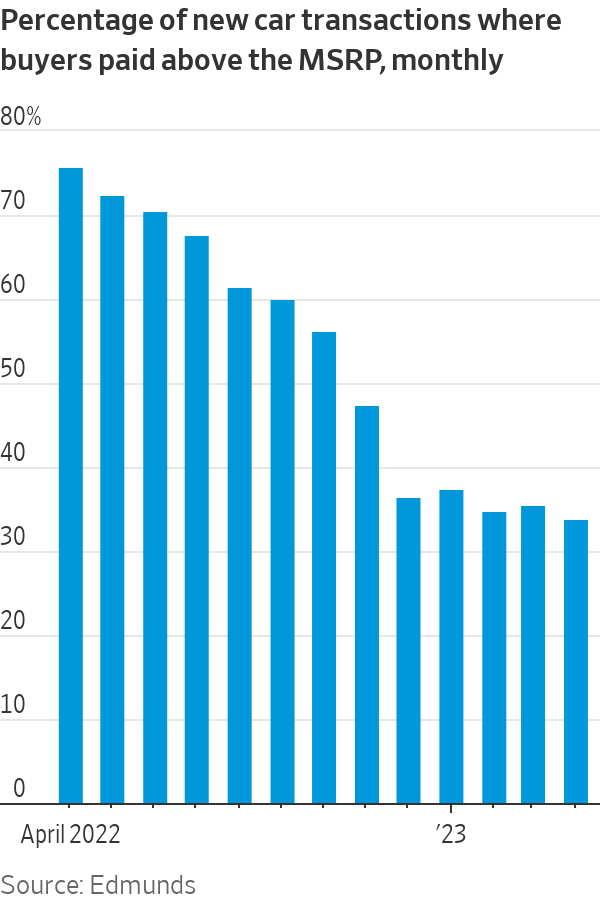
While there is more information at shoppers’ fingertips now, the car market is trickier to navigate. An inventory crunch sent vehicle prices flying, and buyers routinely paid hundreds of dollars over listed prices last year, according to Edmunds, a car-buying research firm. Pre pandemic, the average transaction price for a set of wheels was typically $2,000 or more below sticker price.
Still, haggling isn’t out of the question. One of the keys to having the upper hand now is to be flexible in what type of vehicle you’re willing to buy, say dealers and car brokers. If you’re hoping to get an “Arctic White” Corvette, and won’t settle for any other colour, be prepared to wait, and pay more.
Dealers have strategies to keep the customer paying a premium. For example, it isn’t wise to immediately tell a dealer you’re planning on trading in your vehicle. They can lowball you on its value, a practice called “stealing the trade,” said Earl Stewart, who owns a Toyota dealership in Florida. When you finalise the terms of your sale, you can alert the dealer that you would actually like to trade in for another vehicle, he said.
When shopping around for different offers, you can even go incognito by using a fake email or phone number, Stewart said. This will keep incessant follow-up calls from salespeople at bay.
Most of all, keep your cool if you’re trying to negotiate the price of a car down, he said.
“One of the mistakes that people make is they show up to the dealership kind of with the boxing gloves on ready to go to battle,” said Tom McParland, who runs a consulting business where he assists customers with the car-buying process. If you start acting rudely to a salesperson, you can probably kiss a good bargain goodbye.
Some buyers got creative during the pandemic in their pursuit of a deal, including flying across the country to snag a reasonably priced set of wheels. One buyer even created a haggling tipsheet, including a last-ditch measure: bring your grandma to the dealership to cry.
Home mortgages
ROH Score: 7 (It can feel awkward to ask a zillion questions to parse the terms of a mortgage loan, but you could score tens of thousands of dollars in savings over decades by landing a lower rate.)
Degree of difficulty: Intermediate
If you’re shopping for something complex, say a mortgage, beware of the human tendency to go on autopilot and accept the first price you’re offered, said Samantha Lamas, senior behavioural researcher at fund-research firm Morningstar.
Lenders may be counting on you to choose the easiest route because you feel overwhelmed, she said.
But here’s a reminder: Shopping around is haggling and pays off.
Borrowers who applied with two different lenders reduced their mortgage rate by an average of 0.10 percentage point, according to research from Freddie Mac that examined purchases between 2010 and 2021.
Take a $450,000 home price where the buyer puts 20% down and is looking at current mortgage rates ranging from 6.5% to about 7.5%. Over 30 years, the difference between 6.5% and 7.5% could add up to roughly $87,000 savings in interest, said Ted Rossman, a consumer-spending analyst at Bankrate.
Lenders are far more willing to work with borrowers these days. For one, they aren’t as busy as they used to be. Mortgage underwriting has slowed to a crawl in recent months as rates are keeping many prospective home buyers on the sidelines.
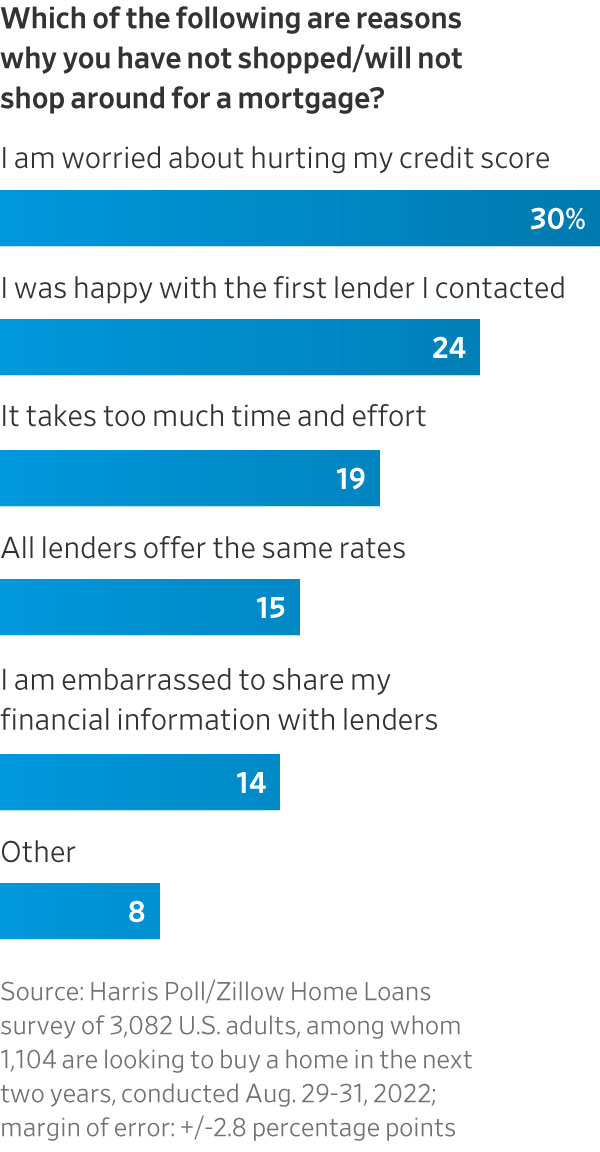
There are some guidelines. Don’t take a lenders’ first offer. Instead, compare offers from three to five lenders including a credit union, financial advisers say. Don’t let misconceptions or technical financial language hold you back either.
Doing this homework puts you ahead in seeking a loan. Most mortgage shoppers don’t bother to ask around for a lower rate, studies show.
It is also important to understand how mortgage inquiries affect your credit score. Lenders pull borrower’s credit reports, or make what’s called hard inquiries, before they decide if they’ll give you a mortgage. A hard inquiry usually dings your credit score by a few points, said Aniva Hinduja, general manager of home and mortgage at Credit Karma. All mortgage credit inquiries within a 45-day window count as one inquiry so, shop within this period to minimise how much your score will fall, said Bill Banfield, executive vice president of capital markets for Rocket Mortgage.
Once you compare terms such as the loan’s annual percentage rate and monthly mortgage payment, narrow down your list of possible lenders to two or three. Feel free to play one lender against another as you decide which loan is ultimately best for your financial situation.
Cellphone and internet
ROH SCORE: 5 (It is just a few phone calls, but also just a few hundred dollars a year in savings, most likely.)
Degree of difficulty: Beginner
The end of your wireless or internet bill contract means you’re free to change providers. It also means you’re ripe with fresh haggling power.
Companies may be more willing to dish out their best offerings to convince you to stick around.
Start by familiarising yourself with your plan. Salespeople often sell the priciest option, so there is a chance you’re already paying for a bunch of features you don’t need. You should also know competing service providers’ plan offerings, even if you want to stick with your current provider.
Now for the hard part: Picking up the phone. Don’t waste your time chatting with the general customer-service line. Ask to speak to the retention department (where trained specialists are better prepared to get you a sweeter deal) and mention that you’re thinking of switching providers.
“It’s the threat of canceling the service that gets us the most amount of money,” says Brian Keaney, chief operating officer at Billshark, a company that helps customers negotiate monthly bills.
Pat yourself on the back for making it this far, because it should get easier from here—you shouldn’t have to say much more. Industry executives suggest you say that you want to pay as little as possible, ask what they can do for you and listen. If they give you an offer, politely ask if there is more they can do.
Heads up: Wireless carriers won’t change the price of your plan. But! They could upgrade you to a better one—potentially one that isn’t advertised—or shave off pesky add-ons you don’t want. Even if you have a bare-bones plan, they could still give you loyalty credits to bring the cost down for a while.
If you do get one of those credits, check your bill and make sure it gets added. It can take two to three billing cycles to show up on your statement, Keaney said. Find out if your new plan or credit runs for a limited amount of time, like a year or two. If so, mark your calendar so you know to renegotiate the deal before the price increases again.
Some executives recommend mentioning life events such as a birth or job loss to unlock certain discounts if true, but only toward the end of the call after you’ve gained other offerings. Otherwise, the representative may be inclined to only give discounts that help in the short-term.
If you feel like you’re not getting anywhere with the representative you’re speaking to, politely let them know that you’ll call back later. (You can scream into the void after you hang up.) Every representative is different and you could get matched with someone who is more willing to help you out next time. Be patient, pick up the phone and repeat the previous steps.
Medical bills
ROH Score: 8 (It is a massive headache to negotiate payments when you’re dealing with a health crisis, but lower cost of treatments can save you thousands.)
Degree of difficulty: Pro
In 2010, Amanda Grossman was speechless when a receptionist requested a higher-than-expected $75 dental copay. She didn’t yell or scream. The shock and confused look on her face must have said it all. Seconds later, the receptionist said $50 would be acceptable.
“I thought, ‘Oh My Gosh. There’s wiggle room,’” says Grossman, 40, a certified financial education instructor.
Now emboldened, Grossman regularly questions medical charges, requests discounts and cheaper prescriptions. To her surprise and relief, she discovered that doctors who don’t accept her health insurance are sometimes willing to lower costs.
For example, her son sees a specialist who doesn’t accept the family’s health insurance. Grossman asked if the specialist would lower the per-visit cost, which the specialist did—to $150 from $200. Then, Grossman submitted a claim to her insurance company, which covered $97 for each $150 visit.
It also helps, she says, to ask for itemised bills to spot potential overcharges or errors. She recalls going to the hospital on a pregnancy-related visit seven years ago and seeing a $200 copay charge on her itemised bill for the emergency room, even though she never went to the emergency room. The charge was dropped after she called.
Nearly half of adults who received a medical or dental bill that they thought contained an error successfully resolved the disputed bill with their medical care provider or insurer, according to a 2022 healthcare debt survey from the Kaiser Family Foundation, a nonprofit organisation that focuses on health care issues.
With a few questions, prescription costs can be reduced or avoided as well.
Grossman’s husband, Paul Peacock, was prescribed a $400 medication from his dermatologist. She suggested he call his doctor, say $400 was too much for them, and ask if there was a cheaper alternative. He did and there was. His new prescription costs $168.
Grossman isn’t afraid to ask for price breaks in other parts of their lives as well. When the couple needed the HVAC replaced, the contractor handed them a bill for $7,600.
“Is there anything else you can do for us?” she asked. He gave one glance to his partner, she recalls, and responded “How about if we lop off $400?”
“Yes, let’s do that,” she responded.
 Copyright 2020, Dow Jones & Company, Inc. All Rights Reserved Worldwide. LEARN MORE





From making unpopular decisions to learning when to listen, leaders from five businesses reveal what nobody prepared them for — and how running a company has challenged their expectations.

Technology and semiconductor shares fell sharply as investors questioned the debt financing the AI infrastructure boom and confronted higher rates and Chinese competition.

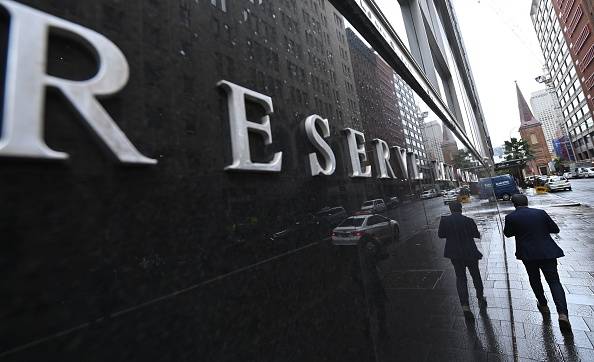
Technology and semiconductor shares fell sharply as investors questioned the debt financing the AI infrastructure boom and confronted higher rates and Chinese competition.
4 minA sharp technology sell-off has exposed a new anxiety on global markets: whether the enormous borrowing behind the artificial-intelligence infrastructure boom can generate sufficient returns as interest rates rise and Chinese competition intensifies.
The artificial-intelligence investment boom has powered technology shares, semiconductor manufacturers and data-centre operators to extraordinary heights. Last week, investors were given a reminder that much of this expansion is being built with borrowed money.
The technology-heavy Nasdaq Composite fell 4.5 per cent over the week ended October 16, its weakest performance since late June. Semiconductor shares suffered an even deeper correction, with the Philadelphia Semiconductor Index losing about 11.4 per cent.
The selling spread quickly through global markets. Micron Technology fell 14.6 per cent over the week, while South Korea’s Samsung Electronics and SK Hynix dropped approximately 18 per cent and 24 per cent respectively.
This was more than a routine bout of profit-taking. Investors were reassessing three interconnected risks: higher interest rates, the rapidly expanding debt burden attached to AI infrastructure and the prospect of stronger competition from Chinese memory-chip manufacturers.
The debt behind the AI build-out
Artificial intelligence requires a physical infrastructure network of enormous scale. Data centres must be built, advanced processors purchased, power supplies secured and cooling systems installed before customers begin generating meaningful revenue from them.
Technology companies are increasingly supplementing their own cash with corporate bonds, syndicated loans, equipment leases, private credit and project-level financing.
JPMorgan describes the emerging funding model as a combination of conventional corporate borrowing and project finance tied to individual data-centre assets. In Australia, the Reserve Bank estimates that syndicated loans accounted for approximately three-quarters of data-centre financing during 2025 and 2026 to date.
The numbers are becoming large enough to affect broader credit markets. The Federal Reserve Bank of Dallas has cited Wall Street estimates suggesting AI-related investment-grade bond issuance could approach US$300 billion in 2026 alone.
That borrowing is not automatically problematic. Debt can be an efficient way to finance long-lived infrastructure when future revenue is sufficiently predictable. The concern is that AI technology, customer demand and computing economics are changing much faster than the repayment schedules attached to the assets.
A data centre financed today may carry debt for years. Investors must therefore make assumptions about future utilisation rates, electricity prices, chip performance, customer concentration and the amount businesses will ultimately pay for AI computing.
When interest rates rise, those assumptions become less forgiving.
Inflation changes the calculation
September’s US inflation data intensified the pressure. Consumer prices increased 3.7 per cent over the year, ahead of market expectations and up from 3.4 per cent in August.
The hotter reading reduced confidence that interest rates would fall quickly and pushed bond yields higher. That matters particularly for companies whose valuations depend on profits expected well into the future, as well as highly leveraged infrastructure operators that may need to refinance.
CoreWeave has emerged as a closely watched test case. The specialist cloud-computing company has accumulated substantial debt and lease obligations to build AI capacity, while relying on a concentrated group of large technology customers.
Its shares fell sharply during the sell-off, while the cost of insuring its debt against default climbed. CoreWeave has argued that its contracted backlog more than covers its obligations and that financial markets do not always understand its business model. Nevertheless, its securities have become a proxy for investor confidence in debt-funded AI infrastructure.
Oracle, another major investor in AI computing capacity, fell 8.8 per cent in Friday trading, while CoreWeave dropped 15.5 per cent.
The question is shifting from how much AI infrastructure can be built to how profitably it can be operated.
China adds another source of pressure
Interest rates were not the only catalyst. Reports of advances by Chinese memory-chip producer ChangXin Memory Technologies raised concerns that lower-cost Chinese products could increase competition across the global semiconductor industry.
Memory chips are essential to AI systems, but the industry is historically cyclical. Periods of tight supply and high pricing can encourage rapid investment, eventually producing oversupply and falling margins.
The prospect of a well-funded Chinese competitor expanding its technological capabilities unsettled investors in Samsung, SK Hynix and Micron. It also demonstrated that AI-related demand does not insulate chipmakers from conventional competitive pressures.
That combination—slower rate cuts, more expensive financing and potentially cheaper supply—challenged the assumption that every company exposed to AI would enjoy continually expanding margins.
A reset rather than the end of the boom
The sell-off does not establish that the AI boom is ending. Demand for computing power remains strong, the largest technology companies continue to generate formidable cash flows and many infrastructure projects are backed by long-term customer contracts.
What has changed is the market’s willingness to overlook the price and financing structure of that growth.
The most resilient companies are likely to be those able to fund investment from operating cash flow, secure long-duration customers and demonstrate that new capacity will earn returns comfortably above its financing costs.
More speculative operators may face greater scrutiny, particularly where debt is expensive, customers are concentrated or expected revenue depends on demand that has not yet materialised.
For Australian investors, the lesson extends beyond US technology shares. Local data-centre operators, infrastructure funds, electricity suppliers and property groups are increasingly exposed to the same investment cycle.
Artificial intelligence may remain one of the defining growth themes of the decade. But last week’s correction showed that enthusiasm for the technology does not eliminate financial discipline.
The next stage of the AI boom will be judged not only by computing power, model performance or demand for chips, but by something more traditional: whether the assets being financed can generate enough cash to repay the money borrowed to build them.
Fact box
Nasdaq Composite: Down 4.5 per cent for the week ended October 16, 2026
Philadelphia Semiconductor Index: Down approximately 11.4 per cent
Micron Technology: Down approximately 14.6 per cent
Samsung Electronics: Down approximately 18 per cent
SK Hynix: Down approximately 24 per cent
US September inflation: 3.7 per cent annually
Estimated 2026 AI-related investment-grade issuance: Approximately US$300 billion

An opulent Ryde home, packed with cinema, pool, sauna and more, is hitting the auction block with a $1 reserve.

Records keep falling in 2025 as harbourfront, beachfront and blue-chip estates crowd the top of the market.