


European Central Bank Raises Key Interest Rate to Record High
Central bank signals this might be enough to combat inflation, but doesn’t rule out further increases

 4 min
4 min
FRANKFURT—The European Central Bank raised interest rates by a quarter percentage point to a record high but signalled that eurozone borrowing costs may have peaked, sending the euro tumbling.
In a split decision, ECB officials raised the bank’s deposit rate to 4%, the 10th increase in a row and a vertiginous rise from below zero last year.
At a news conference, ECB President Christine Lagarde signalled that Thursday’s rate increase might be the last, although she didn’t rule out further hikes if economic data disappoint.
ECB officials judge that rates “have reached levels that, maintained for a sufficiently long duration, will make a substantial contribution” to reducing inflation to their 2% target, Lagarde said, repeating language used in the bank’s policy statement.
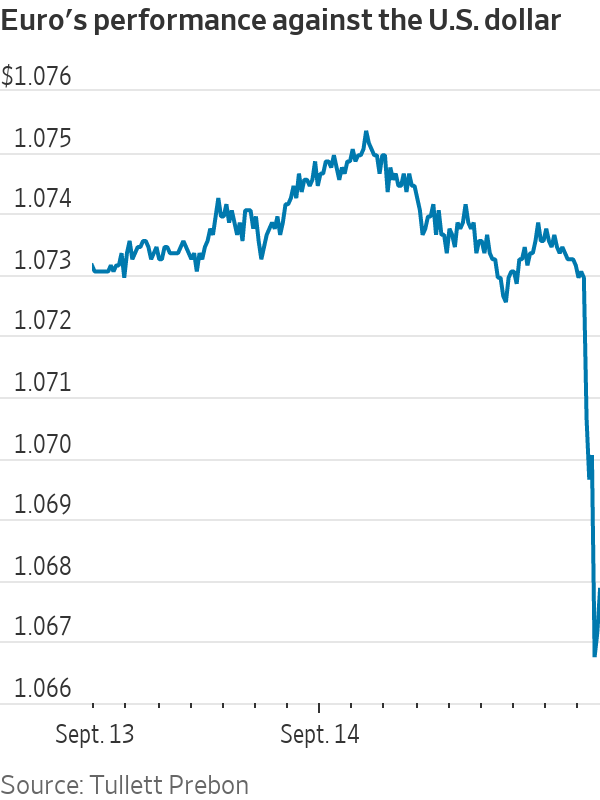
The comment prompted investors to downgrade their expectations for future ECB rates, sending the euro down by almost a cent against the dollar to below $1.07, its lowest level since March. Bond yields slid, with yields on the benchmark 10-year government bonds of Germany, France and Italy down between 0.05 and 0.10 percentage point. European stocks rallied, with the benchmark Stoxx Europe 600 index rising more than 1%.
The eurozone still has lower interest rates than the U.S., as well as higher inflation and a struggling economy that contrasts with relatively healthy economic growth in the U.S.—all factors that are weighing on the euro.
“In all likelihood the ECB is done,” said Frederik Ducrozet, head of macroeconomic research at Pictet Wealth Management in Geneva.
Major central banks including the Federal Reserve are signalling a possible halt to a historic series of interest-rate increases over the past 18 months aimed at tackling a surge in inflation unseen since the 1970s.
Ending rate increases would favour borrowers amid uncertainty in the global economy, declining international trade and faltering industrial output. However, signalling a peak in interest rates now risks letting excessive inflation on both sides of the Atlantic become entrenched. Some central banks, including those of Australia and Canada, signalled a pause in recent months, only to start raising rates again.
Recent market movements suggest investors are now betting that rates will peak and even start falling as early as next spring as inflation and economic growth both come down.
They expect the ECB to hold interest rates at about 4% through next summer before starting to cut them, according to data from Refinitiv. They think the Fed will hold rates steady in a range between 5.25% and 5.5% at its meeting next week, and to start cutting rates early next year. The Bank of England is expected to increase interest rates at least once more this year before cutting them later next year.
Investors had been unusually divided before Thursday’s decision over whether the ECB would pause already or unveil one last rate increase. That disagreement reflects uncertainty over how much a slowdown in eurozone growth, together with the ECB’s past rate increases, will cool the region’s inflation rate, which stood at 5.3% in August, unchanged from a month earlier.
Lagarde said some of the central bank’s governors would have preferred to hold rates steady at this month’s meeting. However, a “solid majority” of them agreed on the decision to take rates higher, she said.
New economic forecasts published by the ECB Thursday suggested that eurozone growth will slow significantly more than previously expected this year and next, while inflation will remain markedly above the ECB’s target of 2% through next year. The bank raised its forecast for inflation next year from 3% to 3.2%, mainly to reflect “a higher path for energy prices.”
Asked about the prospect of rate cuts, Lagarde replied that “is not even a word we have pronounced.”
“The longer they can keep interest rates at elevated levels, the more insurance they buy against a downturn down the road,” said Robert Dishner, a senior portfolio manager at Neuberger Berman. “If they end up cutting too soon, they risk reigniting inflation.”
Central banks in Europe face a particularly daunting challenge because while recent interest rate rises have weighed heavily on lending and probably lowered economic growth, they have yet to show a marked effect on underlying inflation. This contrasts with the U.S., where the Fed has taken interest rates higher than the ECB and underlying inflation has fallen significantly while the nation’s growth remains robust. Underlying inflation in August was 5.3% in the eurozone and 4.3% in the U.S.
Recent data and business surveys signal a darkening economic outlook for Europe amid weak growth in China and a decline in global manufacturing. The eurozone economy has largely stagnated since late last year, and industrial production declined in July, dragged down by weakness in Germany, the region’s largest economy.
Lagarde warned that Europe is currently going through a phase of very sluggish growth and suggested that the ECB’s rate hikes are filtering through to the economy. “We are beginning to see weakness in the volume of hires particularly in the services sector that is related to manufacturing,” she said.
Meanwhile, a recent increase in oil prices is pushing inflation in the wrong direction. The euro has slumped against the dollar in recent weeks, to around $1.07 from $1.12 in July, as the eurozone’s economic prospects have soured. That increases the cost of imported goods, making the ECB’s job harder.
Matthew Ryan, head of market strategy at financial-services firm Ebury, said the ECB would likely start cutting rates later, and possibly at a more gradual pace, than the Fed, which should support the euro.
Some of the economic weakening is as intended. The ECB expects its rate increases to slow the region’s economy by weighing on asset prices and demand for loans. However, it isn’t clear if inflation is starting to fall because of the ECB’s actions or because of other factors, such as the fact natural-gas prices are dramatically lower compared with last year, when Russia throttled Europe’s gas supplies. This makes it hard to predict if the region’s economic slowdown will push inflation all the way down to 2%.
Market confidence in the ECB’s ability to achieve its objectives is gradually eroding, with the closely watched five-year, five-year inflation swap—a gauge of expected inflation over a 10-year horizon—standing at 2.6%, according to Franck Dixmier, global chief investment officer for fixed income at Allianz Global Investors.
High current and expected future inflation could mean that investors are underestimating the potential for further ECB rate increases, Dixmier said.
 Copyright 2020, Dow Jones & Company, Inc. All Rights Reserved Worldwide. LEARN MORE





Exclusive eco-conscious lodges are attracting wealthy travellers seeking immersive experiences that prioritise conservation, community and restraint over excess.

Margot Robbie and Jacob Elordi star in an adaptation of the classic novel that respects the romance’s slow burn.


The social-media company’s revenue increased 14%, falling short of estimates.
2 min
Pinterest shares tumbled after the company projected that revenue growth would slow in the first quarter, amid an advertiser pullback that weighed on its fourth-quarter earnings.
Shares slid 18.5% to $15.10 in after-hours trading after closing the market session down 2.9% at $18.54.
Pinterest reported a 14% increase in fourth-quarter revenue to $1.32 billion, up from $1.15 billion a year earlier, but short of analysts’ estimate of $1.33 billion, according to FactSet. The company posted 17% revenue growth in the third quarter.
The company expects growth to decelerate further in the current first quarter, projecting growth between 11% and 14%. It’s forecasting revenue between $951 million and $971 million.
Chief Executive Officer William Ready said the company needs to broaden its revenue mix and accelerate sales going forward.
“We are not satisfied with our Q4 revenue performance and believe it does not reflect what Pinterest can deliver over time,” he told analysts on a call Thursday. “We are moving with urgency to return over time to the mid-to-high-teens growth, or better than what we have been consistently delivering.”
Pinterest on Thursday recorded a profit of $277.1 million, or 41 cents a share, compared with its profit of $1.85 billion, or $2.68 a share, a year earlier. The $1.85 billion profit in 2024 included a $1.6 billion benefit from deferred tax assets.
Stripping out certain one-time items, Pinterest logged adjusted earnings of 67 cents a share, in line with analyst expectations, according to FactSet.
Ready said the company continues to see headwinds from larger retailers pulling back on advertising spending to protect their margins amid the impact from President Trump’s tariffs.
“We saw continued softness from this cohort of large retailers,” Ready said. “While we see opportunity over the long term, the near-term outlook for this cohort on our platform remains pressured given these headwinds.”
Ready said the company has expanded its footprint among mid-market and small-to-medium business advertisers, as well as international businesses. Still, he said Pinterest had a ways to go to offset the headwinds from larger advertisers, which may become even more pronounced in the current quarter.
Chief Financial Officer Julia Donnelly added that the company is looking to increase its investments in sales and research and development related to artificial-intelligence following the launch of its restructuring effort in January. Pinterest said last month that it would cut about 15% of its workforce, or approximately 700 jobs.

When the Writers Festival was called off and the skies refused to clear, one weekend away turned into a rare lesson in slowing down, ice baths included.

The era of the gorgeous golden retriever is over. Today’s most coveted pooches have frightful faces bred to tug at our hearts.