Big Tech Stops Doing Stupid Stuff
This year it might be smart to invest in companies that think a little smaller

 3 min
3 min
The era of moonshots is (mostly) over. This year tech companies are taking a more earthly approach.
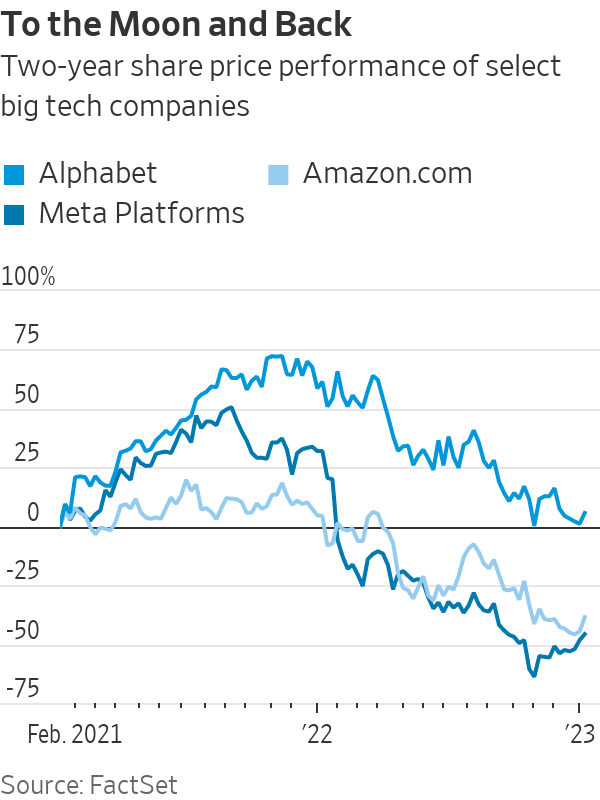
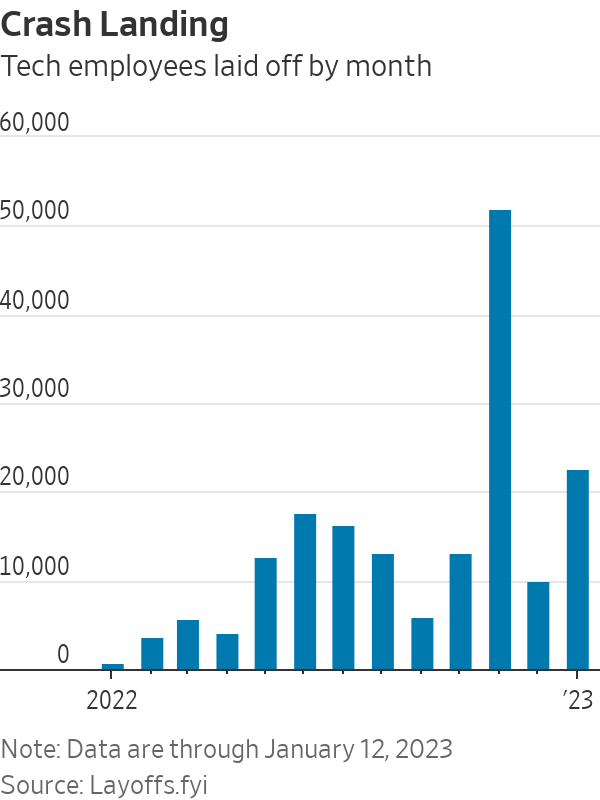
Stock charts both explain the change in boardroom sentiment and tell the story following an epic Covid-fuelled rise and fall. The tech-heavy Nasdaq fell 33% last year—its worst performance since 2008. Big tech, which spent the past several years spending on big dreams, is starting to think smaller. Last year more than 1,000 tech companies laid off employees, resulting in over 150,000 lost jobs, a tally by layoffs.fyi shows. It is an eye- popping number that could actually get worse: More than 23,000 tech workers have already been let go this year as of Jan. 13, the same tracker shows.
Many of these workers were newly hired under the mistaken assumption that booming pandemic demand would become the new normal. But a good percentage were legacy employees working on projects that, given today’s market environment, range from fiscally irresponsible to projects that fall well outside their parent company’s wheelhouse.
Meta Platforms and Amazon.com are the most high-profile examples, having cut a combined 29,000 workers so far. Meta is still reeling from an online advertising slump and the many billions of dollars that Chief Executive Officer Mark Zuckerberg is throwing at a new virtual world dubbed the metaverse. Amazon is coping with a retail slowdown in part by scaling back spending in unprofitable business areas such as its Alexa-controlled electronics products.
Meta Chief Technology Officer Andrew Bosworth said in an internal memo late last year that his company had “solved too many problems by adding headcount,” according to a recent newsletter published by the Verge. He reportedly added that headcount comes with overhead, which “makes everything slower.”
Despite its much-touted virtual ambitions, Meta said in a blog post last month that it is still devoting 80% of its total investment dollars to improving its own legacy business. In the Verge’s recent interview, Mr. Bosworth acknowledged that Meta is “changing our investment strategy” to the extent that some projects have to demonstrate value sooner to justify their high burn.
The ax also seems to be falling at the original moonshot factory: The Wall Street Journal reported that Google-parent Alphabet is laying off more than 200 employees at its Verily Life Sciences unit, plus another 40 at its robotics software company, Intrinsic. Both are part of Alphabet’s Other Bets segment, which racked up $5.9 billion in operating losses over the past four quarters while generating barely $1 billion in revenue.
Those cuts are unlikely to be the last at the Google parent, which added more than 30,000 new employees in the first nine months of 2022, even as its own advertising business started slowing.
Smaller tech companies are feeling the burn too. Redfin CEO Glenn Kelman told the Journal recently that if he could jump back in time 18 months, he would advise companies looking for profits to just “stop doing stupid stuff.”
He speaks from experience: The real-estate brokerage laid off 13% of its staff and shut down its automated home-flipping business late last year after deeming the operation too risky and expensive to continue. That followed a second quarter in which its so-called iBuying business had swelled to account for over 40% of its overall revenue. Channeling an old playbook for the new year, Mr. Kelman said in his company’s third-quarter report that Redfin “will have more cash and sell more properties” by focusing on its online audience and on better brokerage services.
Competitor Zillow gave up on its own iBuying business a year earlier than Redfin for similar reasons. It has since refocused on finding better ways to help its customers buy and sell other people’s homes. It is now using artificial intelligence to do such things as helping apartment hunters view available listings on New York City buildings they pass by and helping sellers generate floor plans for online listings based on photos. Zillow is also bundling its technology into an updated product to bolster traditional agents’ businesses.
A sector that has long worked to disrupt is now focusing on enhancing what already exists. In ride-share, Uber Technologies has now added taxi bookings to its platform in many cities, essentially feeding business to a competitor (but not without taking a small cut, of course). In Britain, Uber users can also book trains, buses and rental cars through its app. With Uber Explore, users across several cities can even book restaurant reservations and experiences.
Reinventing the wheel is so last year. The best tech investments of 2023 might be companies content to spend their coin greasing it.
 Copyright 2020, Dow Jones & Company, Inc. All Rights Reserved Worldwide. LEARN MORE





Victorian auction buyers will soon receive a piece of information that has traditionally been withheld until bidding reaches it: the vendor’s reserve price. Under new property-sale and underquoting laws, agents must publish the agreed reserve at least seven days before an auction or fixed-date sale. Most changes begin on 1 October 2026 and apply to …
Continue reading “Victoria’s New Auction Rules Will Force Reserve Prices Into the Open”

Four decks, 34.5 metres and a made-to-measure interior: step aboard the new Custom Line Navetta 35, unveiled at Cannes.

The ASX 200 rose about 0.27% as energy and materials advanced. Woodside and gold miners gained while financials and technology weakened.
2 min
The Australian sharemarket rebounded from its lowest close in three months on Wednesday, with energy and materials companies leading a cautious recovery.
The S&P/ASX 200 finished approximately 23 points, or 0.27 per cent, higher at 8,695.6 on 16 September. A second data source placed the closing index at 8,696.5, up 24 points or 0.28 per cent. The official close should be confirmed through a licensed feed before publication.
The broader All Ordinaries added 25.2 points, or 0.28 per cent, to 8,874.5.
Energy was the strongest sector, rising 2.19 per cent as Australian producers reflected the previous overnight increase in global oil prices. Woodside gained 2.84 per cent. Brent had settled near US$108.75 a barrel before the local session, although it later traded around US$107.68.
Materials advanced 1.28 per cent and provided the largest positive contribution to the index. Gold producers featured prominently among the strongest stocks, with Pantoro rising 9.3 per cent and St Barbara gaining 8.18 per cent. BCI Minerals added 7.48 per cent.
Financials fell 0.37 per cent, detracting from the benchmark despite earlier strength. Rate expectations remained a significant influence after Westpac joined the other major banks in forecasting a possible Reserve Bank increase in November. Higher rates can expand bank margins in some circumstances but also raise funding costs and increase the risk of loan stress and slower credit growth.
Technology remained weak. Life360 declined 5.46 per cent, while healthcare names that had rallied during Tuesday’s sell-off gave back ground. 4DMedical lost 5.35 per cent and Telix Pharmaceuticals fell 4.96 per cent.
James Hardie dropped 5.23 per cent. Codan moved against the weaker technology tone, gaining 7.51 per cent.
The session produced positive breadth, with more advancers than decliners among the largest 250 stocks, but the broader backdrop remains unsettled. Oil prices have revived inflation concerns, bond yields are elevated and investors are assessing the prospect of further monetary tightening in Australia and the United States.
The rebound therefore recovered only part of Tuesday’s 0.9 per cent decline. For Thursday, investors will be watching overnight central-bank developments, energy markets and whether gains can broaden beyond resources.
Market dashboard — 16 September 2026
S&P/ASX 200* Approximately 8,695.6, up 23.1 points or 0.27 per cent; verify the official closing print
All Ordinaries: 8,874.5, up 25.2 points or 0.28 per cent
Best-performing sector: Energy, up 2.19 per cent
Materials: Up 1.28 per cent
Weak sector: Financials, down 0.37 per cent
Leading mover: Pantoro, up 9.30 per cent
Notable large-cap mover: Woodside, up 2.84 per cent
Notable loser: Sunrise Energy Metals, down 6.22 per cent
Life360: Down 5.46 per cent
Australian dollar: About US71.3 cents in the preceding market snapshot
Gold: Approximately US$4,375 an ounce in the afternoon snapshot
Brent crude: Approximately US$107.68 a barrel in the afternoon snapshot

By improving sluggish performance or replacing a broken screen, you can make your old iPhone feel new agai

A record-breaking $11 million sale at The Centennial Collection has set a new benchmark for luxury apartment living in Bondi Junction.