Global Executives Say Greenwashing Remains Rife
Nearly three-quarters of corporate leaders say most organisations in their industry would be caught greenwashing if they were investigated thoroughly

 3 min
3 min
Most global executives think greenwashing is widespread in their industry, and despite customers becoming more vocal about preferring sustainable brands, many companies are cutting corners on their environmental, social and corporate governance initiatives.
Nearly three-quarters of executives said most organisations in their industry would be caught greenwashing if they were investigated thoroughly, according to a survey of nearly 1,500 executives across 17 countries and seven industries conducted in January by the Harris Poll on behalf of Google Cloud.
The risk of greenwashing is increasing with crackdowns on overstated green claims on both sides of the Atlantic. Despite that threat, the figures are consistent with last year’s findings: Nearly 60% say their own organisation is overstating its sustainability methods. While for some it may be intentional, most say it is instead often due to setting sustainability goals or pledges without a concrete plan to reach them.
“There are actors that are maybe intentionally overstating what they’re doing, but I honestly think for the most part, companies are sincere—they’ve set their goals, they’re working towards them, but they don’t always have the data to be transparent,” said Kate Brandt, chief sustainability officer at Google.
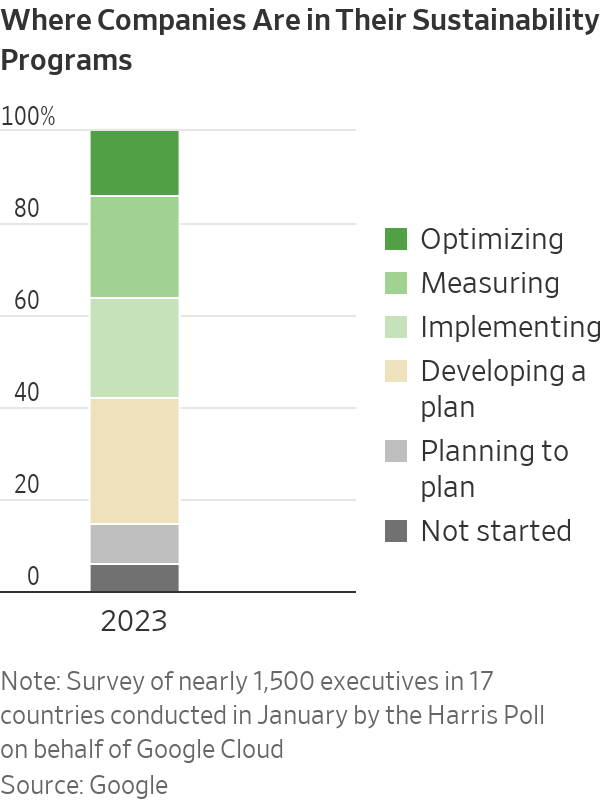
The survey gives insight into where companies are in their sustainability efforts. A little more than a quarter are developing their sustainability programs, 22% have a plan they are implementing, another 22% are able to measure its impact, and 14% are in the final stage of optimising their plan based on measured outcomes. In contrast, nearly a tenth plan to start developing their sustainability plan in the near future, while the remaining 6% don’t have a plan or any intention to come up with one soon.
Nearly three-quarters of executives said they want to advance sustainability efforts but don’t actually know how to go about doing it. Top tools identified to improve their ability were having a dedicated sustainability leader, support from senior management, advanced measurement tools, and education for employees and executives. And the two main ways they expect advancement is through technology innovation as well as investment in sustainable operations or services.
With nearly a decade of experience as a CSO, Ms. Brandt said the survey findings reinforced her point of view on how a company can set itself up to be successful. Businesses need strong governance powered by good data and metrics and a dedicated sustainability leader to be the center of gravity but one who can also embed sustainability inside business functions.
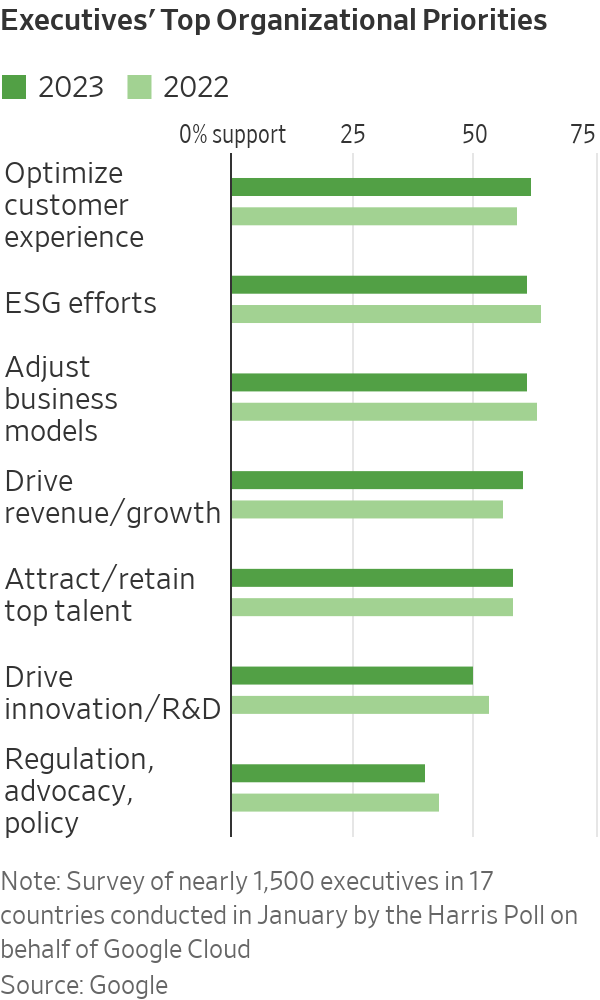
Most executives surveyed—85%—said customers and clients are becoming more vocal about their preference for engaging with sustainable brands. However, economic uncertainty means that business leaders have increased their focus on customers, revenue and growth, although ESG issues remain one of businesses’ top three priorities.
While an earlier survey by industrial conglomerate Honeywell International Inc. found that sustainability budgets at most companies were relatively insulated from cuts, the more recent Google Cloud survey indicates things may have changed. Two-thirds of executives in the latest survey said they are having to cut corners on sustainability initiatives and 45% said the economy is negatively affecting their organisations’ sustainability efforts.
“Essentially when times are getting hard, you get to see who’s serious about this agenda and those who are paying lip service or perhaps accidentally overstating their efforts,” said Justin Keeble, managing director of global sustainability at Google Cloud.
 Copyright 2020, Dow Jones & Company, Inc. All Rights Reserved Worldwide. LEARN MORE





Borrowers cannot control the Reserve Bank, but they can control how exposed their household budget is to its next decision. The RBA meets on 29 September with inflation concerns still elevated and major-bank economists increasingly bringing forward their rate-rise calls. Fixed mortgage rates have also been moving, reducing the value of waiting for perfect certainty. …
Continue reading “What mortgage holders should do before the next RBA decision”

Australian shares finished higher on Tuesday, September 22, as a technology rally and lower oil prices outweighed weakness in energy companies and continued anxiety about domestic interest rates. The S&P/ASX 200 closed 25.9 points, or 0.30 per cent, higher at 8,757.8. The All Ordinaries gained 0.36 per cent to 8,951.0, while the All Technology index …
Continue reading “ASX Wrap: Technology lifts the ASX as falling oil relieves inflation pressure”
 2 min
2 minAustralian shares finished higher on Tuesday, September 22, as a technology rally and lower oil prices outweighed weakness in energy companies and continued anxiety about domestic interest rates.
The S&P/ASX 200 closed 25.9 points, or 0.30 per cent, higher at 8,757.8. The All Ordinaries gained 0.36 per cent to 8,951.0, while the All Technology index rose 1.71 per cent.
Information technology was the strongest major sector, up 2.67 per cent. Megaport gained 4.3 per cent, NextDC rose 3.8 per cent and Life360 added 2.9 per cent, according to the ABC’s closing market report. The move followed a record Nasdaq close and reflected renewed demand for growth assets as oil prices eased.
Consumer discretionary gained 1.29 per cent, while real estate and healthcare each rose 0.76 per cent. The simultaneous strength of technology, discretionary shares and listed property was consistent with a modest easing in market inflation anxiety, although it did not erase expectations of a possible RBA increase at the 29 September meeting.
Energy was the clear laggard, down 1.16 per cent, after Brent crude briefly fell below US$100 a barrel overnight. Origin Energy dropped about 4 per cent, Woodside lost 2.4 per cent and AGL declined 2.3 per cent. Utilities were the weakest sector overall, down 2.03 per cent.
Among larger and liquid movers, Telix Pharmaceuticals rebounded 6.85 per cent after the previous session’s sharp acquisition-related decline. IDP Education jumped 20.67 per cent and was the largest percentage gainer in the ASX 300 screen, while Catalyst Metals fell 14.37 per cent. Those moves should be checked against company announcements before publication; percentage rankings alone do not establish cause or index impact.
Mining performance was mixed. Sunrise Energy Metals rose 12.71 per cent, FireFly Metals added 5.7 per cent and Bellevue Gold gained 4.8 per cent, while Resolute Mining lost 4.44 per cent.
The Australian dollar traded near US71.18 cents late in the session. Oil remained volatile as markets assessed potential US–Iran talks, making energy prices a continuing input into inflation expectations, bond yields and the RBA outlook.
For Wednesday, investors will watch oil, offshore technology leads, Australian bond yields and any new evidence that changes the probability of a September rate rise.
Market dashboard
S&P/ASX 200: 8,757.8, up 25.9 points or 0.30 per cent.
All Ordinaries: 8,951.0, up 0.36 per cent.
Best sector: Information Technology, up 2.67 per cent.
Weakest sector: Utilities, down 2.03 per cent. Energy fell 1.16 per cent.
Material winner: Telix Pharmaceuticals, up 6.85 per cent. Megaport rose 4.3 per cent and NextDC rose 3.8 per cent.
Material loser: Origin Energy, down about 4 per cent. Woodside fell 2.4 per cent.
ASX 300 percentage leader: IDP Education, up 20.67 per cent. Confirm announcement context before publication.
ASX 300 percentage laggard: Catalyst Metals, down 14.37 per cent. Confirm announcement context before publication.
AUD/USD: Approximately US$0.7118 late in the session.
Next catalyst: RBA policy decision on 29 September, oil-price volatility and offshore technology trading.

Odd Culture Group brings a new kind of after-dark energy to the CBD, where daiquiris, disco and design collide beneath the city streets.
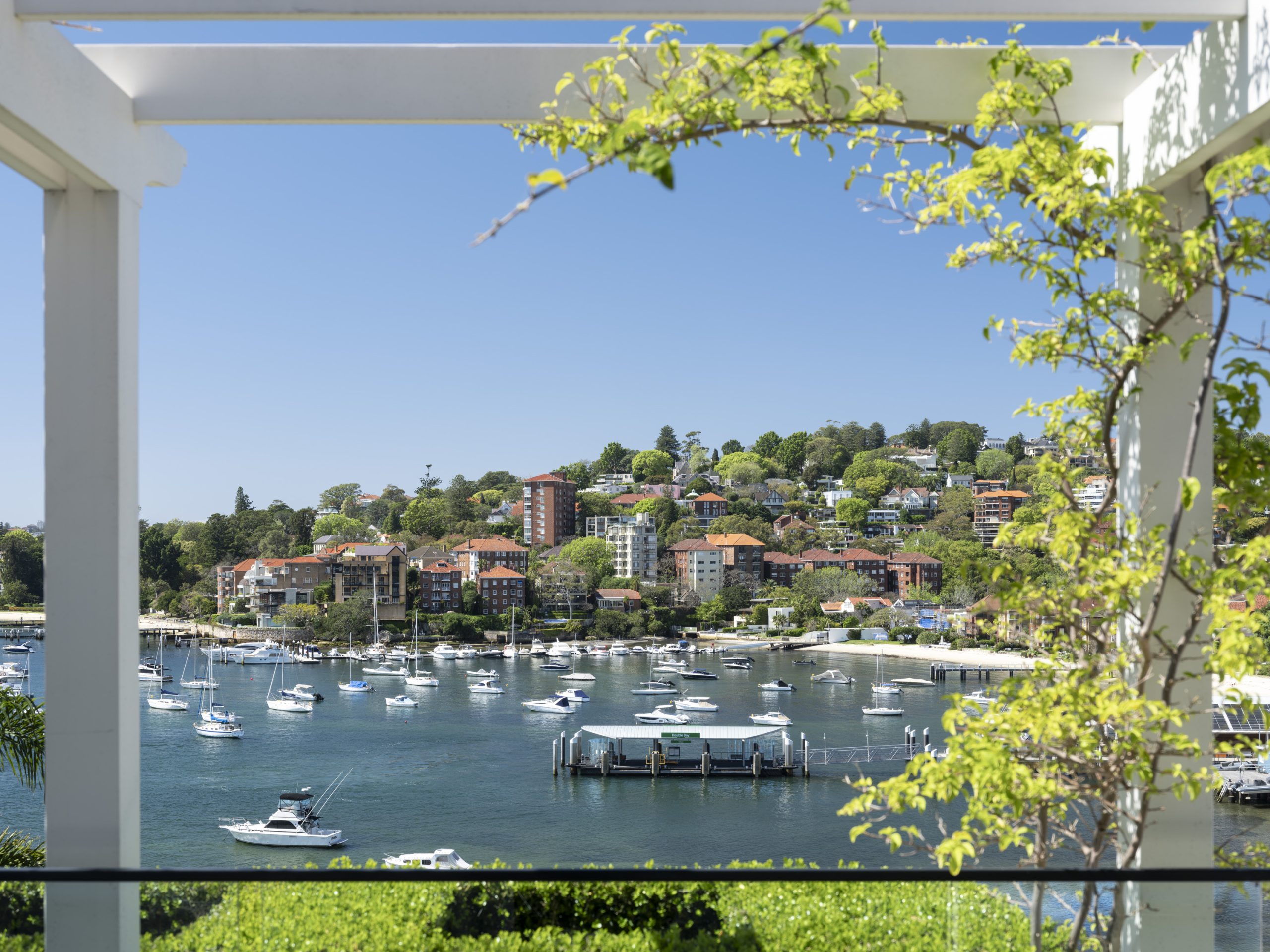
The grand harbourside residence combines sweeping Sydney Heads views, resort-style entertaining and refined designer finishes with a reported $36 million price guide.