What’s Next at Work? Much Change, and Likely Some Pain for Employees
At the Journal’s Future of Everything Festival, many predicted work could shift, jobs will vanish and some employees might be displaced; ‘there’s going to be disruption’

 3 min
3 min
Workers, brace yourselves.
The rise of artificial intelligence and other new technology may mean plenty of roles and professions shift in the coming years, displacing some employees and requiring far different skills and training, according to executives in a range of industries.
In sessions at The Wall Street Journal’s Future of Everything Festival this week, some leaders gave blunt assessments of the coming transition and said current employees may not be able to adapt.
“This is the hard part: I’m not sure we can upskill everyone. I don’t think they’re going to make it. It’ll take too long,” said Jim Farley, CEO of Ford Motor, in an onstage interview on Wednesday. “There’s going to be a big shift in know-how in the company.”
At Ford, the automaker will still need traditional roles such as powertrain engineers and supply-chain specialists to help it manufacture vehicles, but it will also require employees with more digital expertise, Mr. Farley said. The company has been recruiting more technical employees, and its office in Silicon Valley is now full of such workers, he said.
“There’s a new skill set we’re going to need, and I don’t think I can teach everyone,” he said. “It’ll take too much time. So there’s going to be disruption.”
For years, workplace specialists predicted that technology would upend work, often warning that blue-collar jobs could be most affected by automation. More recently, though, many leaders see AI as having a far greater potential impact on corporate employees than hourly workers.
At the hotel giant Hilton, CEO Chris Nassetta said he could see AI being used in marketing, revenue management, customer insights and finance functions in the company.
Many executives said they were still unclear about AI’s role inside companies, and some expressed optimism about how the technology could free workers from drudgery.

“AI is going to take away a lot of mundane tasks from people and hopefully free people up to spend more time creatively, spend more time with the people they want to spend time with,” said Marissa Mayer, the former Yahoo CEO. She is now the CEO and co-founder of the startup Sunshine, whose product helps people to better manage their digital contacts.
Others said AI potentially could help with tasks such as summarising messages from colleagues, freeing employees from reading hundreds of emails and other communication.
“When there is so much happening in organisations, AI can also help you focus,” said Lidiane Jones, CEO of the messaging platform Slack. “So out of my 5,000 pings, what are the things that I should really prioritise?”
Labor leaders said they, too, were eyeing AI’s influence on the workplace. Sara Nelson, the international president of the Association of Flight Attendants-CWA, AFL-CIO, said she hopes any sort of efficiency benefits achieved through AI would be shared with workers.
“Workers really need to be at the table to make sure that these are going to be technologies that are going to work for us, and give us more tools to do our job,” she said. “So we do want to implement these things in a way where, No. 1, we are sharing the benefits of that productivity, and that’s going into everyone’s pockets who’s a part of that company.”
Beyond technology, executives said they were seeing other changes in the job market. It is now easier to hire cooks, housekeepers and other hotel employees than it was earlier in the pandemic, Hilton’s Mr. Nassetta said, though he added that the hospitality industry is still dealing with some labor shortages. He also called for changes to immigration policies to enable more workers to come to the U.S.
“There just aren’t enough people in our country in terms of service-level jobs to do the things that we need to do,” he said. “If we don’t think about immigration really sensibly, we’re eventually going to stunt the growth of our economy.”
New York City Mayor Eric Adams said his administration was considering flexible hours and other benefits to get more people to take jobs with the city. Mayor Adams also said he was concerned by layoffs among financial companies in New York.
“It’s crucial that we stabilise Wall Street,” he said. “Wall Street is so important to the economic stability of the city.”
Throughout the event, a number of speakers also sprinkled their remarks with guidance for professionals looking to navigate the challenges of careers. Fashion designer Michael Kors said he made the biggest mistakes in his career when he became too focused on others.
“You cannot constantly be looking at everyone else. You can’t look over your shoulder. You have to do what’s right for you,” Mr. Kors said. “Listen to your gut. Move slowly. Stay focused.”
 Copyright 2020, Dow Jones & Company, Inc. All Rights Reserved Worldwide. LEARN MORE




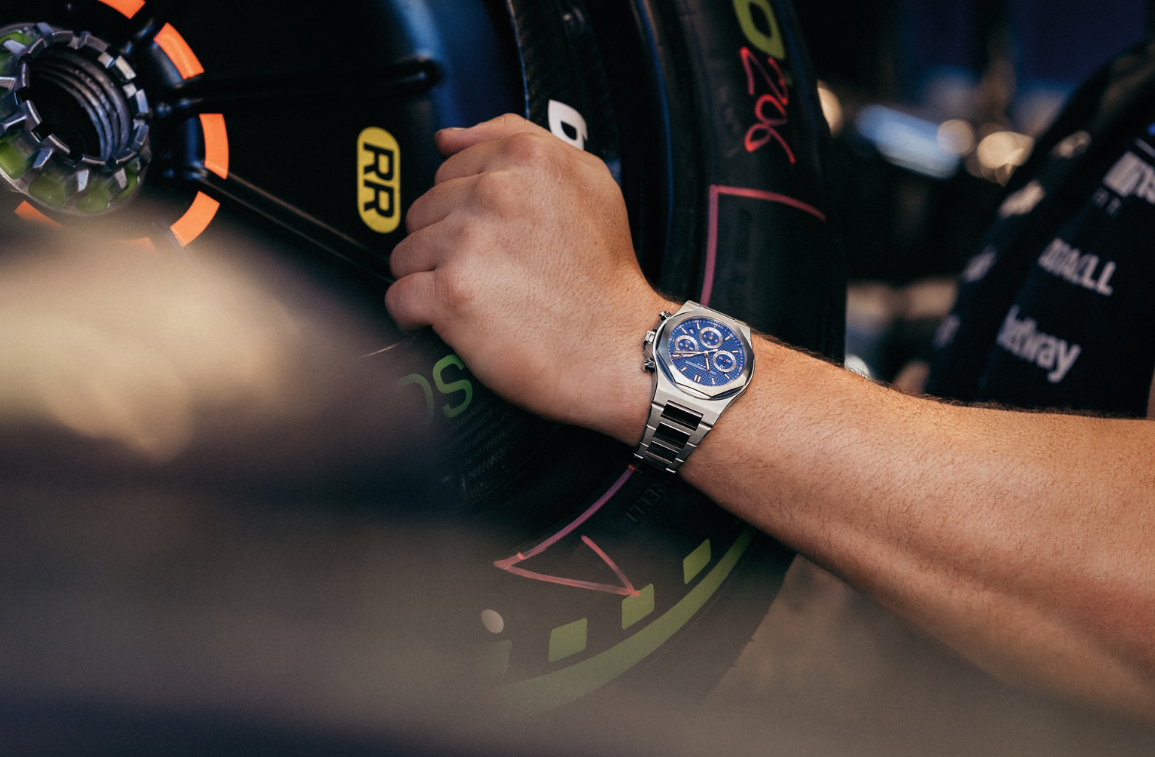
The Swiss watchmaker’s first collaboration with Atlassian Williams F1 Team produces two sporting Laureato models inspired by the team’s 2026 racing car.
Victorian auction buyers will soon receive a piece of information that has traditionally been withheld until bidding reaches it: the vendor’s reserve price. Under new property-sale and underquoting laws, agents must publish the agreed reserve at least seven days before an auction or fixed-date sale. Most changes begin on 1 October 2026 and apply to …
Continue reading “Victoria’s New Auction Rules Will Force Reserve Prices Into the Open”

The Swiss watchmaker’s first collaboration with Atlassian Williams F1 Team produces two sporting Laureato models inspired by the team’s 2026 racing car.
3 minGirard-Perregaux has revealed the first watches created through its partnership with Atlassian Williams F1 Team, bringing the British racing team’s colours to one of Switzerland’s most recognisable integrated-bracelet designs.
The collaboration comprises two 42mm steel watches: the time-and-date Laureato Williams Edition and the more technical Laureato Chronograph Williams Edition.
Both retain the familiar architecture of the Laureato, including its octagonal bezel, integrated bracelet and mix of polished and satin-finished surfaces. The influence of Williams is comparatively restrained, appearing through colour, discreet branding and details inspired by the team’s current Formula 1 car.
It is a welcome departure from the oversized logos and literal automotive references that can characterise motorsport watches.
The Williams FW48 inspires the dial
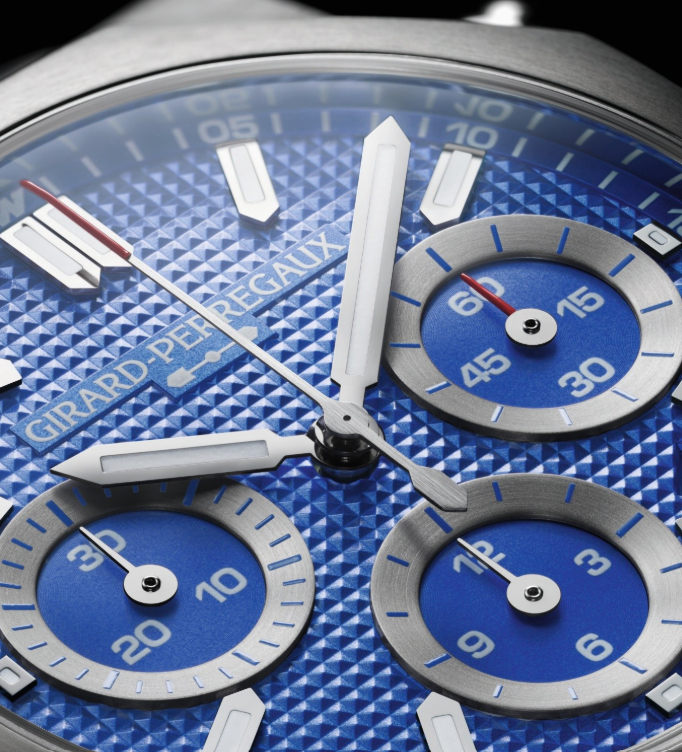
The centrepiece of both models is a blue Clous de Paris dial informed by the livery of the Williams FW48, the car being campaigned by the team during the 2026 Formula 1 season.
A small Williams “W” replaces the conventional marker at 12 o’clock, while the team emblem appears on the sapphire crystal caseback. Red accents echo the keyline used on the FW48 without overwhelming the established Laureato design.
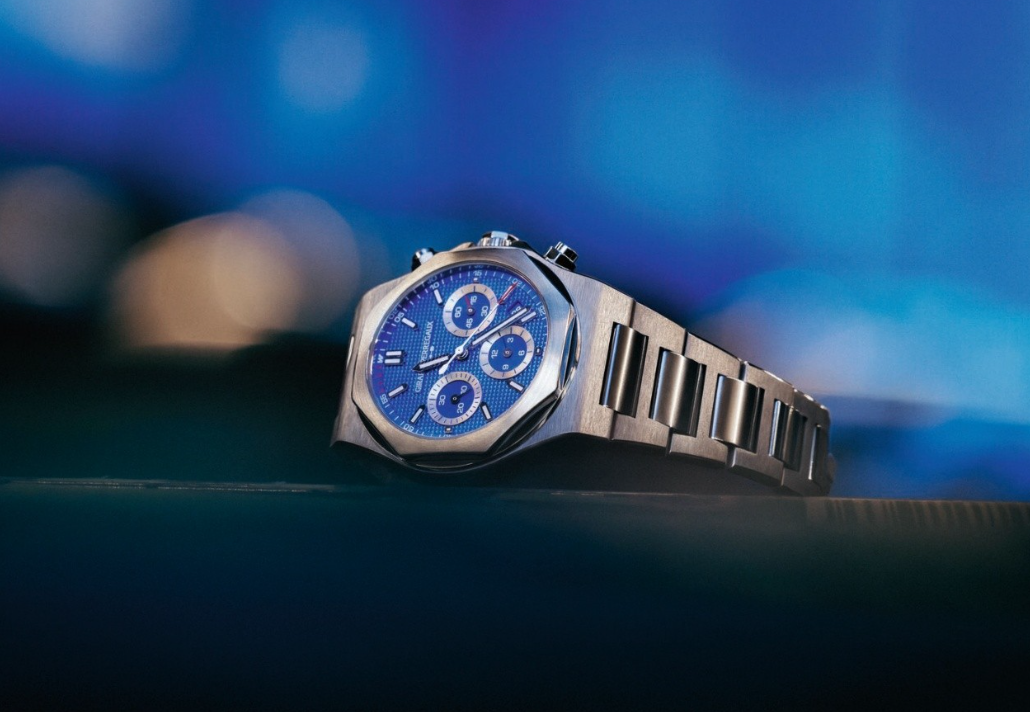
The three-hand model offers the quieter interpretation. Baton-shaped, rhodium-plated hands and hour markers are filled with white-emitting luminescent material, while a date window sits at three o’clock.
The chronograph creates a more obvious connection with motorsport. Three subdials are framed by rhodium-plated rings, with red appearing on the small-seconds hand and the tip of the central chronograph seconds hand.
Both watches measure 42mm across and are water resistant to 100 metres. The standard Laureato has a case thickness of 10.68mm, while the additional mechanics of the chronograph increase its profile to 12.16mm.
Two in-house automatic movements
The Laureato Williams Edition is powered by Girard-Perregaux’s self-winding GP01800 calibre. The movement provides hours, minutes, central seconds and the date, with a minimum power reserve of 54 hours.
The Laureato Chronograph Williams Edition uses the automatic GP03300 calibre, which combines its chronograph functions with a date display and offers a minimum power reserve of 46 hours.
Both movements operate at 28,800 vibrations per hour and can be viewed through their sapphire crystal casebacks.
Their decoration provides a more traditional counterpoint to the Formula 1 association. Finishing techniques include Côtes de Genève, circular graining, bevelling, mirror polishing, satin finishing, engraving and snailing.
The result is less about reproducing the appearance of a racing car than identifying the common ground between two mechanical disciplines: precision, incremental development and the considerable work hidden beneath the finished product.
Parallel histories
The timing of the partnership draws attention to the remarkably similar ages of its two protagonists.
Girard-Perregaux introduced the original Laureato in 1975, establishing an integrated-bracelet sports watch with a distinctive octagonal bezel. Williams entered Formula 1 two years later in 1977.
Both have evolved continuously across the five decades since. The Laureato has moved through different sizes, materials and complications, while retaining its central design language. Williams, meanwhile, has remained one of Formula 1’s most historically significant teams.
That gives the collaboration greater credibility than a simple licensing exercise. Girard-Perregaux and Williams are not being connected solely through the familiar language of speed. Their stronger link is a shared dependence on engineering, testing and the accumulation of specialist knowledge.
The watches are described as the beginning of a longer collaboration, suggesting further Williams editions may follow.
Girard-Perregaux’s international website lists the Laureato Williams Edition at US$16,200 and the Laureato Chronograph Williams Edition at US$20,900. Australian pricing has not been announced.
Specifications
Girard-Perregaux Laureato Williams Edition 42mm
Reference: 81010-11-3680-1GM
Case: Steel
Diameter: 42mm
Thickness: 10.68mm
Crystal: Anti-reflective sapphire crystal
Dial: Blue Clous de Paris pattern
Movement: Automatic GP01800
Functions: Hours, minutes, central seconds and date
Power reserve: Minimum 54 hours
Water resistance: 100 metres
Bracelet: Integrated steel bracelet with triple-folding clasp
International price: US$16,200
Girard-Perregaux Laureato Chronograph Williams Edition 42mm
Reference: 81020-11-3681-1GM
Case: 904L steel
Diameter: 42mm
Thickness: 12.16mm
Crystal: Anti-reflective sapphire crystal
Dial: Blue Clous de Paris pattern with three chronograph counters
Movement: Automatic GP03300
Functions: Chronograph, hours, minutes, small seconds and date
Power reserve: Minimum 46 hours
Water resistance: 100 metres
Bracelet: Integrated 904L steel bracelet with triple-folding clasp
International price: US$20,900

A record-breaking $11 million sale at The Centennial Collection has set a new benchmark for luxury apartment living in Bondi Junction.
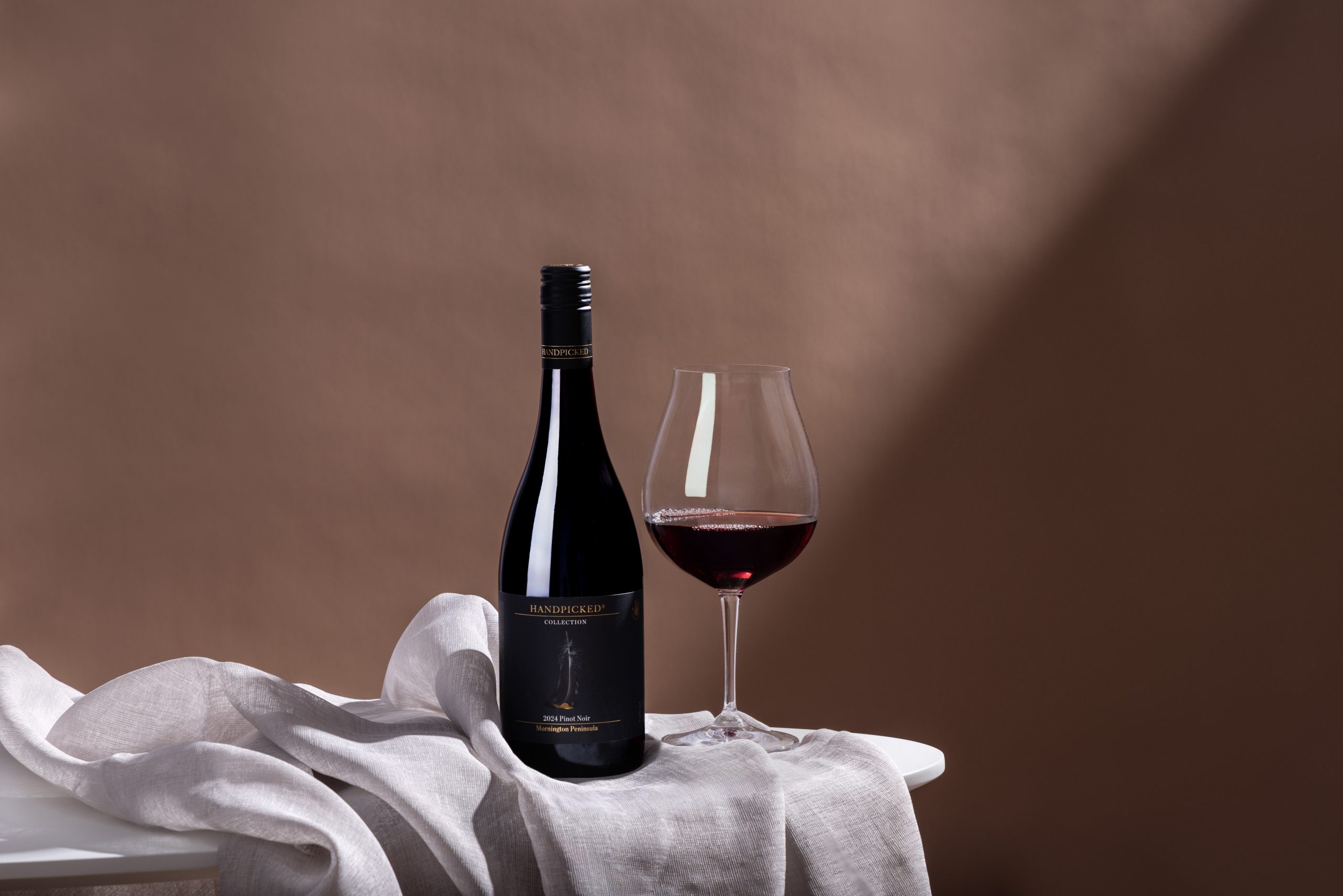
As the season turns, Handpicked Wines’ latest Pinot Noir and Chardonnay releases reveal how subtle shifts in place shape what ends up in the glass.