‘Pig Butchering’ Online Scams Are Proliferating. Here’s Why They Work So Well.
It starts with an unsolicited text message. And then it’s all about gaining the victim’s trust.

 5 min
5 min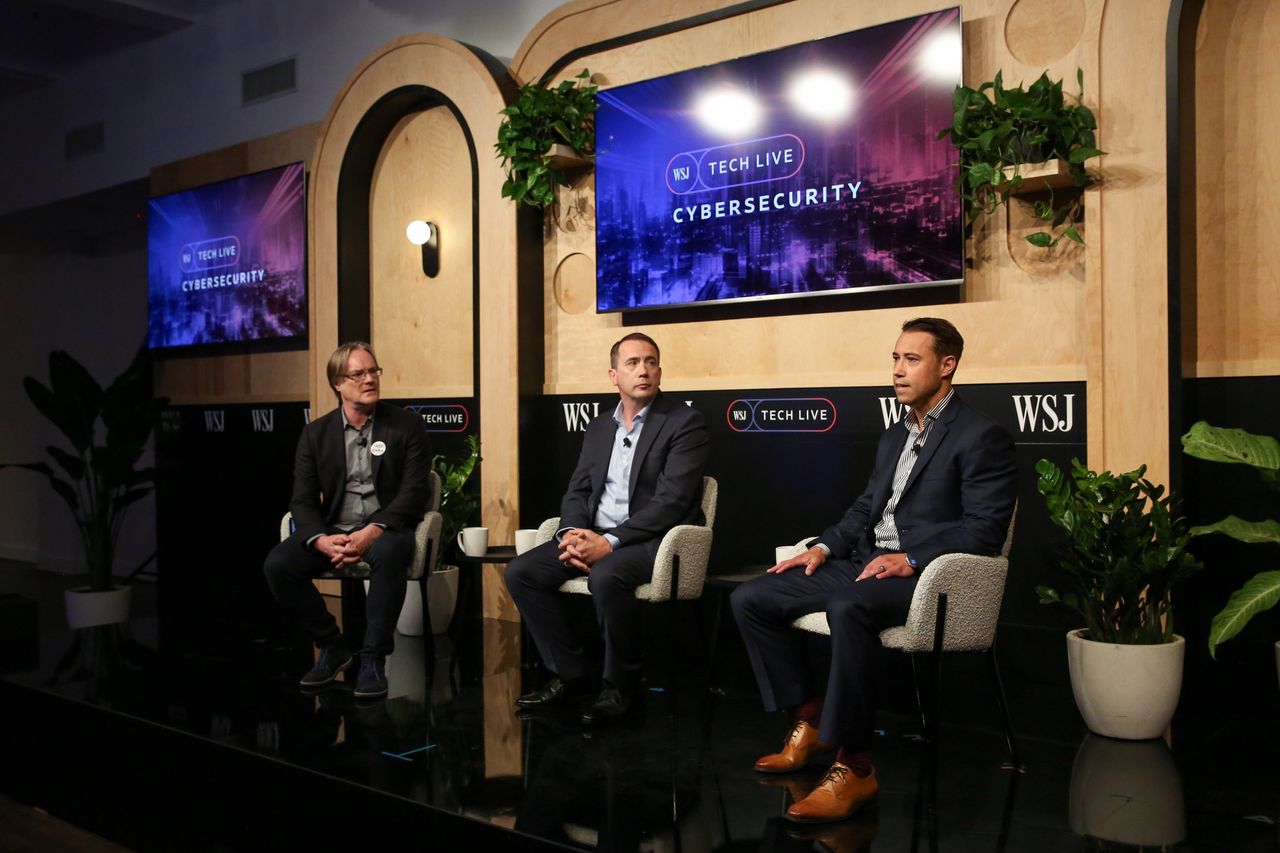
Do you get unsolicited text messages from people you don’t know? Be forewarned: If you respond, you could be falling for a particularly dangerous online scam that has found victims around the world. Some unfortunate individuals have lost millions of dollars.
There is even a name for it. Pig butchering. Victims are fattened up, made to trust the scammer and think they are making tons of money, until they are mercilessly taken—sometimes for everything they have.
On June 6, at the WSJ Tech Live: Cybersecurity conference in New York City, two cybercrime experts sat down with Wall Street Journal reporter Robert McMillan to discuss how pig butchering works and what is being done about it. The participants were Troy Gochenour, an investigator with the Global Anti-Scam Organization, a nonprofit that helps victims and raises public awareness of scams, and Jamil Hassani, a supervisory special agent with the Federal Bureau of Investigation. An edited transcript of their conversation follows.
How the scam works
WSJ: Why “pig butchering”?
GOCHENOUR: It’s not our term. In Chinese, it is shā zū pán , or pig-killing plate. What makes this scam so effective is they want to build trust so that you might think they could be a potential love interest or a business partner. Once they built that trust, then they will start talking about how they’ve made a lot of money in cryptocurrencies and how the victim could, too.
WSJ: It’s a variation on the romance scam. Instead of asking for money to buy a plane ticket, they propose to make money together?
HASSANI: Absolutely. The rise in cryptocurrency has opened the door for these scammers to take your money instantaneously. There are no third parties doing the reconciliation. If you do a regular wire transfer and you contact the FBI within 72 hours, chances are we can get that money back for you. But with crypto, it’s almost immediate and it’s gone.
WSJ: Are you seeing more pig butchering because of the rise of crypto?
HASSANI: Absolutely. The rise since 2019 for victimization is almost 2,000%.
WSJ: Why does it work?
GOCHENOUR: The social-engineering aspect is very powerful. I have stories that are very sad: folks who have been warned that they’re getting scammed, and yet, because they’ve been socially engineered so much, they actually continue to invest.
They’re looking for everybody, but they prefer people with titles—doctor, dentist, IT professional, CEO. I follow them on the communications platform Telegram, so I have a lot of their training documents, manuals on how they build those relationships. This is an entire industry tied to largely Chinese organized crime.
The victim’s psychology
WSJ: Jamie, psychologically speaking, why does this work?
HASSANI: I remember arresting a hacker out of Tunisia. A 19-year-old kid that was able to bypass levels of security within the Department of Defense, took down a few banks and was wreaking havoc across the world. He explained to me: “Hackers are stupid. They go after the systems, when human beings have way more vulnerabilities. They have the keys to the treasure chest. And it’s so easy to turn off their mental firewall.”
Try to think of a time you were in a relationship where the threat of your spouse or significant other leaving caused you to do pretty much anything to keep them around. Every scam evokes an emotion. It could be love, fear, panic. Your ability to critically think is shut off.
WSJ: Sometimes when I’ve talked to scam victims, it’s like the more they have invested, the harder it is for them to believe they have been taken.
HASSANI: It’s the stigma. The victims can’t fathom that they could have been so stupid, quote unquote. So they hold on to this hope that it had to have been real, the love had to have been there, or the trust, because they’re texting every day, 30 to 100 times. The scammers use information they glean from your communications and social media to validate you in a way that no one else can.
WSJ: If you suspect or know somebody is a victim, is there something you can say that will snap them out of it?
GOCHENOUR: Unfortunately, people are people. We’ve had victims we’ve warned more than once, and they continued to give.
The United Nations Office on Drugs and Crime says there could be as many as a couple hundred thousand of these scammers operating throughout Southeast Asia.
HASSANI: A lot of these scammers are trafficked human beings. When a human being is subjected to that kind of circumstance, their will to succeed is intense, because their life, or their family’s life, depends on it. They are constantly fine-tuning strategies, and trying to stay one step ahead of whoever is closest on their tail. These scammers contribute something like half of their country’s GDP, so the local government’s not going to do much.
WSJ: The FBI knows who’s running these scams, largely?
HASSANI: Yes, absolutely.
WSJ: Can you get them?
HASSANI: There are no treaties between those specific countries and the U.S. We’ve taken steps. We work with multiple organizations, including the Secret Service, Department of Homeland Security, and we’re applying pressure on these countries to start to take action.
The first approach
WSJ: There are different layers of operators; some do the texting, others do the talking and then there are the video calls.
GOCHENOUR: Sure. So if you get that wrong number, the text to your phone, you respond, saying wrong number. I’m not Paul. Jane. Whoever. They say, oh, so sorry. Uh, my assistant gave me your number. I hope I’m not bothering you.
Sometimes they even send you a picture. That sounds interesting. So you continue to talk. Oh, what’s your name? Where do you live? What do you do?
They’re looking for a weakness. Are you single? Oh, weakness might be romance. Oh, you’re in business. I could be your business partner. But they also want to know what kind of assets they can take from you.
On their Telegram pages, I’ve seen screenshots of their chats. They can chat in Chinese, and it shows up to you as your native language. And when you chat back it shows up to them in Chinese. At the top, it would say your first name, maybe your age, two homes, 401(k).
As you continue to chat, you’re actually being sent to multiple people chatting with you on this one account. You may not even recognize it. They are all in the compound. Everything they do is monitored. So if that person is there against their will, if they don’t chat with you to lure you in, they could get beaten.
What can be done?
WSJ: This scam involves legitimate organizations as well, right? Cryptocurrency companies, the messages come on legitimate apps. What can be done to mitigate this?
HASSANI: Until a collective strategy is put together, you need to be aware of the red flags. And the first one is unsolicited contact. We’ve all gotten that text message, “hi.” That message has a fundamentally different feeling to somebody who is elderly and widowed and lonely. When they see “hi,” that has a profound impact on them.
If you get an unsolicited contact, ask questions. If they want you to invest in cryptocurrency, do a little research on the site. Is this website legit? Some are legitimate and registered with, say, the Treasury Department’s Financial Crimes Enforcement Network or the Securities and Exchange Commission.
WSJ: Some of the scam sites actually register.
HASSANI: True. Most of them aren’t registered with the SEC, but a lot are.
GOCHENOUR: In 2021, 2022, they were using apps like MetaTrader 5 or 4, a foreign-exchange trading app. It’s legitimate. You could go on this app and think you’re doing something legitimate, but you’re sending money to their scam broker website.
WSJ: Why can’t you stop these guys?
HASSANI: They’ll have one major domain with multiple subdomains, so to speak. So as soon as we take that website down, another one pops up. Our strategy is to go after the kingpin.
WSJ: Have you hit any kingpins yet?
HASSANI: We have. The indictments, a lot of them are still under seal. But tech-support scams are a big part of this. We took down three tech-support buildings near Kolkata less than a year ago.
WSJ: All connected to pig butchering?
HASSANI: Yes, and they do the same thing—traffic human beings to scam.
WSJ: Scammers use services like WhatsApp, and the money gets sent to them often through a legit crypto company. Could the tech companies be doing more here?
GOCHENOUR: The tech companies and the exchanges are doing more. And I know that because when I follow the scammers on their chats, they talk about, “Why can’t I get this money? The victim put it in the account, but I can’t get it. What’s going on?”
 Copyright 2020, Dow Jones & Company, Inc. All Rights Reserved Worldwide. LEARN MORE





From making unpopular decisions to learning when to listen, leaders from five businesses reveal what nobody prepared them for — and how running a company has challenged their expectations.

Technology and semiconductor shares fell sharply as investors questioned the debt financing the AI infrastructure boom and confronted higher rates and Chinese competition.

Technology and semiconductor shares fell sharply as investors questioned the debt financing the AI infrastructure boom and confronted higher rates and Chinese competition.
4 minA sharp technology sell-off has exposed a new anxiety on global markets: whether the enormous borrowing behind the artificial-intelligence infrastructure boom can generate sufficient returns as interest rates rise and Chinese competition intensifies.
The artificial-intelligence investment boom has powered technology shares, semiconductor manufacturers and data-centre operators to extraordinary heights. Last week, investors were given a reminder that much of this expansion is being built with borrowed money.
The technology-heavy Nasdaq Composite fell 4.5 per cent over the week ended October 16, its weakest performance since late June. Semiconductor shares suffered an even deeper correction, with the Philadelphia Semiconductor Index losing about 11.4 per cent.
The selling spread quickly through global markets. Micron Technology fell 14.6 per cent over the week, while South Korea’s Samsung Electronics and SK Hynix dropped approximately 18 per cent and 24 per cent respectively.
This was more than a routine bout of profit-taking. Investors were reassessing three interconnected risks: higher interest rates, the rapidly expanding debt burden attached to AI infrastructure and the prospect of stronger competition from Chinese memory-chip manufacturers.
The debt behind the AI build-out
Artificial intelligence requires a physical infrastructure network of enormous scale. Data centres must be built, advanced processors purchased, power supplies secured and cooling systems installed before customers begin generating meaningful revenue from them.
Technology companies are increasingly supplementing their own cash with corporate bonds, syndicated loans, equipment leases, private credit and project-level financing.
JPMorgan describes the emerging funding model as a combination of conventional corporate borrowing and project finance tied to individual data-centre assets. In Australia, the Reserve Bank estimates that syndicated loans accounted for approximately three-quarters of data-centre financing during 2025 and 2026 to date.
The numbers are becoming large enough to affect broader credit markets. The Federal Reserve Bank of Dallas has cited Wall Street estimates suggesting AI-related investment-grade bond issuance could approach US$300 billion in 2026 alone.
That borrowing is not automatically problematic. Debt can be an efficient way to finance long-lived infrastructure when future revenue is sufficiently predictable. The concern is that AI technology, customer demand and computing economics are changing much faster than the repayment schedules attached to the assets.
A data centre financed today may carry debt for years. Investors must therefore make assumptions about future utilisation rates, electricity prices, chip performance, customer concentration and the amount businesses will ultimately pay for AI computing.
When interest rates rise, those assumptions become less forgiving.
Inflation changes the calculation
September’s US inflation data intensified the pressure. Consumer prices increased 3.7 per cent over the year, ahead of market expectations and up from 3.4 per cent in August.
The hotter reading reduced confidence that interest rates would fall quickly and pushed bond yields higher. That matters particularly for companies whose valuations depend on profits expected well into the future, as well as highly leveraged infrastructure operators that may need to refinance.
CoreWeave has emerged as a closely watched test case. The specialist cloud-computing company has accumulated substantial debt and lease obligations to build AI capacity, while relying on a concentrated group of large technology customers.
Its shares fell sharply during the sell-off, while the cost of insuring its debt against default climbed. CoreWeave has argued that its contracted backlog more than covers its obligations and that financial markets do not always understand its business model. Nevertheless, its securities have become a proxy for investor confidence in debt-funded AI infrastructure.
Oracle, another major investor in AI computing capacity, fell 8.8 per cent in Friday trading, while CoreWeave dropped 15.5 per cent.
The question is shifting from how much AI infrastructure can be built to how profitably it can be operated.
China adds another source of pressure
Interest rates were not the only catalyst. Reports of advances by Chinese memory-chip producer ChangXin Memory Technologies raised concerns that lower-cost Chinese products could increase competition across the global semiconductor industry.
Memory chips are essential to AI systems, but the industry is historically cyclical. Periods of tight supply and high pricing can encourage rapid investment, eventually producing oversupply and falling margins.
The prospect of a well-funded Chinese competitor expanding its technological capabilities unsettled investors in Samsung, SK Hynix and Micron. It also demonstrated that AI-related demand does not insulate chipmakers from conventional competitive pressures.
That combination—slower rate cuts, more expensive financing and potentially cheaper supply—challenged the assumption that every company exposed to AI would enjoy continually expanding margins.
A reset rather than the end of the boom
The sell-off does not establish that the AI boom is ending. Demand for computing power remains strong, the largest technology companies continue to generate formidable cash flows and many infrastructure projects are backed by long-term customer contracts.
What has changed is the market’s willingness to overlook the price and financing structure of that growth.
The most resilient companies are likely to be those able to fund investment from operating cash flow, secure long-duration customers and demonstrate that new capacity will earn returns comfortably above its financing costs.
More speculative operators may face greater scrutiny, particularly where debt is expensive, customers are concentrated or expected revenue depends on demand that has not yet materialised.
For Australian investors, the lesson extends beyond US technology shares. Local data-centre operators, infrastructure funds, electricity suppliers and property groups are increasingly exposed to the same investment cycle.
Artificial intelligence may remain one of the defining growth themes of the decade. But last week’s correction showed that enthusiasm for the technology does not eliminate financial discipline.
The next stage of the AI boom will be judged not only by computing power, model performance or demand for chips, but by something more traditional: whether the assets being financed can generate enough cash to repay the money borrowed to build them.
Fact box
Nasdaq Composite: Down 4.5 per cent for the week ended October 16, 2026
Philadelphia Semiconductor Index: Down approximately 11.4 per cent
Micron Technology: Down approximately 14.6 per cent
Samsung Electronics: Down approximately 18 per cent
SK Hynix: Down approximately 24 per cent
US September inflation: 3.7 per cent annually
Estimated 2026 AI-related investment-grade issuance: Approximately US$300 billion

As housing drives wealth and policy debate, the real risk is an economy hooked on growth without productivity to sustain it.

A record-breaking $11 million sale at The Centennial Collection has set a new benchmark for luxury apartment living in Bondi Junction.