Road Trip Like James Bond in Aston Martin’s DB12

 4 min
4 min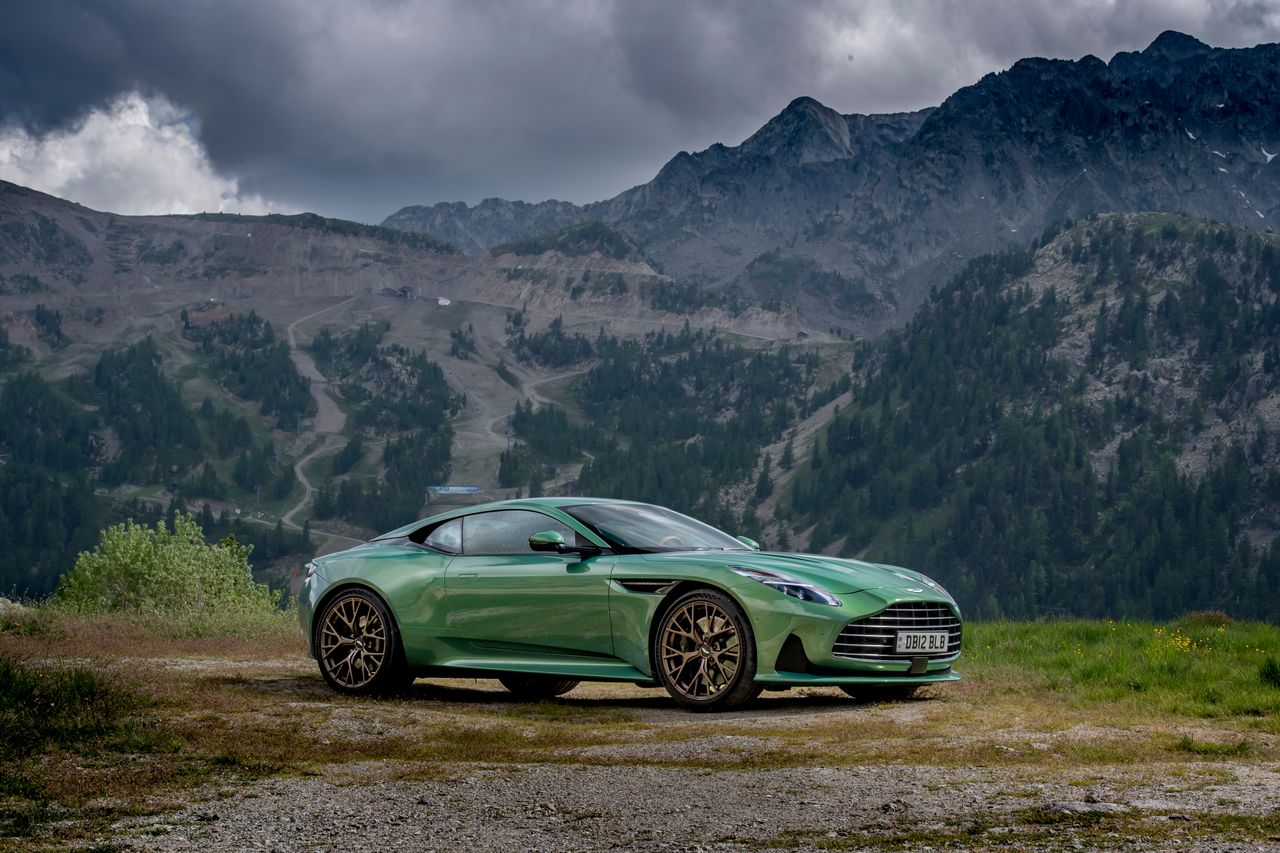
Aston Martin has been celebrating its 110th anniversary throughout this year. With more than a century under its very expensive belt, you’d think the automaker would’ve already served all of the luxury model types. Still, the experts out of Gaydon, England, managed to coin a first for the company this summer.
The DB12, which has a base price of US248,000, will arrive on the scene christened as not only Aston Martin’s but the world’s first “super tourer,” what the company defines as an elite, immaculately styled powerhouse built for long leisurely drives. While the DB line is recognised for its sophisticated, mature lines, the Super Tourer label stamped on the DB12 puts the focus on the interior cockpit surrounding its front seats with all of the essential luxury appointments.
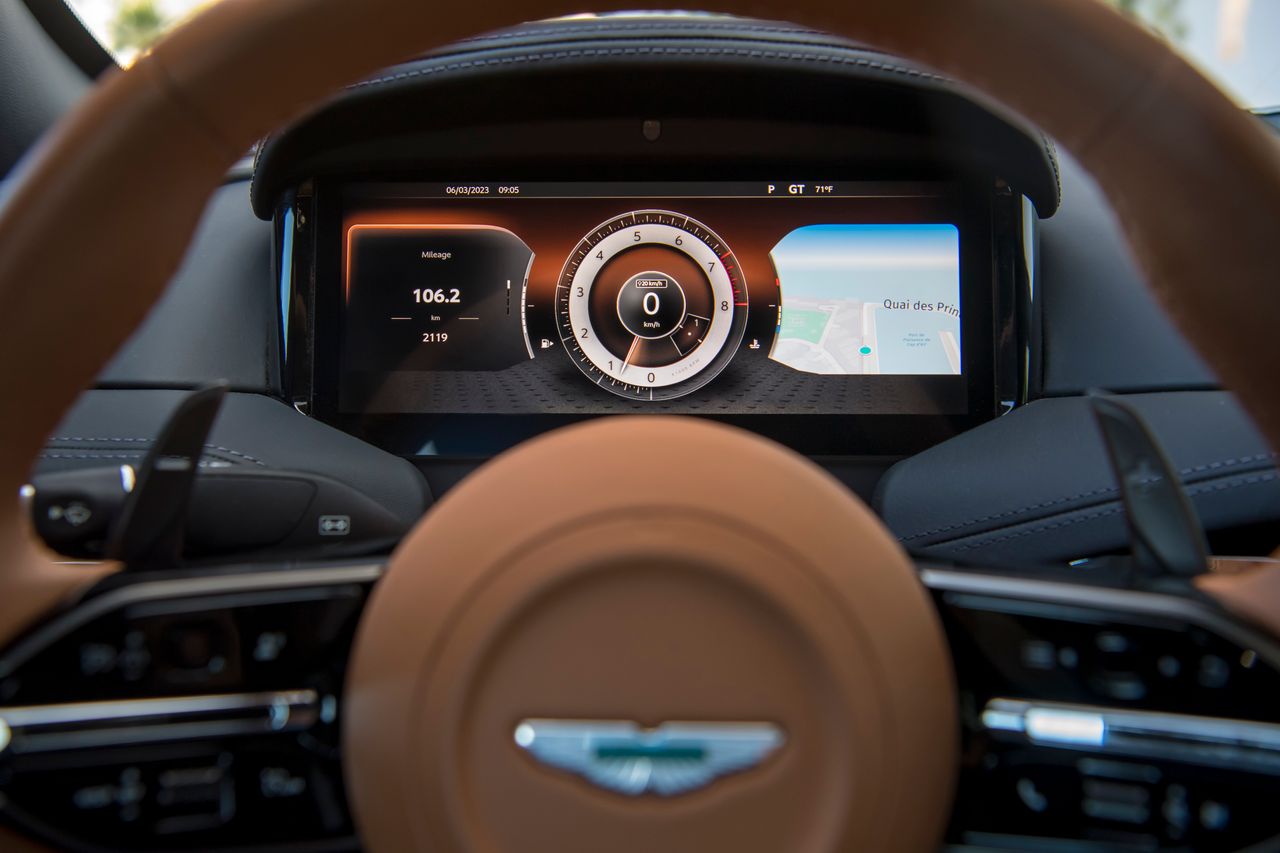
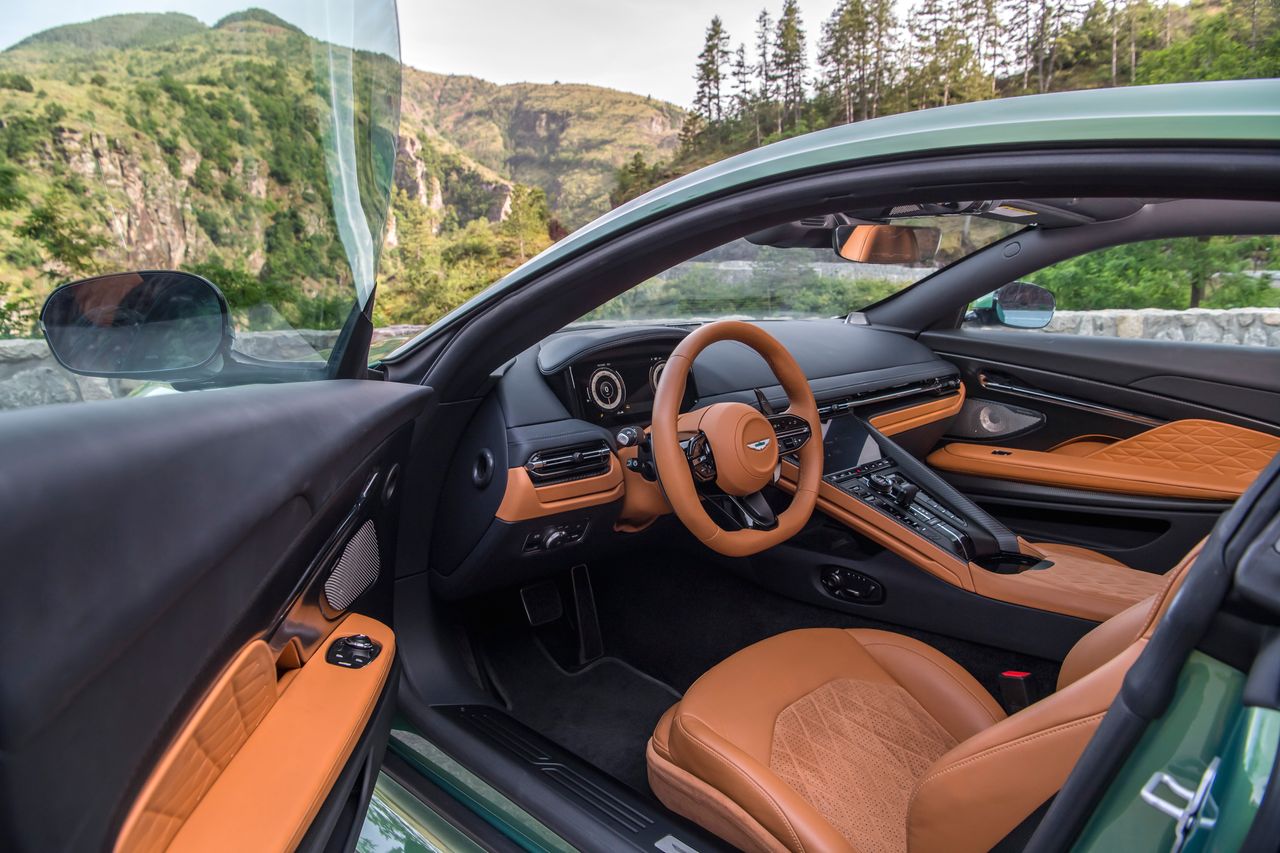
While there is a back seat in a modern DB model, it’s there more or less for appearances and to make insurers happier. You might be able to fit a ventriloquist’s doll back there, but that’s about it. Practically speaking, this is an ultra-luxury two-seater. Inside the cabin wrapping around the snug, contoured leather seats, the owner finds the interior focused on the driving experience.
The infotainment screen is lowered and out of the driver’s direct eye line. The HUD is clean and centred for the operator’s frequent checks. The adjustable steering wheel offers oversize paddle shifters for confident flicks, and the gauge cluster is tightly arranged as it would be for a track car. Meanwhile, a new Bowers & Wilkins 15-speaker stereo system combined with impressive soundproofing keeps your music inside and the clumsy noises of a rude outside world at bay.
The car’s DB9 or DB11 predecessors were just as pretty and equally capable, but neither earned that super tourer title. According to Simon Newton, Aston Martin’s director of vehicle performance, buyers drove that evolution toward this new identity.
“The market and brand expectation are for elevated performance in addition to refinement,” Newton says. “There’s keen interest in more extreme duality of purpose, such as increasing the breadth of capability whilst preserving the grand-touring character.”
The DB12 must offer supercar performance with its indulgent comfort. Newton insists his team met those expectations by focusing on refinement when the car is on the move to overcome the pavements imperfections—while keeping the feel of driving intact.
“The car needed to exude more dynamic capabilities,” he explains. “Our philosophy was to have a structurally stiffer chassis, which would help with comfort and dynamics, then tune the suspension for additional comfort with systems capable of controlling the body in sportier driving. Every control should be predictable and easy to use. Linearity of response, including steering, braking, and throttle, was key to making a refined car easy to drive fast.”
The DB12 can’t help but drive fast with an all-new, 671-horsepower V8 engine. The car builder informs the world it’ll do 0-60 mph in a tick north of 3 seconds and top out around 202 mph. While the car keeps its voice down while idling or cruising, it lets loose a roar when the driver puts a toe down to pass mere mortals along the roadways.
Those performance numbers should put gearheads at ease if they worried about Aston Martin thrills fading away with the company phasing out its largest engines in favour of more efficient V8 units. The V12 is headed into the sunset, but Aston Martin’s in-house tuned eight cylinders achieve power and acceleration in line with previous, heavier engines.
“The high-performance V8 engines are engineered to give the best balance of response, power, torque, and efficiency for any given Aston Martin platform,” Newton explains. “A V8 engine is more efficient and allows for flexibility to match powertrain characteristics to the product.”
The DB12’s engineers employ up-to-date turbocharger technology to achieve V12 power with less weight and more immediate response.
“With our expertise surrounding V8 engines, we are able to engineer the very best combinations of turbochargers, inlets, compression ratios, and camshafts, along with in-house engine calibration, for each and every application,” Newton adds.
With the power more than ample and readily on demand, Newton’s department needed to restrain it when the vehicle was in comfort travel mode over hill and dale.
“Some technologies were a prerequisite for performance, such as the tires and an advanced ESP [Environmental Response System],” he says. “We also invested in technologies which helped define the dual character of the DB12. For example, the dampers and suspension have a greater range of performance, allowing for comfort but also immediate control of reactive, powerful damping when needed for dynamic driving.”
A well-chosen test run through the hills above Monaco put the DB12’s dynamic capabilities to the test around hairpins and past lesser cars stubbornly unwilling to clear the way. Even the occasional glut of well-heeled traffic served a purpose—confirming the cabin seating ergonomics would cozily stand up to long-haul transport.
Any weaknesses remain mere quibbles. The centre console infotainment screen is small for cars at this technological level. However, the engineers at Aston Martin want very little to distract from the driving experience. The satellite navigation is touchy, but the DB12 has the ability to update its onboard software automatically, and Aston Martin should have those wrinkles well ironed out by the time the car heads out to its first buyers.
Finally, Penta’s test vehicle lacked a massage seat option. Admittedly, that would add weight to the machine, but it’s a feature that’s fair to expect in a grand touring, US$200,000-plus ride.
None of those minor complaints detract from the car’s beauty. The designers here kept many of DB11’s lines and flair intact, while lowering the car’s profile and smoothing out the bonnet and haunches. The final effect is unmistakable and eye-capturing.
Like its supercar and hyper-luxury competitors, Aston Martin will lean into hybrids and complete electrification in the near future. Though the automaker recently put its legendary V12 engines to rest, it must please driving enthusiasts everywhere to know that the V8 lives on in the DB12.
 Copyright 2020, Dow Jones & Company, Inc. All Rights Reserved Worldwide. LEARN MORE





From making unpopular decisions to learning when to listen, leaders from five businesses reveal what nobody prepared them for — and how running a company has challenged their expectations.

Technology and semiconductor shares fell sharply as investors questioned the debt financing the AI infrastructure boom and confronted higher rates and Chinese competition.

Technology and semiconductor shares fell sharply as investors questioned the debt financing the AI infrastructure boom and confronted higher rates and Chinese competition.
4 minA sharp technology sell-off has exposed a new anxiety on global markets: whether the enormous borrowing behind the artificial-intelligence infrastructure boom can generate sufficient returns as interest rates rise and Chinese competition intensifies.
The artificial-intelligence investment boom has powered technology shares, semiconductor manufacturers and data-centre operators to extraordinary heights. Last week, investors were given a reminder that much of this expansion is being built with borrowed money.
The technology-heavy Nasdaq Composite fell 4.5 per cent over the week ended October 16, its weakest performance since late June. Semiconductor shares suffered an even deeper correction, with the Philadelphia Semiconductor Index losing about 11.4 per cent.
The selling spread quickly through global markets. Micron Technology fell 14.6 per cent over the week, while South Korea’s Samsung Electronics and SK Hynix dropped approximately 18 per cent and 24 per cent respectively.
This was more than a routine bout of profit-taking. Investors were reassessing three interconnected risks: higher interest rates, the rapidly expanding debt burden attached to AI infrastructure and the prospect of stronger competition from Chinese memory-chip manufacturers.
The debt behind the AI build-out
Artificial intelligence requires a physical infrastructure network of enormous scale. Data centres must be built, advanced processors purchased, power supplies secured and cooling systems installed before customers begin generating meaningful revenue from them.
Technology companies are increasingly supplementing their own cash with corporate bonds, syndicated loans, equipment leases, private credit and project-level financing.
JPMorgan describes the emerging funding model as a combination of conventional corporate borrowing and project finance tied to individual data-centre assets. In Australia, the Reserve Bank estimates that syndicated loans accounted for approximately three-quarters of data-centre financing during 2025 and 2026 to date.
The numbers are becoming large enough to affect broader credit markets. The Federal Reserve Bank of Dallas has cited Wall Street estimates suggesting AI-related investment-grade bond issuance could approach US$300 billion in 2026 alone.
That borrowing is not automatically problematic. Debt can be an efficient way to finance long-lived infrastructure when future revenue is sufficiently predictable. The concern is that AI technology, customer demand and computing economics are changing much faster than the repayment schedules attached to the assets.
A data centre financed today may carry debt for years. Investors must therefore make assumptions about future utilisation rates, electricity prices, chip performance, customer concentration and the amount businesses will ultimately pay for AI computing.
When interest rates rise, those assumptions become less forgiving.
Inflation changes the calculation
September’s US inflation data intensified the pressure. Consumer prices increased 3.7 per cent over the year, ahead of market expectations and up from 3.4 per cent in August.
The hotter reading reduced confidence that interest rates would fall quickly and pushed bond yields higher. That matters particularly for companies whose valuations depend on profits expected well into the future, as well as highly leveraged infrastructure operators that may need to refinance.
CoreWeave has emerged as a closely watched test case. The specialist cloud-computing company has accumulated substantial debt and lease obligations to build AI capacity, while relying on a concentrated group of large technology customers.
Its shares fell sharply during the sell-off, while the cost of insuring its debt against default climbed. CoreWeave has argued that its contracted backlog more than covers its obligations and that financial markets do not always understand its business model. Nevertheless, its securities have become a proxy for investor confidence in debt-funded AI infrastructure.
Oracle, another major investor in AI computing capacity, fell 8.8 per cent in Friday trading, while CoreWeave dropped 15.5 per cent.
The question is shifting from how much AI infrastructure can be built to how profitably it can be operated.
China adds another source of pressure
Interest rates were not the only catalyst. Reports of advances by Chinese memory-chip producer ChangXin Memory Technologies raised concerns that lower-cost Chinese products could increase competition across the global semiconductor industry.
Memory chips are essential to AI systems, but the industry is historically cyclical. Periods of tight supply and high pricing can encourage rapid investment, eventually producing oversupply and falling margins.
The prospect of a well-funded Chinese competitor expanding its technological capabilities unsettled investors in Samsung, SK Hynix and Micron. It also demonstrated that AI-related demand does not insulate chipmakers from conventional competitive pressures.
That combination—slower rate cuts, more expensive financing and potentially cheaper supply—challenged the assumption that every company exposed to AI would enjoy continually expanding margins.
A reset rather than the end of the boom
The sell-off does not establish that the AI boom is ending. Demand for computing power remains strong, the largest technology companies continue to generate formidable cash flows and many infrastructure projects are backed by long-term customer contracts.
What has changed is the market’s willingness to overlook the price and financing structure of that growth.
The most resilient companies are likely to be those able to fund investment from operating cash flow, secure long-duration customers and demonstrate that new capacity will earn returns comfortably above its financing costs.
More speculative operators may face greater scrutiny, particularly where debt is expensive, customers are concentrated or expected revenue depends on demand that has not yet materialised.
For Australian investors, the lesson extends beyond US technology shares. Local data-centre operators, infrastructure funds, electricity suppliers and property groups are increasingly exposed to the same investment cycle.
Artificial intelligence may remain one of the defining growth themes of the decade. But last week’s correction showed that enthusiasm for the technology does not eliminate financial discipline.
The next stage of the AI boom will be judged not only by computing power, model performance or demand for chips, but by something more traditional: whether the assets being financed can generate enough cash to repay the money borrowed to build them.
Fact box
Nasdaq Composite: Down 4.5 per cent for the week ended October 16, 2026
Philadelphia Semiconductor Index: Down approximately 11.4 per cent
Micron Technology: Down approximately 14.6 per cent
Samsung Electronics: Down approximately 18 per cent
SK Hynix: Down approximately 24 per cent
US September inflation: 3.7 per cent annually
Estimated 2026 AI-related investment-grade issuance: Approximately US$300 billion

A Vaucluse masterpiece by MHNDU with interiors by Poco Designs brings architectural ambition and breathtaking ocean outlook to the auction block.

A restored 1860s Brisbane residence transformed by GRAYA has smashed Paddington’s house price record, selling for more than $12 million.