Why we’re working anywhere but the office
In a post pandemic environment, Australian workers are voting with their feet and skipping the office in favour of other, more appealing environments
 4 min
4 min
From the latest issue of Kanebridge Quarterly magazine. Order your copy here.
For many, working from home is the new normal. The transition from being based in the office to working off-site has been a fundamental one, and almost four in 10 Australians worked from home at least once a week throughout 2023.
While figures show a slight decrease on 2021, working from home (WFH, it even has its own acronym) has continued to escalate in white-collar occupations, with 60 percent of managers and professionals eschewing the traditional office set-up. And those who aren’t already doing it wish they were. According to the annual Taking the Pulse of the Nation report, almost all workers (94pc) would like to do at least part of their work hours at home.
“I would say that the days of only full-time in the office for all employees are likely gone for good,” says the author of the report, the Melbourne Institute’s Professor Ragan Petrie.
“The trends in Australia mimic those in other countries where hybrid schedules are quite common.”
But is it all good news? Among the many compelling reasons to ditch the commute — saving time, improved mental health, higher productivity and being able to put the washing on — there are the well-documented shortcomings regarding the isolation, and missing out on the opportunities that those casual catch ups in the stairwell can offer.

“Constant drop-bys for chit-chat are not productive, but purposeful conversations are,” counters Petrie. “There might not be shortcomings of working from home per se, but rather not having the right infrastructure and support in place for workers to be productive. It’s important for employers and workers to figure this out.”
For those who are new to the workforce, flexible working arrangements are just the way things are. According to one survey, two out of every three Generation Z workers believe that the option to work from home is a non-negotiable.
Underpinning the normality of remote work are the advancements in automation and technology that make the transition smoother than ever — and perhaps support the use of email and text over the meetings and phone calls that younger generations shy away from.
“People of different ages have differential experience with technology, and there are some ways of communication people may feel more comfortable with than others,” says Petrie. “Certainly, technology plays a large role. Those whose jobs allow them to tap into technology to perform their tasks are well poised to be successful with a hybrid schedule.
“In the end, if worker output is satisfactory, why is it important where it is done?”
At the start of the pandemic as office-goers scrambled for a space to call work, the kitchen table was the go-to location. Now working remotely has become a more permanent arrangement, a purpose-designed study area or hybrid space is as desirable in real estate brochures as a media room or butler’s pantry.
Roger Wardy is a director at Ray White Touma Group in inner city Sydney, where more than 100,000 office employees have left the CBD for the greener pastures of remote work arrangements.
“Most house hunters want to see a home office or office space these days, and in larger homes it’s an expectation,” he says.
“As such, we’d be more likely to market a six-bed home as a five-bed plus office. If a buyer works from home, that will definitely add value.”
But the home office is just the beginning. Having paved the way for more flexible work arrangements, there’s now a growing trend towards co-working environments for companionship, productivity and a delineation of work and home.
High-tech co-working spaces offer several advantages over working from home, making them the preferred choice for many. A professional environment means distractions are minimised, and you’ll have access to state-of-the-art amenities that you probably won’t have at home. And then there are those networking opportunities — co-working spaces attract a diverse group of professionals and who knows what you might find out at the communal coffee bar? It’s something that’s making its way up the agenda for apartment developers, too, with those on the front foot offering co-working spaces along with the pool, gym and rooftop entertaining.
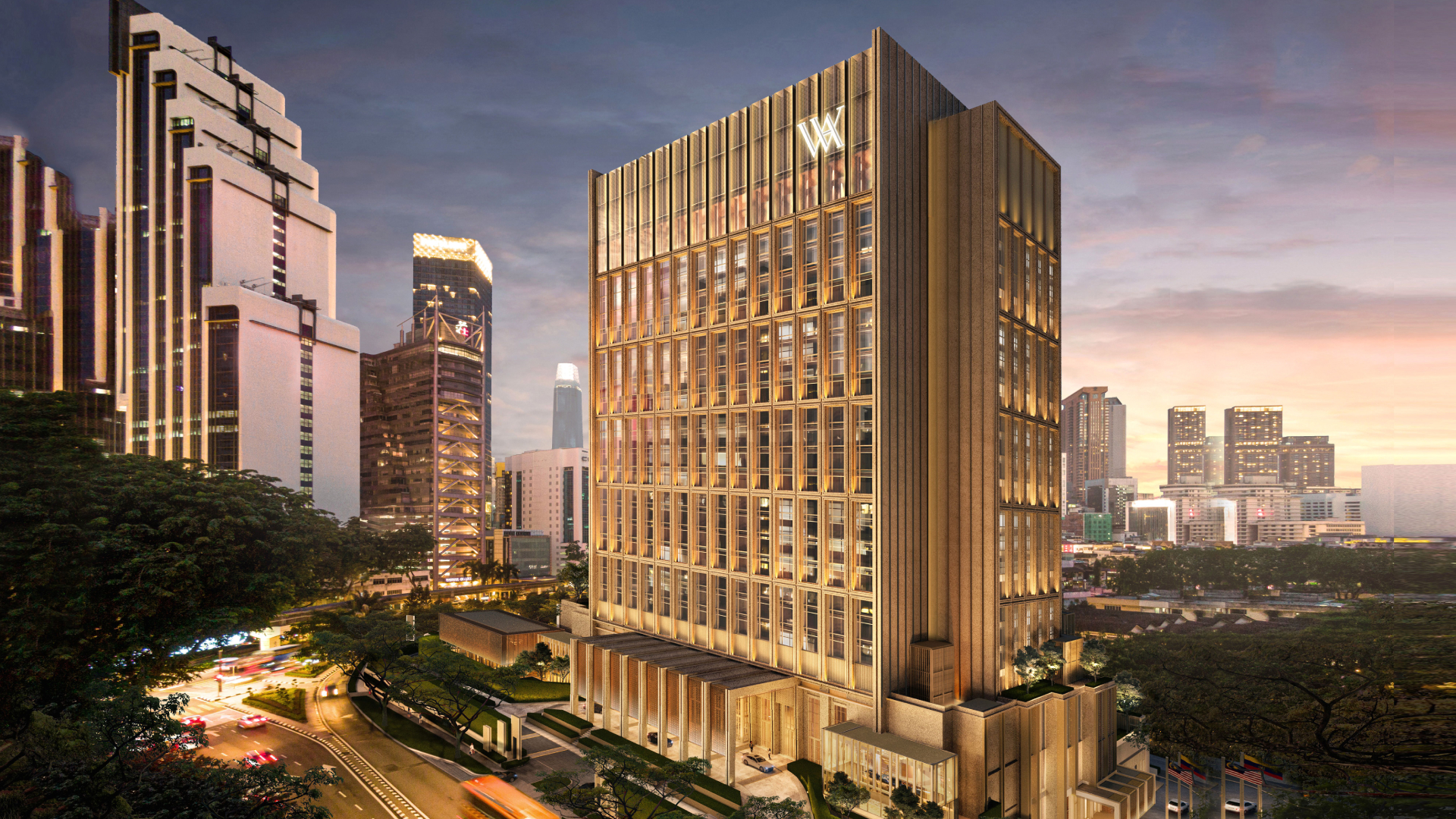
At the luxury new development Paradiso Place in Surfers Paradise (pictured above), the entire 2900sqm 26th floor is dedicated to a state-of-the-art co-working space, maximising 360-degree views of the Gold Coast from the ocean to the hinterland.
“To have the option of working in a space like this with all the facilities of a high-tech office within your own apartment building is an exciting prospect for buyers,” says Total Property Group Managing Director Adrian Parsons. “We have been receiving a great deal of interest in this development from business owners, entrepreneurs and professionals who can see themselves waking up in their luxury apartment with ocean views to go for a walk or run along the beach, use the onsite gym, then conveniently head to work in a state-of-the-art co-working space within their own building.”
The space incorporates a boardroom, private meeting rooms, work pods and multiple hot desks. And it’s not all about focused work; there’s also a spacious balcony event space and a Coffee Emporium complete with baristas.
“With working from home becoming the new normal, we are seeing many Australians choosing to move to quality lifestyle locations like the Gold Coast, and a full-floor co-working space of this standard is attracting a high level of inquiry,” says Parsons.

From making unpopular decisions to learning when to listen, leaders from five businesses reveal what nobody prepared them for — and how running a company has challenged their expectations.

Technology and semiconductor shares fell sharply as investors questioned the debt financing the AI infrastructure boom and confronted higher rates and Chinese competition.

Technology and semiconductor shares fell sharply as investors questioned the debt financing the AI infrastructure boom and confronted higher rates and Chinese competition.
4 minA sharp technology sell-off has exposed a new anxiety on global markets: whether the enormous borrowing behind the artificial-intelligence infrastructure boom can generate sufficient returns as interest rates rise and Chinese competition intensifies.
The artificial-intelligence investment boom has powered technology shares, semiconductor manufacturers and data-centre operators to extraordinary heights. Last week, investors were given a reminder that much of this expansion is being built with borrowed money.
The technology-heavy Nasdaq Composite fell 4.5 per cent over the week ended October 16, its weakest performance since late June. Semiconductor shares suffered an even deeper correction, with the Philadelphia Semiconductor Index losing about 11.4 per cent.
The selling spread quickly through global markets. Micron Technology fell 14.6 per cent over the week, while South Korea’s Samsung Electronics and SK Hynix dropped approximately 18 per cent and 24 per cent respectively.
This was more than a routine bout of profit-taking. Investors were reassessing three interconnected risks: higher interest rates, the rapidly expanding debt burden attached to AI infrastructure and the prospect of stronger competition from Chinese memory-chip manufacturers.
The debt behind the AI build-out
Artificial intelligence requires a physical infrastructure network of enormous scale. Data centres must be built, advanced processors purchased, power supplies secured and cooling systems installed before customers begin generating meaningful revenue from them.
Technology companies are increasingly supplementing their own cash with corporate bonds, syndicated loans, equipment leases, private credit and project-level financing.
JPMorgan describes the emerging funding model as a combination of conventional corporate borrowing and project finance tied to individual data-centre assets. In Australia, the Reserve Bank estimates that syndicated loans accounted for approximately three-quarters of data-centre financing during 2025 and 2026 to date.
The numbers are becoming large enough to affect broader credit markets. The Federal Reserve Bank of Dallas has cited Wall Street estimates suggesting AI-related investment-grade bond issuance could approach US$300 billion in 2026 alone.
That borrowing is not automatically problematic. Debt can be an efficient way to finance long-lived infrastructure when future revenue is sufficiently predictable. The concern is that AI technology, customer demand and computing economics are changing much faster than the repayment schedules attached to the assets.
A data centre financed today may carry debt for years. Investors must therefore make assumptions about future utilisation rates, electricity prices, chip performance, customer concentration and the amount businesses will ultimately pay for AI computing.
When interest rates rise, those assumptions become less forgiving.
Inflation changes the calculation
September’s US inflation data intensified the pressure. Consumer prices increased 3.7 per cent over the year, ahead of market expectations and up from 3.4 per cent in August.
The hotter reading reduced confidence that interest rates would fall quickly and pushed bond yields higher. That matters particularly for companies whose valuations depend on profits expected well into the future, as well as highly leveraged infrastructure operators that may need to refinance.
CoreWeave has emerged as a closely watched test case. The specialist cloud-computing company has accumulated substantial debt and lease obligations to build AI capacity, while relying on a concentrated group of large technology customers.
Its shares fell sharply during the sell-off, while the cost of insuring its debt against default climbed. CoreWeave has argued that its contracted backlog more than covers its obligations and that financial markets do not always understand its business model. Nevertheless, its securities have become a proxy for investor confidence in debt-funded AI infrastructure.
Oracle, another major investor in AI computing capacity, fell 8.8 per cent in Friday trading, while CoreWeave dropped 15.5 per cent.
The question is shifting from how much AI infrastructure can be built to how profitably it can be operated.
China adds another source of pressure
Interest rates were not the only catalyst. Reports of advances by Chinese memory-chip producer ChangXin Memory Technologies raised concerns that lower-cost Chinese products could increase competition across the global semiconductor industry.
Memory chips are essential to AI systems, but the industry is historically cyclical. Periods of tight supply and high pricing can encourage rapid investment, eventually producing oversupply and falling margins.
The prospect of a well-funded Chinese competitor expanding its technological capabilities unsettled investors in Samsung, SK Hynix and Micron. It also demonstrated that AI-related demand does not insulate chipmakers from conventional competitive pressures.
That combination—slower rate cuts, more expensive financing and potentially cheaper supply—challenged the assumption that every company exposed to AI would enjoy continually expanding margins.
A reset rather than the end of the boom
The sell-off does not establish that the AI boom is ending. Demand for computing power remains strong, the largest technology companies continue to generate formidable cash flows and many infrastructure projects are backed by long-term customer contracts.
What has changed is the market’s willingness to overlook the price and financing structure of that growth.
The most resilient companies are likely to be those able to fund investment from operating cash flow, secure long-duration customers and demonstrate that new capacity will earn returns comfortably above its financing costs.
More speculative operators may face greater scrutiny, particularly where debt is expensive, customers are concentrated or expected revenue depends on demand that has not yet materialised.
For Australian investors, the lesson extends beyond US technology shares. Local data-centre operators, infrastructure funds, electricity suppliers and property groups are increasingly exposed to the same investment cycle.
Artificial intelligence may remain one of the defining growth themes of the decade. But last week’s correction showed that enthusiasm for the technology does not eliminate financial discipline.
The next stage of the AI boom will be judged not only by computing power, model performance or demand for chips, but by something more traditional: whether the assets being financed can generate enough cash to repay the money borrowed to build them.
Fact box
Nasdaq Composite: Down 4.5 per cent for the week ended October 16, 2026
Philadelphia Semiconductor Index: Down approximately 11.4 per cent
Micron Technology: Down approximately 14.6 per cent
Samsung Electronics: Down approximately 18 per cent
SK Hynix: Down approximately 24 per cent
US September inflation: 3.7 per cent annually
Estimated 2026 AI-related investment-grade issuance: Approximately US$300 billion

Rising rates, construction inflation and shrinking investor confidence are pushing Australia deeper into a dangerous housing spiral that monetary policy alone cannot fix.

The completed penthouse at Park Residences showcases a considered approach to luxury apartment living, combining northern light, curated interiors and the privacy of a whole-floor residence.