Your Old Clothes Are Worth Billions
Secondhand apparel retail is a booming business, but turning a profit is harder than it sounds

 3 min
3 min
Closets are full of unworn clothes ready for purging, thrifting is in vogue , and everybody’s looking for a good deal these days. It all sounds like a golden business opportunity—if anyone can figure it out.
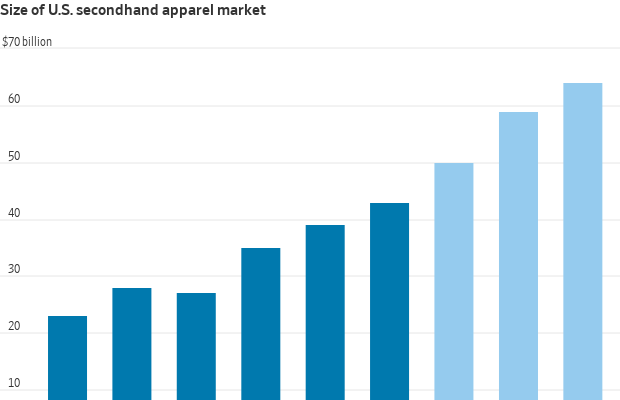
Americans on average throw away some 70 pounds of clothes a year, and thrifting is becoming more popular by the day—particularly among younger consumers. The U.S. secondhand apparel market was worth about $43 billion last year, according to an annual market report from the online apparel reseller ThredUp . It estimates that the market could grow about 11% a year on average through 2028. The market is fragmented, with about 74% of thrift stores being independently run, according to a report from Piper Sandler.
Companies specialising in thrift, though, are struggling to stitch together a compelling investment case. Shares of the online seller ThredUp and the bricks-and-mortar thrift-store chain Savers Value Village are each down around 29% year to date. The luxury online resale platform RealReal has fared better, but in large part thanks to a debt exchange it announced in late February to address liquidity concerns. ThredUp and RealReal are both down significantly from their peaks a few years back.
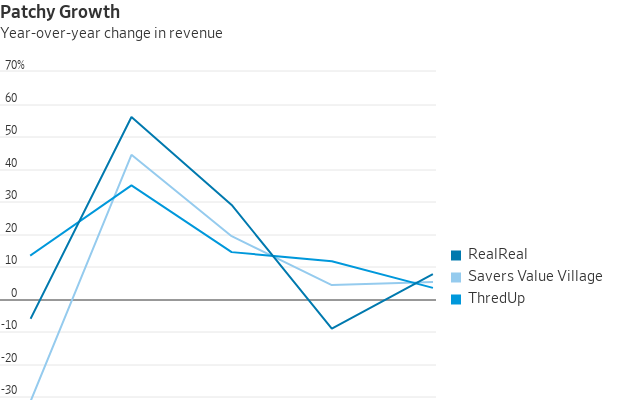
This could simply be air coming out of highly inflated expectations. ThredUp and the RealReal made their debuts with much fanfare in 2021 and 2019, respectively. Savers listed last year with a lofty valuation. But sales growth for all three companies has slowed, and they are all growing slower than the overall market.
Nonprofits such as Goodwill control a sizeable portion of the secondhand market, with a steady supply of donations, and eBay dominates the resale market online. ThredUp and RealReal’s bet is that consignors and buyers would be willing to pay a premium for a more convenient selling and buying experience. Sellers need only mail in or drop off their goods, and the platforms do the work of photographing, pricing and tagging each item by size, brand, colour and condition so that items are easily searchable. For RealReal, there is an extra human step of making sure the products aren’t fakes. A single-item distribution system is difficult to recreate and is therefore a powerful moat, says Dylan Carden, an equity analyst at William Blair, referring to ThredUp.
But the expensive process also means profitability is distant: Neither ThredUp nor RealReal is expected to turn a profit on the basis of generally accepted accounting principles for the next four years, according to analyst estimates polled by Visible Alpha.
Balancing the quantity of supply with quality has been difficult. ThredUp last year introduced fees that are subtracted from the payout customers receive if their items are sold on the platform. The change is meant to encourage consumers to send in high volumes of high-quality clothes. RealReal last year tweaked its commission structure to motivate consignors to send in expensive items priced above $100.
While these moves could attract higher quality, they might also divert consignors to platforms such as Poshmark and eBay, where selling involves more work but potentially higher payout. Notably, both of those marketplaces have authentication features for high-end items, and eBay has been trying to simplify sellers’ listing process through generative AI .
Meanwhile, the bricks-and-mortar Savers comes with the promise of a more efficient shopping experience than nonprofits. Piper Sandler estimates that its sales per store is nearly twice that of Goodwill and more than six times that of the Salvation Army. But the retailer faces similar quality challenges.
Only about half the items that Savers gets actually end up on the sales floor, and of those about half actually are sold, according to a company filing. Savers receives all of its items—whether directly or indirectly—by paying nonprofits by the pound for donated products. Savers has previously said that it might be able to snag higher-quality donations by placing its drop-off trailers—known as GreenDrop—near locations frequented by wealthier shoppers.
While Savers has been profitable for the past three years, same-store sales have unexpectedly slowed in recent quarters, and its investment case is highly dependent on new-store growth. This remains a risk. Previous management had trouble opening up stores because they weren’t able to procure enough supplies of secondhand clothing, notes Peter Keith, equity analyst at Piper Sandler, who is still confident about the company’s ability to expand.
Much like that shirt you only wore once, secondhand-apparel sellers so far hold more promise than substance.
 Copyright 2020, Dow Jones & Company, Inc. All Rights Reserved Worldwide. LEARN MORE





From making unpopular decisions to learning when to listen, leaders from five businesses reveal what nobody prepared them for — and how running a company has challenged their expectations.

Technology and semiconductor shares fell sharply as investors questioned the debt financing the AI infrastructure boom and confronted higher rates and Chinese competition.

Technology and semiconductor shares fell sharply as investors questioned the debt financing the AI infrastructure boom and confronted higher rates and Chinese competition.
4 minA sharp technology sell-off has exposed a new anxiety on global markets: whether the enormous borrowing behind the artificial-intelligence infrastructure boom can generate sufficient returns as interest rates rise and Chinese competition intensifies.
The artificial-intelligence investment boom has powered technology shares, semiconductor manufacturers and data-centre operators to extraordinary heights. Last week, investors were given a reminder that much of this expansion is being built with borrowed money.
The technology-heavy Nasdaq Composite fell 4.5 per cent over the week ended October 16, its weakest performance since late June. Semiconductor shares suffered an even deeper correction, with the Philadelphia Semiconductor Index losing about 11.4 per cent.
The selling spread quickly through global markets. Micron Technology fell 14.6 per cent over the week, while South Korea’s Samsung Electronics and SK Hynix dropped approximately 18 per cent and 24 per cent respectively.
This was more than a routine bout of profit-taking. Investors were reassessing three interconnected risks: higher interest rates, the rapidly expanding debt burden attached to AI infrastructure and the prospect of stronger competition from Chinese memory-chip manufacturers.
The debt behind the AI build-out
Artificial intelligence requires a physical infrastructure network of enormous scale. Data centres must be built, advanced processors purchased, power supplies secured and cooling systems installed before customers begin generating meaningful revenue from them.
Technology companies are increasingly supplementing their own cash with corporate bonds, syndicated loans, equipment leases, private credit and project-level financing.
JPMorgan describes the emerging funding model as a combination of conventional corporate borrowing and project finance tied to individual data-centre assets. In Australia, the Reserve Bank estimates that syndicated loans accounted for approximately three-quarters of data-centre financing during 2025 and 2026 to date.
The numbers are becoming large enough to affect broader credit markets. The Federal Reserve Bank of Dallas has cited Wall Street estimates suggesting AI-related investment-grade bond issuance could approach US$300 billion in 2026 alone.
That borrowing is not automatically problematic. Debt can be an efficient way to finance long-lived infrastructure when future revenue is sufficiently predictable. The concern is that AI technology, customer demand and computing economics are changing much faster than the repayment schedules attached to the assets.
A data centre financed today may carry debt for years. Investors must therefore make assumptions about future utilisation rates, electricity prices, chip performance, customer concentration and the amount businesses will ultimately pay for AI computing.
When interest rates rise, those assumptions become less forgiving.
Inflation changes the calculation
September’s US inflation data intensified the pressure. Consumer prices increased 3.7 per cent over the year, ahead of market expectations and up from 3.4 per cent in August.
The hotter reading reduced confidence that interest rates would fall quickly and pushed bond yields higher. That matters particularly for companies whose valuations depend on profits expected well into the future, as well as highly leveraged infrastructure operators that may need to refinance.
CoreWeave has emerged as a closely watched test case. The specialist cloud-computing company has accumulated substantial debt and lease obligations to build AI capacity, while relying on a concentrated group of large technology customers.
Its shares fell sharply during the sell-off, while the cost of insuring its debt against default climbed. CoreWeave has argued that its contracted backlog more than covers its obligations and that financial markets do not always understand its business model. Nevertheless, its securities have become a proxy for investor confidence in debt-funded AI infrastructure.
Oracle, another major investor in AI computing capacity, fell 8.8 per cent in Friday trading, while CoreWeave dropped 15.5 per cent.
The question is shifting from how much AI infrastructure can be built to how profitably it can be operated.
China adds another source of pressure
Interest rates were not the only catalyst. Reports of advances by Chinese memory-chip producer ChangXin Memory Technologies raised concerns that lower-cost Chinese products could increase competition across the global semiconductor industry.
Memory chips are essential to AI systems, but the industry is historically cyclical. Periods of tight supply and high pricing can encourage rapid investment, eventually producing oversupply and falling margins.
The prospect of a well-funded Chinese competitor expanding its technological capabilities unsettled investors in Samsung, SK Hynix and Micron. It also demonstrated that AI-related demand does not insulate chipmakers from conventional competitive pressures.
That combination—slower rate cuts, more expensive financing and potentially cheaper supply—challenged the assumption that every company exposed to AI would enjoy continually expanding margins.
A reset rather than the end of the boom
The sell-off does not establish that the AI boom is ending. Demand for computing power remains strong, the largest technology companies continue to generate formidable cash flows and many infrastructure projects are backed by long-term customer contracts.
What has changed is the market’s willingness to overlook the price and financing structure of that growth.
The most resilient companies are likely to be those able to fund investment from operating cash flow, secure long-duration customers and demonstrate that new capacity will earn returns comfortably above its financing costs.
More speculative operators may face greater scrutiny, particularly where debt is expensive, customers are concentrated or expected revenue depends on demand that has not yet materialised.
For Australian investors, the lesson extends beyond US technology shares. Local data-centre operators, infrastructure funds, electricity suppliers and property groups are increasingly exposed to the same investment cycle.
Artificial intelligence may remain one of the defining growth themes of the decade. But last week’s correction showed that enthusiasm for the technology does not eliminate financial discipline.
The next stage of the AI boom will be judged not only by computing power, model performance or demand for chips, but by something more traditional: whether the assets being financed can generate enough cash to repay the money borrowed to build them.
Fact box
Nasdaq Composite: Down 4.5 per cent for the week ended October 16, 2026
Philadelphia Semiconductor Index: Down approximately 11.4 per cent
Micron Technology: Down approximately 14.6 per cent
Samsung Electronics: Down approximately 18 per cent
SK Hynix: Down approximately 24 per cent
US September inflation: 3.7 per cent annually
Estimated 2026 AI-related investment-grade issuance: Approximately US$300 billion

International AI strategist Justin Kabbani will headline the Kanebridge Property Summit in Sydney on June 18, with tickets selling fast.

From gorilla encounters in Uganda to a reimagined Okavango retreat, Abercrombie & Kent elevates its African journeys with two spectacular lodge transformations.