Penthouse Atop a French Riviera Hotel that Hosted Ernest Hemingway to Coco Chanel Lists for €40 Million
The former Hôtel Provençal in resort town Juan-les-Pins is now luxury apartments, including this three-story unit with lots of outdoor space

 2 min
2 min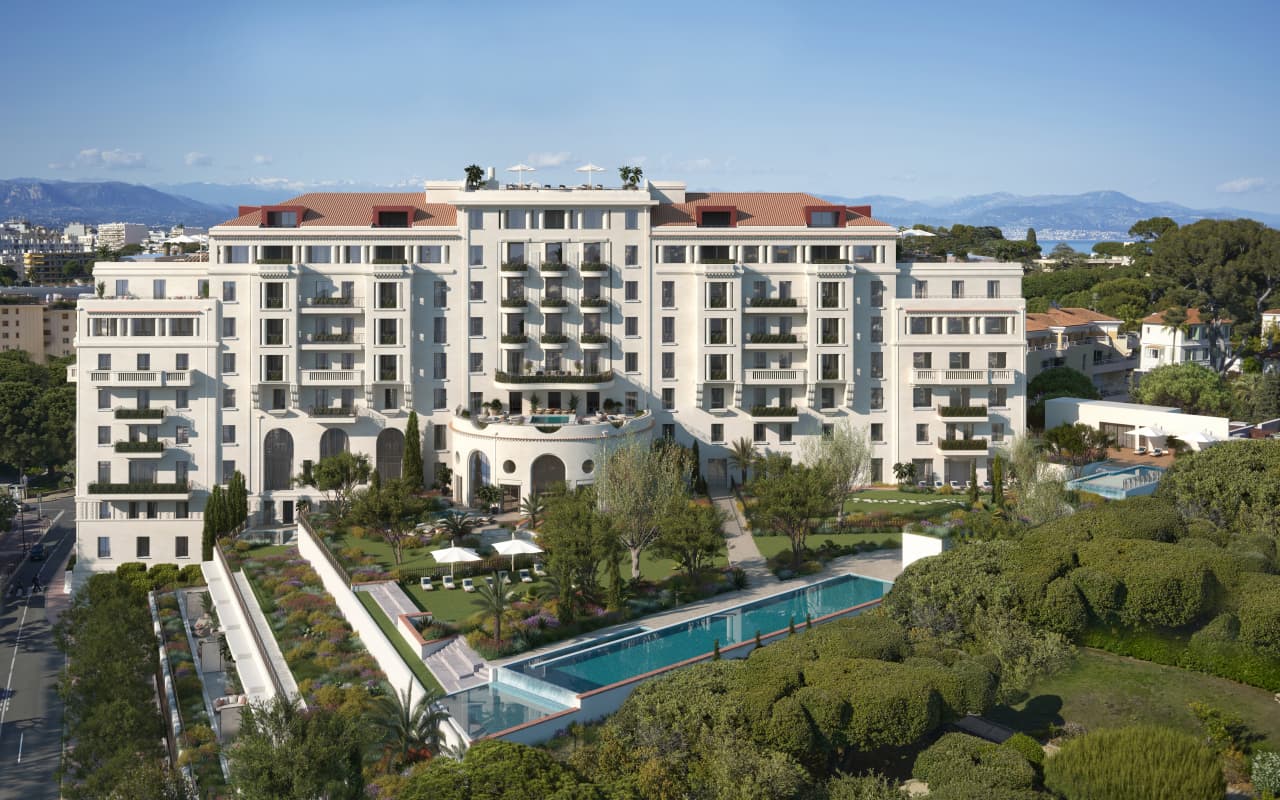
A lavish penthouse on the French Riviera within a former Art Deco hotel that was frequented by a veritable who’s who of writers, artists and actors has hit the market for €40 million (US$43.4 million).
The three-level unit sits atop Le Provençal, a residential development converted from the Hôtel Provençal, which was built in the mid-1920s at the direction of American millionaire Frank Jay Gould.
In its prime, the 290-room hotel in the resort town Juan-les-Pins was the place to see and be seen.
“Chanel invented pyjamas as beachwear there. Ernest Hemingway sat at the bar, and Edith Piaf partied in the ballroom. Picasso painted the beach scenes, and Man Ray photographed them,” according to The New York Times.

Caudwell
The hotel shuttered in 1977, and its transformation into 39 residences by British developer Caudwell is expected to be completed next year.
Entered via private elevator and spanning upward of 9,000 square feet, the six-bedroom penthouse, which hit the market earlier this week, spans the east wing of the building across the eighth, ninth and 10th floors.

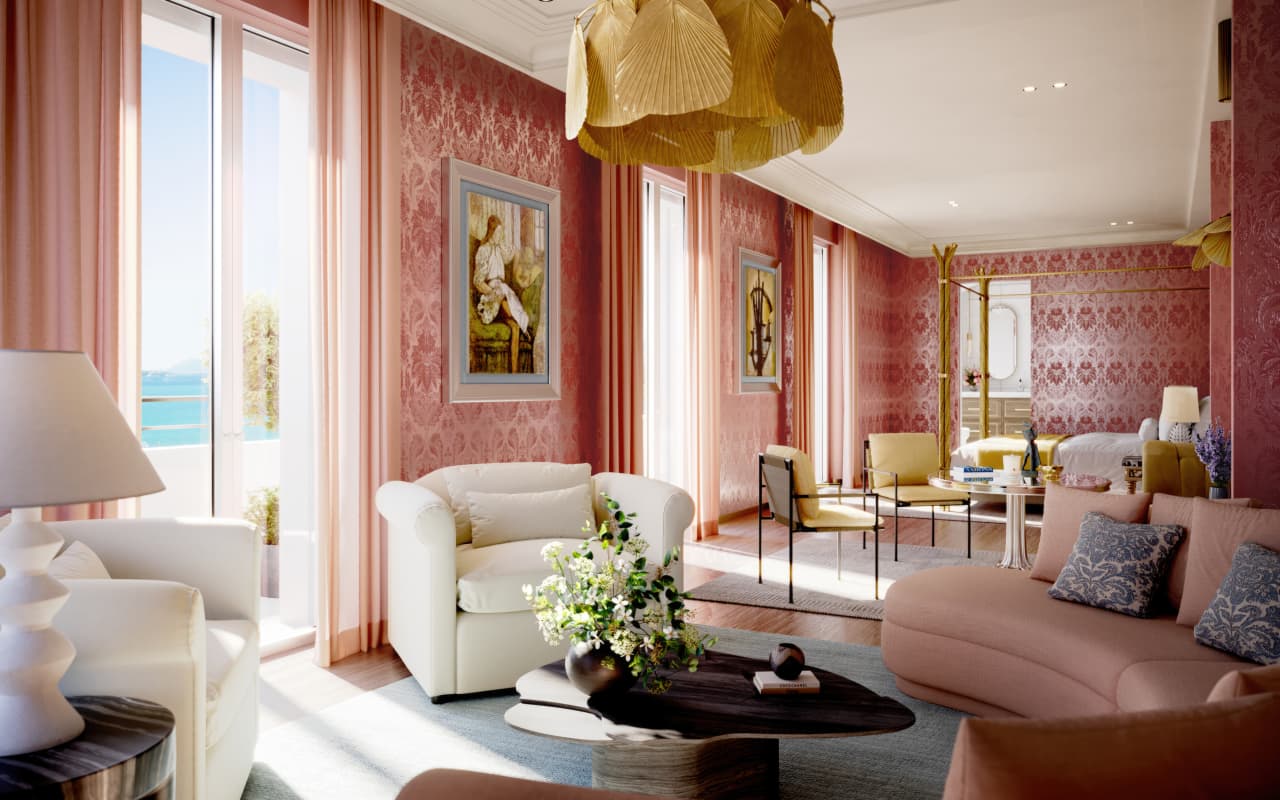
For its interiors, the developer aimed to channel the glamour for which the area is renowned, and turned to the outfits of famous names who frequently visited, along with the colours of the French Riviera, as inspiration.
The primary bedroom suite, for example—which has two bathrooms, dressing rooms and a private terrace—pays homage to the pink hues of the surroundings and the elaborate caftans that Elizabeth Taylor wore on one of her many visits to the area.
Caudwell
The home also boasts a family room, a home cinema, a gym, a family kitchen and breakfast room, a sculptural oval staircase, vast living and entertaining spaces, and impressive views along the French Riviera.

There’s a whopping 3,789 square feet of private terraces across the home—making its outdoor space larger than many single-family homes—a private pool and six parking bays in the development’s secure parking garage.
“With their private terraces, swimming pools and far-reaching panoramic views the penthouses at Le Provençal are the jewels in the [development’s] crown,” said Lars Christiaanse, group director of sales at Caudwell.
 Copyright 2020, Dow Jones & Company, Inc. All Rights Reserved Worldwide. LEARN MORE





Borrowers cannot control the Reserve Bank, but they can control how exposed their household budget is to its next decision. The RBA meets on 29 September with inflation concerns still elevated and major-bank economists increasingly bringing forward their rate-rise calls. Fixed mortgage rates have also been moving, reducing the value of waiting for perfect certainty. …
Continue reading “What mortgage holders should do before the next RBA decision”

Australian shares finished higher on Tuesday, September 22, as a technology rally and lower oil prices outweighed weakness in energy companies and continued anxiety about domestic interest rates. The S&P/ASX 200 closed 25.9 points, or 0.30 per cent, higher at 8,757.8. The All Ordinaries gained 0.36 per cent to 8,951.0, while the All Technology index …
Continue reading “ASX Wrap: Technology lifts the ASX as falling oil relieves inflation pressure”

 2 min
2 minBorrowers cannot control the Reserve Bank, but they can control how exposed their household budget is to its next decision.
The RBA meets on 29 September with inflation concerns still elevated and major-bank economists increasingly bringing forward their rate-rise calls. Fixed mortgage rates have also been moving, reducing the value of waiting for perfect certainty.
The first task is to calculate the impact of another 0.25 percentage-point increase. Indicative Canstar figures reported earlier this month suggest that such a move would add about $91 a month to repayments on a $600,000 loan, $122 on $800,000 and $152 on $1 million, although actual changes depend on rate, term and loan structure.
The second task is to compare the current loan with the market. Borrowers should examine the interest rate, annual package fee, offset balance, redraw rules and the revert rate on any expiring fixed portion. A lower advertised rate is not necessarily a better deal after fees, lost features or refinancing costs.
Third, test the household budget at least one percentage point above the current rate. This is not a forecast; it is a resilience exercise. Include council rates, strata, insurance, maintenance, school costs and realistic discretionary spending. Investors should also allow for vacancy and repairs rather than assuming uninterrupted rent.
Fourth, contact the existing lender before lodging multiple applications. A borrower with a sound repayment history may be able to negotiate a discount without refinancing. If the offer is weak, obtain comparable quotes and seek advice on whether changing lenders will genuinely improve the position.
Fifth, preserve liquidity. Using every available dollar to reduce principal may feel prudent, but an offset account can provide interest savings while retaining access to cash. The right structure depends on tax position and loan purpose, particularly where owner-occupied and investment debt coexist.
Borrowers considering a fixed rate face a trade-off. Fixing can provide repayment certainty, but may restrict additional repayments, offsets or early exit. Splitting a loan can diversify rate exposure without removing risk.
The worst time to examine a mortgage is after repayments have become unmanageable. A review conducted now gives borrowers more choices: renegotiate, refinance, adjust spending or build a buffer while their record remains strong.
Borrower checklist
Calculate: Repayments after a 0.25 and one percentage-point increase.
Compare: Rate, fees, offset, redraw, cashback conditions and total cost.
Review: Fixed-rate expiry, interest-only expiry and remaining loan term.
Protect: Emergency liquidity and insurance.

Many of the most-important events have slipped from our collective memories. But their impacts live on.

Once a sleepy surf town, Noosa has become Australia’s prestige property hotspot, where multi-million dollar knockdowns, architectural showpieces and record-setting sales are the new normal.