The End of Japan’s Negative Rates Will Be a Slow-Moving Tsunami
Long-term effects of positive Japanese rates could be profound—on everything from mortgage rates to U.S. government finances

 3 min
3 min
Japan’s stocks have reached levels that haven’t been seen for 34 years . The country is likely to hit another milestone soon: Its central bank could raise interest rates for the first time in 17 years as soon as Tuesday.
Higher, and positive, Japanese rates won’t reshape markets overnight. But the long-term effects could be profound, particularly if U.S. growth heads structurally lower for any reason, further narrowing the yield advantage of many U.S. assets. Japan is the single largest overseas holder of U.S. Treasurys, a major overseas lender, and an export heavyweight whose corporate earnings—and stocks—have been significantly supported by the ultra cheap Japanese yen. More Japanese capital staying at home could eventually impact the price of everything from U.S. mortgages to infrastructure finance in the developing world.
For much of the past two years, Japan has swum against global monetary tides, maintaining its ultra low interest-rate regime. But now, as most other major central banks are about to cut rates, the Bank of Japan is poised to break the trend again. Domestic media reported over the weekend that Japan’s central bank will end its negative interest rates, which have been in place since 2016, during its policy board meeting on Monday and Tuesday.
The decision would come after mounting evidence that the job market is on an increasingly strong footing , after years of stagnant wage growth. Unions secured an average salary increase of 5.28% , according to the first-round results of Japan’s annual spring wage negotiations, the Japanese Trade Union Confederation said last week. For the entire decade ending in 2022, the final annual increase never exceeded 2.4%.
Much likely won’t change in the short term. The Bank of Japan will probably pace its rate increases slowly: The past couple of years have, if anything, reaffirmed its reputation for moving slowly and deliberately. Moreover, while inflation is still high by Japanese standards—2.2% in January—it has already cooled from the peaks of last year.
Japanese bond yields have picked up, but they are still substantially lower than in the U.S. The rate differential between 10-year government bonds in the U.S. and Japan stands at 3.5 percentage points. That is significantly lower than the 4.2-percentage-point gap of a few months ago, but still way higher than the 1.5 percentage points of three years ago.
Even so, a narrowing rate gap—especially if the Fed cuts rates later this year, as seems likely—will support the Japanese yen . That could damp enthusiasm for rip-roaring Japanese stocks . They would become more expensive in dollar terms for foreign investors, who have been significant drivers of the rally. A stronger yen would also hit profits at some Japanese companies , especially big exporters.
Likewise, gradual interest-rate increases in Japan probably won’t change investment flows much in the short term. But it could be a different story down the road if the shift back to positive rates proves sustainable.
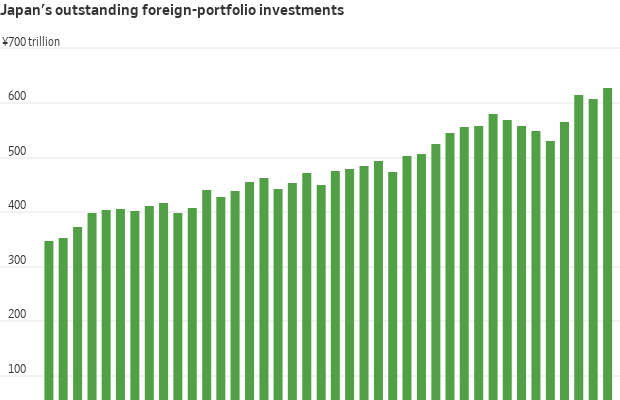
Japanese individuals and companies have been big investors abroad in search of higher yield for decades. The country’s foreign-portfolio investments stood at the equivalent of $4.2 trillion at the end of last year. A big chunk of that comes from Japanese pension funds and insurers, who would suddenly have more attractive options at home. Japanese investors, for example, hold around $1.1 trillion of Treasury bonds, making them the largest foreign owner.
Japanese investors have been scouring the globe for better returns for as long as most investors can remember. If that starts to change, the effects will be felt nearly everywhere—sooner or later.
 Copyright 2020, Dow Jones & Company, Inc. All Rights Reserved Worldwide. LEARN MORE





The Swiss watchmaker’s first collaboration with Atlassian Williams F1 Team produces two sporting Laureato models inspired by the team’s 2026 racing car.

Victorian auction buyers will soon receive a piece of information that has traditionally been withheld until bidding reaches it: the vendor’s reserve price. Under new property-sale and underquoting laws, agents must publish the agreed reserve at least seven days before an auction or fixed-date sale. Most changes begin on 1 October 2026 and apply to …
Continue reading “Victoria’s New Auction Rules Will Force Reserve Prices Into the Open”

The Swiss watchmaker’s first collaboration with Atlassian Williams F1 Team produces two sporting Laureato models inspired by the team’s 2026 racing car.
3 minGirard-Perregaux has revealed the first watches created through its partnership with Atlassian Williams F1 Team, bringing the British racing team’s colours to one of Switzerland’s most recognisable integrated-bracelet designs.
The collaboration comprises two 42mm steel watches: the time-and-date Laureato Williams Edition and the more technical Laureato Chronograph Williams Edition.
Both retain the familiar architecture of the Laureato, including its octagonal bezel, integrated bracelet and mix of polished and satin-finished surfaces. The influence of Williams is comparatively restrained, appearing through colour, discreet branding and details inspired by the team’s current Formula 1 car.
It is a welcome departure from the oversized logos and literal automotive references that can characterise motorsport watches.
The Williams FW48 inspires the dial
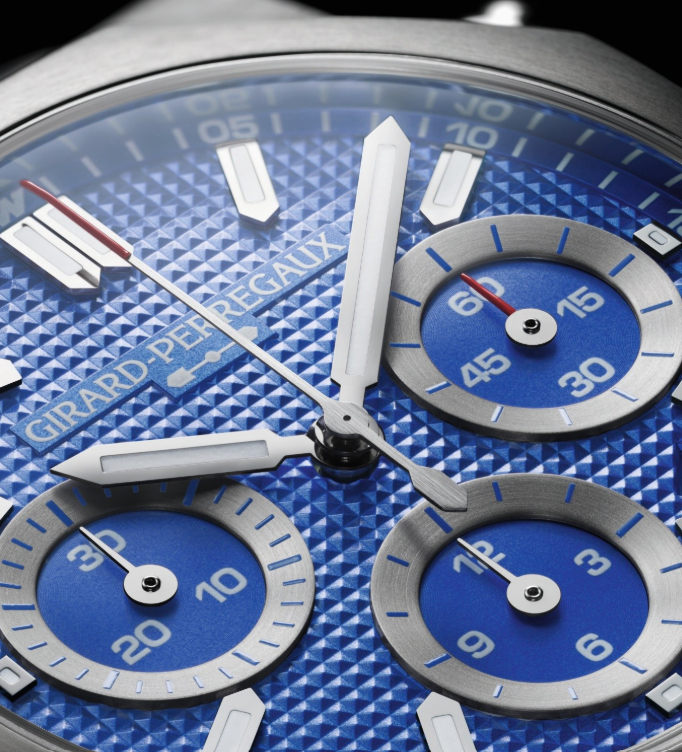
The centrepiece of both models is a blue Clous de Paris dial informed by the livery of the Williams FW48, the car being campaigned by the team during the 2026 Formula 1 season.
A small Williams “W” replaces the conventional marker at 12 o’clock, while the team emblem appears on the sapphire crystal caseback. Red accents echo the keyline used on the FW48 without overwhelming the established Laureato design.
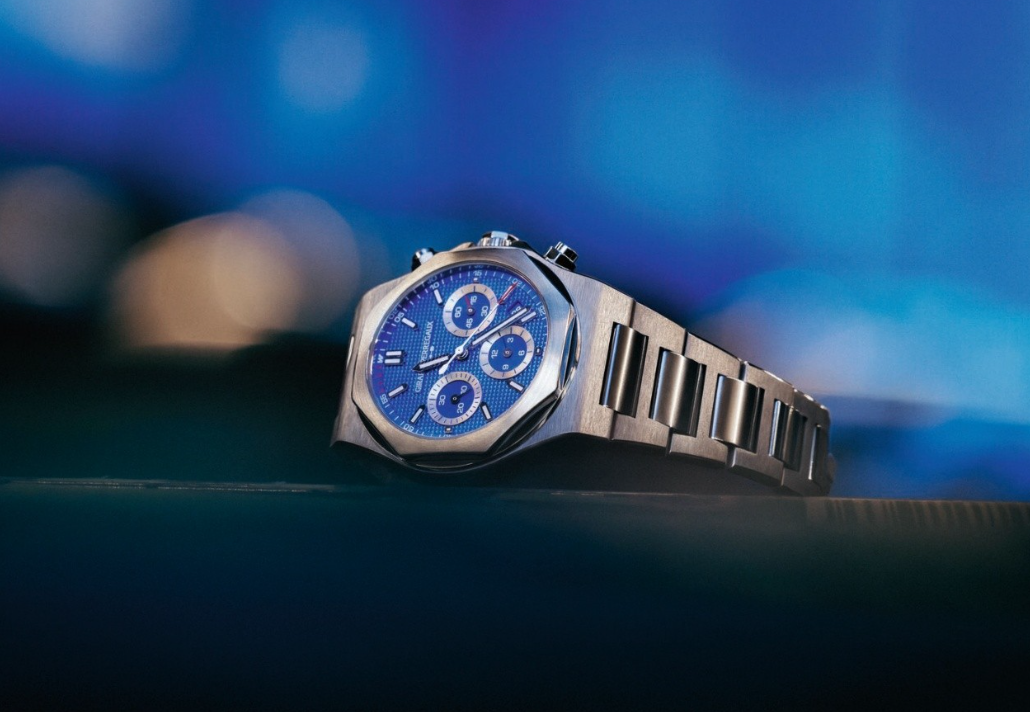
The three-hand model offers the quieter interpretation. Baton-shaped, rhodium-plated hands and hour markers are filled with white-emitting luminescent material, while a date window sits at three o’clock.
The chronograph creates a more obvious connection with motorsport. Three subdials are framed by rhodium-plated rings, with red appearing on the small-seconds hand and the tip of the central chronograph seconds hand.
Both watches measure 42mm across and are water resistant to 100 metres. The standard Laureato has a case thickness of 10.68mm, while the additional mechanics of the chronograph increase its profile to 12.16mm.
Two in-house automatic movements
The Laureato Williams Edition is powered by Girard-Perregaux’s self-winding GP01800 calibre. The movement provides hours, minutes, central seconds and the date, with a minimum power reserve of 54 hours.
The Laureato Chronograph Williams Edition uses the automatic GP03300 calibre, which combines its chronograph functions with a date display and offers a minimum power reserve of 46 hours.
Both movements operate at 28,800 vibrations per hour and can be viewed through their sapphire crystal casebacks.
Their decoration provides a more traditional counterpoint to the Formula 1 association. Finishing techniques include Côtes de Genève, circular graining, bevelling, mirror polishing, satin finishing, engraving and snailing.
The result is less about reproducing the appearance of a racing car than identifying the common ground between two mechanical disciplines: precision, incremental development and the considerable work hidden beneath the finished product.
Parallel histories
The timing of the partnership draws attention to the remarkably similar ages of its two protagonists.
Girard-Perregaux introduced the original Laureato in 1975, establishing an integrated-bracelet sports watch with a distinctive octagonal bezel. Williams entered Formula 1 two years later in 1977.
Both have evolved continuously across the five decades since. The Laureato has moved through different sizes, materials and complications, while retaining its central design language. Williams, meanwhile, has remained one of Formula 1’s most historically significant teams.
That gives the collaboration greater credibility than a simple licensing exercise. Girard-Perregaux and Williams are not being connected solely through the familiar language of speed. Their stronger link is a shared dependence on engineering, testing and the accumulation of specialist knowledge.
The watches are described as the beginning of a longer collaboration, suggesting further Williams editions may follow.
Girard-Perregaux’s international website lists the Laureato Williams Edition at US$16,200 and the Laureato Chronograph Williams Edition at US$20,900. Australian pricing has not been announced.
Specifications
Girard-Perregaux Laureato Williams Edition 42mm
Reference: 81010-11-3680-1GM
Case: Steel
Diameter: 42mm
Thickness: 10.68mm
Crystal: Anti-reflective sapphire crystal
Dial: Blue Clous de Paris pattern
Movement: Automatic GP01800
Functions: Hours, minutes, central seconds and date
Power reserve: Minimum 54 hours
Water resistance: 100 metres
Bracelet: Integrated steel bracelet with triple-folding clasp
International price: US$16,200
Girard-Perregaux Laureato Chronograph Williams Edition 42mm
Reference: 81020-11-3681-1GM
Case: 904L steel
Diameter: 42mm
Thickness: 12.16mm
Crystal: Anti-reflective sapphire crystal
Dial: Blue Clous de Paris pattern with three chronograph counters
Movement: Automatic GP03300
Functions: Chronograph, hours, minutes, small seconds and date
Power reserve: Minimum 46 hours
Water resistance: 100 metres
Bracelet: Integrated 904L steel bracelet with triple-folding clasp
International price: US$20,900

The pandemic-fuelled love affair with casual footwear is fading, with Bank of America warning the downturn shows no sign of easing.

The Australian leather house has opened an immersive four-day pop-up in Manhattan, unveiling its Bloom Collection and redefining what a product launch can look like.