A Godfather of AI Just Won a Nobel. He Has Been Warning the Machines Could Take Over the World.
Geoffrey Hinton hopes the prize will add credibility to his claims about the dangers of AI technology he pioneered

 4 min
4 min
The newly minted Nobel laureate Geoffrey Hinton has a message about the artificial-intelligence systems he helped create: get more serious about safety or they could endanger humanity.
“I think we’re at a kind of bifurcation point in history where, in the next few years, we need to figure out if there’s a way to deal with that threat,” Hinton said in an interview Tuesday with a Nobel Prize official that mixed pride in his life’s work with warnings about the growing danger it poses.
The 76-year-old Hinton resigned from Google last year in part so he could talk more about the possibility that AI systems could escape human control and influence elections or power dangerous robots. Along with other experienced AI researchers, he has called on such companies as OpenAI, Meta Platforms and Alphabet -owned Google to devote more resources to the safety of the advanced systems that they are competing against each other to develop as quickly as possible.
Hinton’s Nobel win has provided a new platform for his doomsday warnings at the same time it celebrates his critical role in advancing the technologies fueling them. Hinton has argued that advanced AI systems are capable of understanding their outputs, a controversial view in research circles.
“Hopefully, it will make me more credible when I say these things really do understand what they’re saying,” he said of the prize.
Hinton’s views have pitted him against factions of the AI community that believe dwelling on doomsday scenarios needlessly slows technological progress or distracts from more immediate harms, such as discrimination against minority groups .
“I think that he’s a smart guy, but I think a lot of people have way overhyped the risk of these things, and that’s really convinced a lot of the general public that this is what we should be focusing on, not the more immediate harms of AI,” said Melanie Mitchell, a professor at the Santa Fe Institute, during a panel last year.
Hinton visited Google’s Silicon Valley headquarters Tuesday for an informal celebration, and some of the company’s top AI executives congratulated him on social media.
On Wednesday, other prominent Googlers specialising in AI were also awarded a Nobel Prize. Demis Hassabis, chief executive of Google DeepMind, and John M. Jumper, director at the AI lab, were part of a group of three scientists who won the chemistry prize for their work on predicting the shape of proteins.
Thinking like people
Hinton is sharing the Nobel Prize in physics with John Hopfield of Princeton University for their work since the 1980s on neural networks that process information in ways inspired by the human brain. That work is the basis for many of the AI technologies in use today, from ChatGPT’s humanlike conversations to Google Photos’ ability to recognise who is in every picture you take.
“Their contributions to connect fundamental concepts in physics with concepts in biology, not just AI—these concepts are still with us today,” said Yoshua Bengio , an AI researcher at the University of Montreal.
In 2012, Hinton worked with two of his University of Toronto graduate students, Alex Krizhevsky and Ilya Sutskever, on a neural network called AlexNet programmed to recognise images in photos. Until that point, computer algorithms had often been unable to tell that a picture of a dog was really a dog and not a cat or a car.
AlexNet’s blowout victory at a 2012 contest for image-recognition technology was a pivotal moment in the development of the modern AI boom, as it proved the power of neural nets over other approaches.
That same year, Hinton started a company with Krizhevsky and Sutskever that turned out to be short-lived. Google acquired it in 2013 in an auction against competitors including Baidu and Microsoft, paying $44 million essentially to hire the three men, according to the book “Genius Makers.” Hinton began splitting time between the University of Toronto and Google, where he continued research on neural networks.
Hinton is widely revered as a mentor for the current generation of top AI researchers including Sutskever, who co-founded OpenAI before leaving this spring to start a company called Safe Superintelligence.
Hinton received the 2018 Turing Award, a computer-science prize, for his work on neural networks alongside Bengio and a fellow AI researcher, Yann LeCun . The three are often referred to as the modern “godfathers of AI.”
Warnings of disaster
By 2023, Hinton had become alarmed about the consequences of building more powerful artificial intelligence. He began talking about the possibility that AI systems could escape the control of their creators and cause catastrophic harm to humanity. In doing so, he aligned himself with a vocal movement of people concerned about the existential risks of the technology.
“We’re in a situation that most people can’t even conceive of, which is that these digital intelligences are going to be a lot smarter than us, and if they want to get stuff done, they’re going to want to take control,” Hinton said in an interview last year.
Hinton announced he was leaving Google in spring 2023, saying he wanted to be able to freely discuss the dangers of AI without worrying about consequences for the company. Google had acted “very responsibly,” he said in an X post.
In the subsequent months, Hinton has spent much of his time speaking to policymakers and tech executives, including Elon Musk , about AI risks.
Hinton cosigned a paper last year saying companies doing AI work should allocate at least one-third of their research and development resources to ensuring the safety and ethical use of their systems.
“One thing governments can do is force the big companies to spend a lot more of their resources on safety research, so that for example companies like OpenAI can’t just put safety research on the back burner,” Hinton said in the Nobel interview.
An OpenAI spokeswoman said the company is proud of its safety work.
With Bengio and other researchers, Hinton supported an artificial-intelligence safety bill passed by the California Legislature this summer that would have required developers of large AI systems to take a number of steps to ensure they can’t cause catastrophic damage. Gov. Gavin Newsom recently vetoed the bill , which was opposed by most big tech companies including Google.
Hinton’s increased activism has put him in opposition to other respected researchers who believe his warnings are fantastical because AI is far from having the capability to cause serious harm.
“Their complete lack of understanding of the physical world and lack of planning abilities put them way below cat-level intelligence, never mind human-level,” LeCun wrote in a response to Hinton on X last year.
 Copyright 2020, Dow Jones & Company, Inc. All Rights Reserved Worldwide. LEARN MORE




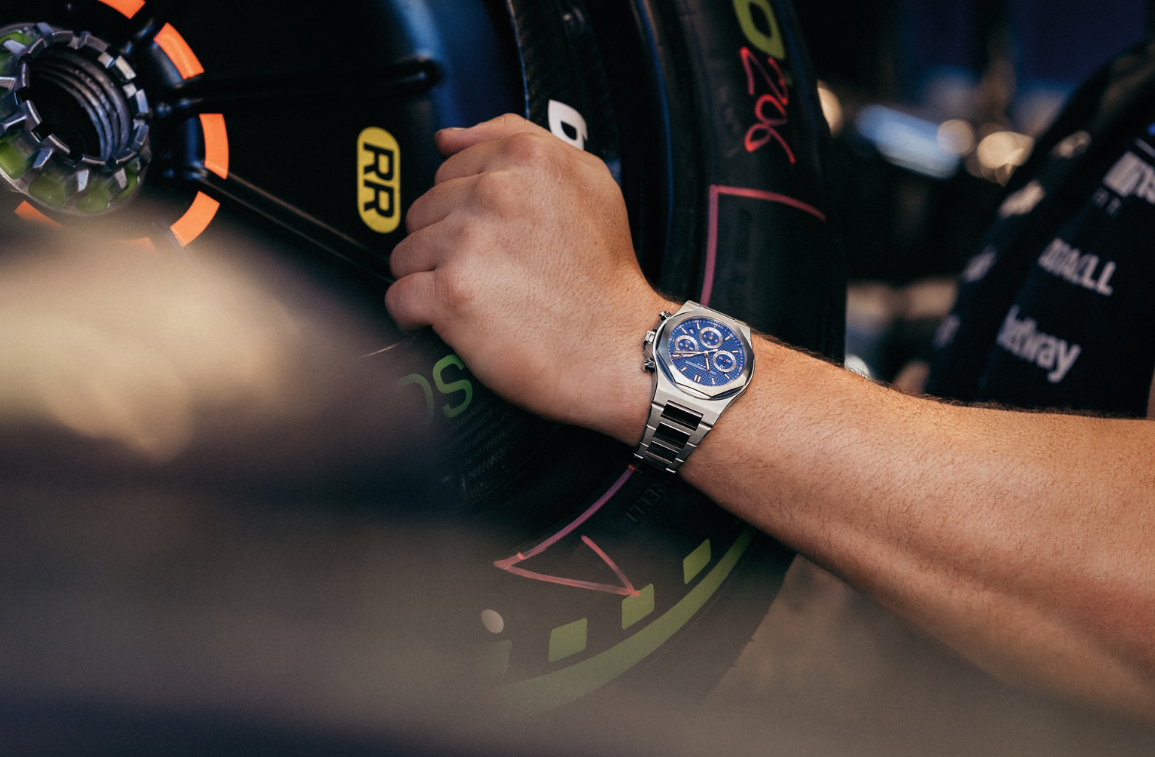
The Swiss watchmaker’s first collaboration with Atlassian Williams F1 Team produces two sporting Laureato models inspired by the team’s 2026 racing car.
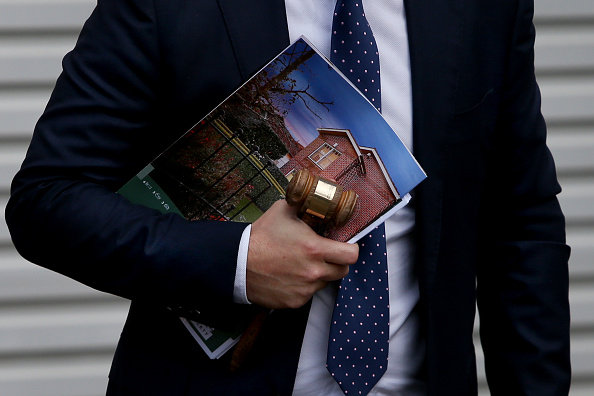
Victorian auction buyers will soon receive a piece of information that has traditionally been withheld until bidding reaches it: the vendor’s reserve price. Under new property-sale and underquoting laws, agents must publish the agreed reserve at least seven days before an auction or fixed-date sale. Most changes begin on 1 October 2026 and apply to …
Continue reading “Victoria’s New Auction Rules Will Force Reserve Prices Into the Open”

The Swiss watchmaker’s first collaboration with Atlassian Williams F1 Team produces two sporting Laureato models inspired by the team’s 2026 racing car.
3 minGirard-Perregaux has revealed the first watches created through its partnership with Atlassian Williams F1 Team, bringing the British racing team’s colours to one of Switzerland’s most recognisable integrated-bracelet designs.
The collaboration comprises two 42mm steel watches: the time-and-date Laureato Williams Edition and the more technical Laureato Chronograph Williams Edition.
Both retain the familiar architecture of the Laureato, including its octagonal bezel, integrated bracelet and mix of polished and satin-finished surfaces. The influence of Williams is comparatively restrained, appearing through colour, discreet branding and details inspired by the team’s current Formula 1 car.
It is a welcome departure from the oversized logos and literal automotive references that can characterise motorsport watches.
The Williams FW48 inspires the dial
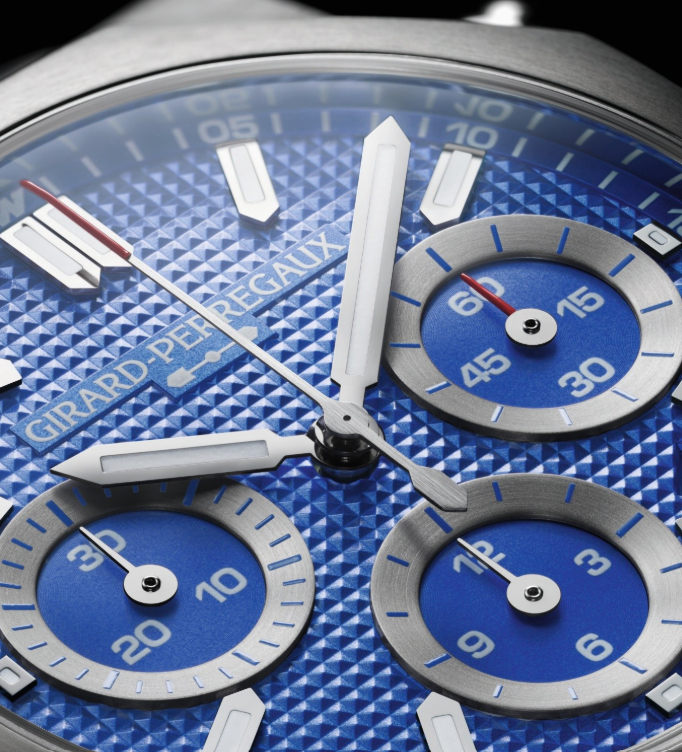
The centrepiece of both models is a blue Clous de Paris dial informed by the livery of the Williams FW48, the car being campaigned by the team during the 2026 Formula 1 season.
A small Williams “W” replaces the conventional marker at 12 o’clock, while the team emblem appears on the sapphire crystal caseback. Red accents echo the keyline used on the FW48 without overwhelming the established Laureato design.
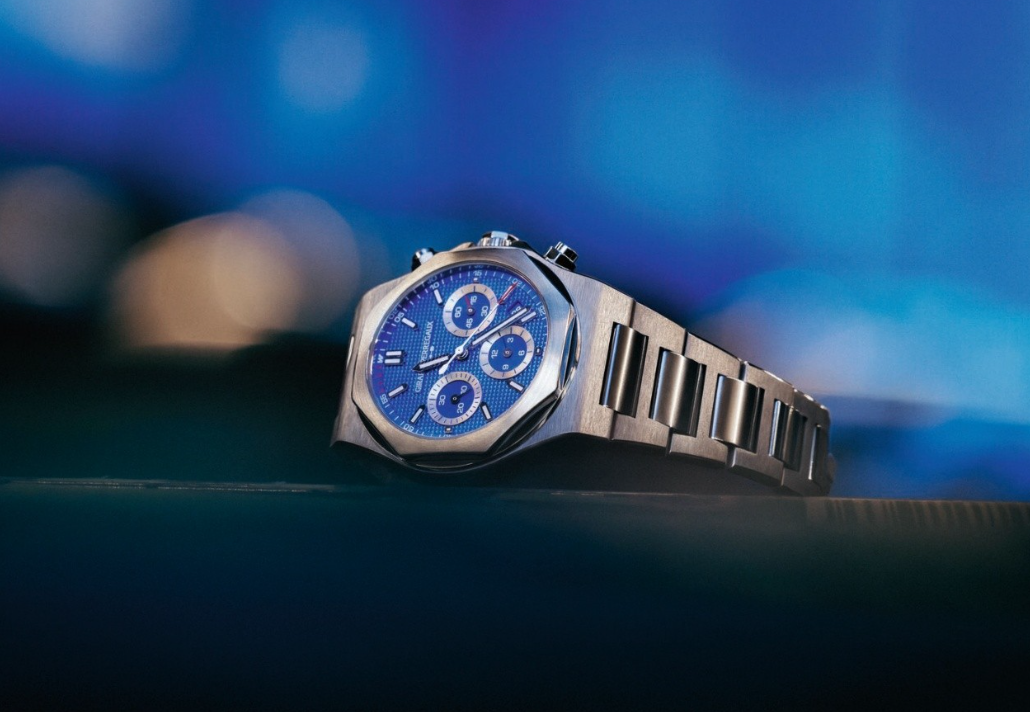
The three-hand model offers the quieter interpretation. Baton-shaped, rhodium-plated hands and hour markers are filled with white-emitting luminescent material, while a date window sits at three o’clock.
The chronograph creates a more obvious connection with motorsport. Three subdials are framed by rhodium-plated rings, with red appearing on the small-seconds hand and the tip of the central chronograph seconds hand.
Both watches measure 42mm across and are water resistant to 100 metres. The standard Laureato has a case thickness of 10.68mm, while the additional mechanics of the chronograph increase its profile to 12.16mm.
Two in-house automatic movements
The Laureato Williams Edition is powered by Girard-Perregaux’s self-winding GP01800 calibre. The movement provides hours, minutes, central seconds and the date, with a minimum power reserve of 54 hours.
The Laureato Chronograph Williams Edition uses the automatic GP03300 calibre, which combines its chronograph functions with a date display and offers a minimum power reserve of 46 hours.
Both movements operate at 28,800 vibrations per hour and can be viewed through their sapphire crystal casebacks.
Their decoration provides a more traditional counterpoint to the Formula 1 association. Finishing techniques include Côtes de Genève, circular graining, bevelling, mirror polishing, satin finishing, engraving and snailing.
The result is less about reproducing the appearance of a racing car than identifying the common ground between two mechanical disciplines: precision, incremental development and the considerable work hidden beneath the finished product.
Parallel histories
The timing of the partnership draws attention to the remarkably similar ages of its two protagonists.
Girard-Perregaux introduced the original Laureato in 1975, establishing an integrated-bracelet sports watch with a distinctive octagonal bezel. Williams entered Formula 1 two years later in 1977.
Both have evolved continuously across the five decades since. The Laureato has moved through different sizes, materials and complications, while retaining its central design language. Williams, meanwhile, has remained one of Formula 1’s most historically significant teams.
That gives the collaboration greater credibility than a simple licensing exercise. Girard-Perregaux and Williams are not being connected solely through the familiar language of speed. Their stronger link is a shared dependence on engineering, testing and the accumulation of specialist knowledge.
The watches are described as the beginning of a longer collaboration, suggesting further Williams editions may follow.
Girard-Perregaux’s international website lists the Laureato Williams Edition at US$16,200 and the Laureato Chronograph Williams Edition at US$20,900. Australian pricing has not been announced.
Specifications
Girard-Perregaux Laureato Williams Edition 42mm
Reference: 81010-11-3680-1GM
Case: Steel
Diameter: 42mm
Thickness: 10.68mm
Crystal: Anti-reflective sapphire crystal
Dial: Blue Clous de Paris pattern
Movement: Automatic GP01800
Functions: Hours, minutes, central seconds and date
Power reserve: Minimum 54 hours
Water resistance: 100 metres
Bracelet: Integrated steel bracelet with triple-folding clasp
International price: US$16,200
Girard-Perregaux Laureato Chronograph Williams Edition 42mm
Reference: 81020-11-3681-1GM
Case: 904L steel
Diameter: 42mm
Thickness: 12.16mm
Crystal: Anti-reflective sapphire crystal
Dial: Blue Clous de Paris pattern with three chronograph counters
Movement: Automatic GP03300
Functions: Chronograph, hours, minutes, small seconds and date
Power reserve: Minimum 46 hours
Water resistance: 100 metres
Bracelet: Integrated 904L steel bracelet with triple-folding clasp
International price: US$20,900

Micro-needling promises glow and firmness, but timing can make all the difference.
Advertising legend John Singleton unveils an exclusive 16-residence Caroline Bay development, marking his latest high-end property play on the Central Coast.