As Greedflation Starts to Fade, Wageflation Creeps In
Softer demand, more supply and rising labor costs all take the air out of profit margins

 4 min
4 min
When inflation took off in 2021 in the U.S., so did corporate profits, leading to accusations of “greedflation” and calls in some corners for price controls. This year, Europe is going through the same debate amid soaring food prices.
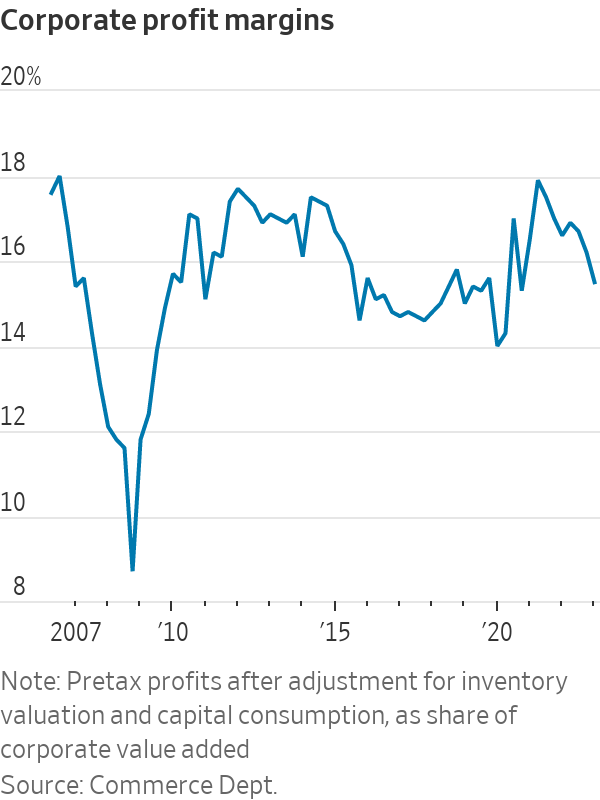
Judging by recent developments, inflation driven by corporations flexing their power to jack up prices more than costs—greedflation, as some called it—is on its way out. Pretax margins, which widened sharply in 2021 and 2022, were roughly back to pre pandemic levels in the first quarter of 2023, according to revised government data released last week. Margins in six of the S&P 500’s 11 sectors were lower in the second quarter than four years earlier, according to FactSet.
Narrowing profit margins, though, doesn’t necessarily mean an end to inflation. Wages are now growing faster than prices. While that doesn’t provoke the same outrage as soaring profits, it’s just as problematic for getting inflation down.
The circumstances of 2021 and 2022 made for a seller’s paradise. As the economy reopened, newly vaccinated consumers rushed to spend pent-up savings and stimulus cash. That demand collided with supply held down by pandemic disruptions and the inability of meeting so much demand with existing capacity.
The result: pretax margins shot from 15.6% in the fourth quarter of 2019 to 17.9% in the second quarter of 2021. That’s based on the Commerce Department’s measure of total value added by corporate businesses. This measure separates total costs into labor, profits, and non labour costs such as depreciation, interest and excise taxes, while excluding inputs, such as energy.
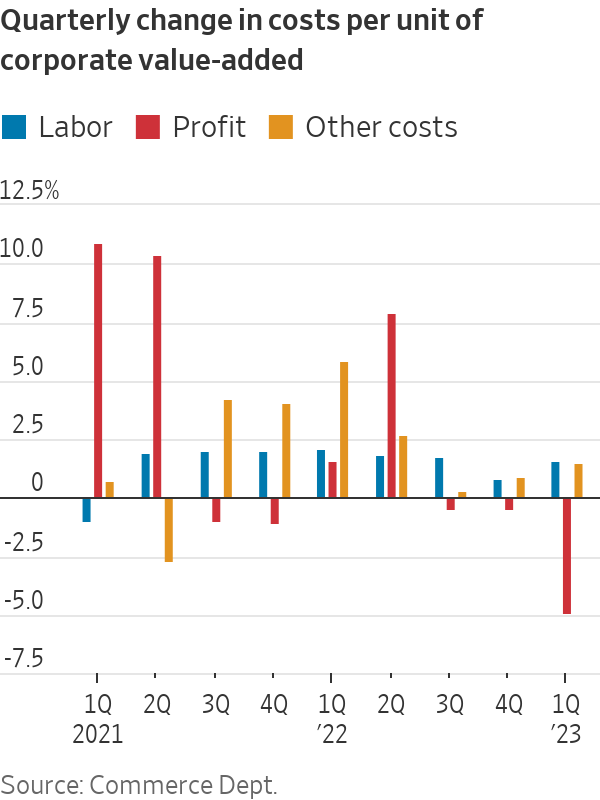
In the year through the second quarter of 2021, those companies’ prices rose 4.3%. At the same time, the cost of labour per unit of output fell 2.3%, because though wages were rising in that time, output per worker (productivity) was rising faster. Profit per unit of output rose a whopping 40%.
Greedflation is a catchy phrase, but not of much analytical value. Businesses always set prices to maximise profits. Raising them too much risks competitors ramping up supply to take market share.
But in 2021 and most of 2022 many companies couldn’t expand supply because of shortages of materials, labour or transport capacity. In the past when demand for vehicles rose, manufacturers effortlessly boosted output. This time, a shortage of semiconductors curtailed production and manufacturers responded to strong demand by slashing incentives and raising prices. General Motors sold fewer vehicles in both 2021 and 2022 than in 2019 but in both years made about 50% more profit. Companies weren’t the only beneficiaries: so was anyone with a used car to sell.
While greed is timeless, companies conceivably may have more power to translate greed into prices because of declining competition. The Biden administration, for example, blamed soaring meat prices in part on consolidation among meatpackers. But that wouldn’t have translated into such high prices without so much demand from locked-down consumers and the industry enduring production interruptions and labour shortages due to Covid-19, drought, avian flu and shrunken herds.
In recent quarters demand has softened. Adjusted for inflation, consumer spending was flat in three of the past four months. Tyson Foods lost money in the second quarter as soft demand pulled down prices for pork and beef while feed and labour expenses rose.
Supply, meanwhile, seems to be improving, at least for goods. In a report this week, economists at Goldman Sachs said global shipments of automotive semiconductor chips and U.S. auto production in the past few months are finally above pre pandemic levels. As a result, automotive inventories and incentives are both on the rise. In May the average new car buyer paid $410 below sticker price, compared with $637 above a year earlier, according to Cox Automotive.
Demand for services is holding up better than for goods, and services supply is still constrained, in particular by labour shortages. One reason air travel is so expensive is that airline capacity this year is about 14% below pre pandemic trend levels, Delta Air Lines recently told shareholders.
As airlines add flights they stretch staff, aircraft and air-traffic controllers to capacity, leaving them vulnerable to the slightest disruption. After thunderstorms triggered hundreds of flight cancellations in recent weeks, United Airlines said it might reduce flights out of its Newark, N.J. hub to create a buffer.
Airlines also reflect a broader reality: Whatever pricing power business still commands is increasingly eaten up by labor costs. Pilot shortages caused by pandemic retirements have given unions bargaining leverage, with many seeking to replicate a 34%, four-year increase Delta gave its pilots this year.
Workers are slowly recapturing more of the economic pie. In the first quarter of 2023, wages and salaries rose to 49.3% of corporate value added, higher than in 2019. Labor costs per unit of sales rose 6% in the year through the first quarter, ahead of prices, which were up 5.3% in the same period. Profits per unit of output rose just 1.6%.
The trend of wages rising faster than prices has continued in recent months. That’s welcome relief for workers but poses a set of difficult tradeoffs: Either profit margins will have to narrow further, which businesses will resist; high inflation will have to continue, which the Federal Reserve is fighting; or productivity will have to boom, of which there is no sign yet. If none of those things happen, then wageflation, like greedflation, will have to go away.
 Copyright 2020, Dow Jones & Company, Inc. All Rights Reserved Worldwide. LEARN MORE




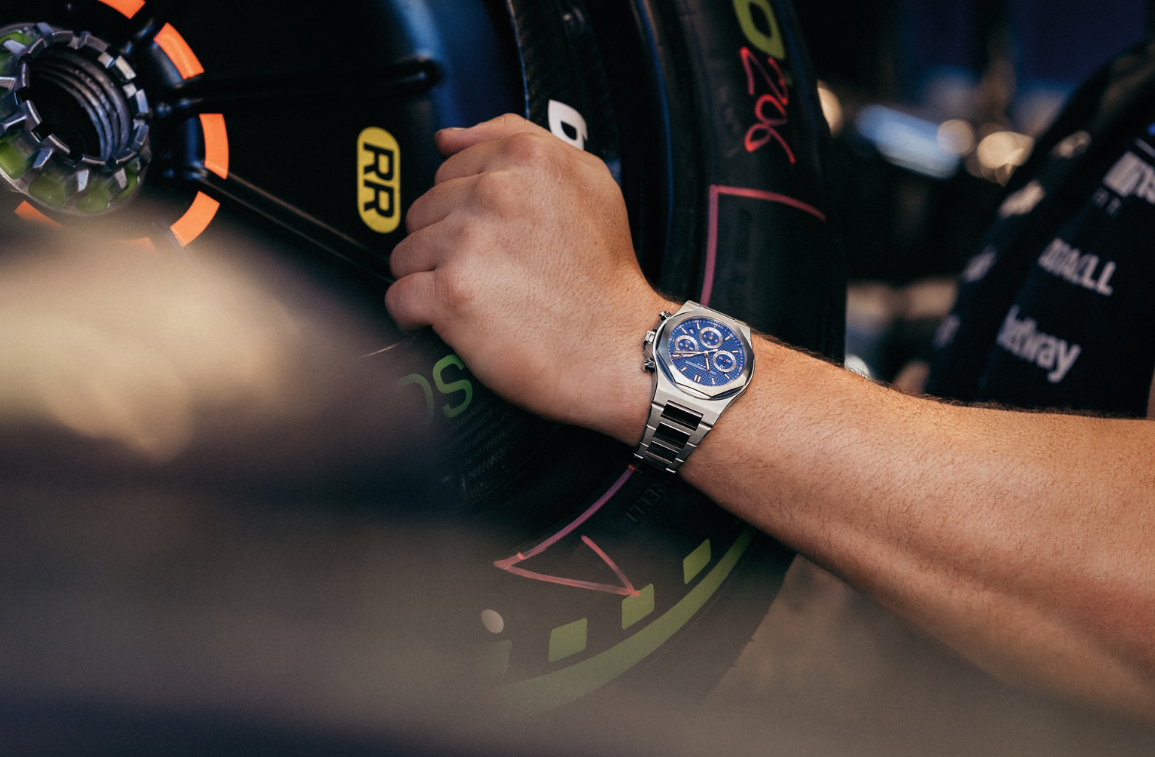
The Swiss watchmaker’s first collaboration with Atlassian Williams F1 Team produces two sporting Laureato models inspired by the team’s 2026 racing car.

Victorian auction buyers will soon receive a piece of information that has traditionally been withheld until bidding reaches it: the vendor’s reserve price. Under new property-sale and underquoting laws, agents must publish the agreed reserve at least seven days before an auction or fixed-date sale. Most changes begin on 1 October 2026 and apply to …
Continue reading “Victoria’s New Auction Rules Will Force Reserve Prices Into the Open”

The Swiss watchmaker’s first collaboration with Atlassian Williams F1 Team produces two sporting Laureato models inspired by the team’s 2026 racing car.
3 minGirard-Perregaux has revealed the first watches created through its partnership with Atlassian Williams F1 Team, bringing the British racing team’s colours to one of Switzerland’s most recognisable integrated-bracelet designs.
The collaboration comprises two 42mm steel watches: the time-and-date Laureato Williams Edition and the more technical Laureato Chronograph Williams Edition.
Both retain the familiar architecture of the Laureato, including its octagonal bezel, integrated bracelet and mix of polished and satin-finished surfaces. The influence of Williams is comparatively restrained, appearing through colour, discreet branding and details inspired by the team’s current Formula 1 car.
It is a welcome departure from the oversized logos and literal automotive references that can characterise motorsport watches.
The Williams FW48 inspires the dial
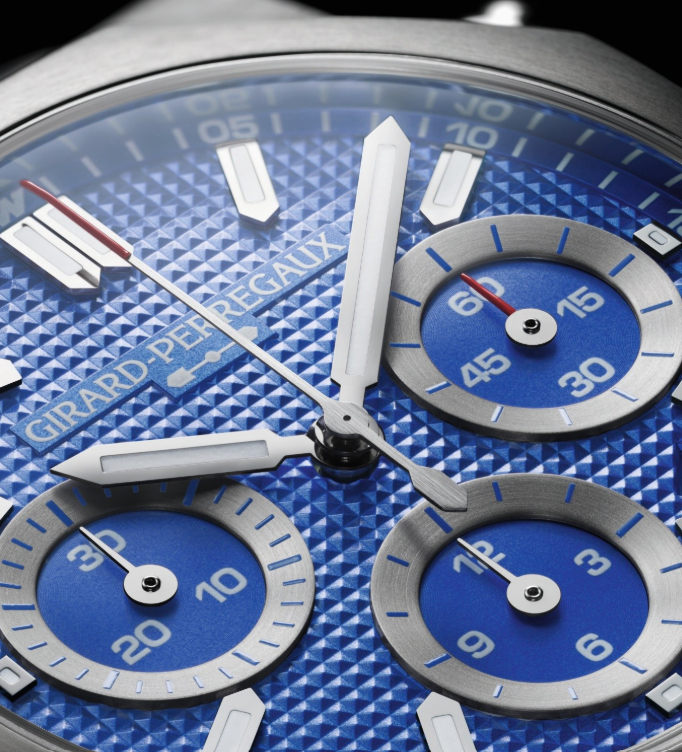
The centrepiece of both models is a blue Clous de Paris dial informed by the livery of the Williams FW48, the car being campaigned by the team during the 2026 Formula 1 season.
A small Williams “W” replaces the conventional marker at 12 o’clock, while the team emblem appears on the sapphire crystal caseback. Red accents echo the keyline used on the FW48 without overwhelming the established Laureato design.
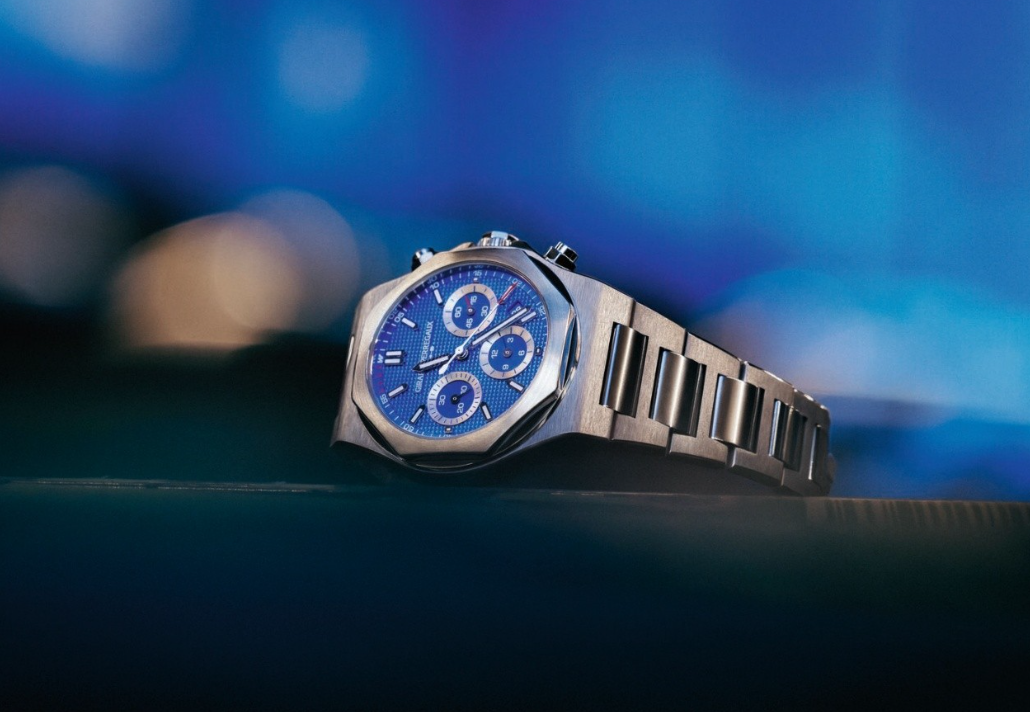
The three-hand model offers the quieter interpretation. Baton-shaped, rhodium-plated hands and hour markers are filled with white-emitting luminescent material, while a date window sits at three o’clock.
The chronograph creates a more obvious connection with motorsport. Three subdials are framed by rhodium-plated rings, with red appearing on the small-seconds hand and the tip of the central chronograph seconds hand.
Both watches measure 42mm across and are water resistant to 100 metres. The standard Laureato has a case thickness of 10.68mm, while the additional mechanics of the chronograph increase its profile to 12.16mm.
Two in-house automatic movements
The Laureato Williams Edition is powered by Girard-Perregaux’s self-winding GP01800 calibre. The movement provides hours, minutes, central seconds and the date, with a minimum power reserve of 54 hours.
The Laureato Chronograph Williams Edition uses the automatic GP03300 calibre, which combines its chronograph functions with a date display and offers a minimum power reserve of 46 hours.
Both movements operate at 28,800 vibrations per hour and can be viewed through their sapphire crystal casebacks.
Their decoration provides a more traditional counterpoint to the Formula 1 association. Finishing techniques include Côtes de Genève, circular graining, bevelling, mirror polishing, satin finishing, engraving and snailing.
The result is less about reproducing the appearance of a racing car than identifying the common ground between two mechanical disciplines: precision, incremental development and the considerable work hidden beneath the finished product.
Parallel histories
The timing of the partnership draws attention to the remarkably similar ages of its two protagonists.
Girard-Perregaux introduced the original Laureato in 1975, establishing an integrated-bracelet sports watch with a distinctive octagonal bezel. Williams entered Formula 1 two years later in 1977.
Both have evolved continuously across the five decades since. The Laureato has moved through different sizes, materials and complications, while retaining its central design language. Williams, meanwhile, has remained one of Formula 1’s most historically significant teams.
That gives the collaboration greater credibility than a simple licensing exercise. Girard-Perregaux and Williams are not being connected solely through the familiar language of speed. Their stronger link is a shared dependence on engineering, testing and the accumulation of specialist knowledge.
The watches are described as the beginning of a longer collaboration, suggesting further Williams editions may follow.
Girard-Perregaux’s international website lists the Laureato Williams Edition at US$16,200 and the Laureato Chronograph Williams Edition at US$20,900. Australian pricing has not been announced.
Specifications
Girard-Perregaux Laureato Williams Edition 42mm
Reference: 81010-11-3680-1GM
Case: Steel
Diameter: 42mm
Thickness: 10.68mm
Crystal: Anti-reflective sapphire crystal
Dial: Blue Clous de Paris pattern
Movement: Automatic GP01800
Functions: Hours, minutes, central seconds and date
Power reserve: Minimum 54 hours
Water resistance: 100 metres
Bracelet: Integrated steel bracelet with triple-folding clasp
International price: US$16,200
Girard-Perregaux Laureato Chronograph Williams Edition 42mm
Reference: 81020-11-3681-1GM
Case: 904L steel
Diameter: 42mm
Thickness: 12.16mm
Crystal: Anti-reflective sapphire crystal
Dial: Blue Clous de Paris pattern with three chronograph counters
Movement: Automatic GP03300
Functions: Chronograph, hours, minutes, small seconds and date
Power reserve: Minimum 46 hours
Water resistance: 100 metres
Bracelet: Integrated 904L steel bracelet with triple-folding clasp
International price: US$20,900

BMW has unveiled the Neue Klasse in Munich, marking its biggest investment to date and a new era of electrification, digitalisation and sustainable design.

A thoughtful timber-led renovation in Byron Bay has reimagined an existing house as a warm, resort-style family sanctuary grounded in natural materials.