Gender pay gap greatest among Australian managers
Kanebridge News
    HOUSE MEDIAN ASKING PRICES AND WEEKLY CHANGE     Sydney $1,702,906 (-1.01%)       Melbourne $1,027,687 (-0.43%)       Brisbane $1,188,506 (-1.17%)       Adelaide $1,040,164 (-1.83%)       Perth $1,093,053 (-0.29%)       Hobart $848,961 (-0.09%)       Darwin $857,095 (-2.30%)       Canberra $982,629 (-1.33%)       National Capitals $1,151,606 (-1.04%)                UNIT MEDIAN ASKING PRICES AND WEEKLY CHANGE     Sydney $794,268 (-0.20%)       Melbourne $545,029 (-0.01%)       Brisbane $775,077 (-0.34%)       Adelaide $575,261 (-0.26%)       Perth $641,686 (-0.65%)       Hobart $577,016 (+0.45%)       Darwin $463,462 (-0.22%)       Canberra $480,245 (-3.79%)       National Capitals $628,545 (-0.43%)                HOUSES FOR SALE AND WEEKLY CHANGE     Sydney 13,829 (-23)       Melbourne 16,088 (-233)       Brisbane 9,659 (+311)       Adelaide 3,284 (+43)       Perth 8,149 (+103)       Hobart 705 (-20)       Darwin 165 (+3)       Canberra 1,168 (+13)       National Capitals 53,047 (+197)                UNITS FOR SALE AND WEEKLY CHANGE     Sydney 9,436 (-87)       Melbourne 6,839 (-122)       Brisbane 2,104 (+7)       Adelaide 566 (+5)       Perth 1,567 (+10)       Hobart 161 (-6)       Darwin 222 (+1)       Canberra 1,230 (-9)       National Capitals 22,125 (-201)                HOUSE MEDIAN ASKING RENTS AND WEEKLY CHANGE     Sydney $870 (-$5)       Melbourne $620 ($0)       Brisbane $700 (-$10)       Adelaide $670 (+$5)       Perth $750 ($0)       Hobart $613 (-$8)       Darwin $850 ($0)       Canberra $750 ($0)       National Capitals $739 (-$2)                UNIT MEDIAN ASKING RENTS AND WEEKLY CHANGE     Sydney $840 (-$10)       Melbourne $630 ($0)       Brisbane $680 ($0)       Adelaide $560 (-$10)       Perth $700 ($0)       Hobart $538 (-$8)       Darwin $650 ($0)       Canberra $595 (-$5)       National Capitals $661 (-$4)                HOUSES FOR RENT AND WEEKLY CHANGE     Sydney 6,441 (-57)       Melbourne 7,404 (-61)       Brisbane 3,528 (-127)       Adelaide 1,303 (-91)       Perth 2,272 (-1)       Hobart 230 (-17)       Darwin 47 (+6)       Canberra 474 (+4)       National Capitals 21,699 (-344)                UNITS FOR RENT AND WEEKLY CHANGE     Sydney 10,223 (-38)       Melbourne 6,146 (-118)       Brisbane 1,994 (-28)       Adelaide 409 (-9)       Perth 799 (-18)       Hobart 78 (+6)       Darwin 89 (+20)       Canberra 765 (+2)       National Capitals 20,503 (-183)                HOUSE ANNUAL GROSS YIELDS AND TREND       Sydney 2.66% (↑)      Melbourne 3.14% (↑)        Brisbane 3.06% (↓)     Adelaide 3.35% (↑)      Perth 3.57% (↑)        Hobart 3.75% (↓)     Darwin 5.16% (↑)      Canberra 3.97% (↑)      National Capitals 3.34% (↑)             UNIT ANNUAL GROSS YIELDS AND TREND         Sydney 5.50% (↓)     Melbourne 6.01% (↑)      Brisbane 4.56% (↑)        Adelaide 5.06% (↓)     Perth 5.67% (↑)        Hobart 4.84% (↓)     Darwin 7.29% (↑)      Canberra 6.44% (↑)        National Capitals 5.47% (↓)            HOUSE RENTAL VACANCY RATES AND TREND       Sydney 1.4% (↑)      Melbourne 1.5% (↑)      Brisbane 1.2% (↑)      Adelaide 1.2% (↑)      Perth 1.0% (↑)        Hobart 0.5% (↓)       Darwin 0.7% (↓)     Canberra 1.6% (↑)      National Capitals $1.1% (↑)             UNIT RENTAL VACANCY RATES AND TREND       Sydney 1.4% (↑)      Melbourne 2.4% (↑)      Brisbane 1.5% (↑)      Adelaide 0.8% (↑)      Perth 0.9% (↑)      Hobart 1.2% (↑)        Darwin 1.4% (↓)     Canberra 2.7% (↑)      National Capitals $1.5% (↑)             AVERAGE DAYS TO SELL HOUSES AND TREND       Sydney 36.5 (↑)      Melbourne 35.4 (↑)        Brisbane 37.5 (↓)     Adelaide 29.0 (↑)      Perth 42.3 (↑)        Hobart 30.9 (↓)     Darwin 30.1 (↑)        Canberra 34.3 (↓)     National Capitals 34.5 (↑)             AVERAGE DAYS TO SELL UNITS AND TREND       Sydney 33.6 (↑)      Melbourne 30.7 (↑)      Brisbane 36.2 (↑)      Adelaide 29.0 (↑)        Perth 39.0 (↓)       Hobart 26.4 (↓)     Darwin 33.1 (↑)      Canberra 38.9 (↑)      National Capitals 33.4 (↑)            
Share Button

Gender pay gap greatest among Australian managers

Detailed earnings information released by the ABS today reveal a clearer picture of the differences between men and women’s pay packets

By KANEBRIDGE NEWS
Wed, Jan 24, 2024 12:23pmGrey Clock 2 min

Women in management experience the greatest hourly pay gap, new data from the Australian Bureau of Statistics shows.

The Survey of Employee Earnings and Hours released today showed the difference between average hourly earnings for men and women in management roles in May 2023 was $14.10 per hour, ABS head of labour statistics, Bjorn Jarvis said. In percentage terms, that represents a 19 percent difference.
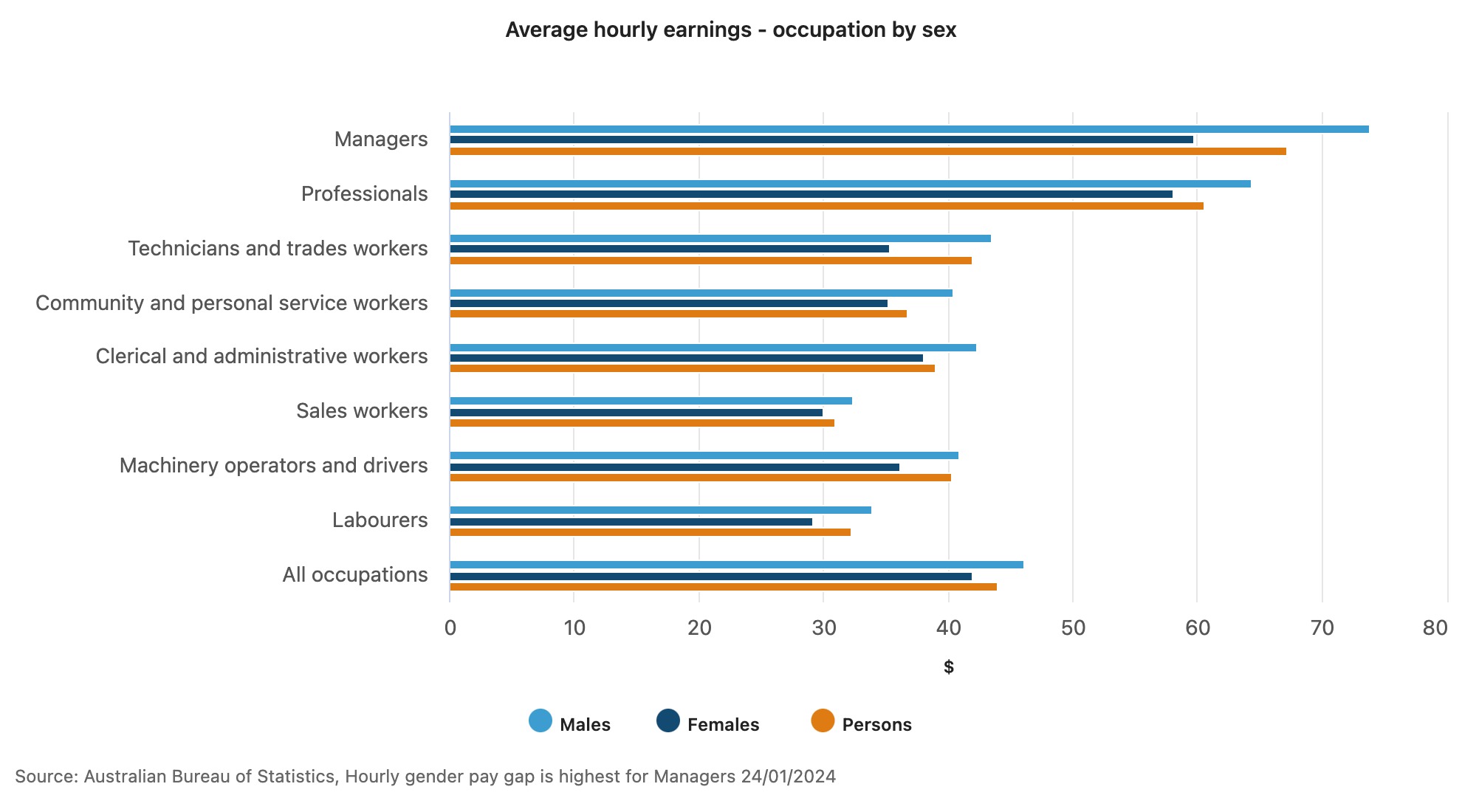
While the gap was starkest at the top level, men continued to earn more per hour across all eight major occupation groups, the statistics revealed, with the smallest gap among sales workers at 7 percent.

In terms of weekly earnings, men earned an average of $1,731 and women $1,261. The average pay for all employees was $1,490 in May 2023.

“Analysing the difference between male and female earnings is complex and there is no single measure that can provide a complete picture,” Mr Jarvis said. “Hourly earnings comparisons are particularly useful in understanding gender pay differences beyond weekly earnings measures, given women are more likely to work part-time than men.”

For part time workers, where women make up the majority at 69 percent of employees, women earn more on average at $817 compared with $759 for men.

“This reflects the greater use of part-time working arrangements by women in higher paying jobs, compared to men,” Mr Jarvis says.

Across the employment sector, distributional data showed that the top 25 percent of workers earned more than $1,956 per week in May 2023 while the lowest 25 percent earned less than $785. On an hourly basis, managers came out on top at $67.20 per hour, followed by professionals at $60.60, followed by labourers ($32.20) and sales workers ($30.90). 


MOST POPULAR

The 1860s Darlinghurst mansion Stoneleigh could become Sydney’s most expensive home ever sold under the hammer when it goes to auction. Clint Ballard is giving buyers a $28 million guide for the heritage-listed mansion on Darley Street, opposite Iona, the former home of Hollywood royalty Baz Luhrmann. Stoneleigh is being offered for sale for the …

Set on one of the city’s last absolute riverfront sites, The Riversdale by Mosaic combines irreplaceable waterfront ownership with one of Brisbane’s most significant residential opportunities.

Related Stories
Money
Australia’s Top 10 Finance Influencers of 2026
By Kanebridge News Editorial 03/08/2026
Money
Why Chasing Yield After the Budget Could Cost You Everything
By Jeni O'Dowd 30/06/2026
Money
$3.6 Million an Hour—and Other Ways to Measure Elon Musk’s Fortune
By THEO FRANCIS, JULIET CHUNG & MAX RUST 29/06/2026
Australia’s Top 10 Finance Influencers of 2026

The voices reshaping how Australians think about money — and why credibility matters more than reach.

By Kanebridge News Editorial
Mon, Aug 3, 2026 6 min

The best financial advice many Australians are receiving right now is not coming from licensed advisers charging by the hour. It is coming through a phone screen, in the ten minutes between work and dinner, from creators who have built credibility the hard way: by being right, being transparent, and being specific in a space where vagueness has always been the easy default.

This is not a ranking by follower count. Follower count is a measure of distribution, not of quality. What follows is a ranking by substance — credentials, accuracy, community depth, and the quality of what an audience actually learns from following these accounts. The distinction matters, because the Australians acting on this content are making real financial decisions with real money.

1- Queenie Tan – Corporate Authorised Representative; Co-Founder & Director, Invest With Queenie & Billroo

There are finance influencers who talk about building wealth, and there are those who document it in real time with receipts. Queenie Tan belongs firmly in the second category. Starting from a $400-per-week income, Tan built her net worth past $1 million while publishing the actual numbers — income, savings rate, investment decisions — for an audience of more than 400,000 across platforms.

She is a Corporate Authorised Representative, co-founder of the personal finance app Billroo, and the author of a book that has become a practical reference for young Australians navigating ETFs, superannuation and property. What separates her from the crowded field of money educators is precision: she does not talk in principles when she can talk in percentages.

Photo: @investwithqueenie

2- Alan Kohler – Editor-in-Chief, Eureka Report; Editor-in-Chief, InvestSMART Group; ABC News finance presenter, host of Inside Business.

If Queenie Tan represents the new wave of personal finance creators, Alan Kohler represents something the new wave will spend decades trying to build: institutional credibility that has survived multiple economic cycles. As Editor-in-Chief of the Eureka Report and InvestSMART Group, and a decades-long presence on ABC News, Kohler has spent more than thirty years making financial analysis accessible without dumbing it down.

His coverage of RBA decisions, market movements and economic policy is cited by podcasters, journalists and fund managers alike. He is not chasing virality. He does not need to.

Photo: Alan Kohler

3- Aleks Nikolic – Corporate lawyer; host, Big Swinging Stocks podcast

Most finance creators address the mechanics of money. Aleks Nikolic addresses the psychology — and that distinction explains why her following is as loyal as it is. Operating as Broke Girl Wealth across Instagram, TikTok and YouTube, Nikolic covers ETFs, crypto and investment strategy, but her real differentiator is a willingness to discuss the emotional architecture of financial decision-making.

Shame around debt. Fear around market volatility. The limiting beliefs that stop people acting on what they already know. In a space where confidence is routinely performed, her candour is a genuine competitive advantage.

Photo: @brokegirlwealth

4- Bryce Leske & Alec Renehan – Equity Mates Media

Equity Mates did not build a following. They built a media company. What began as a podcast by two friends learning to invest has grown into Australia’s most established investing media brand, covering ASX stocks, ETFs, global markets and fund manager interviews across podcast, social and YouTube.

The longevity is the credential. Equity Mates has operated through multiple market cycles, a global pandemic, and a generational shift in how Australians engage with investing — and its audience has grown through all of it. When the hosts speak, their listeners know they have been paying attention for years.

Photo: Equity Mates

5- The Lazy CEO – CEO & Founder, Showpo; Shark Tank Australia investor

The metric that matters most on social media is not followers — it is engagement, because engagement signals trust. Jane Lu, known as The Lazy CEO, maintains an engagement rate of approximately 1.15 per cent on Instagram, which is exceptional for a finance account of his size. Her 242,000-plus followers are not passive consumers: they ask questions, share experiences and apply what they read.

Her content focuses on business finance and wealth building, and the active comment sections are the clearest possible evidence that her audience does not merely scroll past.

Photo: @thelazyceo

6- Tash Invests – Founder, Tash Lends; Forbes Australia 30 Under 30

Tash Invests built her following on a premise that sounds simple but is rarer in practice than it should be: she publishes the actual numbers. Not approximations or ranges or anonymised case studies — her salary, her savings rate, her portfolio value, her net worth, updated and on the record.

Having bought her first property at twenty-two and grown her documented net worth past $1 million, she has become the primary reference point for young Australians trying to understand what building wealth on a moderate income genuinely looks like. The specificity is the product.

Photo: @tashinvests

7- David Scutt – APAC Market Analyst at StoneX Group

The authority of most finance social media content rests on research and reading. David Scutt‘s authority rests on having done the job. A former Treasury Dealer at Arab Bank and the Commonwealth Bank, former ASX Business Supervisor, and former Global Markets Editor at Business Insider Australia and anchor at ausbiz TV, Scutt now brings that direct market experience to his role as APAC Market Analyst at StoneX Group, rather than relying on secondary commentary.

When he discusses foreign exchange movements or ASX dynamics, it is not because he has read about them. It is because he has traded them.

Photo: David Scutt

8- Meddy Demars – Investing & crypto content creator

The gap Meddy Demars fills is specific and underserviced: connecting global macroeconomic events to the practical reality of Australian investors. When the US Federal Reserve adjusts interest rates, when inflation data moves, when commodity prices shift — most Australian finance content either ignores the local implications or translates them poorly.

Demars, operating across TikTok and Instagram from Sydney, does the translation well: explaining what global conditions mean for Australian stocks, savings rates and investment portfolios in terms that are accessible without being condescending.

Photo: Meddy Demars

9- Simran Kaur – Founder, Friends That Invest

Friends That Invest is arguably the most successful community-building exercise in Australian personal finance, and Simran Kaur is the reason why. The New Zealand-based creator — whose audience is predominantly Australian — built a podcast, a book and a social media presence around a single insight: that the personal finance world was not speaking to young women, and that the consequences of that gap were significant.

The measurable cultural shift that followed — women engaging with investing concepts in communities that had not previously existed — is the kind of impact that most financial literacy programmes aim for and rarely achieve.

Photo: @friendsthatinvest

10- Effie Zahos – Money Editor at 9News

Effie Zahos is one of Australia’s most recognised financial commentators, appearing regularly across 9News, A Current Affair, Today and Today Extra as 9News Money Editor. Her role puts everyday money questions, from mortgage rates to cost-of-living pressures, in front of a national broadcast audience.

Before television, she spent years as editor of Money magazine, building the editorial foundation for her current commentary. She is also Director and Money Commentator at InvestSMART, an ambassador for Canstar, and a published author, with her financial advice available in print as well as on screen.

That combination, decades of editorial experience, an active broadcast presence, and a body of published work, is what makes her commentary carry weight beyond any single platform or post.

Photo: @effiezahos

The common thread across this list is not follower count or platform presence. It is that each creator has built an audience willing to act on what they say, and for the Australians making financial decisions off the back of this content, that trust is the only thing that actually matters.

MOST POPULAR

Australia’s market is on the move again, and not always where you’d expect. We’ve found the surprise suburbs where prices are climbing fastest.

The sports-car maker delivered 279,449 cars last year, down from 310,718 in 2024.

Related Stories
Lifestyle
One Night. One Chef. One Chance: Join Dan Arnold for Michelin-Inspired Dining
By Staff Writer 15/09/2025
Money
Louis Vuitton Owner LVMH Closes Year-End Quarter With Weak Sales Growth
By MAURO ORRU 28/01/2026
Property
Charming 1840s Berrima Residence Lists in the Highlands’ Most Sought-After Village
By Kirsten Craze 14/11/2025
0
    Your Cart
    Your cart is emptyReturn to Shop