Does a ‘Status Handbag’ Still Have Status in 2024? We Investigate.
Some designer handbags like the Hermès Kelly have implied power. But can a purse alone really get you a restaurant table—or even a job?

 6 min
6 min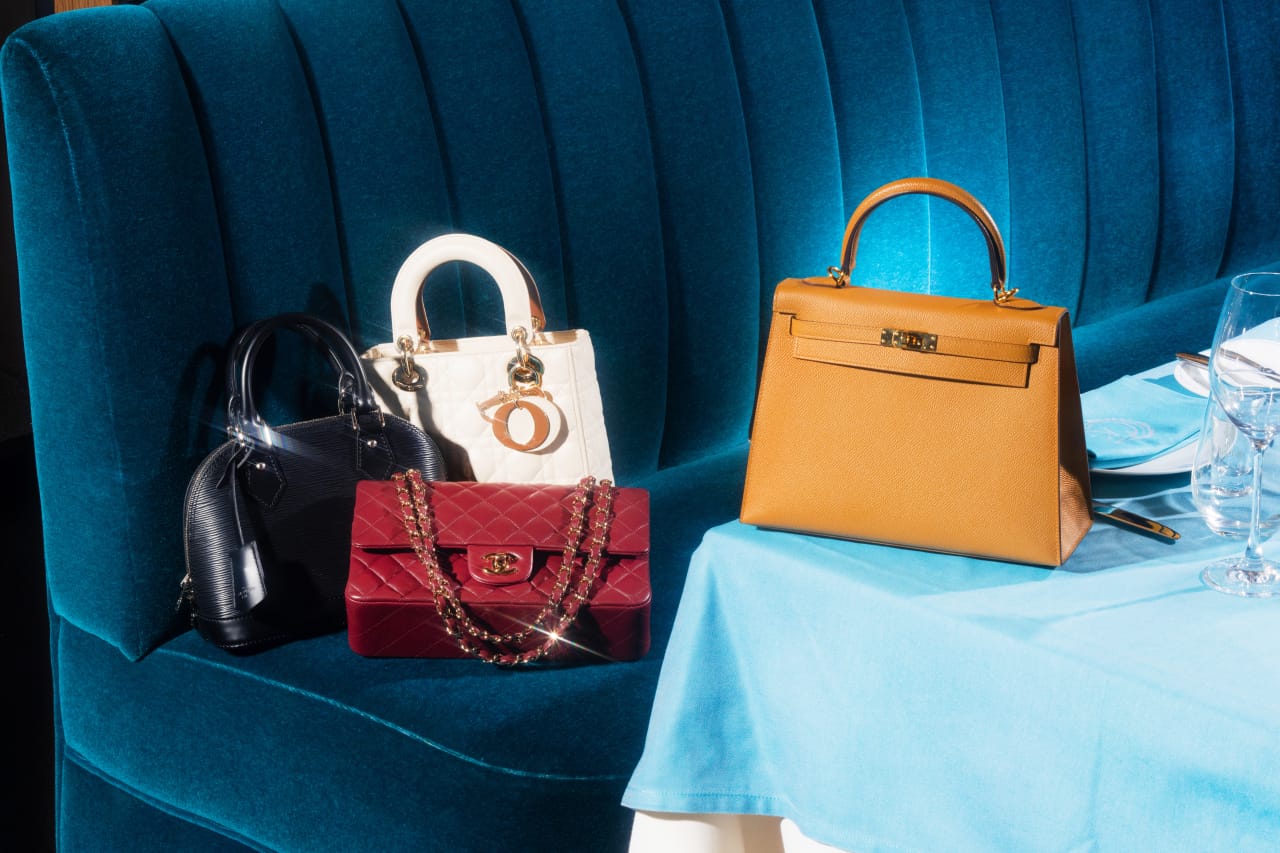
LIKE MARVEL VILLAINS, most fashion writers have origin stories. Mine began with a navy nylon Prada purse, salvaged from a Boston thrift store when I was a teen in the 1990s. Scuffed with black streaks and sagging, it was terribly beat-up. But I saw it as a golden ticket to a future, chicer self. No longer a screechy suburban theatre kid, I would revamp myself as sophisticated, arch, even aloof. The bag, I reasoned, would lead the way.
That fall, I slung it against my shoulder like a shotgun and marched into school, where a girl far more interesting than I was called out, “Hey, cool bag.” After feigning apathy —“I don’t know, you could use a Sharpie on a lunch bag and it would look the same”—we became friends. She introduced me to a former classmate who worked at a magazine. That woman helped me get an internship, which led to a job.
Twenty years later, I still wonder how big of a role that Prada purse played in my future—and whether designer bags can function as a silent partner in our success. Branded luxury bags took off in 1957, when Grace Kelly posed with an Hermès bag in Life magazine. (Hermès renamed that bag “the Kelly” in 1973.) The term “status bag” was popularised in 1990 by Gaile Robinson in the Los Angeles Times, describing any purse that projects social or economic power. Not surprisingly, these accessories are costly. Kelly bags cost over $10,000; ditto Chanel’s 11.22 handbag. Some bags by Louis Vuitton and Dior command similar price points. The cost isn’t repelling customers—both brands reported revenue surges in 2023. But isn’t there something dusty about the idea that a branded bag carries meaning along with your phone and wallet? How much status can a status bag deliver in 2024?
Quite a lot, said Daniel Langer, a business professor at Pepperdine University and the CEO of Équité, a Swiss luxury consulting firm. Beginning in 2007, Langer showed a series of photo portraits to hundreds of people across Europe, Asia and the U.S., then asked them 60 questions. Those pictured carrying a luxury handbag were seen as “more attractive, more intelligent, more interesting,” he said. The conclusion was “so ridiculous” to Langer that he repeated the studies several times over the next decade and a half. The results were always the same: “Purchasing a ‘status bag’ will prepare you to be more successful in your social actions. That is the data.”
Intrigued, I gathered various Very Important Purses—I borrowed some from friends, and others from brands—to see if they could elevate my station with the same unspoken oomph as a “Pride and Prejudice” suitor.
First, I took Alaïa’s Le Teckel bag—a narrow purse resembling an elegant flute case and carried by actress Margot Robbie—to New York’s Carlyle Hotel on a Saturday night. The line for the famous Bemelmans Bar stretched to the fire exit. “Can I get a table right away?” I asked the host, holding out my bag like a passport before an international flight. “It’s very busy,” he said in hushed tones. “But come sit. A table should open soon.” I sank into one of the Carlyle’s lush red sofas and sipped a martini while waiting—a much nicer way to kill 30 minutes than slumped against a lobby wall.
Wondering if this was a one-time thing, I called up Desta, the mononymous “culture director” (read: gatekeeper) who has worked for Manhattan celebrity hide-outs like Chapel Bar and Boom, the Standard Hotel bar that hosts the Met Gala’s official after party. “Sure, we pay attention to bags,” he said. “Not too long ago at Veronika,” the Park Avenue restaurant where Desta also steered the social ship, “we had one table left. A woman had a Saint Laurent bag from the Hedi Era,” he said, referencing Hedi Slimane , the brand’s revered designer from 2012 to 2016. “I said, ‘Give her the table. She appreciates style. She’ll appreciate this place.’”
Some say a status bag can open professional doors, too. Cleo Capital founder Sarah Kunst, who lives between San Francisco and London, notes that in private-equity circles, these accessories can act as a quick head-nod in introductory situations. Kunst says that especially as a Black woman, she found a designer bag to be “almost like armour” at the beginning of her career. “You put it on, and if you’re walking into a work event or a happy hour where you need to network, it can help you fit in immediately.” She cites Chanel flap bags made from the brand’s signature quilted leather and stamped with a double-C logo as an industry favourite. “People love to talk about them. They’ll say, ‘Ohhh, I love your bag,’ in a low voice.” They talk to you, said Kunst, “like you’re a tiger.”
For high-stakes jobs that rely on commissions—sports agents or sales reps, for instance—a fancy handbag can help establish credibility. “It says, ‘I’m succeeding at my job,’” said Mary Bonnet, vice president of the Oppenheim Group, the California real-estate firm at the centre of Netflix reality show “Selling Sunset.” As a new real-estate agent in her 20s, Bonnet brought a fake designer bag to a meeting. To her horror, a potential buyer had the real thing. “I work in an industry where trust is important, and there I was being inauthentic. That was a real lesson.” Now Bonnet rotates several (real) Saint Laurent and Chanel bags, but notes that a super-expensive purse could alienate some clients. “I don’t think I’d walk into [some client homes] with a giant Hermès bag.”
Hermès bags are supposedly the apex predator of purses. But I didn’t feel invincible when I strapped a Kelly bag around my chest like a pebbled-leather ammo belt. The dun-brown purse cost $11,800, a sum that prompted my boyfriend to ask if I needed a bodyguard. Shaking with “is this insured?” anxiety, I walked into a showing for an $8.5 million apartment steps from Central Park. I made it through the door but was soon stopped by a gruff real-estate agent asking if I had an appointment. No, but I had an Hermès bag? Alas, it wasn’t enough. The gleaming black door closed in my face.
“What went wrong?” I asked Dafna Goor, a London Business School professor who studies the psychology behind luxury purchases. “You felt nervous,” she replied. “That always makes others uncomfortable, especially in a high stakes situation,” like an open house with jittery agents. Goor said recognisable bags from Louis Vuitton and Christian Dior are also often faked, which can lead to suspicion if not paired with “other signals of wealth.”
“You can’t just treat a bag as a backstage pass,” said Jess Graves, who runs the shopping Substack the Love List. Graves says bags are more of a secret code shared between potential connections. “I’ve been in line for coffee and a woman will see my Margaux [from the Row] and go, ‘Oh, I know that bag.’ Then we’ll chat.” Graves moved from Atlanta to Manhattan in 2023, and says she’s made some new, local friends thanks to these “bag chats.”
I had my own bag chat that night, when I brought Khaite’s Olivia—a slim crescent of shiny maroon leather—to a house party thrown by a rock star I’d never met. In fact I knew hardly any guests, but as I stood in the kitchen, a woman in vintage Chanel pointed to my bag and asked, “How did you get that colour? It’s sold out!” Before I could tell her my name, she told me the make and model of my purse. Then she laughed about her ex-boss, a tech billionaire, and encouraged me to buy some cryptocurrency. The token I picked surged nearly 30% in about a week. Now I was onto something—a status bag that might bring not just status, but an actual market return.
Thanks to their prominence on social media, certain bags have gained favour among Gen Zers. “TikTok and Instagram make some luxury items even more visible and more desirable to young people,” said Goor. I experienced this firsthand on a stormy Saturday morning, when a girl in a college hoodie pointed at my Miu Miu Wander bag as I puddle-hopped through downtown New York. The piglet-pink purse is a TikTok favourite seen on young stars like Sydney Sweeney and Hailey Bieber. “Your bag is everything!” yelled the girl from the crosswalk. “Thanks, can I have your umbrella?” I shouted back. She laughed and left. My Wander had made a splash—but it couldn’t keep me dry. I ran to the subway, soaked. The bag looked even better wet.
Changing the Status Bag Quo
Everyone loves an ingénue—fashion insiders included. Perhaps that’s why at Paris Fashion Week in September, newer handbags from Bottega Veneta and Loewe jostled for space and street-style flashbulbs.
“These bags, especially ones by independent labels like Khaite, are quieter signals of cultural access,” explained Goor. “Everyone knows what an Hermès Kelly bag is. So now there need to be new signals” beyond traditional status bags to convey power.
Sasha Bikoff Cooper, a Manhattan interior designer, says there’s a less cynical explanation for why these bags have captured celebrity fans—and more important, paying customers. “They’re fresh and also beautiful,” she said. “Hermès is always classic. It’s like a first love. But you want newness, too.”
The Wall Street Journal is not compensated by retailers listed in its articles as outlets for products. Listed retailers frequently are not the sole retail outlets.
 Copyright 2020, Dow Jones & Company, Inc. All Rights Reserved Worldwide. LEARN MORE





From making unpopular decisions to learning when to listen, leaders from five businesses reveal what nobody prepared them for — and how running a company has challenged their expectations.

Technology and semiconductor shares fell sharply as investors questioned the debt financing the AI infrastructure boom and confronted higher rates and Chinese competition.

Technology and semiconductor shares fell sharply as investors questioned the debt financing the AI infrastructure boom and confronted higher rates and Chinese competition.
4 minA sharp technology sell-off has exposed a new anxiety on global markets: whether the enormous borrowing behind the artificial-intelligence infrastructure boom can generate sufficient returns as interest rates rise and Chinese competition intensifies.
The artificial-intelligence investment boom has powered technology shares, semiconductor manufacturers and data-centre operators to extraordinary heights. Last week, investors were given a reminder that much of this expansion is being built with borrowed money.
The technology-heavy Nasdaq Composite fell 4.5 per cent over the week ended October 16, its weakest performance since late June. Semiconductor shares suffered an even deeper correction, with the Philadelphia Semiconductor Index losing about 11.4 per cent.
The selling spread quickly through global markets. Micron Technology fell 14.6 per cent over the week, while South Korea’s Samsung Electronics and SK Hynix dropped approximately 18 per cent and 24 per cent respectively.
This was more than a routine bout of profit-taking. Investors were reassessing three interconnected risks: higher interest rates, the rapidly expanding debt burden attached to AI infrastructure and the prospect of stronger competition from Chinese memory-chip manufacturers.
The debt behind the AI build-out
Artificial intelligence requires a physical infrastructure network of enormous scale. Data centres must be built, advanced processors purchased, power supplies secured and cooling systems installed before customers begin generating meaningful revenue from them.
Technology companies are increasingly supplementing their own cash with corporate bonds, syndicated loans, equipment leases, private credit and project-level financing.
JPMorgan describes the emerging funding model as a combination of conventional corporate borrowing and project finance tied to individual data-centre assets. In Australia, the Reserve Bank estimates that syndicated loans accounted for approximately three-quarters of data-centre financing during 2025 and 2026 to date.
The numbers are becoming large enough to affect broader credit markets. The Federal Reserve Bank of Dallas has cited Wall Street estimates suggesting AI-related investment-grade bond issuance could approach US$300 billion in 2026 alone.
That borrowing is not automatically problematic. Debt can be an efficient way to finance long-lived infrastructure when future revenue is sufficiently predictable. The concern is that AI technology, customer demand and computing economics are changing much faster than the repayment schedules attached to the assets.
A data centre financed today may carry debt for years. Investors must therefore make assumptions about future utilisation rates, electricity prices, chip performance, customer concentration and the amount businesses will ultimately pay for AI computing.
When interest rates rise, those assumptions become less forgiving.
Inflation changes the calculation
September’s US inflation data intensified the pressure. Consumer prices increased 3.7 per cent over the year, ahead of market expectations and up from 3.4 per cent in August.
The hotter reading reduced confidence that interest rates would fall quickly and pushed bond yields higher. That matters particularly for companies whose valuations depend on profits expected well into the future, as well as highly leveraged infrastructure operators that may need to refinance.
CoreWeave has emerged as a closely watched test case. The specialist cloud-computing company has accumulated substantial debt and lease obligations to build AI capacity, while relying on a concentrated group of large technology customers.
Its shares fell sharply during the sell-off, while the cost of insuring its debt against default climbed. CoreWeave has argued that its contracted backlog more than covers its obligations and that financial markets do not always understand its business model. Nevertheless, its securities have become a proxy for investor confidence in debt-funded AI infrastructure.
Oracle, another major investor in AI computing capacity, fell 8.8 per cent in Friday trading, while CoreWeave dropped 15.5 per cent.
The question is shifting from how much AI infrastructure can be built to how profitably it can be operated.
China adds another source of pressure
Interest rates were not the only catalyst. Reports of advances by Chinese memory-chip producer ChangXin Memory Technologies raised concerns that lower-cost Chinese products could increase competition across the global semiconductor industry.
Memory chips are essential to AI systems, but the industry is historically cyclical. Periods of tight supply and high pricing can encourage rapid investment, eventually producing oversupply and falling margins.
The prospect of a well-funded Chinese competitor expanding its technological capabilities unsettled investors in Samsung, SK Hynix and Micron. It also demonstrated that AI-related demand does not insulate chipmakers from conventional competitive pressures.
That combination—slower rate cuts, more expensive financing and potentially cheaper supply—challenged the assumption that every company exposed to AI would enjoy continually expanding margins.
A reset rather than the end of the boom
The sell-off does not establish that the AI boom is ending. Demand for computing power remains strong, the largest technology companies continue to generate formidable cash flows and many infrastructure projects are backed by long-term customer contracts.
What has changed is the market’s willingness to overlook the price and financing structure of that growth.
The most resilient companies are likely to be those able to fund investment from operating cash flow, secure long-duration customers and demonstrate that new capacity will earn returns comfortably above its financing costs.
More speculative operators may face greater scrutiny, particularly where debt is expensive, customers are concentrated or expected revenue depends on demand that has not yet materialised.
For Australian investors, the lesson extends beyond US technology shares. Local data-centre operators, infrastructure funds, electricity suppliers and property groups are increasingly exposed to the same investment cycle.
Artificial intelligence may remain one of the defining growth themes of the decade. But last week’s correction showed that enthusiasm for the technology does not eliminate financial discipline.
The next stage of the AI boom will be judged not only by computing power, model performance or demand for chips, but by something more traditional: whether the assets being financed can generate enough cash to repay the money borrowed to build them.
Fact box
Nasdaq Composite: Down 4.5 per cent for the week ended October 16, 2026
Philadelphia Semiconductor Index: Down approximately 11.4 per cent
Micron Technology: Down approximately 14.6 per cent
Samsung Electronics: Down approximately 18 per cent
SK Hynix: Down approximately 24 per cent
US September inflation: 3.7 per cent annually
Estimated 2026 AI-related investment-grade issuance: Approximately US$300 billion

A 30-metre masterpiece unveiled in Monaco brings Lamborghini’s supercar drama to the high seas, powered by 7,600 horsepower and unmistakable Italian design.

From farm-to-table Thai to fairy-lit mango trees and Coral Sea vistas, Port Douglas has award-winning dining and plenty of tropical charm on the side.