Five Wall Street Investors Explain How They’re Approaching the Coming Year
Here’s how they are looking at artificial intelligence, interest rates and economic pressures.

 4 min
4 min
The S&P 500 just completed one of its best three-year runs ever, rising around 80% from the start of 2023 through New Year’s Eve. Wall Street thinks the party is just getting started.
Few expect the good times to keep rolling indefinitely, but you would be hard-pressed to find a major bank predicting anything except more gains in 2026.
Yet worries abound about the stretched valuations of artificial-intelligence companies, the path of interest rates and the outlook in Washington, D.C.
So we asked five investors where they’re putting their money:
Alex Chaloff
Count Alex Chaloff among the investors concerned about a reckoning with the huge gains in AI stocks.
The chief investment officer at Bernstein Private Wealth Management fielded questions from clients on the topic all last year.
After several years of huge returns, he is advocating a more surgical approach to picking stocks.
“On one hand, they’re thrilled with the returns. On the other, they’re scared of what the next chapter is, because I’ve been telling them: It’s 1990-something,” Chaloff said, referring to the final years of the dot-com bubble.
“Our view is that we still have room to run, but there will be an end to this.”
Chaloff isn’t selling out of AI, but he is happy to help concerned clients seeking protection against declines in the whole index or a handful of individual big tech stocks.
One tool he is using is buffered exchange-traded funds, which seek to smooth out market swings. Those offer “some upside exposure with either defined or variable protection, and a great level of visibility, transparency and liquidity,” he said.
Bernstein is also working on an “AI loser” list, screening specifically for companies with high debt loads and low free-cash flow—those that have gotten AI hype, but might lack the fundamentals to survive an arms race.
He also holds an upbeat outlook for U.S. growth, especially if the Supreme Court ends up striking down President Trump’s tariffs: “I think that possibility is being overlooked a bit. It could reduce inflationary pressures, allow more rate cuts and accelerate the economy.”
Saira Malik
Tech bulls point out a key difference between now and the dot-com bubble: Today’s most-valuable companies, such as Nvidia, Microsoft and Alphabet, are some of the most profitable in history. And those profits are growing fast.
Saira Malik , who oversees $1.4 trillion as chief investment officer at Nuveen, thinks there is more upside ahead to the technology and AI trade, and she plans to add to some of her favorite holdings in 2026. It all comes down to profits.
The Magnificent Seven tech companies plus chip maker Broadcom —a group Malik is now referring to as the “Great Eight”—are forecast to grow earnings by 24% this year, well over double the forecast for the S&P 500 as a whole.
“We think the earnings growth and future growth justifies the premium valuations in tech, which will continue to dominate and lead the S&P 500 higher,” Malik said.
Tech stocks’ years long dominant run has made a handful of the biggest companies a larger share of the S&P 500 index than ever, making some investors fret over concentration risk. Malik shrugs those concerns off.
“I don’t necessarily say the market has to broaden out for it to be healthy. We’ve been living in this world of tech dominance for basically a decade straight…as long as the earnings power is there, the stocks will follow,” she said.
Outside of stocks, Nuveen expects municipal bonds and private equity both to bounce back in 2026.
Heavy supply of new muni bonds led to them lagging behind taxable bonds last year, a trend that Malik expects to reverse in a “catch-up trade.” Private equity, meanwhile, stands to benefit from lower interest rates and a pickup in deal activity, she has told clients.
Jack Ablin
Concentration risk isn’t just a stock-market issue, says Jack Ablin , chief investment strategist at Cresset Capital. He worries about the growing share of consumer spending coming from wealthy individuals, which he said puts the economy at risk as well.
“We have a narrowing prosperity on both Wall Street and Main Street, and it probably does create a vulnerability. A minority of the participants are accounting for most of the results,” Ablin said.
Stock owners are feeling a wealth effect that leads to freer spending. That could change quickly during a market downturn, however, leading to a scenario where a drop in the stock market could push the economy into a recession, Ablin said.
Cresset has leaned into value stocks and small-caps recently, expecting that both will benefit from interest-rate cuts and lower financing costs this year.
When it comes to AI, Ablin isn’t ready to pick winners and losers.
“I don’t have a crystal ball. So we buy everything for now, and the winners will ultimately pay for the losers.
Larry Adam
Raymond James Chief Investment Officer Larry Adam thinks stocks will have a more modest 2026, projecting around a 4% gain for the S&P 500.
Equity valuations will struggle to move higher than they currently are, meaning those gains will need to come from earnings growth, he said.
“I think the market is vulnerable to some disappointment after going so long with remarkably low volatility,” he said.
Raymond James is adding to bets on the industrials and consumer discretionary sectors this year. Industrials look like an indirect AI play, since they act as suppliers to utility companies and others helping build out AI infrastructure.
Consumer discretionary stands to benefit from a pickup in consumer spending, Adam reckons, with major tax refunds from the One Big Beautiful Bill Act set to hit pockets this spring.
Rob Arnott
Is there an AI bubble? Rob Arnott says yes, though the Research Affiliates founder and chairman cautions that it isn’t easy to profit on that idea.
“Shorting a bubble is a very fast way to go bankrupt. Bubbles can last longer and go further that you can imagine,” he said.
Like many on Wall Street, Arnott is convinced that AI is the “real deal” and a technological revolution is coming.
But he also warned that technological revolutions take time to play out—and said it is far too early to know which companies will emerge from the pack. During the dot-com boom, he said, Lucent and Nokia numbered among the world’s most-valuable companies.
“Dating back to the industrial revolution, every time you see major disruption there are winners and losers. A lot of losers,” he said. “The disrupters get disrupted.”
Arnott is now running a strategy that automatically trims exposure to stocks if their valuations soar quickly. “Just like averaging in is a time-honoured way to build a position in something cheap, averaging out is a great way to reduce exposure to what’s frothy and expensive,” he said.
With the profits taken from trimming exposure to fast-growing names, Arnott is putting money into areas that look cheaper and less loved, such as international and value stocks, to boost diversification.
 Copyright 2020, Dow Jones & Company, Inc. All Rights Reserved Worldwide. LEARN MORE





Waldorf Astoria Kuala Lumpur is scheduled to open on 30 October, introducing the Hilton luxury brand to Malaysia with an all-suite hotel in the city’s Golden Triangle.

Located steps from Crows Nest Metro, the near-complete development brings luxury living to Sydney’s Lower North Shore.

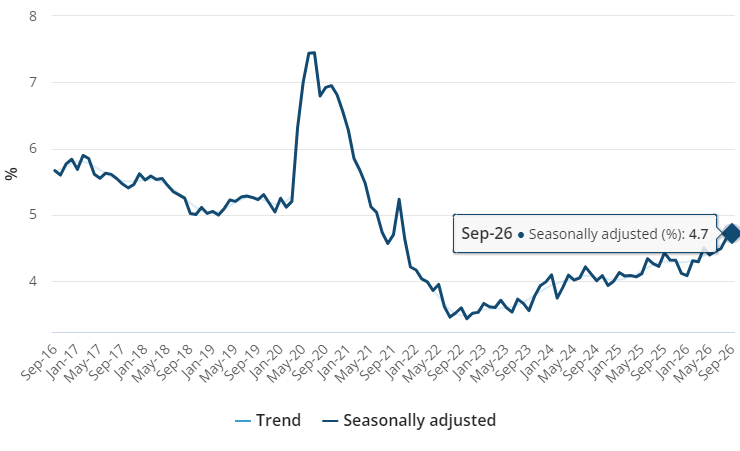
Employment fell by 39,300 and unemployment held at a revised 4.7 per cent, giving the RBA more room to pause in November.
2 min
Australia’s labour market weakened in September, reducing—but not eliminating—the case for another Reserve Bank rate rise in November.
The seasonally adjusted unemployment rate was 4.7 per cent, according to the Australian Bureau of Statistics. August was revised to the same level, while September employment fell by 39,300 people. The number of unemployed Australians increased by 8,900 to 732,000.
The weakness extended beyond the headline rate. The employment-to-population ratio fell 0.3 percentage points to 63.6 per cent, participation declined 0.2 points to 66.8 per cent and underemployment edged up to 6.3 per cent. Part-time employment fell by 73,700, partly offset by a 34,400 increase in full-time work.
For the RBA, this is a clearer sign that restrictive monetary policy is cooling demand. Higher unemployment and falling employment reduce wage pressure over time and increase the risk that another rate rise would push the economy harder than necessary.
That makes a November increase less certain. It does not make a hold inevitable. The RBA must balance labour-market softness against inflation, and the September-quarter consumer price index due later in October will carry more direct weight in the decision.
For mortgage holders and property investors, the practical conclusion is not to trade one data release. Borrowers should continue testing repayments at higher rates, preserve liquidity and avoid basing a purchase on an assumed near-term reversal. Refinancing decisions should be assessed against total cost, not simply the advertised rate.
Property markets may initially welcome a reduced probability of another increase because borrowing capacity and sentiment are highly rate-sensitive. But a weakening labour market is not unambiguously positive for housing: job security supports mortgage serviceability, rental demand and buyer confidence.
The September numbers have given the RBA a credible reason to wait. Inflation will determine whether it can use it.

Ophora Tallawong has launched its final release of quality apartments priced under $700,000.

The PG rating has become the king of the box office. The entertainment business now relies on kids dragging their parents to theatres.