Everyone’s Over ‘Quiet Luxury.’ Here’s What’s Next
Cosy silhouettes and sumptuous fabrics were throughlines of the fashion collections shown last week in Milan

 3 min
3 min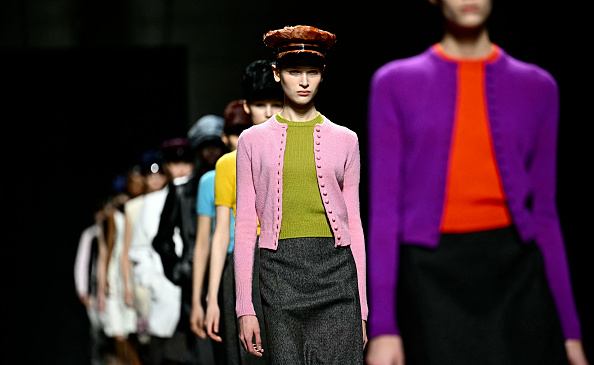
“Quiet luxury” has become a bit of a dirty phrase in Milan. To some at the Italian brands that embody the term , it’s reductive—an overly TikTok-ified way of describing classic, refined clothing. Many fashion industry people roll their eyes when it comes up.
Brunello Cucinelli , one of the kings of natural textiles, prefers the term “gentle luxury.” At his fall presentation in Milan this past week, the (extremely expensive) clothing at which he excels looked especially touchable. Cashmere sweatsuits were layered with blanket-like scarves and silky suiting hung in loose pleats. Even an evening look, composed of a black sweater tucked into a feathered skirt, appeared comfy. Holding a pillowy bag, one Brunello disciple called it “accogliente”—Italian for “cozy.”
One step beyond coziness is protection, and there was plenty of that in Milan, too. Chalk it up to an uncertain luxury market , the roiling geopolitical climate or global warming, but using clothing as a sanctuary seemed to be on many designers’ minds. For some, like the excellent Brioni La Donna and Loro Piana collections, that means impeccable tailoring and forever-worthy double-breasted coats. Others, like Luke and Lucie Meier at Jil Sander, took the cocooning more literally, making succulent, quilted floor-length capes.
Not everyone is swaddling themselves in shearling. Architect Bianca Censori, who joined her companion, the rapper Ye, at the Marni show, wore a mere scrap of leather that failed to cover her buttocks among other body parts. No protection needed—except her bodyguard.
The Look of Love at Prada
Miuccia Prada and Raf Simons, the co-creative directors of Prada, are on quite a roll. If you were feeling hyperbolic, you might even say that they’re making fashion history. The duo’s fall collection started with thinking about love, explained Simons backstage, but “all the elements of love,” including loving your home, or even loving your sheets. There’s that theme of comfort again.
That manifested in a romance for different eras of fashion, remixed: A Jackie O. linen shift dress shot through with a streak of shearling. A leather bomber jacket embellished with “1913,” the year Prada was founded. A twin set in shocking red and ultraviolet. High-tech nylon jackets in midcentury couture shapes.
“There is no way to think about the future unless you have a good understanding of the past,” said Simons.
Everyday Allure at Bottega Veneta
In less than four years, Matthieu Blazy has completely renewed Bottega Veneta, making it a cult spot for creative types that want unique clothing and accessories with plenty of craftsmanship. Without succumbing to naked dresses and other revealing gimmicks, the brand appeals to a broad demographic, as shown by front-row neighbours Julianne Moore, 63, and A$AP Rocky, 35.
The fall collection, Blazy said backstage, was a “celebration of the everyday.” He found himself thinking about the allure of everyday clothing on his nightly dog walks. This meant recognisable pieces like peacoats, skirts and sweaters, reduced to their essential essence but rendered fabulous through textile innovation and fabrication. A simple yellow evening dress had a shirred-fabric fraying (not unlike recent work by Phoebe Philo ) and a long column skirt boasted leather plumes.
Blazy wanted to express resilience, he said, like flowers blooming in the desert. Fittingly, he designed giant Murano glass cactus flowers to decorate the show space.
Womblike Sumptuousness at Jil Sander
Real life crept into the fashion bubble on the day of Jil Sander’s show, when guests were confronted with a triple-whammy of rain, traffic and multiple public protests that closed the streets. Supermodel Mariacarla Boscono, like several models and editors, had a harrowing trip from Dolce & Gabbana to Jil Sander, and was swept right into hair and makeup and then onto the runway. Wearing the first look, a cocoon-like rounded red suit, Boscono was worth the wait.
Jil Sander put forward an extensive 68-look collection chock-full of satisfyingly sumptuous pieces. Chunky knitwear was sheathed in fine netting, tailored pieces were lined in silky quilting. Coats in deer leather and Himalayan goat fur looked like outerwear for an Icelandic wedding.
Androgynous Realism at Tod’s
At conservative Italian stalwart Tod’s, Matteo Tamburini executed an impressive debut. Upon arriving from Bottega Veneta in December, the first thing Tamburini discussed with Tod’s group boss Diego Della Valle was the need to create “desirable objects.” “You don’t want to have a big fashion show and then find nothing in the store,” said Tamburini after the show.
So in just a few short months, Tamburini was able to create a tightly edited women’s collection full of androgynous separates and light, appealing accessories. Stylist Brian Molloy, who’s also worked with The Row and Hermès , worked magic with restraint. One supersoft foldable tote big enough for a laptop had a slit at the top so it could fit under your shoulder—easy stuff that merits a high price tag.
 Copyright 2020, Dow Jones & Company, Inc. All Rights Reserved Worldwide. LEARN MORE





From making unpopular decisions to learning when to listen, leaders from five businesses reveal what nobody prepared them for — and how running a company has challenged their expectations.

Technology and semiconductor shares fell sharply as investors questioned the debt financing the AI infrastructure boom and confronted higher rates and Chinese competition.

Technology and semiconductor shares fell sharply as investors questioned the debt financing the AI infrastructure boom and confronted higher rates and Chinese competition.
4 minA sharp technology sell-off has exposed a new anxiety on global markets: whether the enormous borrowing behind the artificial-intelligence infrastructure boom can generate sufficient returns as interest rates rise and Chinese competition intensifies.
The artificial-intelligence investment boom has powered technology shares, semiconductor manufacturers and data-centre operators to extraordinary heights. Last week, investors were given a reminder that much of this expansion is being built with borrowed money.
The technology-heavy Nasdaq Composite fell 4.5 per cent over the week ended October 16, its weakest performance since late June. Semiconductor shares suffered an even deeper correction, with the Philadelphia Semiconductor Index losing about 11.4 per cent.
The selling spread quickly through global markets. Micron Technology fell 14.6 per cent over the week, while South Korea’s Samsung Electronics and SK Hynix dropped approximately 18 per cent and 24 per cent respectively.
This was more than a routine bout of profit-taking. Investors were reassessing three interconnected risks: higher interest rates, the rapidly expanding debt burden attached to AI infrastructure and the prospect of stronger competition from Chinese memory-chip manufacturers.
The debt behind the AI build-out
Artificial intelligence requires a physical infrastructure network of enormous scale. Data centres must be built, advanced processors purchased, power supplies secured and cooling systems installed before customers begin generating meaningful revenue from them.
Technology companies are increasingly supplementing their own cash with corporate bonds, syndicated loans, equipment leases, private credit and project-level financing.
JPMorgan describes the emerging funding model as a combination of conventional corporate borrowing and project finance tied to individual data-centre assets. In Australia, the Reserve Bank estimates that syndicated loans accounted for approximately three-quarters of data-centre financing during 2025 and 2026 to date.
The numbers are becoming large enough to affect broader credit markets. The Federal Reserve Bank of Dallas has cited Wall Street estimates suggesting AI-related investment-grade bond issuance could approach US$300 billion in 2026 alone.
That borrowing is not automatically problematic. Debt can be an efficient way to finance long-lived infrastructure when future revenue is sufficiently predictable. The concern is that AI technology, customer demand and computing economics are changing much faster than the repayment schedules attached to the assets.
A data centre financed today may carry debt for years. Investors must therefore make assumptions about future utilisation rates, electricity prices, chip performance, customer concentration and the amount businesses will ultimately pay for AI computing.
When interest rates rise, those assumptions become less forgiving.
Inflation changes the calculation
September’s US inflation data intensified the pressure. Consumer prices increased 3.7 per cent over the year, ahead of market expectations and up from 3.4 per cent in August.
The hotter reading reduced confidence that interest rates would fall quickly and pushed bond yields higher. That matters particularly for companies whose valuations depend on profits expected well into the future, as well as highly leveraged infrastructure operators that may need to refinance.
CoreWeave has emerged as a closely watched test case. The specialist cloud-computing company has accumulated substantial debt and lease obligations to build AI capacity, while relying on a concentrated group of large technology customers.
Its shares fell sharply during the sell-off, while the cost of insuring its debt against default climbed. CoreWeave has argued that its contracted backlog more than covers its obligations and that financial markets do not always understand its business model. Nevertheless, its securities have become a proxy for investor confidence in debt-funded AI infrastructure.
Oracle, another major investor in AI computing capacity, fell 8.8 per cent in Friday trading, while CoreWeave dropped 15.5 per cent.
The question is shifting from how much AI infrastructure can be built to how profitably it can be operated.
China adds another source of pressure
Interest rates were not the only catalyst. Reports of advances by Chinese memory-chip producer ChangXin Memory Technologies raised concerns that lower-cost Chinese products could increase competition across the global semiconductor industry.
Memory chips are essential to AI systems, but the industry is historically cyclical. Periods of tight supply and high pricing can encourage rapid investment, eventually producing oversupply and falling margins.
The prospect of a well-funded Chinese competitor expanding its technological capabilities unsettled investors in Samsung, SK Hynix and Micron. It also demonstrated that AI-related demand does not insulate chipmakers from conventional competitive pressures.
That combination—slower rate cuts, more expensive financing and potentially cheaper supply—challenged the assumption that every company exposed to AI would enjoy continually expanding margins.
A reset rather than the end of the boom
The sell-off does not establish that the AI boom is ending. Demand for computing power remains strong, the largest technology companies continue to generate formidable cash flows and many infrastructure projects are backed by long-term customer contracts.
What has changed is the market’s willingness to overlook the price and financing structure of that growth.
The most resilient companies are likely to be those able to fund investment from operating cash flow, secure long-duration customers and demonstrate that new capacity will earn returns comfortably above its financing costs.
More speculative operators may face greater scrutiny, particularly where debt is expensive, customers are concentrated or expected revenue depends on demand that has not yet materialised.
For Australian investors, the lesson extends beyond US technology shares. Local data-centre operators, infrastructure funds, electricity suppliers and property groups are increasingly exposed to the same investment cycle.
Artificial intelligence may remain one of the defining growth themes of the decade. But last week’s correction showed that enthusiasm for the technology does not eliminate financial discipline.
The next stage of the AI boom will be judged not only by computing power, model performance or demand for chips, but by something more traditional: whether the assets being financed can generate enough cash to repay the money borrowed to build them.
Fact box
Nasdaq Composite: Down 4.5 per cent for the week ended October 16, 2026
Philadelphia Semiconductor Index: Down approximately 11.4 per cent
Micron Technology: Down approximately 14.6 per cent
Samsung Electronics: Down approximately 18 per cent
SK Hynix: Down approximately 24 per cent
US September inflation: 3.7 per cent annually
Estimated 2026 AI-related investment-grade issuance: Approximately US$300 billion

Australian shares finished higher on Tuesday, September 22, as a technology rally and lower oil prices outweighed weakness in energy companies and continued anxiety about domestic interest rates. The S&P/ASX 200 closed 25.9 points, or 0.30 per cent, higher at 8,757.8. The All Ordinaries gained 0.36 per cent to 8,951.0, while the All Technology index …
Continue reading “ASX Wrap: Technology lifts the ASX as falling oil relieves inflation pressure”

Barnet, in North London, lays claim to two of the country’s most expensive roads to own a home.