‘Harry Potter and the Philosopher’s Stone’ Original Cover Artwork Sells for $1.9 Million
Kanebridge News
    HOUSE MEDIAN ASKING PRICES AND WEEKLY CHANGE     Sydney $1,797,295 (-0.31%)       Melbourne $1,075,632 (-0.17%)       Brisbane $1,249,605 (-0.00%)       Adelaide $1,097,216 (-0.97%)       Perth $1,122,957 (-1.33%)       Hobart $865,909 (+0.08%)       Darwin $845,396 (-2.25%)       Canberra $1,062,919 (-0.56%)       National Capitals $1,207,421 (-0.51%)                UNIT MEDIAN ASKING PRICES AND WEEKLY CHANGE     Sydney $820,260 (+0.40%)       Melbourne $553,256 (+0.31%)       Brisbane $796,351 (-1.62%)       Adelaide $595,818 (+3.94%)       Perth $683,075 (-0.20%)       Hobart $581,624 (-0.60%)       Darwin $496,326 (+5.24%)       Canberra $499,963 (+0.25%)       National Capitals $650,385 (+0.27%)                HOUSES FOR SALE AND WEEKLY CHANGE     Sydney 13,543 (-93)       Melbourne 16,685 (+164)       Brisbane 7,546 (+68)       Adelaide 2,737 (+47)       Perth 5,954 (+96)       Hobart 847 (-33)       Darwin 130 (+7)       Canberra 1,219 (+19)       National Capitals 48,661 (+275)                UNITS FOR SALE AND WEEKLY CHANGE     Sydney 9,158 (-16)       Melbourne 6,926 (+89)       Brisbane 1,459 (-16)       Adelaide 413 (-7)       Perth 1,233 (+17)       Hobart 165 (+6)       Darwin 174 (-3)       Canberra 1,201 (+42)       National Capitals 20,729 (+112)                HOUSE MEDIAN ASKING RENTS AND WEEKLY CHANGE     Sydney $850 (+$10)       Melbourne $600 (+$5)       Brisbane $700 ($0)       Adelaide $650 ($0)       Perth $750 ($0)       Hobart $643 (-$8)       Darwin $720 (-$30)       Canberra $740 (+$20)       National Capitals $714 (+$)                UNIT MEDIAN ASKING RENTS AND WEEKLY CHANGE     Sydney $820 (+$10)       Melbourne $585 (+$5)       Brisbane $650 ($0)       Adelaide $550 ($0)       Perth $700 ($0)       Hobart $520 ($0)       Darwin $640 (+$30)       Canberra $595 ($0)       National Capitals $645 (+$6)                HOUSES FOR RENT AND WEEKLY CHANGE     Sydney 5,384 (-35)       Melbourne 6,776 (-135)       Brisbane 3,626 (-33)       Adelaide 1,453 (+34)       Perth 2,269 (+4)       Hobart 224 (+8)       Darwin 43 (-12)       Canberra 426 (+6)       National Capitals 20,201 (-163)                UNITS FOR RENT AND WEEKLY CHANGE     Sydney 8,462 (+24)       Melbourne 4,615 (+49)       Brisbane 1,888 (+11)       Adelaide 430 (+6)       Perth 659 (+2)       Hobart 79 (+1)       Darwin 74 (+2)       Canberra 650 (+1)       National Capitals 16,857 (+96)                HOUSE ANNUAL GROSS YIELDS AND TREND       Sydney 2.46% (↑)      Melbourne 2.90% (↑)      Brisbane 2.91% (↑)      Adelaide 3.08% (↑)      Perth 3.47% (↑)        Hobart 3.86% (↓)       Darwin 4.43% (↓)     Canberra 3.62% (↑)      National Capitals 3.08% (↑)             UNIT ANNUAL GROSS YIELDS AND TREND       Sydney 5.20% (↑)      Melbourne 5.50% (↑)      Brisbane 4.24% (↑)        Adelaide 4.80% (↓)     Perth 5.33% (↑)      Hobart 4.65% (↑)        Darwin 6.71% (↓)       Canberra 6.19% (↓)     National Capitals 5.16% (↑)             HOUSE RENTAL VACANCY RATES AND TREND       Sydney 1.4% (↑)      Melbourne 1.5% (↑)      Brisbane 1.2% (↑)      Adelaide 1.2% (↑)      Perth 1.0% (↑)        Hobart 0.5% (↓)       Darwin 0.7% (↓)     Canberra 1.6% (↑)      National Capitals $1.1% (↑)             UNIT RENTAL VACANCY RATES AND TREND       Sydney 1.4% (↑)      Melbourne 2.4% (↑)      Brisbane 1.5% (↑)      Adelaide 0.8% (↑)      Perth 0.9% (↑)      Hobart 1.2% (↑)        Darwin 1.4% (↓)     Canberra 2.7% (↑)      National Capitals $1.5% (↑)             AVERAGE DAYS TO SELL HOUSES AND TREND       Sydney 32.8 (↑)      Melbourne 32.3 (↑)      Brisbane 30.6 (↑)      Adelaide 26.4 (↑)      Perth 36.7 (↑)      Hobart 29.8 (↑)        Darwin 26.1 (↓)     Canberra 32.5 (↑)      National Capitals 30.9 (↑)             AVERAGE DAYS TO SELL UNITS AND TREND       Sydney 31.4 (↑)      Melbourne 30.6 (↑)      Brisbane 29.8 (↑)      Adelaide 24.1 (↑)      Perth 35.2 (↑)      Hobart 29.6 (↑)        Darwin 30.4 (↓)       Canberra 39.1 (↓)       National Capitals 31.3 (↓)           
Share Button

‘Harry Potter and the Philosopher’s Stone’ Original Cover Artwork Sells for $1.9 Million

By CASEY FARMER
Fri, Jun 28, 2024 7:00amGrey Clock < 1 min

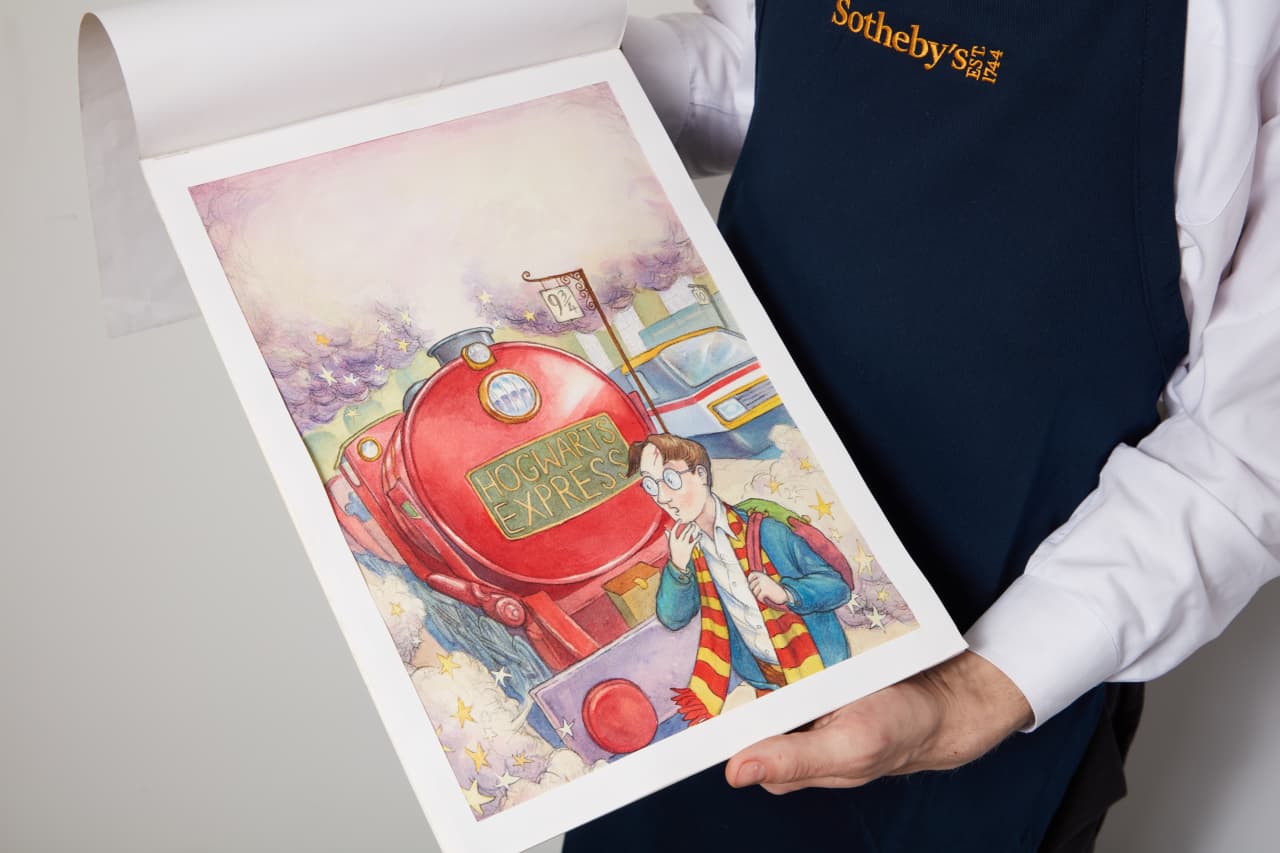
The original watercolour illustration for Harry Potter and the Philosopher’s Stone sold for a record-breaking US$1.9 million on Wednesday, becoming the most valuable Harry Potter item ever sold at auction.

Thomas Taylor’s artwork, which sold at Sotheby’s in New York, was featured on the covers of the first edition of the 1997 novel. Prior to the auction, its price estimate was between US$400,000 and US$600,000—the highest pre-sale estimate ever placed on a Harry Potter-related item.

The illustration was first offered at auction in 2001 at Sotheby’s in London, where it sold for a then-record £85,750 (US$121,431 at the time).

Taylor was just 23 and working in a bookshop when he received his first professional commission to create a cover for J.K. Rowling ’s first novel. Taylor came up with the first-ever depiction of Harry Potter, which has now become the universal image for the iconic character.

The previous record for a Harry Potter auction item was set in 2021 when an unsigned first edition of Harry Potter and the Philosopher’s Stone sold for US$421,000 at Heritage Auctions in Dallas. A handwritten copy of The Tales of Beedle the Bard by Rowling sold in a charity auction at Sotheby’s in 2007 for £1.95 million, however the copy had been produced specifically to raise money for the author’s charity, Lumos, which supports the end of the institutionalisation of children worldwide.

The cover art sold as part of the library of Dr. Rodney P. Swantko, a significant collection of 19th- and 20th-century English and American literature, according to Sotheby’s.


MOST POPULAR

As housing drives wealth and policy debate, the real risk is an economy hooked on growth without productivity to sustain it.

Limited to 630 units, Lamborghini’s latest Urus Capsule pushes personalisation further than ever, blending hybrid performance with over 70 bespoke design combinations.

Related Stories
Property
AUSTRALIA’S PROPERTY BOOM IS MASKING A DEEPER ECONOMIC PROBLEM
By Paul Miron, Opinion 01/05/2026
Money
What Is Artemis II? The NASA Mission to Fly Astronauts Around the Moon
By Micah Maidenberg 30/03/2026
Money
Saudi Arabia Sees a Spike to $180 Oil if Energy Shock Persists Past April
By SUMMER SAID, RYAN DEZEMBER AND DAVID UBERTI 20/03/2026
AUSTRALIA’S PROPERTY BOOM IS MASKING A DEEPER ECONOMIC PROBLEM

As housing drives wealth and policy debate, the real risk is an economy hooked on growth without productivity to sustain it.

By Paul Miron, Opinion
Fri, May 1, 2026 3 min

For decades, Australia has leaned into its reputation as the lucky country. But luck, as it turns out, is not an economic strategy. 

What once looked like resilience now appears increasingly fragile. Beneath the surface of rising property values and steady headline growth, the Australian economy is showing signs of strain that can no longer be ignored. 

Recent data paints a sobering picture. Australia has recorded one of the largest declines in real household disposable income per capita among advanced economies.  

Wages have failed to keep pace with inflation, meaning many Australians are working harder for less. On a per capita basis, income growth has stalled and, at times, reversed. 

And yet, on paper, things still look relatively solid. GDP is growing. Unemployment remains low. But that growth is increasingly being driven by population expansion rather than productivity.  

More people are contributing to output, but not necessarily improving living standards. 

That distinction matters. 

For years, Australia’s economic success rested on a powerful combination: a once-in-a-generation mining boom, a credit-fuelled housing market, strong migration and a property sector that rarely faltered. Between 1991 and 2020, the country avoided recession entirely, building enormous wealth in the process. 

But much of that wealth is tied to property. Around two-thirds of household wealth sits in real estate, inflated by leverage and sustained by demand. It has worked, until now. 

The problem is the supply side of the economy has not kept up. 

Housing supply is falling behind population growth. Rental vacancies are near record lows.  

Construction firms are collapsing at an elevated rate. At the same time, massive infrastructure pipelines are competing with residential projects for labour and materials, pushing costs higher and delaying delivery. 

The result is a system under pressure from all angles. 

Despite near full employment, productivity growth has stagnated for years. In simple terms, Australians are putting in more hours without generating more output per hour. The economy is running faster, butgoing nowhere. 

Meanwhile, government spending continues to expand. Public debt is approaching $1 trillion, with spending now accounting for a record share of GDP.  

The gap between spending and revenue has been filled by borrowing for decades, adding further pressure to an already stretched system. 

This is where the uncomfortable question emerges. 

Has Australia become too reliant on a model driven by rising property values, expanding credit and population growth? 

As asset prices rise, households feel wealthier and borrow more. Banks lend more. Governments collect more revenue. Migration fuels demand. The cycle reinforces itself. 

But when productivity stalls and debt outpaces real income, the system begins to depend on constant expansion just to stay stable. 

It is not a collapse scenario. But it is not particularly stable either. 

Nowhere is this more evident than in housing. 

The National Housing Accord targets 1.2 million new homes over five years, yet current completion rates are well below that pace. With approvals falling and construction costs rising, the gap between supply and demand is widening, not narrowing. 

Housing is also one of the largest contributors to inflation, with costs rising sharply across rents, construction and utilities. Yet the private sector, from small investors to major developers, is struggling to make projects stack up in the current environment. 

This brings the policy debate into sharper focus. 

Tax settings such as negative gearing and capital gains concessions have undoubtedly boosted demand over the past two decades. But they have also supported supply. Removing them may ease prices briefly, but risks deepening the supply shortage over time. 

That is the paradox. 

Policies designed to make housing more affordable can, in practice, make the shortage worse if they discourage development. The optics may appeal, but the economics are far less forgiving. 

It is also worth remembering that most property investors are not institutional players. The majority own just one investment property. They are, in many cases, ordinary Australians using real estate as their primary wealth-building tool. 

Undermining that system without replacing it with a viable alternative risks unintended consequences, from reduced supply to higher rents and increased inflation. 

So where does that leave Australia? 

At a crossroads. 

The country can continue to rely on population growth and rising asset prices to drive economic activity. Or it can shift towards a model built on productivity, innovation and sustainable growth. 

The latter is harder. It requires structural reform, long-term thinking and political discipline. 

But it is also the only path that leads to genuine, lasting prosperity. 

The question is no longer whether Australia has been lucky. 

It is whether it can evolve before that luck runs out. 

Paul Miron is the Co-Founder & Fund Manager of Msquared Capital. 

MOST POPULAR

Here’s how they are looking at artificial intelligence, interest rates and economic pressures.

Three completed developments bring a quieter, more thoughtful style of luxury living to Mosman, Neutral Bay and Crows Nest.

Related Stories
Money
The Hottest Business Strategy This Summer Is Buying Crypto
By GREGORY ZUCKERMAN & VICKY GE HUANG 11/08/2025
Property
RARE TASMANIAN COASTAL ESTATE ON THE MARKET FOR MORE THAN $20 MILLION
By Staff Writer 03/11/2025
Money
Murdoch Family Settles Battle Over Trust
By JEFFREY A. TRACHTENBERG 09/09/2025
0
    Your Cart
    Your cart is emptyReturn to Shop