IWC’s purple Formula 1 chronograph pays tribute to Singapore after dark
 4 min
4 min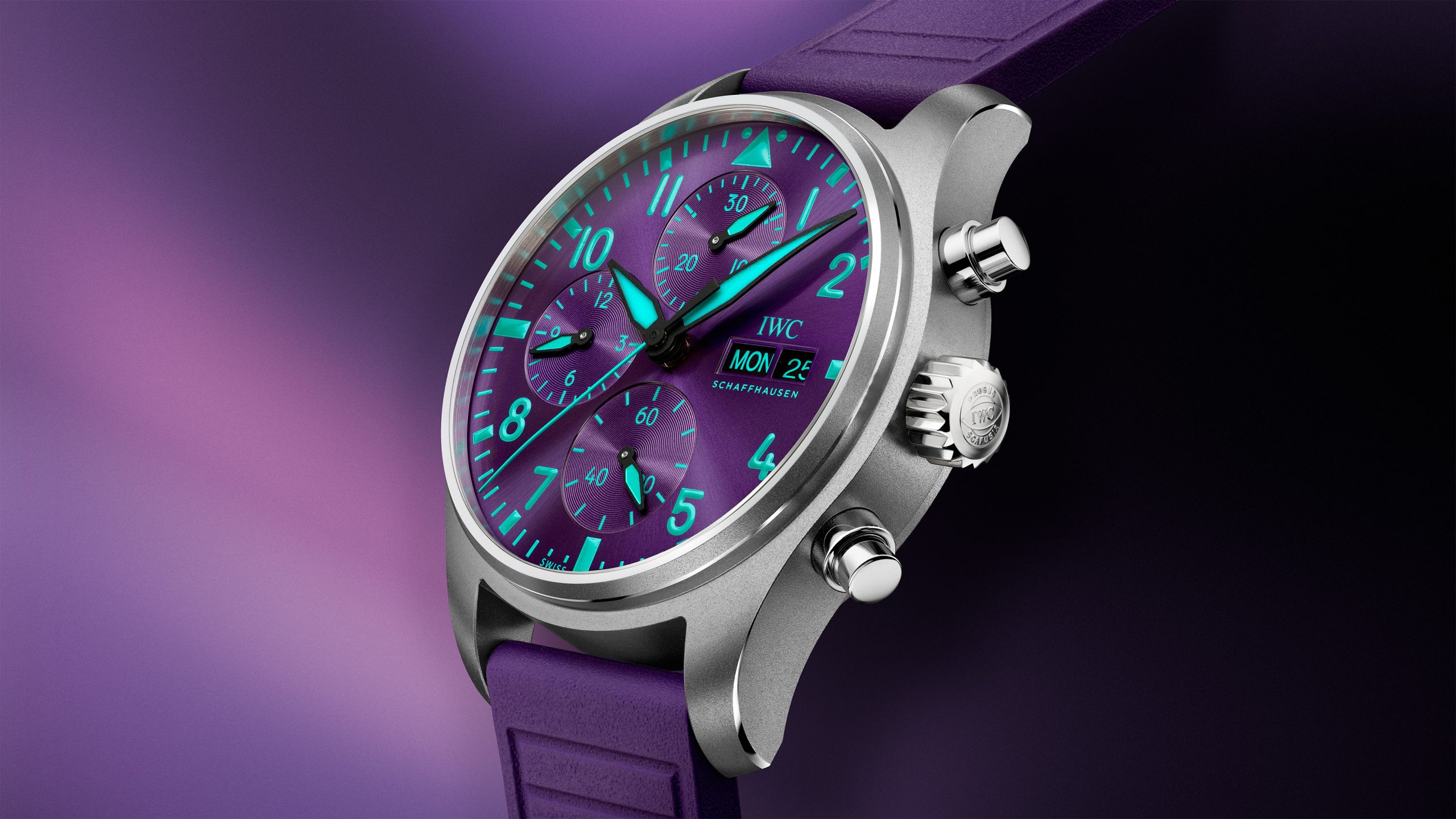
Singapore’s Formula 1 weekend has always looked different.
Held beneath floodlights on the Marina Bay Street Circuit, the race transforms the city into a nocturnal spectacle of speed, heat and saturated colour. It is this distinctive atmosphere — and one of Singapore’s most important natural symbols — that has shaped IWC Schaffhausen’s latest motorsport-inspired watch.
The Pilot’s Watch Chronograph 41 Mercedes-AMG PETRONAS Formula One Team Edition introduces a deep purple dial to IWC’s Pilot’s Watches collection for the first time.
Rather than drawing directly from the race cars, the colour references the Vanda Miss Joaquim, the orchid recognised as Singapore’s national flower. Its vivid purple is paired with numerals, hour markers and luminous hands in the turquoise-green shade closely associated with the Mercedes-AMG PETRONAS Formula One Team.
A matching purple rubber strap completes what is easily the most colourful team watch IWC has produced during its long-running Formula 1 partnership.
A team watch made for the paddock
IWC has been the official engineering partner of the Mercedes-AMG PETRONAS Formula One Team since 2013, with dedicated team watches forming part of the relationship since 2022.
These editions are intended to be worn by mechanics, engineers and other team personnel trackside, as well as staff at the team’s headquarters in Brackley, England. That working role helps explain why the watches tend to prioritise low weight, durability and legibility rather than simply adding Formula 1 branding to an existing luxury timepiece.
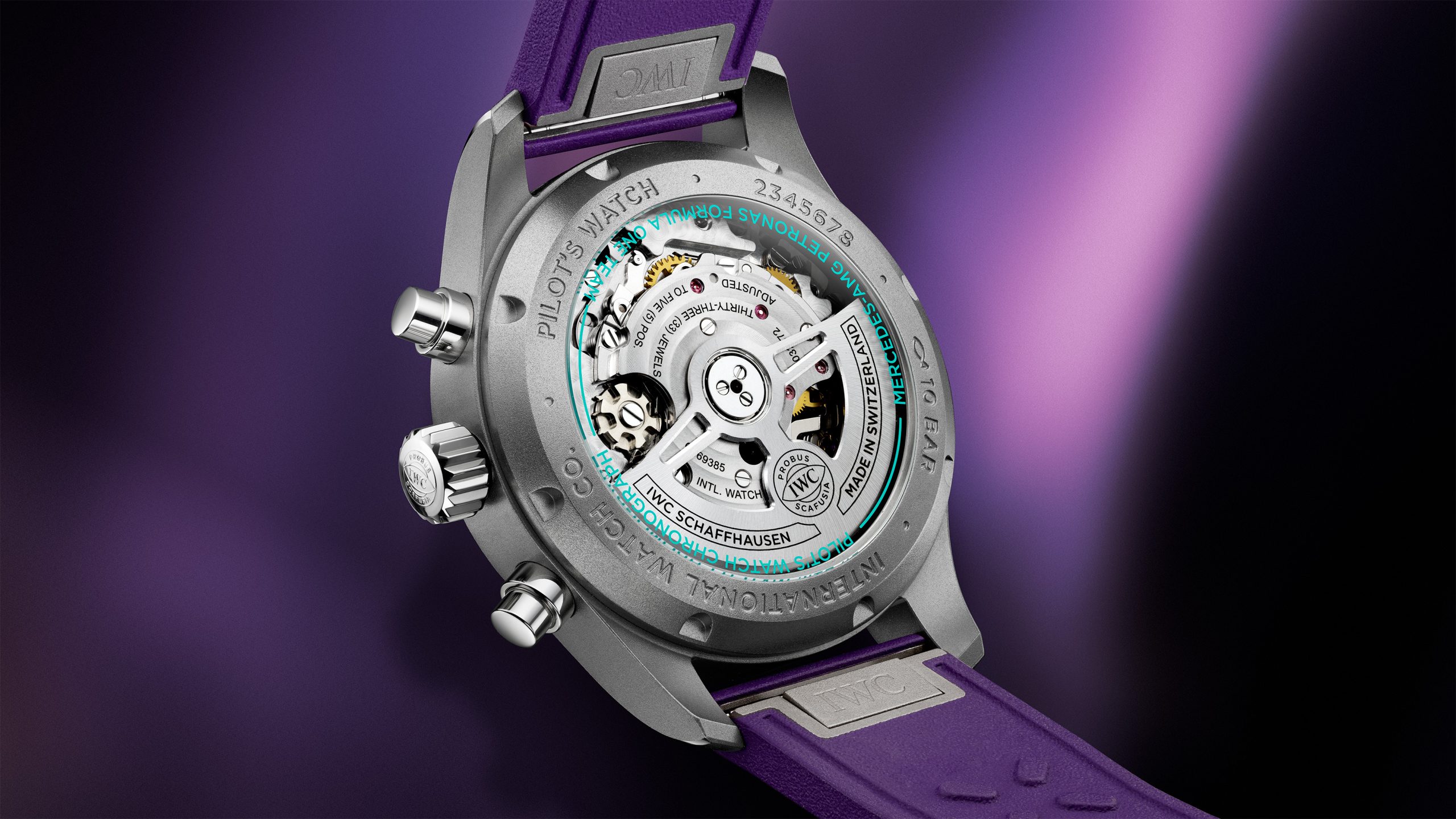
For the new reference, IW388121, IWC has selected a 41mm case made from Grade 5 titanium. The metal is approximately half the weight of steel, resistant to corrosion and valued for its strength-to-weight ratio.
Its connection with motorsport is functional as well as thematic. Titanium alloys are used in Formula 1 components subjected to considerable mechanical and thermal loads. Most visibly, the protective Halo structure positioned above a driver’s cockpit is also manufactured from a high-strength titanium alloy.
IWC has given the case a brushed finish, retaining titanium’s understated grey appearance and allowing the purple dial and green details to carry the visual impact.
At 14.5mm thick, this is still a substantial sports chronograph. The reduced weight of the titanium case should, however, make it noticeably easier to wear over a full day than an equivalent steel model.
Familiar engineering beneath a new dial
Behind the colour is a familiar and proven mechanical package.
The watch is powered by IWC’s automatic 69385 calibre, an in-house chronograph movement built around a traditional column wheel. It operates at 28,800 vibrations per hour and provides a 46-hour power reserve.
Its chronograph layout places the elapsed-minute display at 12 o’clock and running seconds at six. The vertical arrangement has been a defining feature of IWC’s Pilot’s Watch chronographs for decades, keeping the displays clear despite the amount of information presented on the dial.
A combined day-and-date window sits at three o’clock, giving the watch additional everyday usefulness beyond its stopwatch function.
The movement is decorated with Geneva stripes and circular graining and can be viewed through the sapphire crystal caseback. Water resistance is rated to 10 bar, equivalent to approximately 100 metres.
The front is protected by convex sapphire crystal with anti-reflective treatment on both sides. IWC also secures the glass against displacement caused by sudden changes in air pressure, a feature associated with the collection’s aviation origins.
The purple rubber strap is fitted with IWC’s EasX-CHANGE system, allowing it to be removed without conventional tools. A titanium pin buckle maintains the lightweight construction.
The fourth Mercedes-AMG PETRONAS team watch
The purple chronograph is the fourth official team watch produced through the partnership.
The series began at the 2022 Miami Grand Prix with a titanium Pilot’s Watch Chronograph 41 distinguished by PETRONAS-green details. A more performance-focused Ceratanium chronograph followed at the 2023 Las Vegas Grand Prix, complete with a black ceramic tachymeter bezel.
In 2025, IWC changed direction with the slimmer, three-hand Pilot’s Watch Mark XX Mercedes-AMG PETRONAS Formula One Team Edition.
The new Singapore-inspired chronograph returns to the original 41mm format but gives it an unexpectedly expressive identity. It also arrives alongside a new Mercedes-AMG PETRONAS collection from team kit supplier adidas, extending the purple colour story beyond the watch.
For collectors, the appeal lies in that balance. The architecture of the watch is recognisably IWC: practical, engineered and highly legible. The dial, meanwhile, is considerably more adventurous than the black, blue and green treatments typically associated with modern pilot’s watches.
It is a tribute to Singapore that avoids obvious images of the skyline or circuit. Instead, IWC has used colour to capture some of the energy of Formula 1’s original night race — and created one of the partnership’s most distinctive watches in the process.
Fact box
- Model: IWC Pilot’s Watch Chronograph 41 Mercedes-AMG PETRONAS Formula One Team
- Reference: IW388121
- Case: Grade 5 titanium
- Diameter: 41mm
- Thickness: 14.5mm
- Dial: Purple with PETRONAS-green numerals, markers and luminous details
- Crystal: Convex sapphire with anti-reflective coating on both sides
- Movement: IWC-manufactured automatic calibre 69385
- Functions: Hours, minutes, small seconds, chronograph and day-date display
- Frequency: 28,800 vibrations per hour, or 4Hz
- Power reserve: 46 hours
- Jewels: 33
- Water resistance: 10 bar, approximately 100 metres
- Strap: Purple rubber with EasX-CHANGE system
- Buckle: Titanium pin buckle

Located steps from Crows Nest Metro, the near-complete development brings luxury living to Sydney’s Lower North Shore.

Studio apartments have almost disappeared from new Australian developments. Lura is bringing them back to Burleigh Heads from $495,000.

AI-powered travel agents are challenging online booking platforms, but Airbnb’s exclusive listings and direct customer relationships could give it an edge. Its next challenge: turning repeat guests into loyal customers through stronger rewards and innovation.
3 min
AI agents like Muse can already find you the cheapest hotel room in Paris. But they can’t locate a cheaper version of that Catskills cabin you’ve been eyeing, because it might only be available on Airbnb ABNB -1.43%decrease.
Investors should pay attention to that distinction. When Meta Platforms META 3.38%increase launched its Muse agent last month, travel stocks including Booking Holdings BKNG -1.19%decrease, Expedia and Airbnb all fell sharply.
Airbnb, though, has a real chance to emerge as a winner from the upheaval. The catch: Its stock already reflects above-industry growth. To justify its valuation, Airbnb will need to turn repeat customers into loyal ones.
Online travel companies make much of their money by simplifying search and collecting fees on bookings. AI agents threaten that model.
But not all travel marketplaces are equally exposed. Booking and Expedia largely sell hotel rooms that travelers can also book directly or through competing sites. If an agent can find the same room elsewhere, it has little reason to favor either Booking or Expedia.
Booking and Expedia also sell sponsored listings that steer travelers toward particular properties. Wells Fargo estimates those will account for about 8% of Expedia’s revenue and a much higher percentage of profit next year.
Airbnb has more ways to adapt. More than half its listings are available only on its platform, and more than 90% of its traffic comes directly to its app or website.
The customer relationship doesn’t end after booking, either. Bernstein analyst Richard Clarke notes that 90% of Airbnb guests go on to message their hosts about arrival times, keys or local taxes, giving Airbnb a connection to both sides of the transaction.
How the companies have responded to the possible agentic future is telling.
Expedia quickly signed on as a Muse partner. Airbnb hasn’t, and Chief Executive Brian Chesky says AI chatbots have so far been a boon, sending customers to Airbnb’s website.
Chatbots might work for buying paper towels, he quipped at a Skift conference last month, but people enjoy planning trips. He argued that browsing dozens of homes isn’t something a text-based chatbot is well suited for.
Still, the AI jitters arrived just as Airbnb was persuading investors it deserved its pricey multiple. For years after its 2020 initial public offering, the stock—which trades around 25 to 30 times forward earnings—went nowhere. Investors saw a mature operator trading at a growth premium.
This year, Airbnb growth seems to be accelerating. The stock jumped in August after the company raised its full-year revenue-growth guidance with its second-quarter results. Wells Fargo analyst Ken Gawrelski credits a run of product improvements under a revamped leadership team.
Among the changes: letting guests reserve now and pay later, adding hotels, and a redesigned home page and app. Investors were also betting on what comes next, including thousands more hotels, car rentals and, eventually, advertising.
The irony is that some of those growth drivers push Airbnb closer to the kind of business Booking and Expedia run—the kind of business AI agents could threaten. Even if AI agents capture a large share of travel planning and booking, Airbnb would capture the demand. But it and others would slowly lose control over how customers find and choose properties.
That would undermine the advertising opportunity investors are counting on. The bigger point for Airbnb and other marketplaces is that losing control of customer acquisition could mean surrendering some of their pricing power and margins.
To bulletproof itself, Airbnb might look to another e-commerce giant that has so far kept AI agents at arm’s length: Amazon.
Like Amazon, Airbnb has a loyal customer base and hard-to-match supply. But it has nothing like Prime membership to make customers think twice before taking their business elsewhere.
That is where loyalty comes in. Business travelers stick with Hilton or Marriott because enough nights earn them perks. Leisure travelers rarely accumulate stays with one chain. Airbnb has millions of listings and plenty of repeat customers, but no broad rewards program. It has begun experimenting with credits on hotel stays, but it should make loyalty a priority, not just a promotion.
Airbnb also plans to launch its own AI agent next year. But travelers using an agent might still want it to search Airbnb, Vrbo, Booking and hotel websites alike, rather than limit itself to one company’s inventory.
Eventually, Airbnb might have to strike deals with agent makers, using its unique homes as leverage to negotiate favorable terms, says Gawrelski. Such deals, along with rewards for loyal guests, could over the long term eat into the company’s roughly 13% take rate, he adds. But if they bring in enough additional bookings, the trade-off could be worthwhile.
History offers a reason not to panic. The shift from desktop to mobile unsettled investors in Alphabet and Amazon, but both emerged as major beneficiaries. Companies with valuable assets can come out of a platform shift stronger, if they adapt quickly enough.
Airbnb has homes the bots can’t easily replace. Now it needs to give guests a reason to insist on booking them there.

Micro-needling promises glow and firmness, but timing can make all the difference.

Warmer minimalism, tactile materials and wellness focused layouts are redefining luxury interiors as homeowners design for comfort, connection and lasting appeal.