Australia is building apartments at the prices buyers can’t afford
 4 min
4 min
Australia may need more apartments, but new research suggests the homes reaching the market are increasingly disconnected from what buyers can afford.
The realestate.com.au New Homes Buyer Preferences FY26 report reveals a stark mismatch between the budgets of prospective new-apartment buyers and the prices of advertised stock.
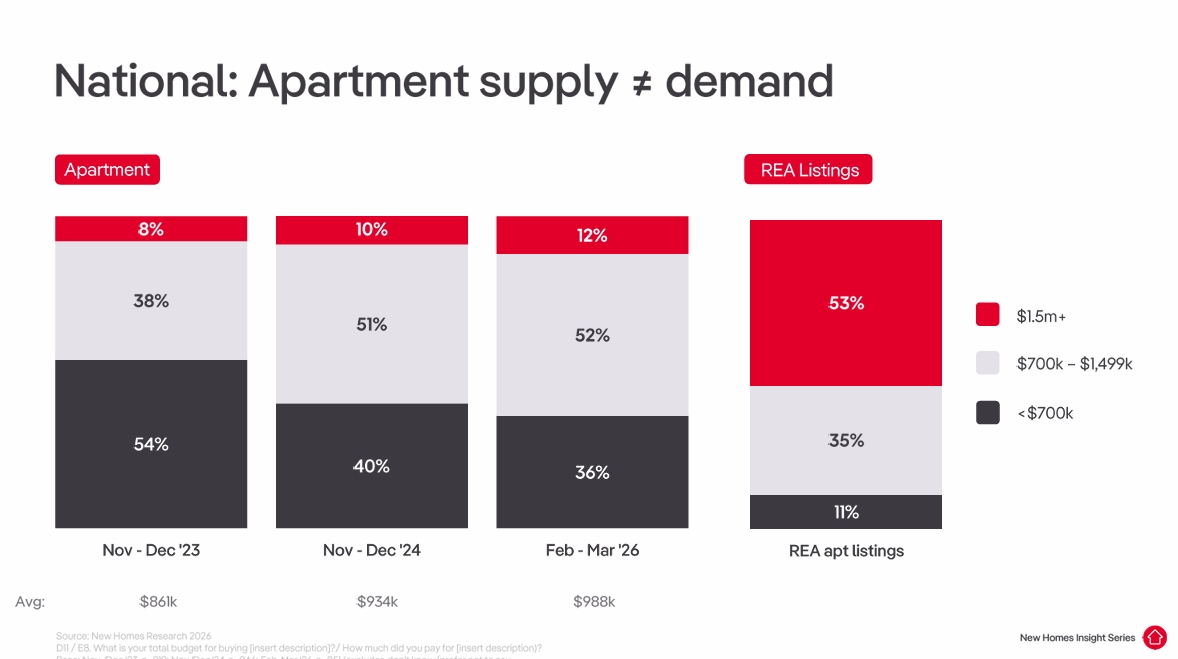
Just 12% of surveyed apartment buyers and considerers had a budget of at least $1.5 million. Yet properties at this level represented 53% of the new-apartment listings analysed by realestate.com.au.
At the other end of the market, 36% of prospective buyers were working with budgets below $700,000, while only 11% of advertised new apartments fell into that price bracket.
The middle of the market was also undersupplied relative to demand. Buyers with budgets between $700,000 and $1.499 million accounted for 52% of respondents, compared with 35% of listings.
In other words, almost nine in 10 prospective buyers had less than $1.5 million to spend, but more than half of advertised new apartments were priced above that threshold.
The findings come from an independent survey of 2,016 new-home buyers and considerers conducted during February and March 2026. That included 1,003 people in the apartment market, with the survey findings supplemented by realestate.com.au listings data.
The results do not necessarily mean that half of all apartments under construction are premium properties. The listing figures reflect advertised new-apartment stock on realestate.com.au rather than the entire development pipeline. Even so, they provide a clear picture of the properties buyers can see and potentially purchase.
That visible market is heavily weighted towards its most expensive segment.
Budgets are rising, but supply is moving faster
Apartment buyers have substantially increased their budgets in recent years.
The average budget among respondents rose from $861,000 in late 2023 to $934,000 in late 2024 and $988,000 in early 2026—an increase of almost 15% in a little over two years.
The proportion of buyers with less than $700,000 to spend consequently fell from 54% in 2023 to 40% in 2024 and 36% in 2026. Meanwhile, the share targeting the middle price band rose from 38% to 52%.
But this increase in purchasing budgets has not been enough to bring the available stock into alignment with demand. The greatest concentration of advertised apartments remains above $1.5 million, a level accessible to only a small minority of those surveyed.
The mismatch helps explain why demand for new homes can appear healthy without translating smoothly into sales. Buyers may want a new apartment, but interest alone cannot overcome a large gap between their borrowing capacity and the asking price.
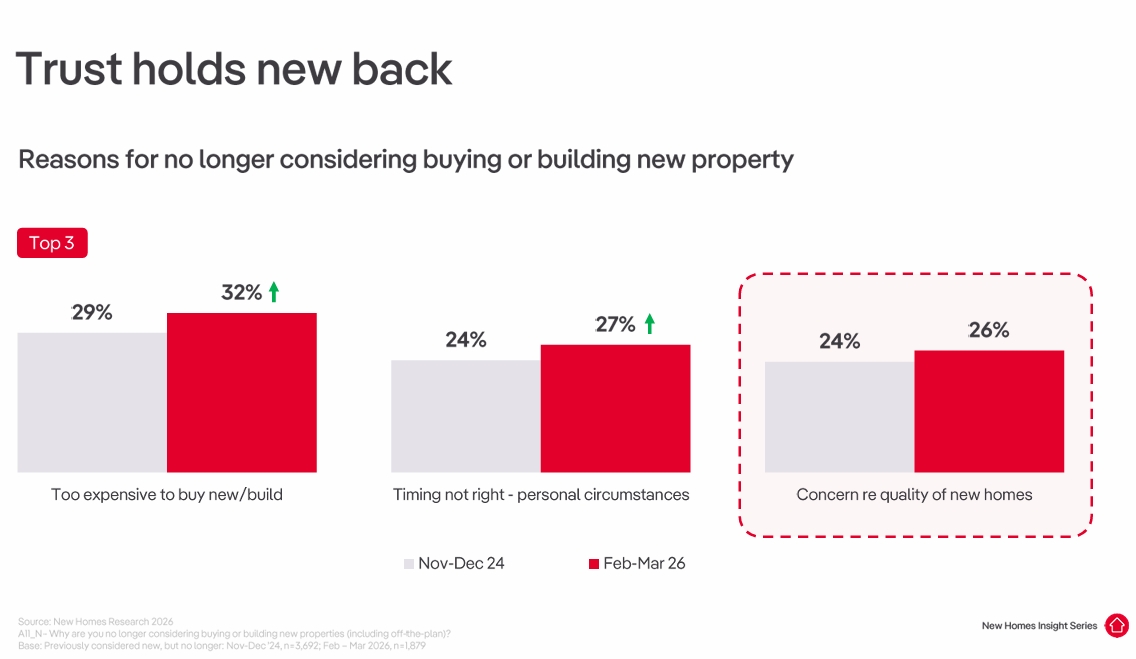
Price was the most commonly cited reason people stopped considering a new home. Almost one-third—32%—said buying or building new had become too expensive, up from 29% in the previous survey.
Buyers are spending longer in the market
The affordability gap is also visible in the time apartment buyers spend searching.
The average apartment-buying journey reached 22 months in March 2026, up from 16 months in late 2023. Buyers spent an average of six months monitoring the market and another five months searching for properties before progressing to inspections, offers and settlement.
That means half of the average journey passes before a buyer reaches the stage of seriously inspecting available projects.
Budget shock was identified as the leading reason buyers found it difficult to move forward. Faced with premium-heavy listings, prospective purchasers may need to save a larger deposit, reassess their expectations or wait for a suitable property to become available.
Many are also widening their search.
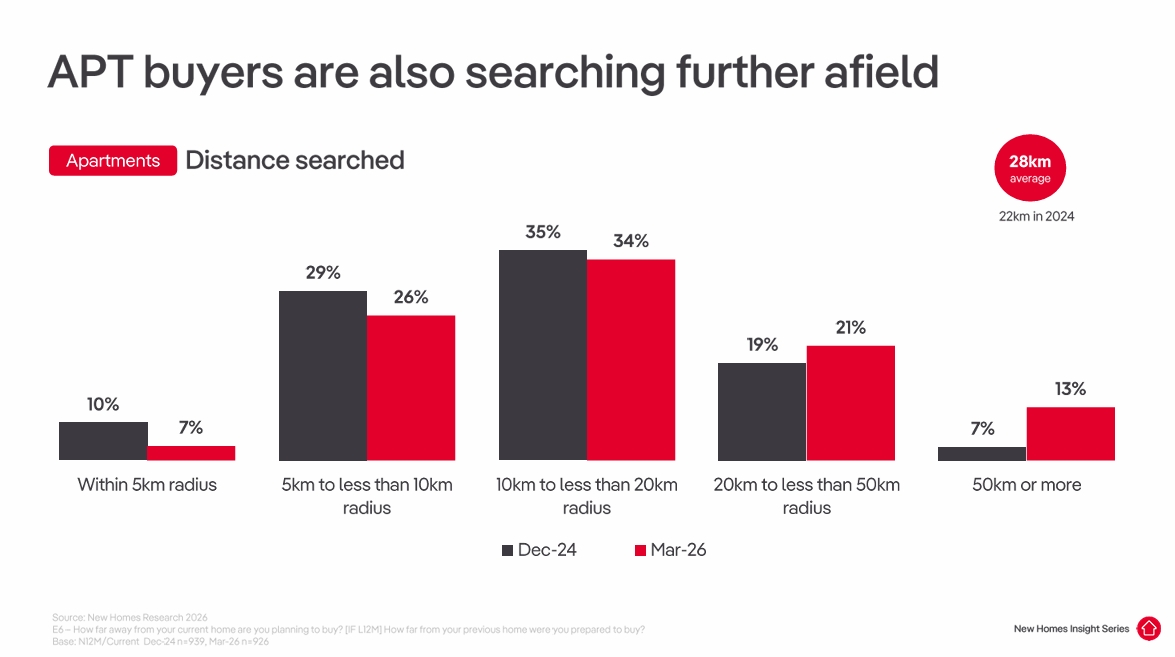
The average distance apartment buyers were prepared to move increased from 22km in 2024 to 28km in 2026. The proportion looking within five kilometres of their existing home fell from 35% to 29%, while the share considering properties 20km to 50km away rose from 21% to 26%.
This suggests buyers are responding to the pricing mismatch by looking beyond their preferred neighbourhoods rather than simply increasing their budgets.
A development feasibility dilemma
The imbalance does not necessarily reflect a failure to understand the market. New apartment projects face high costs for land, construction, finance, planning and compliance. Developers may favour premium projects because higher sale prices are needed to make construction financially viable.
But the survey illustrates the resulting policy and commercial challenge. Australia needs additional housing, particularly in established locations close to jobs, transport and services. If new apartments can only be delivered at prices beyond the reach of most buyers, increasing the number of projects will not automatically address affordability.
The market risks producing an abundance of choice for a relatively narrow group while leaving the largest pools of demand competing for limited lower-priced stock.
House-and-land listings were more closely aligned with buyer budgets, although that segment also displayed a modest shortage at the premium end. The apartment findings were far more pronounced, making the issue difficult to dismiss as a general preference gap.
There is clear interest in new homes. Eighty-eight per cent of apartment considerers were looking at both new and established properties, while the report found demand for new homes was climbing.
The problem is converting that interest into a purchase.
Until the price composition of new-apartment listings more closely reflects the budgets of prospective buyers, Australia’s apartment challenge will be about more than how many homes are built. It will also be about whether the homes being offered are the ones the market can afford.

From making unpopular decisions to learning when to listen, leaders from five businesses reveal what nobody prepared them for — and how running a company has challenged their expectations.

Technology and semiconductor shares fell sharply as investors questioned the debt financing the AI infrastructure boom and confronted higher rates and Chinese competition.
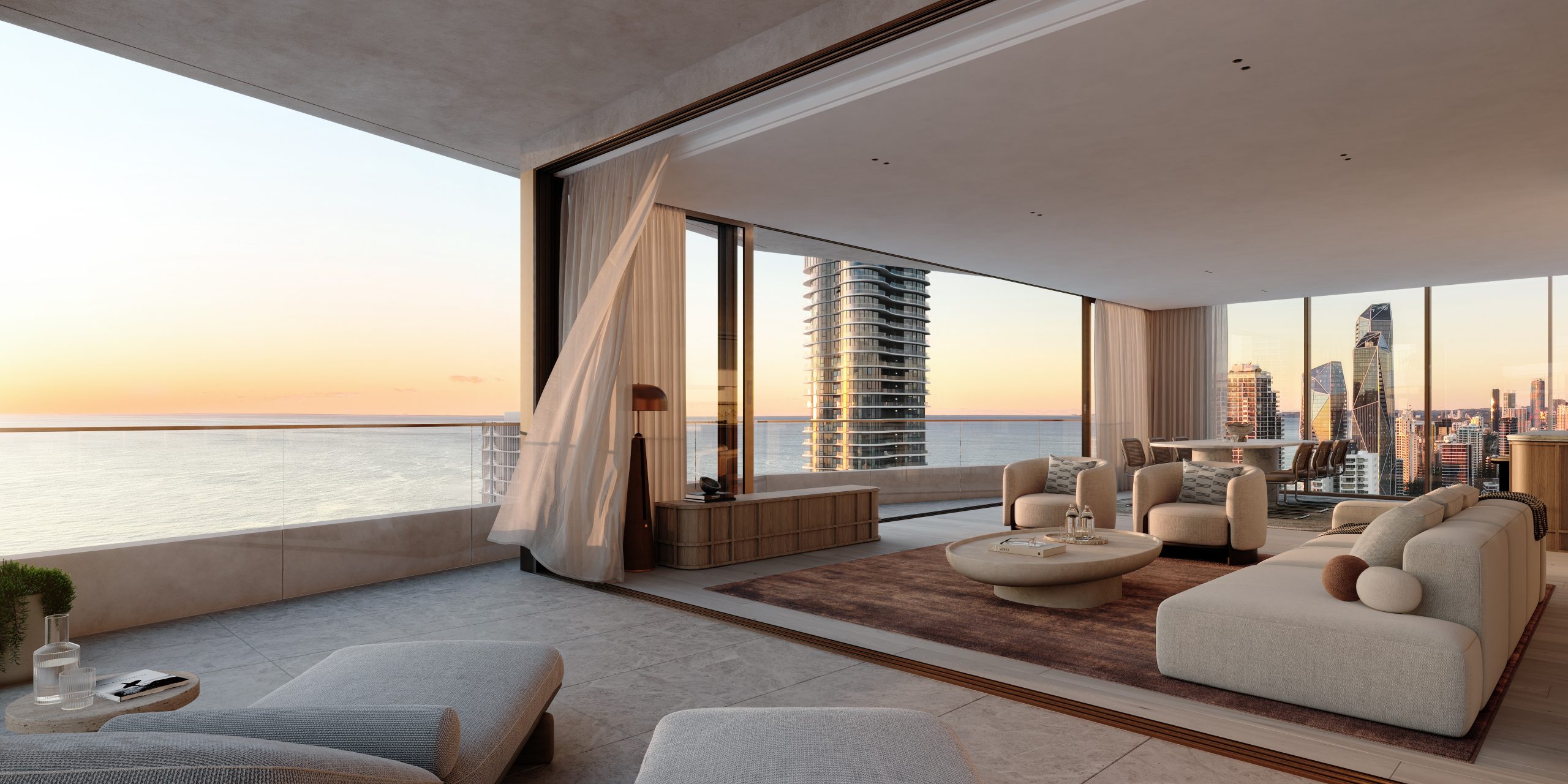
Mirvac’s 45-level Trielle has topped out at Yarra’s Edge, pairing riverfront apartments with wellness facilities, private dining and resident services.
3 min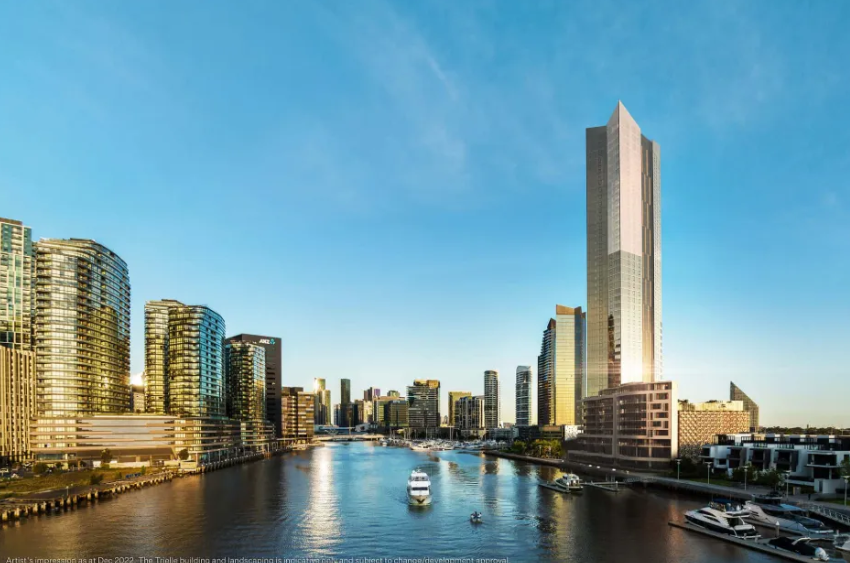
Mirvac has topped out Trielle at Melbourne’s Yarra’s Edge, with more than 70 per cent of the riverfront development sold and approximately 80 per cent of purchasers intending to make their apartment a home.
The figures, released on September 22, point to an owner-occupier audience for one of the precinct’s final residential towers. Mirvac began developing Yarra’s Edge in 2003, and its latest addition occupies one of the remaining absolute riverfront sites.
Mirvac CEO of Development Stuart Penklis said existing residents were among those moving up within the neighbourhood.
“Many purchasers already have a connection to Yarra’s Edge,” Mr Penklis said, describing buyers whose changing needs were encouraging an upgrade within the precinct.
“As one of the final residential towers within Yarra’s Edge, Trielle represents the culmination of more than two decades of creating one of Melbourne’s most established and sought-after waterfront communities,” Penklis said.
“Positioned on the Collins Street axis with absolute river frontage, Trielle offers residents a rare opportunity to enjoy sweeping views across the Yarra River, Melbourne skyline and Port Phillip Bay, while remaining seamlessly connected to the CBD. With Trielle now more than 70 per cent sold, we’re continuing to see strong demand from buyers seeking quality homes in established locations.”
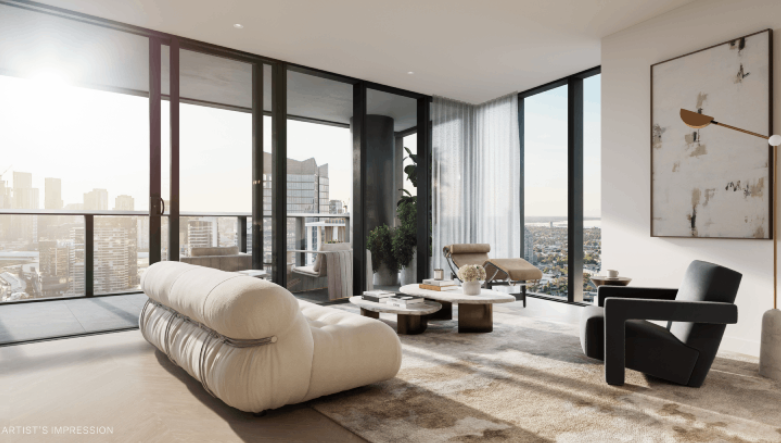
The developer also flagged a penthouse and sub-penthouse collection with larger layouts, premium finishes and broad outlooks. The planned wellness centrepiece, The Oasis, encompasses a 900-square-metre elevated urban rainforest.
Mirvac General Manager Residential Development Victoria Elysa Anderson said Trielle had resonated strongly with buyers seeking a rare lifestyle offering in Melbourne.
“Opportunities to secure a new luxury residence on a riverfront site of this calibre are incredibly rare, particularly within a community like Yarra’s Edge,” Anderson said.
“What makes Trielle unique is the combination of exceptional views, world-class residential facilities and the lifestyle that already exists around it. Residents are buying into a mature waterfront community with parks, promenades, dining, wellness and strong community connections already in place.”
The 45-level tower brings a substantial new presence to that waterfront. Its residential offering spans one-, two-, three- and four-bedroom apartments, with Signature, Prestige and Sub-Penthouse collections accommodating different household sizes. The north-facing position connects the apartments visually to the river and city beyond.
Seven storeys above the promenade, the planned Oasis combines planting and a running stream with a Scandinavian-inspired wellness club developed with spa specialist Naomi Gregory. Facilities include a 25-metre lap pool, hot magnesium pool, sauna, hydrotherapy, a gym, yoga and Pilates room, and treatment spaces.
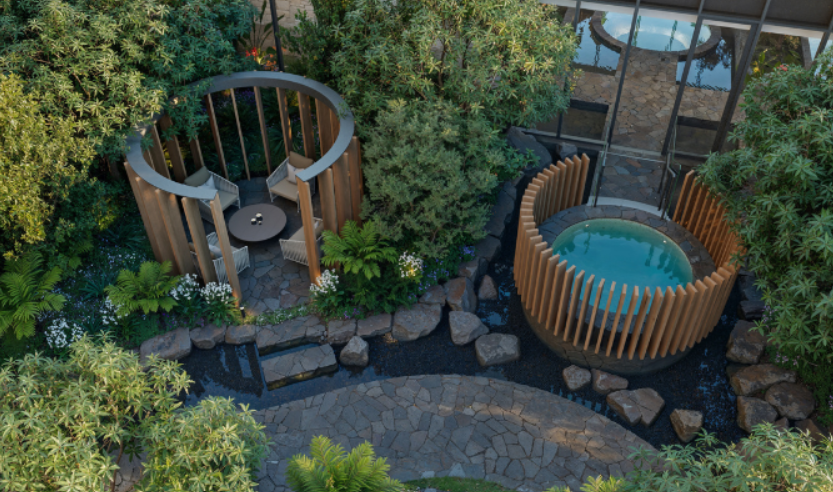
The amenity extends beyond exercise. Residents will have access to The Biblioteca library and workspaces, ground-floor work pods, and The Salone piano lounge. A private Chef’s Table dining room offers a setting for larger gatherings, while a cinema, games room and sports lounge broaden the entertaining options. Concierge services and a dog-wash area support everyday routines.
Trielle comprises a collection of one, two, three and four-bedroom residences. Reflecting strong demand from owner occupiers, approximately 80 per cent of purchasers to date intend to live in their homes, highlighting the project’s appeal to those seeking a long-term waterfront lifestyle.
Mirvac has recently delivered The Albertine, a premium apartment development on the edge of Melbourne’s CBD, and is nearing completion of Prince & Parade in Brunswick, further strengthening its portfolio of thoughtfully designed apartment communities in some of Melbourne’s most sought-after urban locations.

ABC Bullion has launched a pioneering investment product that allows Australians to draw regular cashflow from their precious metal holdings.

With two waterfronts, bushland surrounds and a $35 million price tag, this Belongil Beach retreat could become Byron’s most expensive home ever.