NOOSA IGNITES WITH RECORD TROPHY HOMES
Once a sleepy surf town, Noosa has become Australia’s prestige property hotspot, where multi-million dollar knockdowns, architectural showpieces and record-setting sales are the new normal.
 3 min
3 min


It wasn’t too long ago that Noosa was seen as a relaxed holiday town, more famous for its surf breaks and weekenders than record-breaking prestige property.
But much like much of Queensland, COVID lit a torch under the market, and in Noosa it was the prestige sector that surged the hardest.
Records tumbled, including one-bedroom apartments on Hastings Street, the suburb’s only true beachfront strip, changing hands for nearly $6 million. That’s a price point not seen anywhere else in Australia, not even Bondi Beach.
While some regional markets have since cooled as workers trudged back to the office, Australia’s wealthy have continued to pour into Noosa.
Their growing fortunes, from corporate payouts to generational wealth, have fuelled the demand. Think former Virgin Australia CEO Jayne Hrdlicka, who just received a $50 million payout from her former employer.
Just before Christmas last year she spent $17 million on a 1970s Noosa home, which she plans to knockdown and replace with a three-level luxury residence by Shaun Lockyer Architects.
The regional price record was set in 2021 when Peter Tighe, non-executive chairman of AuKing Mining and part-owner of champion mare Winx, paid $34 million for Webb House in Sunshine Beach.
Initially, speculation swirled that billionaire Gina Rinehart was the mystery buyer. Sunshine Beach still holds the crown for Noosa’s priciest sale, but the bulk of big-ticket transactions are now spread between absolute beachfront in Noosa Heads and the suburb’s sought-after waterways.
So far in 2025, there have been 42 sales above $5 million across the region. That’s broadly in line with the last three years, with the exception of 2021, when more than 90 properties over $5 million changed hands between January and September alone.
Higher interest rates aren’t applicable to this cohort of buyers.
This year Mark Fraser, the Queensland architect who founded beach shade giant CoolCabanas, paid $18 million on an empty X sqm block of land with approved plans for a new luxury home.
Brendan Pickering, the managing director of Pickerings Auto Group, spent $16.5 million to add to his collection of Noosa waterfront trophy homes, while the lesser known, Melbourne-based millionaires Robert and Abigail Polites, emerged as buyers of a $17.6 million home on Witta Circle, widely regarded as Noosa’s premier riverfront street.
The prestige market has been further energised with the listing of one of Noosa’s most striking waterfront homes, and it could set a new benchmark.
Reed & Co. agents Adrian Reed and Donna Taylor have just launched Casa Luca to market, a newly built Wyuna Drive home that recently won the 2025 Master Builders Regional Award.
Translating to “House of Light,” the home has been crafted by renowned designer Paul Clout, whose name is synonymous with Noosa’s most celebrated residences. Interiors are by Hong Henwood, incorporating Italian marble, Portuguese stone, Egyptian limestone, and hand-blown Soktas glass pendants.
Every detail has been carefully curated, and all the custom furnishings are included in the sale.
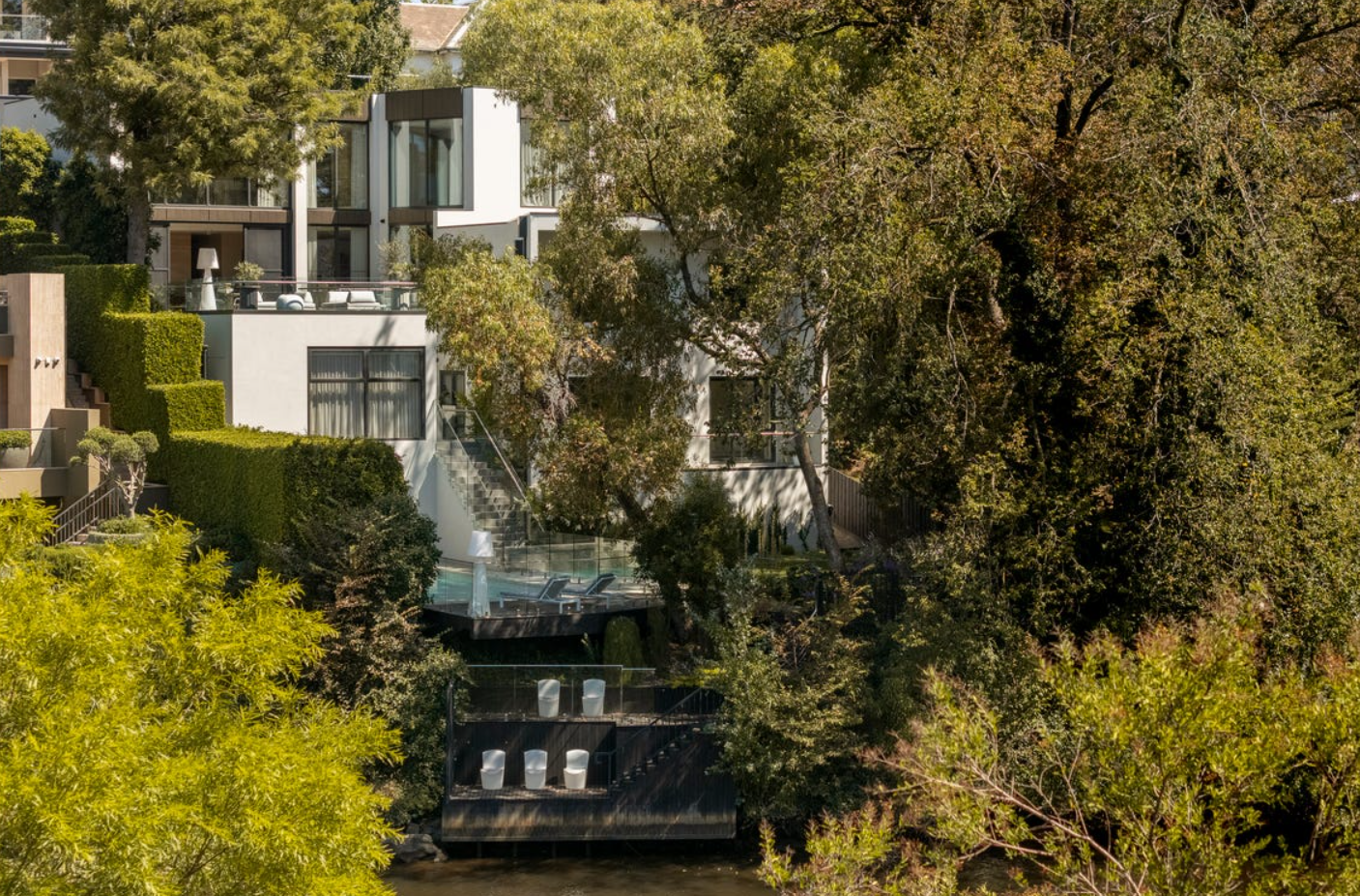
The residence offers a 20-metre river frontage with expansive glass panes framing uninterrupted water views. Inside, curved walls and soaring ceilings deliver dramatic impact, while a marble-clad galley kitchen with a 3.5-metre island bench forms the heart of the home.
It features a Gaggenau cooktop and ovens, dual integrated Fisher & Paykel fridges, and Miele dishwashers, a space designed to entertain as much as cook.
Spread across more than 500 sqm of internal living, the four king-sized bedrooms include a master retreat with a private riverfront terrace, walk-in robe, and ensuite clad in limestone and Italian marble.
Multiple lounge areas are anchored by Jetmaster and gas fireplaces, with terraces flowing to the pool, spa, and private jetty. A custom wine cellar and bar sit alongside the dining space, while an alfresco pavilion with an automated roof, BeefEater barbecue, plumbed gas fire pit, floating daybed, and magnesium pool complete the resort-style setting.
Competing for best trophy home listing this summer is another Paul Clout special, this one on Gympie Terrace in Noosaville. The home, dubbed One W, is listed with Century 21 Conolly Hay Group Noosa Heads agent Rachel Sellman, who is entertaining offers around the $20 million mark.
The highlight of the four-bedroom, three-level home is the rooftop terrace, channeling a chic Mediterranean beach club with a private heated pool and spa, floating daybeds, custom dining and lounging areas with a gas fireplace, a built-in barbecue, a bar with beer taps, and an adjustable pergola. Sharing this level is a fitness studio with a full gym, infrared sauna, and a steam shower.

Technology and semiconductor shares fell sharply as investors questioned the debt financing the AI infrastructure boom and confronted higher rates and Chinese competition.
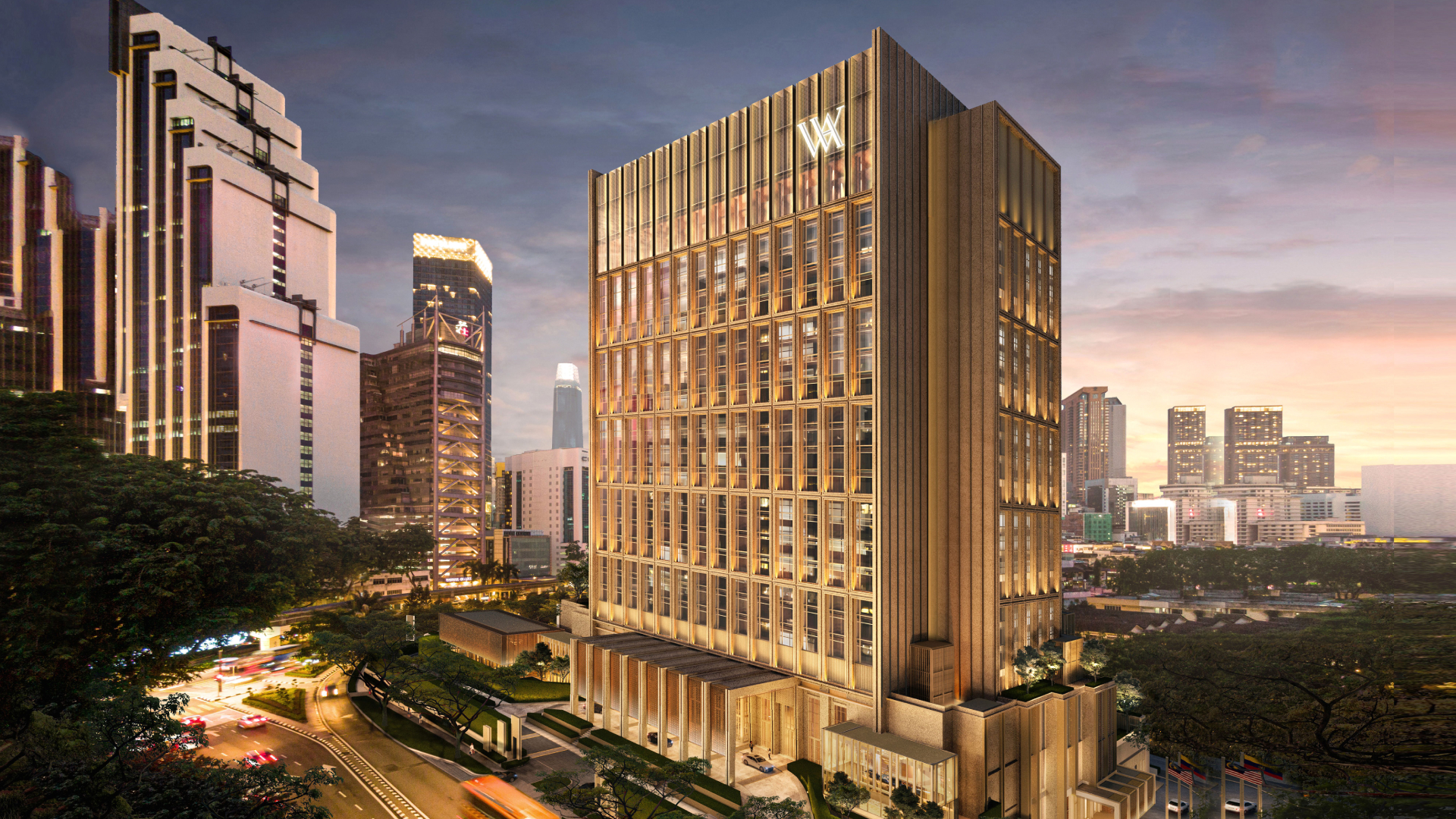
Waldorf Astoria Kuala Lumpur is scheduled to open on 30 October, introducing the Hilton luxury brand to Malaysia with an all-suite hotel in the city’s Golden Triangle.
Employment fell by 39,300 and unemployment held at a revised 4.7 per cent, giving the RBA more room to pause in November.
2 min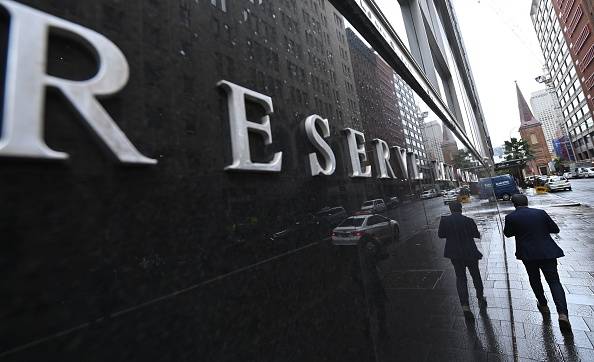
Australia’s labour market weakened in September, reducing—but not eliminating—the case for another Reserve Bank rate rise in November.
The seasonally adjusted unemployment rate was 4.7 per cent, according to the Australian Bureau of Statistics. August was revised to the same level, while September employment fell by 39,300 people. The number of unemployed Australians increased by 8,900 to 732,000.
The weakness extended beyond the headline rate. The employment-to-population ratio fell 0.3 percentage points to 63.6 per cent, participation declined 0.2 points to 66.8 per cent and underemployment edged up to 6.3 per cent. Part-time employment fell by 73,700, partly offset by a 34,400 increase in full-time work.
For the RBA, this is a clearer sign that restrictive monetary policy is cooling demand. Higher unemployment and falling employment reduce wage pressure over time and increase the risk that another rate rise would push the economy harder than necessary.
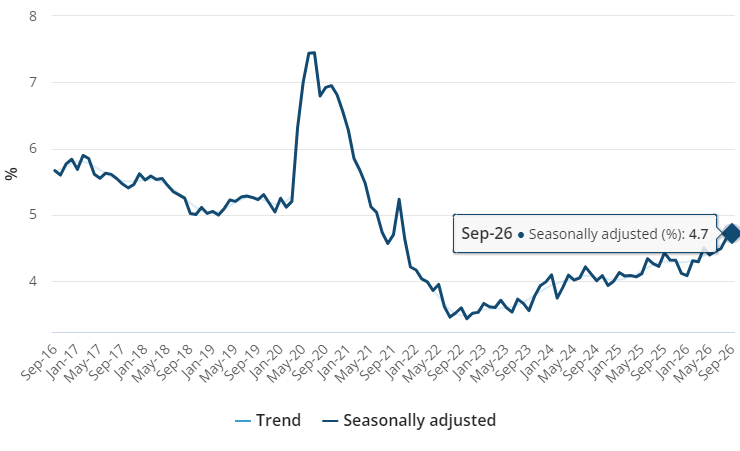
That makes a November increase less certain. It does not make a hold inevitable. The RBA must balance labour-market softness against inflation, and the September-quarter consumer price index due later in October will carry more direct weight in the decision.
For mortgage holders and property investors, the practical conclusion is not to trade one data release. Borrowers should continue testing repayments at higher rates, preserve liquidity and avoid basing a purchase on an assumed near-term reversal. Refinancing decisions should be assessed against total cost, not simply the advertised rate.
Property markets may initially welcome a reduced probability of another increase because borrowing capacity and sentiment are highly rate-sensitive. But a weakening labour market is not unambiguously positive for housing: job security supports mortgage serviceability, rental demand and buyer confidence.
The September numbers have given the RBA a credible reason to wait. Inflation will determine whether it can use it.

Here’s how they are looking at artificial intelligence, interest rates and economic pressures.

New research suggests that bonuses make employees feel more like a mere cog in a wheel.