Fed Cuts Rates Again, This Time by a Quarter Point
Powell says he has no intention of leaving Fed before his term expires

 4 min
4 min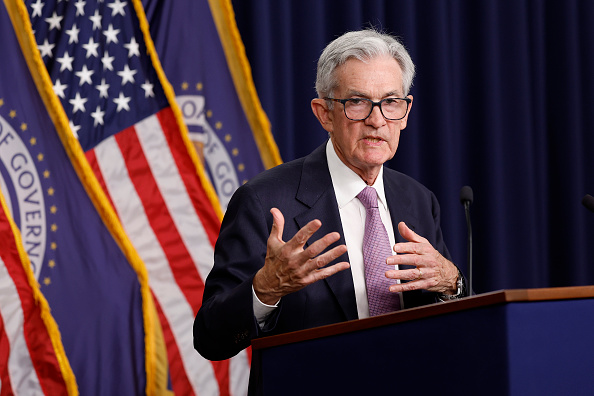
US: The Federal Reserve approved a quarter-point interest-rate cut Thursday, the latest step to prevent large rate increases of the prior 2½ years from weakening the labour market as inflation eases.
The decision, coming the same week as the election of Donald Trump to a second presidential term, followed an initial cut of a half-point in September and will bring the benchmark federal-funds rate to a range between 4.5% and 4.75%. All 12 Fed voters backed the cut.
Officials have said those moves are warranted because they are more confident that inflation will return to the central bank’s target and because they believe rates are still high enough, even with the latest cuts, to dampen economic activity.
The move was expected. Stocks and Treasury yields were steady after the announcement.
“We are committed to maintaining our economy’s strength,” Fed Chair Jerome Powell said at a news conference. He said officials are confident that with an “appropriate recalibration of our policy stance,” inflation can continue heading lower with a solid economy.
Trump’s election victory this week has the potential to reshape the economic outlook, with presumed GOP majorities on both sides of Capitol Hill enabling a broad shift on taxes, spending, immigration and trade. Economists are divided over whether the mix of policies will boost or weaken growth and drive up prices.
The shift in the outlook, in turn, has fuelled questions on Wall Street over whether the Fed will alter its earlier expectation that rates could be steadily dialled lower over the coming year or two.
Powell said it was too soon to say how the next administration’s policies would reshape the economic outlook.
“We don’t guess, we don’t speculate, we don’t assume” what policies will get put into place, Powell said. “In the near term, the election will have no effects on our policy decisions.”
Powell also said he had no intention of leaving the Fed before his four-year term as chair expires in May 2026. “Not permitted under the law,” Powell said when asked if he believed the president could remove him or other Fed personnel from their positions before their term expires.
Since the Fed cut rates in September, longer-dated bond yields have climbed notably, meaning the cost to borrow for a mortgage or car loan has gone up. Yields have increased in large part because better economic data has led investors to reduce their worries about a recession, which could have triggered larger rate cuts.
But some analysts think the bond-market selloff may also reflect concerns by some investors about higher deficits or inflation in a second Trump administration.
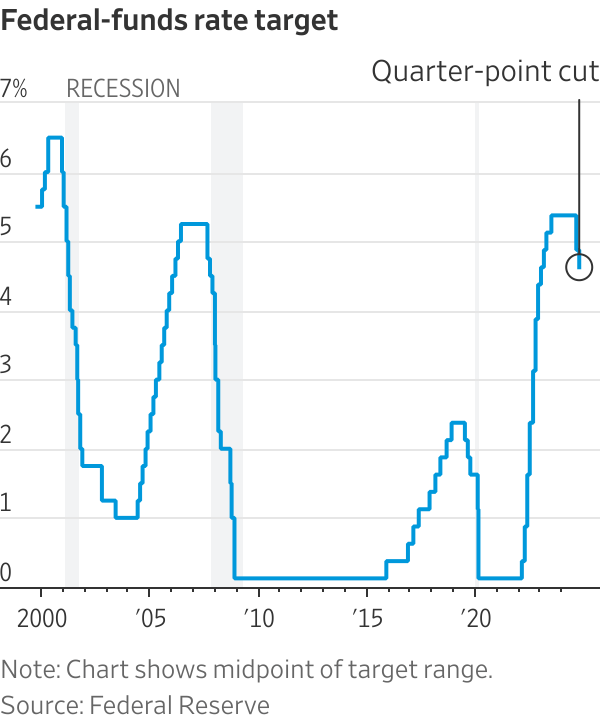
Either way, the market has generated an unusual result: Borrowing costs rose after the Fed cut rates. The average 30-year mortgage rate has jumped since mid-September, to 6.8% this week from 6.1%, according to Freddie Mac.
Over a similar time frame, investors in interest-rate futures markets have steadily reduced their expectations over how much the Fed will cut rates over the next year or so. They now see the Fed cutting rates to around 3.6% by 2026, up from an estimated trough of 2.8% in September, according to Citi.
Officials are trying to bring rates back to a more “normal” or “neutral” setting that neither spurs nor slows growth. But they don’t know what constitutes a normal rate. Policies that boost economic activity or prices could also lead officials to conclude that they should maintain a moderately restrictive rate stance. That means they would hold rates somewhat higher than a normal or neutral level.
Before the 2008-09 financial crisis, many thought a neutral rate might be around 4%, but after the crisis and an extremely sluggish recovery, economists and Fed officials concluded the neutral rate might be closer to 2%.
Interest-rate projections that officials submitted in September show most of them expected that if the economy expanded solidly with inflation continuing to cool , they could cut rates to around 3.5% next year.
Inflation based on the Fed’s preferred index was 2.1% in September, from a year earlier. A separate measure of so-called core inflation that strips out volatile food and energy prices was 2.7%. The Fed targets 2% inflation over time.
Because officials don’t have much conviction over where the neutral rate sits, they are likely to be guided by how the economy performs in the months ahead. If inflation keeps slowing and the demand for workers looks soft, officials could conclude it makes sense to continue cutting rates along the path they envisioned in September.
“We’re going to move carefully as this goes on so we can increase the chances that we get it right,” Powell said. “We’re trying to steer between the risk of moving too quicky…or moving too slowly. We’re trying to be on a middle path.”
If inflation progress stalls or ebullient financial markets raise concerns that inflation might get stuck above their target, officials might face more reservations around continuing to cut rates at a steady, meeting-after-meeting clip.
The most immediate focus is whether the Fed will cut again at its upcoming meeting in December. In September, 19 participants were about evenly divided over whether to cut rates one or two more times this year. Nine of them penciled in no more than one cut in either November or December, while 10 penciled in two cuts.
“There’s a lot to learn between now and the December meeting,” said Diane Swonk, chief U.S. economist at KPMG. “They can’t leave the door wide open, but they can’t close the door either.”
Powell said Thursday it was too soon to rule anything “out or in” at that meeting. Slowing down the pace of rate cuts is “something we’re just beginning to think about,” he said. “We’re on a path to a more neutral stance. That has not changed at all since September. We’re just going to have to see where the data lead us.”
Even before the election result, recent data suggested that cutting again would be a finely balanced decision because inflation looks like it might end the year slightly above officials’ projection, while the unemployment rate has edged lower recently, said Matthew Luzzetti, chief U.S. economist at Deutsche Bank.
The election result— which sent stock markets to new highs while raising the prospect of stronger growth, higher inflation and better labour-market outcomes—boosted the odds that the Fed forgoes a cut next month, he said.
“Those could present a strong case from a risk-management perspective to potentially skip that meeting,” said Luzzetti.
 Copyright 2020, Dow Jones & Company, Inc. All Rights Reserved Worldwide. LEARN MORE





Australian shares fell on Thursday as Wall Street weakness, rising oil and persistent rate concerns weighed on most of the market. The S&P/ASX 200 declined 0.72 per cent to 8,702. The All Ordinaries lost 0.66 per cent to finish at 8,897. Mining stocks were hit particularly hard, while real estate also dragged on the index. …
Continue reading “ASX falls 0.7 per cent as miners and property stocks retreat”

Borrowers cannot control the Reserve Bank, but they can control how exposed their household budget is to its next decision. The RBA meets on 29 September with inflation concerns still elevated and major-bank economists increasingly bringing forward their rate-rise calls. Fixed mortgage rates have also been moving, reducing the value of waiting for perfect certainty. …
Continue reading “What mortgage holders should do before the next RBA decision”

 2 min
2 minAustralian shares fell on Thursday as Wall Street weakness, rising oil and persistent rate concerns weighed on most of the market.
The S&P/ASX 200 declined 0.72 per cent to 8,702. The All Ordinaries lost 0.66 per cent to finish at 8,897. Mining stocks were hit particularly hard, while real estate also dragged on the index.
Energy was the notable exception, gaining more than one per cent as Brent crude traded above US$103 a barrel. Oil had moved higher amid uncertainty surrounding potential US diesel-export restrictions and broader geopolitical supply risks. The move supported energy producers but renewed concern about inflation inputs across transport and the wider economy.
Gold shares were weak even as spot bullion remained historically elevated. The All Ordinaries Gold index fell about 2.25 per cent, showing that equity performance can diverge from the commodity because of valuation, currency, operating and company-specific factors.
Zip was a prominent loser, falling 11.38 per cent after the company reported short sales after the previous close. Nine Entertainment also weakened after UBS analysts warned of near-term revenue challenges associated with its advertising-supported subscription tier.
Premier Investments led larger winners despite caution about the retail environment. Breville, in which Premier owns a significant stake, also appeared among leading movers. In the broader ASX 300 screen, Myer gained 11.43 per cent and MAAS Group rose 7.93 per cent, while Lotus Resources fell 10.53 per cent. These percentage moves should be checked against company announcements and trading liquidity before attributing causes.
The Australian dollar was broadly flat at US70.38 cents. Spot gold was around US$4,280 an ounce, Brent crude approximately US$103.08 a barrel and iron ore near US$96.90 a tonne late in the session.
The rate outlook remains the central domestic catalyst. Labour-market weakness has not eliminated the possibility of an RBA increase next week, leaving banks, listed property and other rate-sensitive sectors exposed to changing expectations.
Market dashboard
S&P/ASX 200: 8,702, down 0.72 per cent.
All Ordinaries: 8,897, down 0.66 per cent.
Best sector: Energy, up more than one per cent.
Weakest areas: Real estate and materials were the major drags; confirm final sector percentages before publication.
Material winner: Premier Investments led the large-company gainers. Confirm its final closing move from the ASX before publication.
Material loser: Zip, down 11.38 per cent.
ASX 300 percentage leader: Myer, up 11.43 per cent.
ASX 300 percentage laggard: Zip, down 11.38 per cent.
AUD/USD: Approximately US$0.7038, broadly flat.

The era of the gorgeous golden retriever is over. Today’s most coveted pooches have frightful faces bred to tug at our hearts.

From Italian vegetable-tanned leather to real-world training insight, Australian brand PK9 Gear is redefining what luxury means for discerning dog owners.