How Investing Will Change if the Dollar No Longer Rules the World
Should the U.S. currency and stocks no longer rise together, Americans will need to broaden their portfolios.

 3 min
3 min
If you’ve been investing your savings for the past 15 years, there is a situation you’ve hardly ever encountered: the U.S. dollar getting structurally weaker. Given the fallout from President Trump’s “Liberation Day,” you may need to get used to it.
Wall Street was caught off guard when the greenback dropped against major currencies following this past week’s tariff news. Markets feared that protectionism could put an end to the U.S.’s economic dominance since the global financial crisis.
International money managers, who had massively biased their holdings toward U.S. assets, are feeling the urge to find another source of high returns. American investors, long comfortable ignoring foreign stocks, may no longer have that luxury.
“We are working on the assumption that in the next five years, the dollar is going to lose another 10% to 15%,” said Luca Paolini, chief strategist at Switzerland’s Pictet Asset Management.
To be sure, asset managers in many cases are making short-term, defensive moves to protect against a potential recession. It also follows a trend of money leaving the “Magnificent Seven” stocks specifically— Apple , Microsoft , Amazon.com , Alphabet , Meta Platforms , Nvidia and Tesla —for reasons not fully related to Trump .
These companies drove much of the exceptional returns of the past decade and a half, but their collective price/earnings ratio hit a staggering 46 times last December. At such a lofty level, it doesn’t take much for a fall to ensue.
Even excluding the Magnificent Seven, though, Americans who bought the rest of the S&P 500 15 years ago earned a total return of around 380%. Europeans who did the same, unhedged, earned about 490%—thanks to the dollar’s more than 20% gain against the euro, according to FactSet.
The reverse also holds: Eurozone equities returned about 220% in euros, but only 150% in dollars. Japanese equities tell a similar story—the Nikkei 225 gained 300% in yen, but just 160% in dollars. No wonder Americans haven’t rushed to add these stocks to their 401(k)s.
What is striking is that a stronger dollar should, mechanically, hurt U.S. stocks—by reducing the dollar value of overseas earnings—and help foreign ones. Historically, it has been better to buy the S&P 500 when the dollar was weakening. Over the past five years, that held true: Fed rate hikes strengthened the dollar while hurting equities.
But in the seven years before Covid-19, the dollar and U.S. equities moved in sync. That was the heyday of the “American exceptionalism trade,” when U.S. assets outperformed across the board—not just in tech. This included currency-sensitive sectors like industrials.
Two forces helped drive this. One was the fracking boom, which made the U.S. largely energy self-sufficient, cutting corporate costs and turning the dollar into a kind of “petrocurrency.” Investors learned in 2014 the counterintuitive lesson that the U.S. economy may actually suffer when crude prices nosedive, and benefit when they rise.
Indeed, the other factor was that U.S. consumer spending was unrelenting, even at times when gas-pump prices increased. For years, it has been powered by government deficit spending, a tech sector exporting services globally at scale, and the wealth effects from a booming stock market.
Most of that now risks being turned upside down, exposing investors to the prospect of falling equities alongside a weakening currency.
Trump has pledged to plug the budget deficit, which could arguably weaken the dollar. Meanwhile, he has launched a tariff war that has tanked the equity market, triggered retaliation from China and may provoke European blowback against U.S. tech giants.
The new regime could echo the early 2000s, when investors turned against both tech and U.S. stocks in the aftermath of the dot-com bubble. At the time, the dollar also had a positive correlation with equities, as capital flowed into the so-called Brics—Brazil, Russia, India, China, and South Africa.
In a report to clients Friday, Jeff Schulze of ClearBridge Investments noted that international equities have historically picked up the slack when the S&P 500 lagged behind. In such cases, the MSCI EAFE and MSCI Emerging Markets indexes beat the benchmark U.S. index by an annualized average of 2.0 percentage points and 12.1 percentage points, respectively.
A weaker dollar itself helps support the financial resilience of developing nations. Meanwhile, the European Union has rekindled investor hopes that it can close the growth gap with the U.S. through fiscal stimulus, industrial policy and energy independence.
At the same time, this is nothing like the 2000s. The rest of the world is far more exposed to trade than the U.S.’s relatively closed economy and will have to grapple with China rerouting a huge glut of cheap goods there.
Another option for investors, then, is to remain in U.S. equities and hedge the currency risk—but that is expensive—or to broaden exposure to discounted “value” stocks and try to identify potential long-term winners.
An economy reshaped by Trump would imply more investment and less consumption. Since the only profitable way to onshore production—whether a Nike shoe or a General Motors SUV—is to use machines instead of labor, capital goods manufacturers may eventually benefit. But they are also among the hardest hit by today’s indiscriminate disruption to global supply chains.
Given the complete lack of clarity, the only solution for those who still need the long-term upside of stocks may be to do all of it at the same time. Right now, diversification isn’t just a strategy, it is a lifeline.
 Copyright 2020, Dow Jones & Company, Inc. All Rights Reserved Worldwide. LEARN MORE




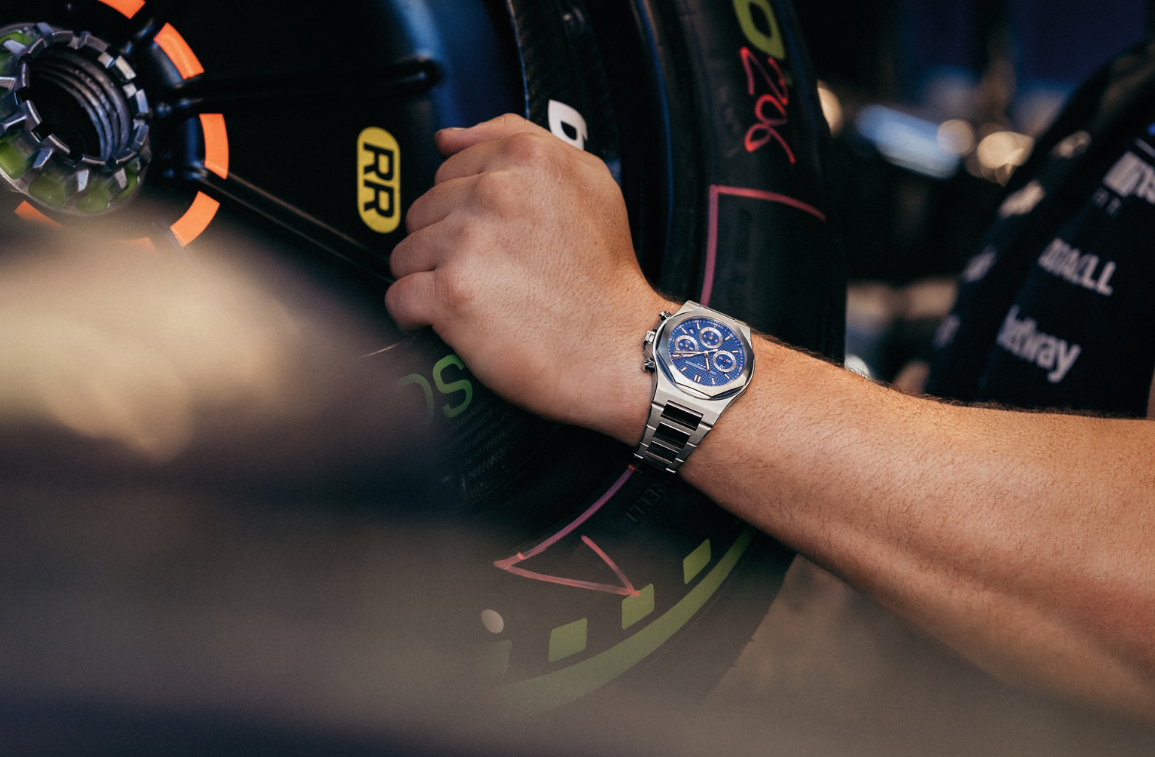
The Swiss watchmaker’s first collaboration with Atlassian Williams F1 Team produces two sporting Laureato models inspired by the team’s 2026 racing car.

Victorian auction buyers will soon receive a piece of information that has traditionally been withheld until bidding reaches it: the vendor’s reserve price. Under new property-sale and underquoting laws, agents must publish the agreed reserve at least seven days before an auction or fixed-date sale. Most changes begin on 1 October 2026 and apply to …
Continue reading “Victoria’s New Auction Rules Will Force Reserve Prices Into the Open”

The Swiss watchmaker’s first collaboration with Atlassian Williams F1 Team produces two sporting Laureato models inspired by the team’s 2026 racing car.
3 minGirard-Perregaux has revealed the first watches created through its partnership with Atlassian Williams F1 Team, bringing the British racing team’s colours to one of Switzerland’s most recognisable integrated-bracelet designs.
The collaboration comprises two 42mm steel watches: the time-and-date Laureato Williams Edition and the more technical Laureato Chronograph Williams Edition.
Both retain the familiar architecture of the Laureato, including its octagonal bezel, integrated bracelet and mix of polished and satin-finished surfaces. The influence of Williams is comparatively restrained, appearing through colour, discreet branding and details inspired by the team’s current Formula 1 car.
It is a welcome departure from the oversized logos and literal automotive references that can characterise motorsport watches.
The Williams FW48 inspires the dial
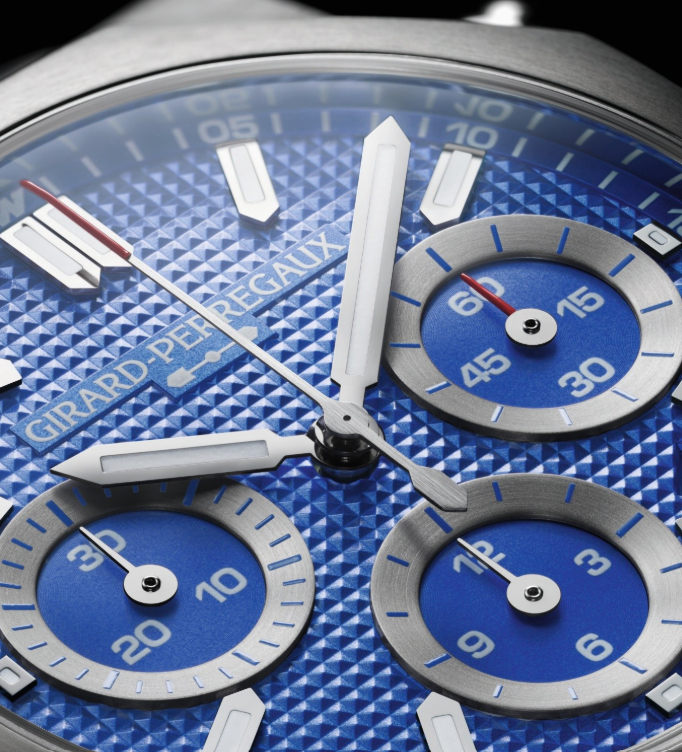
The centrepiece of both models is a blue Clous de Paris dial informed by the livery of the Williams FW48, the car being campaigned by the team during the 2026 Formula 1 season.
A small Williams “W” replaces the conventional marker at 12 o’clock, while the team emblem appears on the sapphire crystal caseback. Red accents echo the keyline used on the FW48 without overwhelming the established Laureato design.
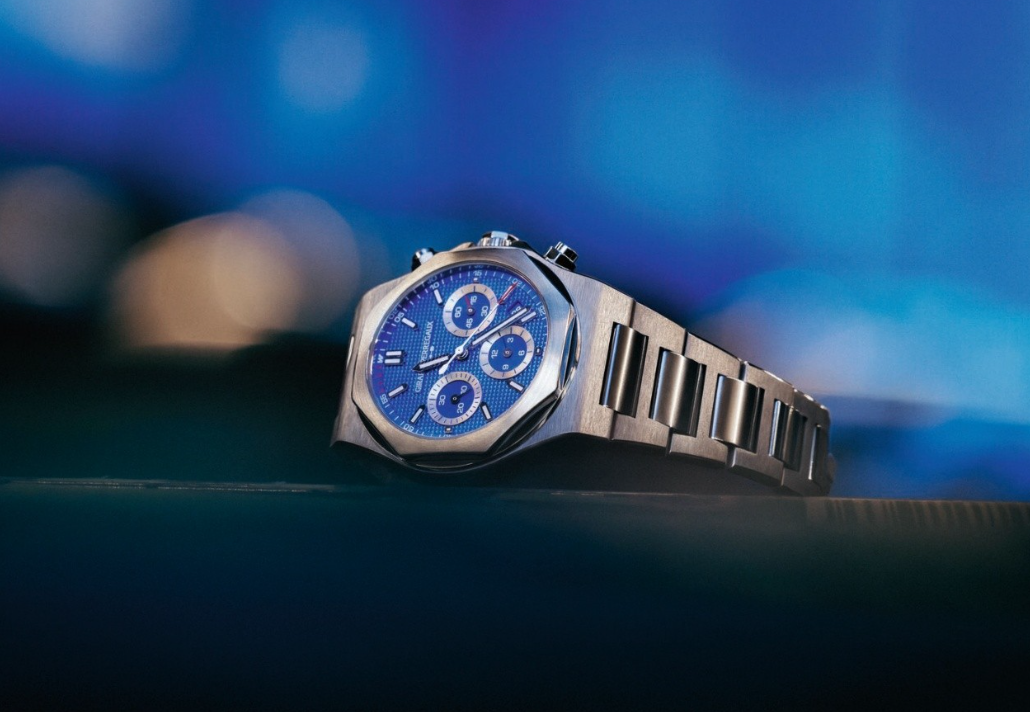
The three-hand model offers the quieter interpretation. Baton-shaped, rhodium-plated hands and hour markers are filled with white-emitting luminescent material, while a date window sits at three o’clock.
The chronograph creates a more obvious connection with motorsport. Three subdials are framed by rhodium-plated rings, with red appearing on the small-seconds hand and the tip of the central chronograph seconds hand.
Both watches measure 42mm across and are water resistant to 100 metres. The standard Laureato has a case thickness of 10.68mm, while the additional mechanics of the chronograph increase its profile to 12.16mm.
Two in-house automatic movements
The Laureato Williams Edition is powered by Girard-Perregaux’s self-winding GP01800 calibre. The movement provides hours, minutes, central seconds and the date, with a minimum power reserve of 54 hours.
The Laureato Chronograph Williams Edition uses the automatic GP03300 calibre, which combines its chronograph functions with a date display and offers a minimum power reserve of 46 hours.
Both movements operate at 28,800 vibrations per hour and can be viewed through their sapphire crystal casebacks.
Their decoration provides a more traditional counterpoint to the Formula 1 association. Finishing techniques include Côtes de Genève, circular graining, bevelling, mirror polishing, satin finishing, engraving and snailing.
The result is less about reproducing the appearance of a racing car than identifying the common ground between two mechanical disciplines: precision, incremental development and the considerable work hidden beneath the finished product.
Parallel histories
The timing of the partnership draws attention to the remarkably similar ages of its two protagonists.
Girard-Perregaux introduced the original Laureato in 1975, establishing an integrated-bracelet sports watch with a distinctive octagonal bezel. Williams entered Formula 1 two years later in 1977.
Both have evolved continuously across the five decades since. The Laureato has moved through different sizes, materials and complications, while retaining its central design language. Williams, meanwhile, has remained one of Formula 1’s most historically significant teams.
That gives the collaboration greater credibility than a simple licensing exercise. Girard-Perregaux and Williams are not being connected solely through the familiar language of speed. Their stronger link is a shared dependence on engineering, testing and the accumulation of specialist knowledge.
The watches are described as the beginning of a longer collaboration, suggesting further Williams editions may follow.
Girard-Perregaux’s international website lists the Laureato Williams Edition at US$16,200 and the Laureato Chronograph Williams Edition at US$20,900. Australian pricing has not been announced.
Specifications
Girard-Perregaux Laureato Williams Edition 42mm
Reference: 81010-11-3680-1GM
Case: Steel
Diameter: 42mm
Thickness: 10.68mm
Crystal: Anti-reflective sapphire crystal
Dial: Blue Clous de Paris pattern
Movement: Automatic GP01800
Functions: Hours, minutes, central seconds and date
Power reserve: Minimum 54 hours
Water resistance: 100 metres
Bracelet: Integrated steel bracelet with triple-folding clasp
International price: US$16,200
Girard-Perregaux Laureato Chronograph Williams Edition 42mm
Reference: 81020-11-3681-1GM
Case: 904L steel
Diameter: 42mm
Thickness: 12.16mm
Crystal: Anti-reflective sapphire crystal
Dial: Blue Clous de Paris pattern with three chronograph counters
Movement: Automatic GP03300
Functions: Chronograph, hours, minutes, small seconds and date
Power reserve: Minimum 46 hours
Water resistance: 100 metres
Bracelet: Integrated 904L steel bracelet with triple-folding clasp
International price: US$20,900

By improving sluggish performance or replacing a broken screen, you can make your old iPhone feel new agai

A record-breaking $11 million sale at The Centennial Collection has set a new benchmark for luxury apartment living in Bondi Junction.