





Capital Haus buys Baker Young in billion-dollar push to reshape Australian wealth advice
Capital Haus has snapped up Adelaide stalwart Baker Young, lifting its funds under management beyond AUD$1 billion and signalling a generational shift in the advice industry.
 3 min
3 min
Capital Haus has moved to expand its national presence with the acquisition of Adelaide advisory firm Baker Young, one of Australia’s longest-standing private wealth practices.
The deal will see the combined group’s funds under management exceed AUD$1 billion, as adviser numbers and client coverage grow across the country.
Founded more than 40 years ago by Alan Young and David Baker, Baker Young today serves over 6,000 clients and manages AUD$700 million in assets.
Under the agreement, the Baker Young brand will be retained, and senior principals including Young and Baker will continue in active advisory roles.
Capital Haus will also migrate its existing clients to the refreshed ‘Baker Young, a Capital Haus company’ banner, which becomes its flagship advisory business.
A new offering for ultra-high-net-worth clients, Baker Young Private, will be introduced, providing access to wholesale opportunities, global private credit financing and capital raises.
Both firms’ clients will continue working with their current advisers, while gaining access to broader group-level capability, including global research, multi-asset solutions and cross-border services. Baker Young will also gain upgraded institutional-grade infrastructure and portfolio management systems.
The acquisition adds further momentum to Capital Haus’ expansion. Established in Sydney in 2019, the company has since launched offices in Dubai and Zurich and acquired practices in Townsville and Bateman’s Bay.
With the addition of Baker Young’s team, plus new managers from RiverX Investment Management and Active Super, the group now employs 41 advisers and support staff.
Brendan Gow, Founder and CEO of Capital Haus Group, said: “Baker Young has been a cornerstone of South Australia’s advice community for four decades, built on deep relationships and trust. We feel privileged to be the next custodian of that legacy.
“By moving our existing client base across to the Baker Young brand, as well as launching the new Baker Young Private service, this deal represents more than just a passing-the-torch moment. We’re combining heritage and innovation to set a new standard for financial advice at a time when the industry needs it most.”
The acquisition lands at a pivotal moment for the sector. Adviser numbers have halved since 2018, falling from around 28,900 to fewer than 15,300 as at September 2025, even as demand surges.
More than 10.2 million Australian adults were seeking financial advice in 2024, driven in part by intergenerational wealth transfer and growing expectations from Millennials and Gen Z for both trusted relationships and digitally enabled service.

Alan Young, Co-Founder and Joint MD of Baker Young, said: “For 40 years, our focus has been simple: put clients first and build relationships that span generations. Capital Haus shares that philosophy.
“We are planning for the long term – for our clients, our team and our brand. Becoming part of the Capital Haus Group means our legacy will endure, while also providing stability for clients, as well as access to exciting new opportunities. It is the right succession step for our practice and a positive evolution for our clients.”
David Baker, Co-Founder and Joint MD, added: “We’ve spent four decades building Baker Young on a foundation of trust, personalised service, and consistent performance. We’re energised by the shared vision Capital Haus is pursuing and we’re proud to be part of it.”
Gow said: “We believe the future of advice belongs to firms that can combine old-fashioned relationship banking with modern, global wealth capabilities. By bringing Baker Young into the Capital Haus family, we’re preserving one of Australia’s great advisory brands while building a platform that can serve the next generation of investors.”
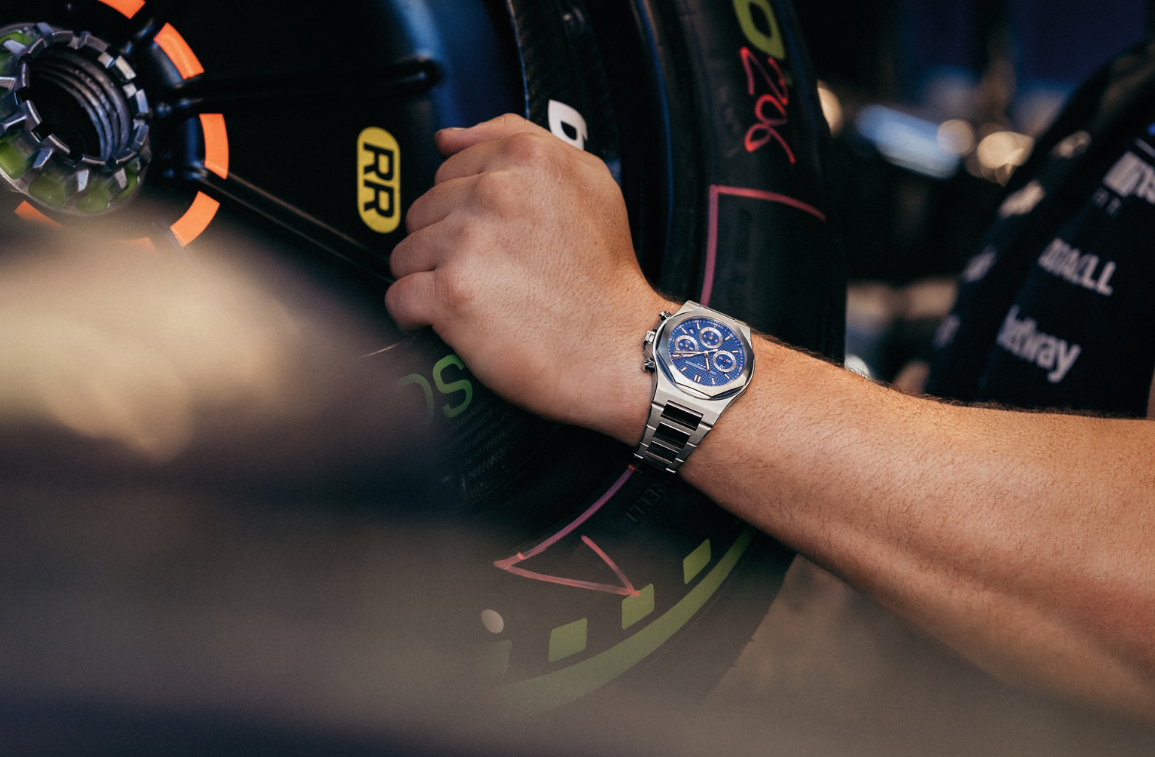
The Swiss watchmaker’s first collaboration with Atlassian Williams F1 Team produces two sporting Laureato models inspired by the team’s 2026 racing car.

Victorian auction buyers will soon receive a piece of information that has traditionally been withheld until bidding reaches it: the vendor’s reserve price. Under new property-sale and underquoting laws, agents must publish the agreed reserve at least seven days before an auction or fixed-date sale. Most changes begin on 1 October 2026 and apply to …
Continue reading “Victoria’s New Auction Rules Will Force Reserve Prices Into the Open”

The Swiss watchmaker’s first collaboration with Atlassian Williams F1 Team produces two sporting Laureato models inspired by the team’s 2026 racing car.
3 minGirard-Perregaux has revealed the first watches created through its partnership with Atlassian Williams F1 Team, bringing the British racing team’s colours to one of Switzerland’s most recognisable integrated-bracelet designs.
The collaboration comprises two 42mm steel watches: the time-and-date Laureato Williams Edition and the more technical Laureato Chronograph Williams Edition.
Both retain the familiar architecture of the Laureato, including its octagonal bezel, integrated bracelet and mix of polished and satin-finished surfaces. The influence of Williams is comparatively restrained, appearing through colour, discreet branding and details inspired by the team’s current Formula 1 car.
It is a welcome departure from the oversized logos and literal automotive references that can characterise motorsport watches.
The Williams FW48 inspires the dial
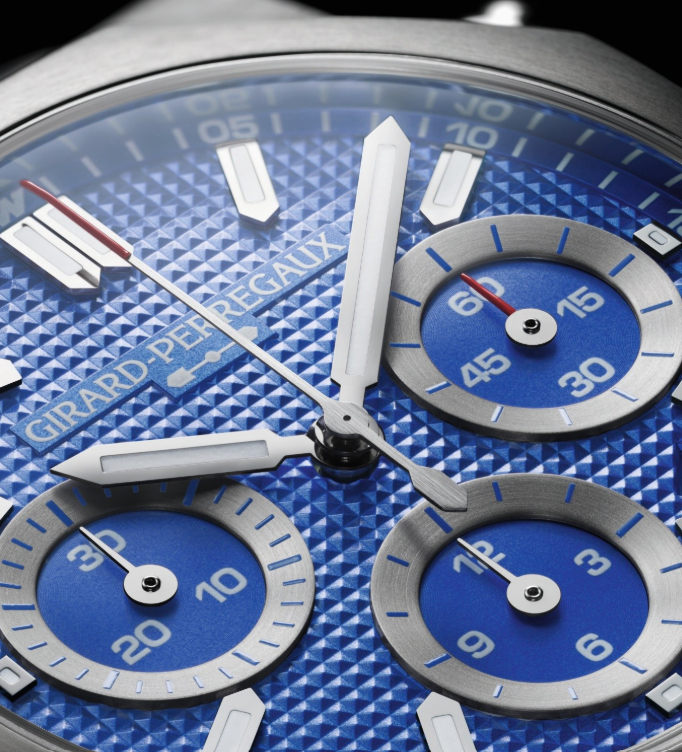
The centrepiece of both models is a blue Clous de Paris dial informed by the livery of the Williams FW48, the car being campaigned by the team during the 2026 Formula 1 season.
A small Williams “W” replaces the conventional marker at 12 o’clock, while the team emblem appears on the sapphire crystal caseback. Red accents echo the keyline used on the FW48 without overwhelming the established Laureato design.
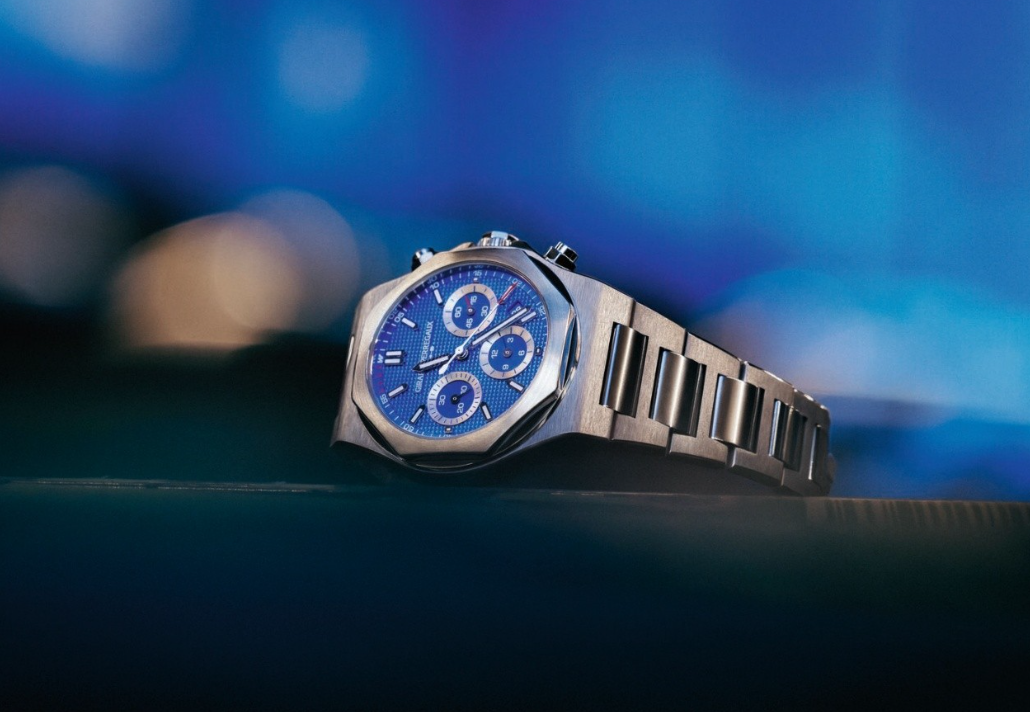
The three-hand model offers the quieter interpretation. Baton-shaped, rhodium-plated hands and hour markers are filled with white-emitting luminescent material, while a date window sits at three o’clock.
The chronograph creates a more obvious connection with motorsport. Three subdials are framed by rhodium-plated rings, with red appearing on the small-seconds hand and the tip of the central chronograph seconds hand.
Both watches measure 42mm across and are water resistant to 100 metres. The standard Laureato has a case thickness of 10.68mm, while the additional mechanics of the chronograph increase its profile to 12.16mm.
Two in-house automatic movements
The Laureato Williams Edition is powered by Girard-Perregaux’s self-winding GP01800 calibre. The movement provides hours, minutes, central seconds and the date, with a minimum power reserve of 54 hours.
The Laureato Chronograph Williams Edition uses the automatic GP03300 calibre, which combines its chronograph functions with a date display and offers a minimum power reserve of 46 hours.
Both movements operate at 28,800 vibrations per hour and can be viewed through their sapphire crystal casebacks.
Their decoration provides a more traditional counterpoint to the Formula 1 association. Finishing techniques include Côtes de Genève, circular graining, bevelling, mirror polishing, satin finishing, engraving and snailing.
The result is less about reproducing the appearance of a racing car than identifying the common ground between two mechanical disciplines: precision, incremental development and the considerable work hidden beneath the finished product.
Parallel histories
The timing of the partnership draws attention to the remarkably similar ages of its two protagonists.
Girard-Perregaux introduced the original Laureato in 1975, establishing an integrated-bracelet sports watch with a distinctive octagonal bezel. Williams entered Formula 1 two years later in 1977.
Both have evolved continuously across the five decades since. The Laureato has moved through different sizes, materials and complications, while retaining its central design language. Williams, meanwhile, has remained one of Formula 1’s most historically significant teams.
That gives the collaboration greater credibility than a simple licensing exercise. Girard-Perregaux and Williams are not being connected solely through the familiar language of speed. Their stronger link is a shared dependence on engineering, testing and the accumulation of specialist knowledge.
The watches are described as the beginning of a longer collaboration, suggesting further Williams editions may follow.
Girard-Perregaux’s international website lists the Laureato Williams Edition at US$16,200 and the Laureato Chronograph Williams Edition at US$20,900. Australian pricing has not been announced.
Specifications
Girard-Perregaux Laureato Williams Edition 42mm
Reference: 81010-11-3680-1GM
Case: Steel
Diameter: 42mm
Thickness: 10.68mm
Crystal: Anti-reflective sapphire crystal
Dial: Blue Clous de Paris pattern
Movement: Automatic GP01800
Functions: Hours, minutes, central seconds and date
Power reserve: Minimum 54 hours
Water resistance: 100 metres
Bracelet: Integrated steel bracelet with triple-folding clasp
International price: US$16,200
Girard-Perregaux Laureato Chronograph Williams Edition 42mm
Reference: 81020-11-3681-1GM
Case: 904L steel
Diameter: 42mm
Thickness: 12.16mm
Crystal: Anti-reflective sapphire crystal
Dial: Blue Clous de Paris pattern with three chronograph counters
Movement: Automatic GP03300
Functions: Chronograph, hours, minutes, small seconds and date
Power reserve: Minimum 46 hours
Water resistance: 100 metres
Bracelet: Integrated 904L steel bracelet with triple-folding clasp
International price: US$20,900
The grand harbourside residence combines sweeping Sydney Heads views, resort-style entertaining and refined designer finishes with a reported $36 million price guide.

Three completed developments bring a quieter, more thoughtful style of luxury living to Mosman, Neutral Bay and Crows Nest.


