Why These Bargain Stocks Can Outshine Gold
Gold miners are emerging as a compelling way to navigate market uncertainty, with analysts pointing to strong cash flows, attractive valuations and rising profit margins. As gold prices stabilize above US$4,000 an ounce, mining stocks could offer investors both downside protection and long-term upside.

 3 min
3 min
Gold is one of the market’s go-to hedges in rocky times. Don’t forget that gold miners’ stocks are too.
The stock market’s gains in 2026 belie the rocky macroeconomic picture: elevated inflation, heightened geopolitical tensions, and jitters about the artificial-intelligence trade. That backdrop, in theory, should be the time for gold to shine. Instead, the price of the yellow metal has tumbled more than 5% so far, after last year’s blistering 65% rally. In part, the U.S. dollar’s recovery has stymied gold, which benefited from the greenback’s weakness in 2025.
Even with the precious metal’s recent weakness, gold mining stocks could be the best way to profit from this year’s uncertainty.
Gold miners “are a valuable hedge against macro risks that would likely be damaging for equities,” BCA Research’s Noah Weisberger and Rishabh Shah wrote this week.
Concerns about the Federal Reserve’s next moves to tackle inflation, the increasingly crowded AI trade, and steep valuations for tech stocks are just some of the drivers that could help gold’s price get on even footing— and lead to even bigger gains for miner stocks.
These stocks’ prices tend to outpace gold’s moves, because the companies have fixed operational costs. So when gold’s price rallies, their profit margins soar, and vice versa. For instance, the VanEck Gold Miners GDX +7.39% exchange-traded fund has fallen 11% this year as the metal has slumped.
Now, gold’s price just needs to stabilize to help miners’ stocks take off, and that seems to be happening. The precious metal has recently found support above the $4,000 level, and has stuck in a narrow range since the end of June. But its price rose ever so slightly in July, ending a four-month losing streak for the metal. Technical analysis also suggests that gold is due for a comeback.
Barron’s recently wrote that the pullbacks for both gold miners and the metal itself are overdone. Senior technical analyst Doug Busch noted that the VanEck ETF is on the “verge of a breakout” and has the potential to hit $11o in early 2027, up more than 40% from its current price.
Gold miners also have more than their role as a market hedge going for them. Their fundamentals are solid, too, says Chris Mancini, portfolio co-manager of the Gabelli Gold Fund.
“Precious metals miners are generating substantial amounts of free cash flow given profit margins of over $2,000 per ounce, and are returning this cash to shareholders through buybacks and dividends,” he said in an email.
“Buying the miners is a cheap way to get exposure to the price of gold,” he added. His fund owns Newmont NEM +6.71%, a Barron’s stock pick last year, and Agnico Eagle Mines as top holdings, as well as miners Northern Star Resources, Endeavour Mining, and Kinross Gold K+8.59%.
Miners are better businesses than they used to be, the BCA team added.
“Capex is more disciplined, margins are high and rising…and they are largely independent of the AI story,” Weisberger, BCA’s head of equities, and Shah, a senior analyst, wrote.
That last part is key. AI is disrupting the software industry and many other services and information-oriented businesses, and investors have piled into AI stocks. But ChatGPT, Claude, Grok, and other large-language models aren’t going to replace the need to mine for metals.
“Equity portfolios can benefit from exposure to quality that is uncorrelated to AI risk, and gold miners fit the bill,” the BCA team said.
They recommend that investors buy the VanEck Gold Miners ETF, which owns top miners such as Agnico, Barrick Mining ABX +7.24%, and Newmont.
An important bonus for big gold miners’ stocks is that their valuations are attractive after the gold’s pullback, too. The VanEck ETF is now trading at just a little more than nine times next year’s earnings estimates. That’s a big discount to its five-year average price-to-earnings ratio of 14, according to FactSet.
What’s more, the ETF is currently valued at a more than 50% discount to the S&P 500 SPX -0.17%, which is trading for about 19 times earnings estimates for 2027. Mining stocks have typically traded at just a 25% discount to the broader market over the past five years. So there is significant upside for the group if valuations move back toward normal levels.
One factor that complicates mining stocks as a market hedge, of course, is if stocks bounce back, which has been the case so far in August.
But both the market and economic outlooks remain cloudy, and investors remain nervous about the Fed’s next moves and AI stocks. Gold miners should do just fine, even if the anxious mood on Wall Street persists.
 Copyright 2020, Dow Jones & Company, Inc. All Rights Reserved Worldwide. LEARN MORE





Waldorf Astoria Kuala Lumpur is scheduled to open on 30 October, introducing the Hilton luxury brand to Malaysia with an all-suite hotel in the city’s Golden Triangle.

Located steps from Crows Nest Metro, the near-complete development brings luxury living to Sydney’s Lower North Shore.

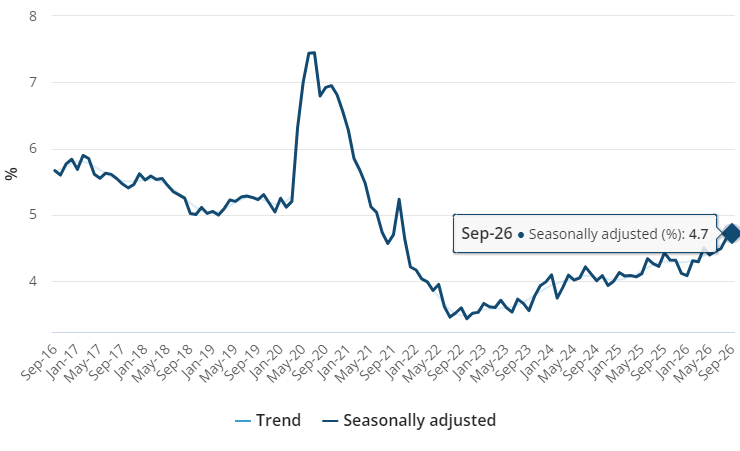
Employment fell by 39,300 and unemployment held at a revised 4.7 per cent, giving the RBA more room to pause in November.
2 min
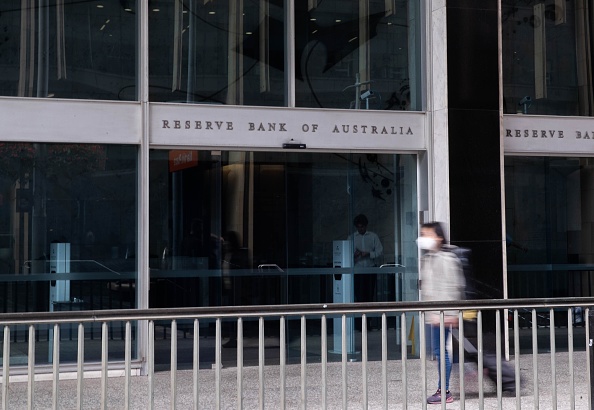
Australia’s labour market weakened in September, reducing—but not eliminating—the case for another Reserve Bank rate rise in November.
The seasonally adjusted unemployment rate was 4.7 per cent, according to the Australian Bureau of Statistics. August was revised to the same level, while September employment fell by 39,300 people. The number of unemployed Australians increased by 8,900 to 732,000.
The weakness extended beyond the headline rate. The employment-to-population ratio fell 0.3 percentage points to 63.6 per cent, participation declined 0.2 points to 66.8 per cent and underemployment edged up to 6.3 per cent. Part-time employment fell by 73,700, partly offset by a 34,400 increase in full-time work.
For the RBA, this is a clearer sign that restrictive monetary policy is cooling demand. Higher unemployment and falling employment reduce wage pressure over time and increase the risk that another rate rise would push the economy harder than necessary.
That makes a November increase less certain. It does not make a hold inevitable. The RBA must balance labour-market softness against inflation, and the September-quarter consumer price index due later in October will carry more direct weight in the decision.
For mortgage holders and property investors, the practical conclusion is not to trade one data release. Borrowers should continue testing repayments at higher rates, preserve liquidity and avoid basing a purchase on an assumed near-term reversal. Refinancing decisions should be assessed against total cost, not simply the advertised rate.
Property markets may initially welcome a reduced probability of another increase because borrowing capacity and sentiment are highly rate-sensitive. But a weakening labour market is not unambiguously positive for housing: job security supports mortgage serviceability, rental demand and buyer confidence.
The September numbers have given the RBA a credible reason to wait. Inflation will determine whether it can use it.

The sports-car maker delivered 279,449 cars last year, down from 310,718 in 2024.

BMW has unveiled the Neue Klasse in Munich, marking its biggest investment to date and a new era of electrification, digitalisation and sustainable design.