Don’t Be a Jerk at Work. (But Don’t Be Too Nice, Either.)
How devolving into people-pleasing can hold back your career

 4 min
4 min
How nice should you be at work?
We’ve supposedly moved on from the era of the militaristic chief executive who barks orders and threats. Most of us agree: We don’t like jerks. Be kind, we implore our kids.
Then we get to the office. We’ve got direct reports to rally, colleagues in other departments to convince and bosses who claim they want honest feedback. Speak with hesitation and you’re ignored. Handle your team with kid gloves and you’re a pushover, not a force to be reckoned with.
“I, personally, think you’re too nice a person to be in the job that you’re in.” That’s what Rep. Greg Murphy (R., N.C.) told Katherine Tai, the lead trade negotiator for the U.S., this spring during a hearing. His comments summed up feedback so many of us, especially women, have heard. We’re too bubbly or kind. We deploy too many apologies or exclamation marks. Yet when we do too little of all that, we’re overly aggressive.
“I want to be a nice person,” Sarah Kleinberg, the director of operations at a healthcare consulting firm, told me. She has realised, though, that being nice often makes others feel good, without actually moving a project forward or prompting a team member to improve.
“You have to have the level of confidence to be beyond people-pleasing,” she says.
‘Customer-service voice’
Many people, desperate not to offend, resort to what speaking coach Samara Bay calls “customer-service voice.” It’s that high-pitched, upspeak-y tone meant to inform the barista, I think you might be out of oat milk?
What are we saying when we use that tone? “I’m not powerful, don’t worry,” Bay says.
Making yourself non intimidating and as small as possible might work earlier in careers, she adds, making the people in charge feel secure. But as we ascend, or try to, the wavering voices can confuse others. Do it enough and people might question whether you’re leadership material, Bay says.
She recommends a vocal exercise for speaking more confidently. Pretend that you’re introducing yourself—“Hi, my name is Rachel”—while throwing a pretend ball against the wall. Match your vocal pitch to the ball’s trajectory. When you throw the ball down to the ground, you’ll hear your voice droop in energy along with the ball. Then throw the ball up, and notice the way your words sound as if you’re half taking them back. Last, throw the ball straight and allow your words to follow through, too.
“It’s the weirdest feeling to say something and mean it all the way to the end,” Bay says. “It feels brave.”
No hedging allowed
When pitching an idea, don’t undercut yourself with hedging language, says Bob Bordone, a negotiations coach. He cringes at questions like: “Would you be willing to consider letting me work remotely on Fridays?”
“It makes me just want to say no because it’s such a weak thing,” he says.
Instead, he says, start with a statement: “I wanted to talk to you about working out a new schedule.” Assure that any agreement you come to would be good for your manager and the company.
When someone tells you no, Bordone suggests trying: “How can we tackle this, even though we see it differently?” You sound strong and assertive, but not nasty, he says.
Good news for the nice guys among us: You don’t have to give up your personality to be taken seriously.
“I’m, 99.9% of the time, a jovial, happy-go-lucky guy,” says Colton Schweitzer, a user-experience designer and educator in Vancouver, Wash. When he doesn’t like the direction a project is going, he pushes back by asking questions and inserting the occasional joke.
“I’m smiling,” he says, “Even when I’m saying, ‘Are you sure about that?’”
Because he’s so pleasant, his serious moments carry weight. At one job, he cheerfully took on more work when colleagues asked—until his manager asked him to pick up the slack for an underperforming employee. He gave a resolute no. His manager dropped the issue, and seemed surprised and impressed by his response, he says.
“It’s like a currency,” he says of invoking a more stern style. “When I use it, it’s really valuable.”
Less yelling, more intensity
To be tough but not jerky, set clear expectations, says Harry Kraemer, a professor of leadership at Northwestern University’s Kellogg School of Management.
Before teaching, Kraemer rose to be chief executive of Baxter International, the healthcare company where he worked for 25 years. As a new manager, he would try to be everyone’s breezy friend, shrugging it off when his team turned in a project hours past deadline. The second time it happened, he devolved into yelling, only to realise he hadn’t made the stakes clear from the start.
“If I focus on being liked, the chance of being respected is very low,” he says.
He adopted a new leadership style of, “I’m not going to surprise you.” He says the yelling just made him look out of control, but following through with consequences worked. When his team missed sales targets, he gathered them for a two-hour debrief—no smiling, his voice intense.
“I don’t need a sorry,” he would tell them. “Hit the number. Do what you told me you were going to do.”
Dinah Davis, a Realtor in Highlands, N.C., still remembers advice an old friend gave her years ago on the golf course. The friend was a skilled neurosurgeon known for being direct, not touchy-feely.
“I have a great bedside manner,” she told Davis. “I just don’t have time for it.”
The advice was freeing for Davis, a former lawyer more comfortable with staunch negotiations than chirpy small talk.
“Do you want your pilot to be nice?” Davis asks. “Or do you want your pilot to get the plane on the ground?”
 Copyright 2020, Dow Jones & Company, Inc. All Rights Reserved Worldwide. LEARN MORE




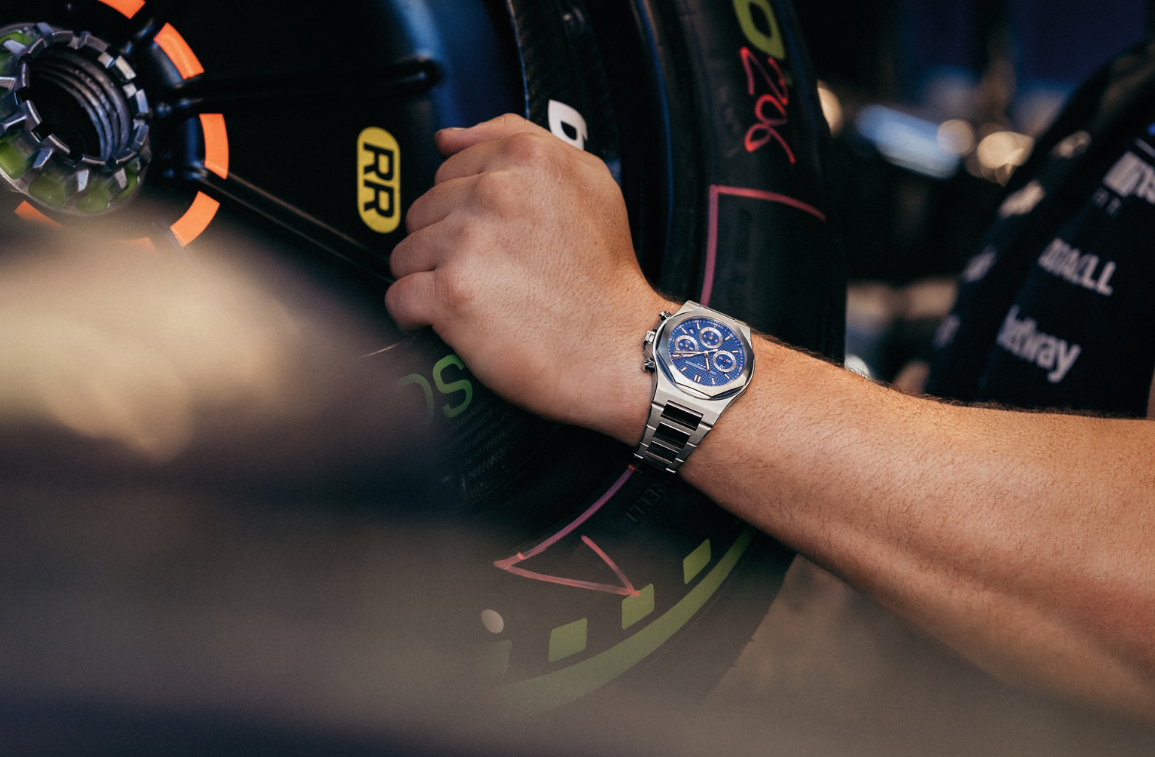
The Swiss watchmaker’s first collaboration with Atlassian Williams F1 Team produces two sporting Laureato models inspired by the team’s 2026 racing car.
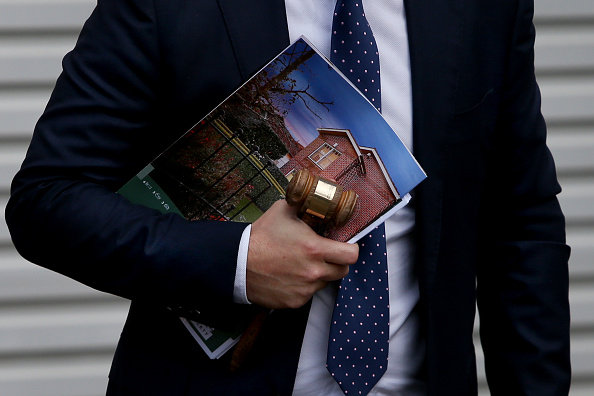
Victorian auction buyers will soon receive a piece of information that has traditionally been withheld until bidding reaches it: the vendor’s reserve price. Under new property-sale and underquoting laws, agents must publish the agreed reserve at least seven days before an auction or fixed-date sale. Most changes begin on 1 October 2026 and apply to …
Continue reading “Victoria’s New Auction Rules Will Force Reserve Prices Into the Open”

The Swiss watchmaker’s first collaboration with Atlassian Williams F1 Team produces two sporting Laureato models inspired by the team’s 2026 racing car.
3 minGirard-Perregaux has revealed the first watches created through its partnership with Atlassian Williams F1 Team, bringing the British racing team’s colours to one of Switzerland’s most recognisable integrated-bracelet designs.
The collaboration comprises two 42mm steel watches: the time-and-date Laureato Williams Edition and the more technical Laureato Chronograph Williams Edition.
Both retain the familiar architecture of the Laureato, including its octagonal bezel, integrated bracelet and mix of polished and satin-finished surfaces. The influence of Williams is comparatively restrained, appearing through colour, discreet branding and details inspired by the team’s current Formula 1 car.
It is a welcome departure from the oversized logos and literal automotive references that can characterise motorsport watches.
The Williams FW48 inspires the dial
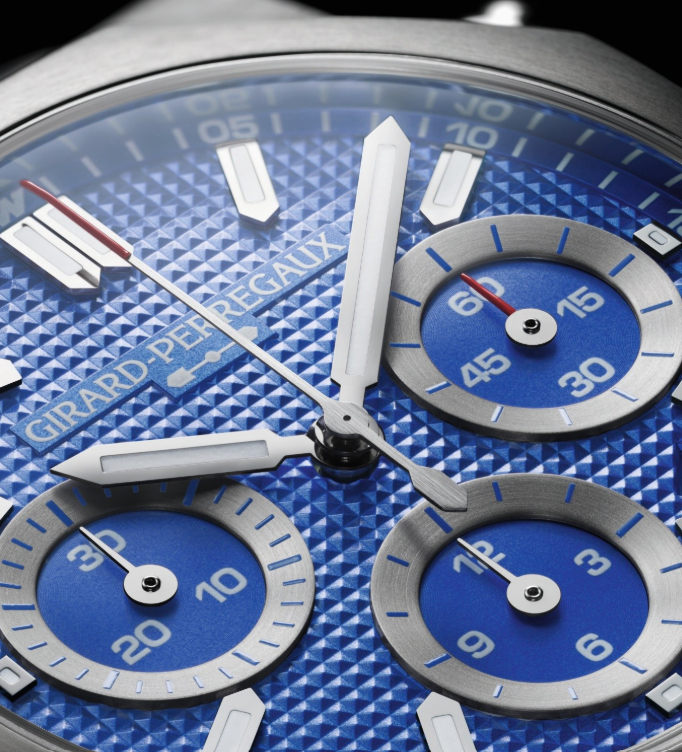
The centrepiece of both models is a blue Clous de Paris dial informed by the livery of the Williams FW48, the car being campaigned by the team during the 2026 Formula 1 season.
A small Williams “W” replaces the conventional marker at 12 o’clock, while the team emblem appears on the sapphire crystal caseback. Red accents echo the keyline used on the FW48 without overwhelming the established Laureato design.
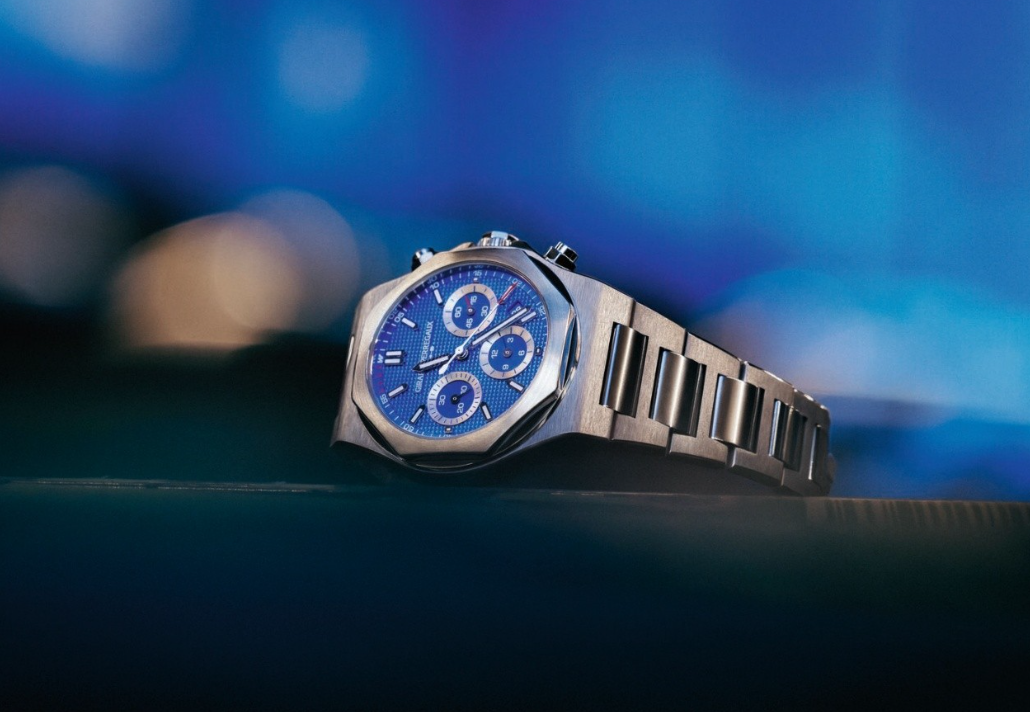
The three-hand model offers the quieter interpretation. Baton-shaped, rhodium-plated hands and hour markers are filled with white-emitting luminescent material, while a date window sits at three o’clock.
The chronograph creates a more obvious connection with motorsport. Three subdials are framed by rhodium-plated rings, with red appearing on the small-seconds hand and the tip of the central chronograph seconds hand.
Both watches measure 42mm across and are water resistant to 100 metres. The standard Laureato has a case thickness of 10.68mm, while the additional mechanics of the chronograph increase its profile to 12.16mm.
Two in-house automatic movements
The Laureato Williams Edition is powered by Girard-Perregaux’s self-winding GP01800 calibre. The movement provides hours, minutes, central seconds and the date, with a minimum power reserve of 54 hours.
The Laureato Chronograph Williams Edition uses the automatic GP03300 calibre, which combines its chronograph functions with a date display and offers a minimum power reserve of 46 hours.
Both movements operate at 28,800 vibrations per hour and can be viewed through their sapphire crystal casebacks.
Their decoration provides a more traditional counterpoint to the Formula 1 association. Finishing techniques include Côtes de Genève, circular graining, bevelling, mirror polishing, satin finishing, engraving and snailing.
The result is less about reproducing the appearance of a racing car than identifying the common ground between two mechanical disciplines: precision, incremental development and the considerable work hidden beneath the finished product.
Parallel histories
The timing of the partnership draws attention to the remarkably similar ages of its two protagonists.
Girard-Perregaux introduced the original Laureato in 1975, establishing an integrated-bracelet sports watch with a distinctive octagonal bezel. Williams entered Formula 1 two years later in 1977.
Both have evolved continuously across the five decades since. The Laureato has moved through different sizes, materials and complications, while retaining its central design language. Williams, meanwhile, has remained one of Formula 1’s most historically significant teams.
That gives the collaboration greater credibility than a simple licensing exercise. Girard-Perregaux and Williams are not being connected solely through the familiar language of speed. Their stronger link is a shared dependence on engineering, testing and the accumulation of specialist knowledge.
The watches are described as the beginning of a longer collaboration, suggesting further Williams editions may follow.
Girard-Perregaux’s international website lists the Laureato Williams Edition at US$16,200 and the Laureato Chronograph Williams Edition at US$20,900. Australian pricing has not been announced.
Specifications
Girard-Perregaux Laureato Williams Edition 42mm
Reference: 81010-11-3680-1GM
Case: Steel
Diameter: 42mm
Thickness: 10.68mm
Crystal: Anti-reflective sapphire crystal
Dial: Blue Clous de Paris pattern
Movement: Automatic GP01800
Functions: Hours, minutes, central seconds and date
Power reserve: Minimum 54 hours
Water resistance: 100 metres
Bracelet: Integrated steel bracelet with triple-folding clasp
International price: US$16,200
Girard-Perregaux Laureato Chronograph Williams Edition 42mm
Reference: 81020-11-3681-1GM
Case: 904L steel
Diameter: 42mm
Thickness: 12.16mm
Crystal: Anti-reflective sapphire crystal
Dial: Blue Clous de Paris pattern with three chronograph counters
Movement: Automatic GP03300
Functions: Chronograph, hours, minutes, small seconds and date
Power reserve: Minimum 46 hours
Water resistance: 100 metres
Bracelet: Integrated 904L steel bracelet with triple-folding clasp
International price: US$20,900
Victorian auction buyers will soon receive a piece of information that has traditionally been withheld until bidding reaches it: the vendor’s reserve price. Under new property-sale and underquoting laws, agents must publish the agreed reserve at least seven days before an auction or fixed-date sale. Most changes begin on 1 October 2026 and apply to …
Continue reading “Victoria’s New Auction Rules Will Force Reserve Prices Into the Open”

Once a sleepy surf town, Noosa has become Australia’s prestige property hotspot, where multi-million dollar knockdowns, architectural showpieces and record-setting sales are the new normal.