Sam Altman’s Counter-Rebellion Leaves OpenAI Leadership Hanging in the Balance
AI startup’s ousted chief executive tries to negotiate his return

 3 min
3 min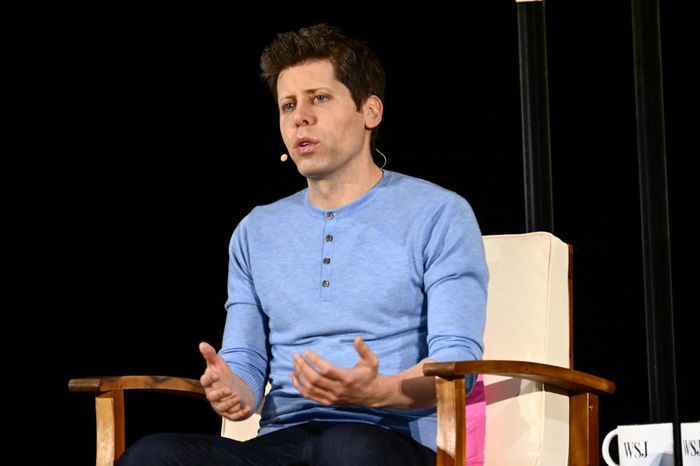
SAN FRANCISCO—Two days after Sam Altman was ousted from OpenAI, he was back at the company’s office, trying to negotiate his return.
The former chief executive officer entered with a guest badge on Sunday and posted on X: “first and last time i ever wear one of these.”
The leadership of the company that created the hit AI chatbot ChatGPT remained unclear Sunday, as investors and many employees pushed over the weekend to restore Altman. He has been engineering a countercoup to retake control of one of Silicon Valley’s most valuable and high-profile startups.
The abrupt shake-up at OpenAI turns on one of the oldest tales in Silicon Valley: a breakup between a founder and his board.
But in this case it was a very particular kind of founder—the face of Silicon Valley’s artificial-intelligence revolution—and a very particular kind of board, which was tasked with making social good a priority over profit. The rupture threatens the future of the company and the billions of dollars investors had put into it.
Altman has also been considering starting his own venture, potentially with talent from OpenAI. He is pursuing both tracks: On Sunday morning, Chief Technology Officer and interim CEO Mira Murati sent a note to staff saying Altman would be returning to the San Francisco office later that day as discussions to reinstate him continued.
Over the weekend, Altman made clear to his allies that if he does return, he wants a new board and governance structure, people familiar with the matter said.
Two days after the board fired Altman, different explanations persisted for the initial firing. The board said Friday it pushed out the CEO after it concluded he hadn’t been candid with the company’s directors. It didn’t elaborate.
Over the weekend, people close to Altman said the ouster had more to do with disputes around the safety of the company’s artificial-intelligence efforts and a power struggle with one co-founder and board member in particular, Ilya Sutskever.
On Sunday, a person familiar with the board stood by the board’s statement citing Altman’s lack of candor. This person said there was no single precipitating incident but rather a mounting loss of trust over communications with Altman that led it to remove him as CEO. The person declined to offer examples.
The ouster from OpenAI wasn’t the first time Altman was asked to leave a company. Several years ago, senior leaders at the venture firm Y Combinator asked Altman to step down as president after mounting concerns about the time he was spending on his other business endeavours, including at OpenAI, according to investors briefed by the venture firm’s executives—information not previously reported.
In addition to OpenAI, Altman recently hatched plans for two new business endeavours. He enlisted Apple’s former chief design officer, Jony Ive, to create a consumer hardware device. And he recently spent weeks in the Middle East gauging investor interest for a new startup aiming to create low-cost chips needed to train OpenAI’s artificial-intelligence models, people familiar with the matter said.
It is unclear whether those efforts, or the communication around it, played into Altman’s dismissal. Bloomberg earlier reported on the new chips venture. The Information and the Financial Times earlier reported the new Ive venture.
With his firing from OpenAI, Altman quickly got the upper hand in terms of public messaging. The board didn’t use a communications or law firm in its dealings, people familiar with the board said, expecting that the OpenAI team would help them. But Altman had loyalty from investors and employees.
The board ended up isolated as social media exploded with shock and support for Altman. His largest backers, including Microsoft and Thrive Capital, immediately on Friday began pressing for Altman’s position to be restored. Microsoft CEO Satya Nadella began working with Altman that evening on his next steps, people familiar with Altman said.
Despite his business success, Altman had been losing the support of a board whose constituents changed as the company’s commercial efforts powered ahead. It was a board structure that he had ironically helped create and publicly promoted as he encountered questions about AI safety.
Before Friday’s dust-up, the board consisted of six people, including Altman. Then, it abruptly removed Greg Brockman, OpenAI’s president and a close friend of Altman’s, and voted to oust Altman. None of the four board members remaining were affiliated with the company’s big investors. It isn’t clear whether the vote was unanimous.
The board that took the action was down from the nine seats it had earlier in the year and lacked at least one key prior Altman backer. Earlier this year, Reid Hoffman, a Silicon Valley venture capitalist with a long history of supporting Altman, stepped down after starting a rival company to OpenAI.
Separately, Shivon Zilis, a tech executive at Elon Musk’s brain-implant startup Neuralink, and Will Hurd, who started a presidential campaign, also left this year.
The board had been working to fill those empty seats for months, though the process stalled, according to a person familiar with the matter.
The other four directors are: Adam D’Angelo, a former Facebook executive and the founder of the question-and-answer website Quora; Tasha McCauley, an adjunct senior management scientist at Rand; Helen Toner, a director at a Washington nonprofit; and OpenAI’s chief scientist, Sutskever.
Altman this weekend was furious with himself for not having ensured the board stayed loyal to him and regretted not spending more time managing its various factions, people familiar with his thinking said.
 Copyright 2020, Dow Jones & Company, Inc. All Rights Reserved Worldwide. LEARN MORE





A record-breaking $11 million sale at The Centennial Collection has set a new benchmark for luxury apartment living in Bondi Junction.

As interest rates, inflation and market sentiment fluctuate, investors are being urged to focus on data, not panic.


The Federal Budget may have softened some of its proposed tax reforms, but it has exposed a bigger issue: too many families are relying on wealth structures that no longer reflect the realities of modern life.
3 min
For many Australians, the 2026 Federal Budget initially felt like a direct challenge to the way wealth is created, held and transferred between generations.
The headlines were immediate: changes to capital gains tax, reforms to discretionary trusts, restrictions on negative gearing and increased scrutiny of investment structures. Unsurprisingly, affluent families, business owners and investors began asking the same question:
Is the way we hold our wealth still fit for purpose?
In recent days, the government has announced several significant amendments following industry consultation and public feedback, including exempting testamentary trusts from the proposed 30 per cent minimum tax and expanding capital gains tax concessions for small businesses.
The backdown is welcome. But it also highlights something much bigger.
This Budget has accelerated a conversation that many Australian families have been postponing for years.
The conversation is not really about tax. It is about wealth stewardship.
For decades, Australians have built wealth through businesses, property, investments and careful long-term planning. Yet many families have not revisited the legal structures surrounding those assets in years, sometimes decades.
We often see clients who have spent years building significant wealth, only to discover their legal arrangements no longer reflect their current circumstances.
Their children are now adults. They may own multiple properties.
They may have sold a business, entered a second marriage, become grandparents or accumulated digital assets that did not exist when their original estate plans were prepared.
The trust that distributes income may need to be reconsidered. The bucket company may no longer be so attractive.
The Budget has simply exposed a reality that already existed: wealth structures cannot remain static while life continues to evolve.
Importantly, trusts themselves are not the issue.
Trusts are legitimate planning tools that provide flexibility, protection and continuity. When used appropriately, they allow families to adapt to changing circumstances over time.
And neither is tax the issue, really. Getting the fundamentals right is more important for long-term, sustainable wealth than a few favourable tax treatments around the edges.
The real issue is complacency.
Too often, families create structures and assume the job is done. It isn’t.
Estate planning is no longer a document you sign once and file away in a drawer. It is an ongoing process that should evolve alongside your life.
We are also seeing a broader shift in how Australians define wealth itself. It is no longer just the family home and an investment portfolio.
Modern wealth includes businesses, digital assets, cryptocurrency, intellectual property, frequent flyer points and increasingly complex family arrangements.
At the same time, Australians are living longer than ever before, meaning wealth may need to support multiple generations simultaneously. This creates new responsibilities and new risks.
How do you help your children enter the property market without exposing family wealth to relationship breakdowns?
How do you structure wealth so that it remains a source of opportunity rather than future conflict?
These are the questions families should be asking now.
The recent debate surrounding testamentary trusts also serves as an important reminder that policy decisions can have unintended consequences for vulnerable Australians. It is encouraging that the government has listened to feedback and clarified its position.
But the lesson remains: the wealth landscape is changing.
Increasingly, governments, regulators and tax authorities are paying closer attention to how wealth is held and transferred. That means families cannot afford to adopt a “set-and-forget” approach to their structures.
The families who will be best placed for the future are not necessarily those with the greatest wealth.
They are the families with the greatest clarity. Clarity around ownership, succession and governance. And clarity around how wealth will transition from one generation to the next.
Ultimately, preserving wealth is not about avoiding change.
It is about preparing for it.
Because the greatest risk is not change itself.
It is losing the ability to respond to it.
Anthony Hunt is Co-Founder of Wealth Lawyers and former COO of Westpac Private Bank. He advises business owners, investors and affluent Australian families on wealth protection, succession planning and intergenerational wealth transfer

The era of the gorgeous golden retriever is over. Today’s most coveted pooches have frightful faces bred to tug at our hearts.

From farm-to-table Thai to fairy-lit mango trees and Coral Sea vistas, Port Douglas has award-winning dining and plenty of tropical charm on the side.