Inflation takes a dip, while bananas and melons make a mash of prices
Kanebridge News
    HOUSE MEDIAN ASKING PRICES AND WEEKLY CHANGE     Sydney $1,822,183 (-0.43%)       Melbourne $1,078,813 (-0.33%)       Brisbane $1,264,391 (-0.87%)       Adelaide $1,112,777 (+0.12%)       Perth $1,149,218 (-1.55%)       Hobart $856,229 (+0.59%)       Darwin $886,634 (-5.18%)       Canberra $1,078,947 (-0.81%)       National Capitals $1,224,455 (-0.79%)                UNIT MEDIAN ASKING PRICES AND WEEKLY CHANGE     Sydney $821,384 (-0.41%)       Melbourne $550,948 (-0.31%)       Brisbane $839,757 (+0.74%)       Adelaide $560,009 (-3.62%)       Perth $677,037 (-0.51%)       Hobart $581,017 (-0.34%)       Darwin $465,561 (+5.05%)       Canberra $509,688 (+0.21%)       National Capitals $653,196 (-0.17%)                HOUSES FOR SALE AND WEEKLY CHANGE     Sydney 13,369 (+370)       Melbourne 16,279 (+411)       Brisbane 7,326 (+232)       Adelaide 2,642 (+103)       Perth 5,799 (+92)       Hobart 869 (+34)       Darwin 127 (+5)       Canberra 1,161 (+61)       National Capitals 47,572 (+1,308)                UNITS FOR SALE AND WEEKLY CHANGE     Sydney 9,191 (+212)       Melbourne 6,775 (+66)       Brisbane 1,471 (+54)       Adelaide 413 (+27)       Perth 1,179 (+39)       Hobart 165 (+5)       Darwin 178 (-3)       Canberra 1,188 (+7)       National Capitals 20,560 (+407)                HOUSE MEDIAN ASKING RENTS AND WEEKLY CHANGE     Sydney $830 ($0)       Melbourne $595 (+$5)       Brisbane $700 (+$10)       Adelaide $650 ($0)       Perth $750 ($0)       Hobart $640 (-$3)       Darwin $800 (-$10)       Canberra $720 (-$5)       National Capitals $719 (-$1)                UNIT MEDIAN ASKING RENTS AND WEEKLY CHANGE     Sydney $810 (-$10)       Melbourne $580 ($0)       Brisbane $650 ($0)       Adelaide $550 ($0)       Perth $700 (-$10)       Hobart $520 (-$30)       Darwin $605 (-$35)       Canberra $598 (-$3)       National Capitals $639 (-$10)                HOUSES FOR RENT AND WEEKLY CHANGE     Sydney 5,362 (+159)       Melbourne 7,007 (+228)       Brisbane 3,620 (+124)       Adelaide 1,477 (+64)       Perth 2,297 (+130)       Hobart 240 (+14)       Darwin 49 (+5)       Canberra 399 (+10)       National Capitals 20,451 (+734)                UNITS FOR RENT AND WEEKLY CHANGE     Sydney 8,450 (+241)       Melbourne 4,569 (+74)       Brisbane 1,844 (+33)       Adelaide 418 (-4)       Perth 652 (+14)       Hobart 77 (+9)       Darwin 76 (-4)       Canberra 640 (+41)       National Capitals 16,726 (+404)                HOUSE ANNUAL GROSS YIELDS AND TREND       Sydney 2.37% (↑)      Melbourne 2.87% (↑)      Brisbane 2.88% (↑)        Adelaide 3.04% (↓)     Perth 3.39% (↑)        Hobart 3.89% (↓)     Darwin 4.69% (↑)      Canberra 3.47% (↑)      National Capitals 3.05% (↑)             UNIT ANNUAL GROSS YIELDS AND TREND         Sydney 5.13% (↓)     Melbourne 5.47% (↑)        Brisbane 4.02% (↓)     Adelaide 5.11% (↑)        Perth 5.38% (↓)       Hobart 4.65% (↓)       Darwin 6.76% (↓)       Canberra 6.10% (↓)       National Capitals 5.08% (↓)            HOUSE RENTAL VACANCY RATES AND TREND       Sydney 1.4% (↑)      Melbourne 1.5% (↑)      Brisbane 1.2% (↑)      Adelaide 1.2% (↑)      Perth 1.0% (↑)        Hobart 0.5% (↓)       Darwin 0.7% (↓)     Canberra 1.6% (↑)      National Capitals $1.1% (↑)             UNIT RENTAL VACANCY RATES AND TREND       Sydney 1.4% (↑)      Melbourne 2.4% (↑)      Brisbane 1.5% (↑)      Adelaide 0.8% (↑)      Perth 0.9% (↑)      Hobart 1.2% (↑)        Darwin 1.4% (↓)     Canberra 2.7% (↑)      National Capitals $1.5% (↑)             AVERAGE DAYS TO SELL HOUSES AND TREND       Sydney 29.5 (↑)      Melbourne 29.5 (↑)      Brisbane 27.9 (↑)      Adelaide 24.4 (↑)      Perth 34.4 (↑)      Hobart 28.4 (↑)      Darwin 28.6 (↑)      Canberra 28.1 (↑)      National Capitals 28.8 (↑)             AVERAGE DAYS TO SELL UNITS AND TREND       Sydney 28.3 (↑)      Melbourne 28.4 (↑)        Brisbane 26.7 (↓)     Adelaide 21.8 (↑)        Perth 32.8 (↓)     Hobart 31.9 (↑)      Darwin 35.3 (↑)      Canberra 39.7 (↑)      National Capitals 30.6 (↑)            
Share Button

Inflation takes a dip, while bananas and melons make a mash of prices

After appeals to cashed-up Australians to stop spending, there’s a little inflationary relief in sight

By KANEBRIDGE NEWS
Wed, Nov 29, 2023 2:18pmGrey Clock 2 min

The rate of inflation in Australia has fallen to 4.9 percent, according to data from the Consumer Price Index. Inflation is down from 5.6 percent in September and a peak of 8.4 percent in December 2022.

The housing, transport and food and non-alcoholic beverages sectors were the strongest contributors to the October increase, which is consistent with trends shown in ABS data from September.
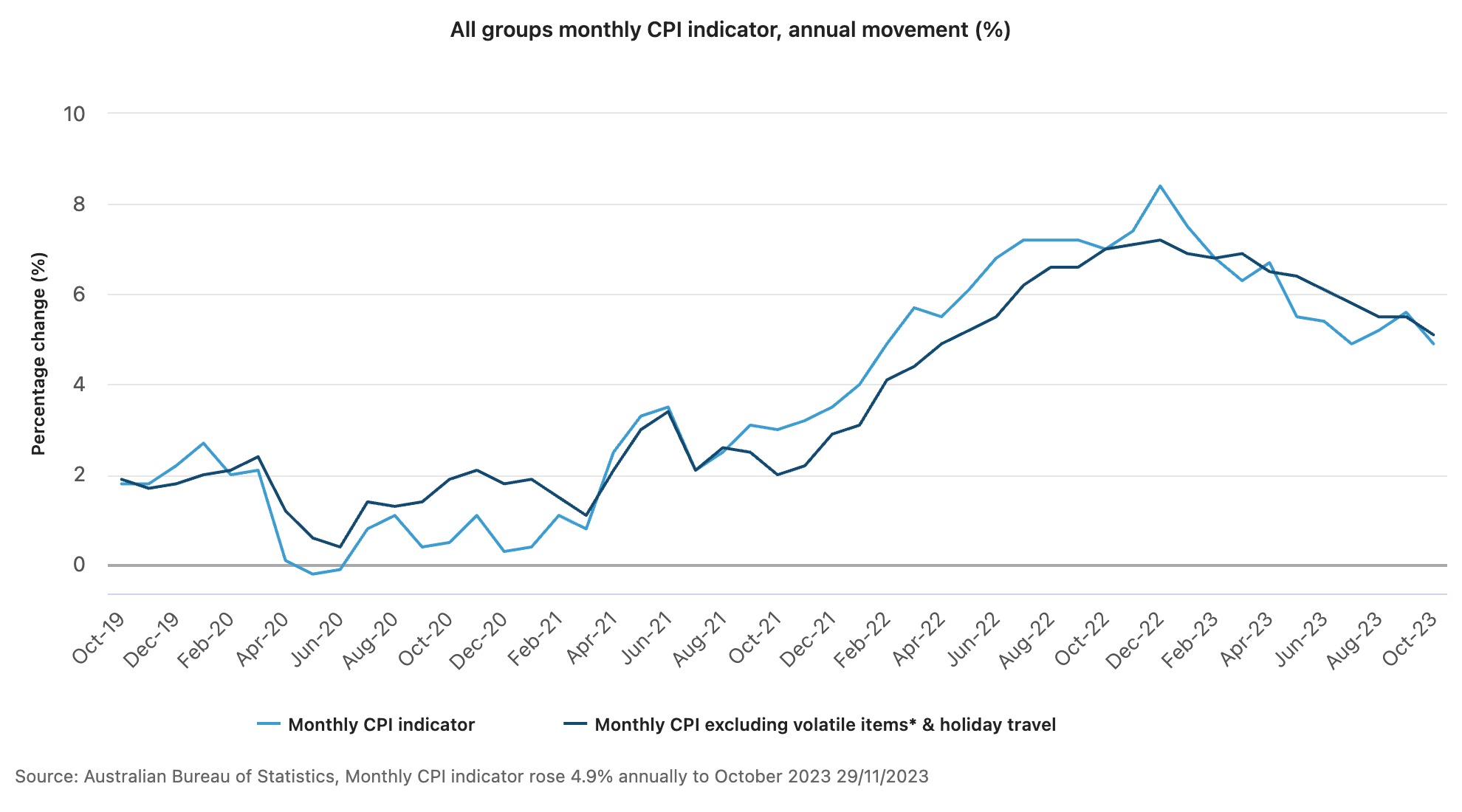
“CPI inflation is often impacted by items with volatile price changes like Automotive fuel, Fruit and vegetables, and Holiday travel,” said acting head of price statistics at the ABS, Leigh Merrington. “It can be helpful to exclude these items from the headline CPI to provide a view of underlying inflation.” 

Food and non-alcoholic beverages rose from 4.7 percent in September to 5.3 percent in the 12 months to October, driven by the rising prices of melons and bananas. 
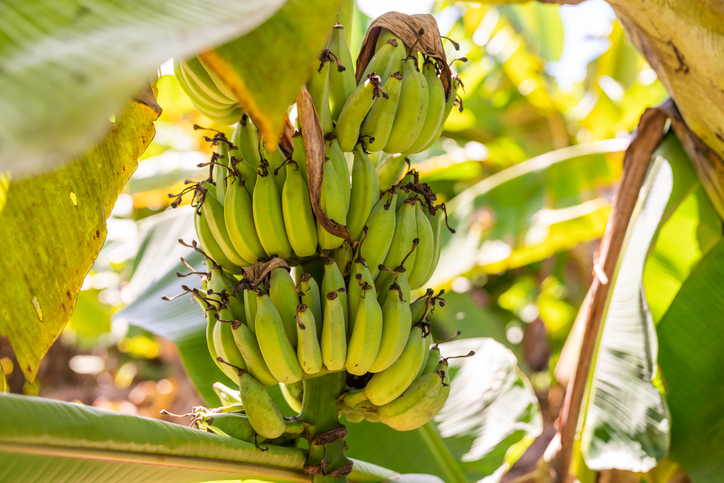
Banana prices are trending upwards, contributing to higher food prices overall. Credit: Nigel Killeen/Getty Images

In good news for would-be home builders, new dwelling prices rose 4.7 percent, the lowest annual rise since August 2021, as a result of easing material supply conditions.

While the ABS noted that electricity prices rose 10.1 percent in the year to October, Mr Merrington said it could have been worse, if not for the introduction of the Energy Bill Relief Fund.

“Electricity prices have risen 8.4 per cent since June 2023. Excluding the rebates, Electricity prices would have increased 18.8 per cent over this period,” Mr Merrington said.  

The inflation figures come ahead of the final meeting for the year of the RBA Board next Tuesday. The board raised the cash rate by 25 basis points at the November meeting following an increase in the rate of inflation in September. 


MOST POPULAR

From snow-dusted valleys to festival-filled autumns, Bhutan reveals itself as a rare destination where culture, nature and spirituality unfold year-round.

Odd Culture Group brings a new kind of after-dark energy to the CBD, where daiquiris, disco and design collide beneath the city streets.

Related Stories
Money
What Is Artemis II? The NASA Mission to Fly Astronauts Around the Moon
By Micah Maidenberg 30/03/2026
Money
Saudi Arabia Sees a Spike to $180 Oil if Energy Shock Persists Past April
By SUMMER SAID, RYAN DEZEMBER AND DAVID UBERTI 20/03/2026
Money
Gen X Is Stuck in the Middle and Financially Squeezed. How One Financial Adviser Is Helping.
By Anne Field 18/03/2026
What Is Artemis II? The NASA Mission to Fly Astronauts Around the Moon

The lunar flyby would be the deepest humans have traveled in space in decades.

By Micah Maidenberg
Mon, Mar 30, 2026 4 min

It’s go time for the highest-stakes mission at NASA in more than 50 years.  

On April 1, the agency is set to launch four astronauts around the moon, the deepest human spaceflight since the final Apollo lunar landing in 1972.  

The launch window for Artemis II , as the mission is called, opens at 6:24 p.m. ET. 

National Aeronautics and Space Administration teams have been preparing the vehicles to depart from Florida’s Kennedy Space Center on the planned roughly 10-day trip. Crew members have trained for years for this moment. 

Reid Wiseman, the NASA astronaut serving as mission commander, said he doesn’t fear taking the voyage. A widower, he does worry at times about what he is putting his daughters through. 

“I could have a very comfortable life for them,” Wiseman said in an interview last September.  

“But I’m also a human, and I see the spirit in their eyes that is burning in my soul too. And so we’ve just got to never stop going.” 

Wiseman’s crewmates on Artemis II are NASA’s Victor Glover and Christina Koch, as well as Canadian Space Agency astronaut Jeremy Hansen. 

Photo: NASA’s Artemis II SLS rocket and Orion spacecraft being rolled out at night. Miguel J. Rodriguez Carrillo/Getty Images

What are the goals for Artemis II? 

The biggest one: Safely fly the crew on vehicles that have never carried astronauts before.  

The towering Space Launch System rocket has the job of lofting a vehicle called Orion into space and on its way to the moon.  

Orion is designed to carry the crew around the moon and back. Myriad systems on the ship—life support, communications, navigation—will be tested with the astronauts on board. 

SLS and Orion don’t have much flight experience. The vehicles last flew in 2022, when the agency completed its uncrewed Artemis I mission . 

How is the mission expected to unfold? 

Artemis II will begin when SLS takes off from a launchpad in Florida with Orion stacked on top of it.  

The so-called upper stage of SLS will later separate from the main part of the rocket with Orion attached, and use its engine to set up the latter vehicle for a push to the moon. 

After Orion separates from the upper stage, it will conduct what is called a translunar injection—the engine firing that commits Orion to soaring out to the moon. It will fly to the moon over the course of a few days and travel around its far side. 

Orion will face a tough return home after speeding through space. As it hits Earth’s atmosphere, Orion will be flying at 25,000 miles an hour and face temperatures of 5,000 degrees as it slows down. The capsule is designed to land under parachutes in the Pacific Ocean, not far from San Diego. 

Water photo: NASA’s Orion capsule after its splash-down in the Pacific Ocean in 2022 for the Artemis I mission. Mario Tama/Press Pool

Is it possible Artemis II will be delayed? 

Yes.  

For safety reasons, the agency won’t launch if certain tough weather conditions roll through the Cape Canaveral, Fla., area. Delays caused by technical problems are possible, too. NASA has other dates identified for the mission if it doesn’t begin April 1. 

Who are the astronauts flying on Artemis II? 

The crew will be led by Wiseman, a retired Navy pilot who completed military deployments before joining NASA’s astronaut corps. He traveled to the International Space Station in 2014. 

Two other astronauts will represent NASA during the mission: Glover, an experienced Navy pilot, and Koch, who began her career as an electrical engineer for the agency and once spent a year at a research station in the South Pole. Both have traveled to the space station before. 

Hansen is a military pilot who joined Canada’s astronaut corps in 2009. He will be making his first trip to space. 

Koch’s participation in Artemis II will mark the first time a woman has flown beyond orbits near Earth. Glover and Hansen will be the first African-American and non-American astronauts, respectively, to do the same. 

What will the astronauts do during the flight? 

The astronauts will evaluate how Orion flies, practice emergency procedures and capture images of the far side of the moon for scientific and exploration purposes (they may become the first humans to see parts of the far side of the lunar surface). Health-tracking projects of the astronauts are designed to inform future missions. 

Those efforts will play out in Orion’s crew module, which has about two minivans worth of living area.  

On board, the astronauts will spend about 30 minutes a day exercising, using a device that allows them to do dead lifts, rowing and more. Sleep will come in eight-hour stretches in hammocks. 

There is a custom-made warmer for meals, with beef brisket and veggie quiche on the menu.  

Each astronaut is permitted two flavored beverages a day, including coffee. The crew will hold one hourlong shared meal each day.  

The Universal Waste Management System—that’s the toilet—uses air flow to pull fluid and solid waste away into containers. 

What happens after Artemis II? 

Assuming it goes well, NASA will march on to Artemis III, scheduled for next year. During that operation, NASA plans to launch Orion with crew members on board and have the ship practice docking with lunar-lander vehicles that Elon Musk’s SpaceX and Jeff Bezos’ Blue Origin have been developing. The rendezvous operations will occur relatively close to Earth. 

NASA hopes that its contractors and the agency itself are ready to attempt one or more lunar landing missions in 2028. Many current and former spaceflight officials are skeptical that timeline is feasible. 

MOST POPULAR

From warmer neutrals to tactile finishes, Australian homes are moving away from stark minimalism and towards spaces that feel more human.

Pure Amazon has begun journeys deep into Peru’s Pacaya-Samiria National Reserve, combining contemporary design, Indigenous craftsmanship and intimate wildlife encounters in one of the richest ecosystems on Earth.

Related Stories
Lifestyle
REAL ESTATE POWER COUPLE’S GREATEST DEAL ARRIVES FOR VALENTINE’S DAY
By Jeni O'Dowd 13/02/2026
Money
Saudi Arabia Sees a Spike to $180 Oil if Energy Shock Persists Past April
By SUMMER SAID, RYAN DEZEMBER AND DAVID UBERTI 20/03/2026
Lifestyle
THE MOTHER’S DAY EDIT: GIFTS THAT FEEL PERSONAL, NOT PREDICTABLE
By Jeni O'Dowd 15/04/2026
0
    Your Cart
    Your cart is emptyReturn to Shop