2023: A Year of Economic Turbulence — and Resilience
 5 min
5 min
OPINION
As 2023 draws to a close, we are presented with an opportune moment to reflect on a year marked by economic resilience and a transformation of our economic environment that has not been seen for decades. We continue to push through the complex circumstances presented by the post-COVID recovery, remaining inflation, and the aggressive array of official interest rate increases during 2023.
Just as we see signs that the fight against global inflation may have finally resolved during an astounding year of economic resilience, there remains the threat of a new set of black swan events lurking in the shadows. We could very well see both global and local economic indicators deteriorating well into 2024. In addition, there remains the major threat of a disruption to global trade due to the Houthi militants’ interference in the Suez Canal.
Undoubtedly, the pace of the economic slowdown hastened in the September quarter with unemployment rising, and GDP only barely increasing by 0.2%, falling short of the anticipated 0.5%. If adjusted for immigration, Australia is officially in a per capita recession.
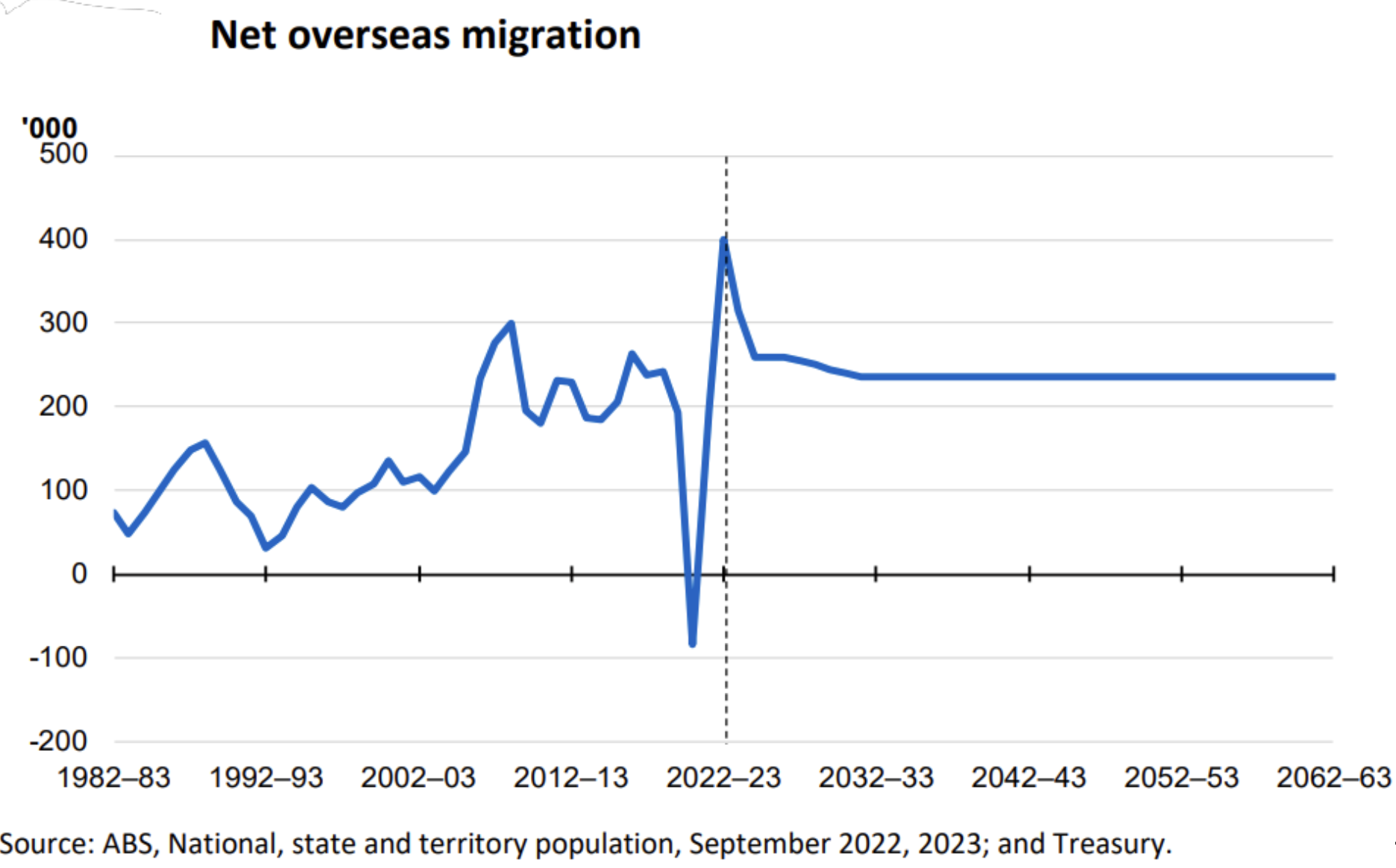
Australia’s record net migration of 2.5% for the 2023 calendar year undoubtedly enabled our economy to remain resilient, while also presenting itself as a potential medium to long-term nuisance. Migration helps ease some of the pressure we are currently experiencing in our tight labour market and leads to higher aggregate demand. However, it also places additional inflationary pressure on housing and rent.
Monetary Policy Outlook
The RBA’s approach to monetary policy has been a topic of much debate, with a very direct transmission channel to mortgage holders in Australia, where there is also higher household leverage. Higher rates end up being passed onto renters and mortgage holders, who comprise roughly 70% of the market. This illustrates the blunt aspect of monetary policy and how it disproportionately impacts certain groups, such as young, lower-income mortgagors trying to support their family. On the other hand, self-funded retirees are a group that is generally well-placed in a rising interest rate environment.
The RBA’s cautious stance, including the decision to keep the cash rate on hold in December, was a response to the evolving economic situation and clear signs of the economy cooling, including slower GDP growth, lower inflation, and higher unemployment.
Many economists now predict that in 2024, during the 4th quarter, interest rates will begin to be reduced. The question is what the neutral cash rate is estimated to be – somewhere between 2.75% and 3.75% – where the rate neither increases nor decreases inflationary pressure.
Labour Market and Unemployment
A significant aspect of 2023 was the labour market beginning to loosen as consumer spending softened. The unemployment rate in Australia rose to 3.9% in November, indicating a clear upward trend. This was coupled with an increased underemployment trend which is expected to continue throughout 2024.
While the RBA’s primary mandate is to manage inflation, it also has a key role in achieving full employment. There is a concept relating to a neutral unemployment rate, where any further increase has an inflationary impact on the economy. This is referred to as the Non-Accelerating Inflation Rate of Unemployment (NAIRU) and is often referred to in the RBA’s statements. They believe that Australia’s natural rate of unemployment should be 4.5%. Moving closer to this rate allows us to see improvements in productivity whilst not incurring significant inflationary pressure or economic weakening. Indeed, such low unemployment during the year has made our economy extraordinarily resilient in the face of adversity.
As the unemployment rate gets closer to the target of 4.5%, it often impels the RBA to cut the official cash rate.
Household and Household Income
The increase in average mortgage rates and the strain on household budgets were notable over the past year. Real household disposable income declined significantly. Interest paid on housing debt and income tax payable increased substantially, further stressing household finances. Despite these adversities, we have witnessed an extraordinary recovery in property prices during the year, which has been rather counterintuitive from a pure economic standpoint.
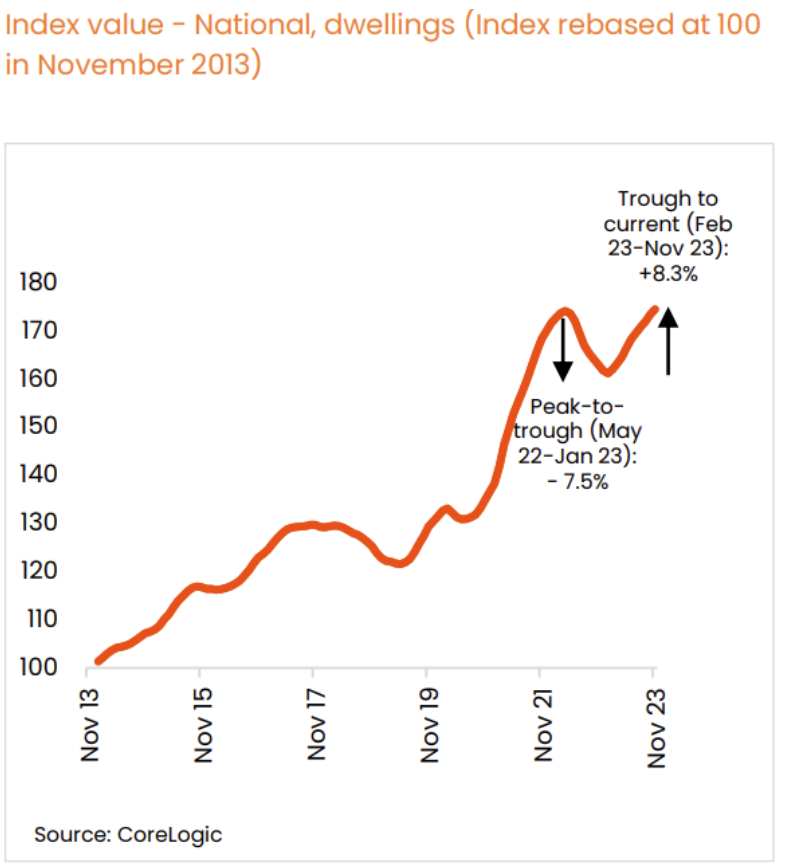
The rationale behind this can be explained by the decade-long chronic shortage of housing supply, combined with high net migration. This reinforces the unrelenting nature of housing demand in Australia. It is also a testament to how families will continue to make sacrifices to enable them to live in their property and avoid renting. As the housing crisis worsens, there is a realisation that residential property is not merely an asset class for investment, but also an essential piece of infrastructure for which all levels of government are responsible to deliver sufficient supply. However, we must remember: there is no immediate or quick fix.
Private Credit’s Role
Private credit, especially secured lending, becomes even more crucial in this uncertain and tumultuous environment. Traditional banks, facing an uncertain economic climate, become more cautious, paving the way for firms like Msquared Capital to provide essential credit to SMEs.
For us at Msquared Capital, our daily interactions with borrowers ensures we are always there to witness and respond to ever-changing conditions. We can see dislocations within the lending market and that is what enables us to find the best risk-rated returns for our investors.
Secured private credit is in high demand as investors navigate uncertain times and move away from riskier assets in which the downside risk is the absolute loss of capital following from heightened market volatility. Investors are seeking a safe haven that provides steady and reliable income, all while being secured by real assets – that is, property – with asset preservation qualities.
Many investors are only now beginning to discover private credit and its benefits. At Msquared Capital we see that there is still a lack of understanding and awareness on the difference between private credit providers and their offerings. Another crucial point to remember is that not all debt, nor fund managers, are the same or of equal quality.
Looking Ahead
2023 was a year of economic turbulence, characterised by slowing growth, a shifting labour market, and evolving monetary policy. For Msquared Capital, this environment necessitates adaptive strategies to navigate the changing landscape. As we look forward to 2024, we remain committed to providing innovative and secure credit solutions, while being mindful of the broader economic context and its implications for our clients and investments.
In our view the RBA will likely continue its inflation-fighting rhetoric, but the need for further rate rises seems to have dissipated given rising unemployment and falling GDP per capita. It is highly unlikely that there will be significant property appreciation in the short-term unless interest rates are reduced more aggressively than anticipated. In addition, some property segments, such as holiday houses, regional areas, and commercial office space, have more inherent downside risk.
Overall, Australia is once again the ‘lucky country’, having been much more resilient than our peers. This is a testament to our resource-rich land, high immigration, farming, stable government, and that we are distanced far enough from other countries so as to not be entangled in their geopolitical mess. This is what allows our lucky country to weather most economic shocks relativity unscathed.
Paul Miron is managing director of Msquared Capital, a private credit provider with investment opportunities backed by quality property located primarily along Australia’s Eastern Seaboard; we ensure that all investment opportunities are based on risk-to-reward as our core offering, coupled with strong performance. Mortgage funds perform well during volatile times, and capital preservation is regular, with a reliable monthly income that gives our investors peace of mind.

The Swiss watchmaker’s first collaboration with Atlassian Williams F1 Team produces two sporting Laureato models inspired by the team’s 2026 racing car.

Victorian auction buyers will soon receive a piece of information that has traditionally been withheld until bidding reaches it: the vendor’s reserve price. Under new property-sale and underquoting laws, agents must publish the agreed reserve at least seven days before an auction or fixed-date sale. Most changes begin on 1 October 2026 and apply to …
Continue reading “Victoria’s New Auction Rules Will Force Reserve Prices Into the Open”

The Swiss watchmaker’s first collaboration with Atlassian Williams F1 Team produces two sporting Laureato models inspired by the team’s 2026 racing car.
3 minGirard-Perregaux has revealed the first watches created through its partnership with Atlassian Williams F1 Team, bringing the British racing team’s colours to one of Switzerland’s most recognisable integrated-bracelet designs.
The collaboration comprises two 42mm steel watches: the time-and-date Laureato Williams Edition and the more technical Laureato Chronograph Williams Edition.
Both retain the familiar architecture of the Laureato, including its octagonal bezel, integrated bracelet and mix of polished and satin-finished surfaces. The influence of Williams is comparatively restrained, appearing through colour, discreet branding and details inspired by the team’s current Formula 1 car.
It is a welcome departure from the oversized logos and literal automotive references that can characterise motorsport watches.
The Williams FW48 inspires the dial
The centrepiece of both models is a blue Clous de Paris dial informed by the livery of the Williams FW48, the car being campaigned by the team during the 2026 Formula 1 season.
A small Williams “W” replaces the conventional marker at 12 o’clock, while the team emblem appears on the sapphire crystal caseback. Red accents echo the keyline used on the FW48 without overwhelming the established Laureato design.

The three-hand model offers the quieter interpretation. Baton-shaped, rhodium-plated hands and hour markers are filled with white-emitting luminescent material, while a date window sits at three o’clock.
The chronograph creates a more obvious connection with motorsport. Three subdials are framed by rhodium-plated rings, with red appearing on the small-seconds hand and the tip of the central chronograph seconds hand.
Both watches measure 42mm across and are water resistant to 100 metres. The standard Laureato has a case thickness of 10.68mm, while the additional mechanics of the chronograph increase its profile to 12.16mm.
Two in-house automatic movements
The Laureato Williams Edition is powered by Girard-Perregaux’s self-winding GP01800 calibre. The movement provides hours, minutes, central seconds and the date, with a minimum power reserve of 54 hours.
The Laureato Chronograph Williams Edition uses the automatic GP03300 calibre, which combines its chronograph functions with a date display and offers a minimum power reserve of 46 hours.
Both movements operate at 28,800 vibrations per hour and can be viewed through their sapphire crystal casebacks.

Their decoration provides a more traditional counterpoint to the Formula 1 association. Finishing techniques include Côtes de Genève, circular graining, bevelling, mirror polishing, satin finishing, engraving and snailing.
The result is less about reproducing the appearance of a racing car than identifying the common ground between two mechanical disciplines: precision, incremental development and the considerable work hidden beneath the finished product.
Parallel histories
The timing of the partnership draws attention to the remarkably similar ages of its two protagonists.
Girard-Perregaux introduced the original Laureato in 1975, establishing an integrated-bracelet sports watch with a distinctive octagonal bezel. Williams entered Formula 1 two years later in 1977.
Both have evolved continuously across the five decades since. The Laureato has moved through different sizes, materials and complications, while retaining its central design language. Williams, meanwhile, has remained one of Formula 1’s most historically significant teams.
That gives the collaboration greater credibility than a simple licensing exercise. Girard-Perregaux and Williams are not being connected solely through the familiar language of speed. Their stronger link is a shared dependence on engineering, testing and the accumulation of specialist knowledge.
The watches are described as the beginning of a longer collaboration, suggesting further Williams editions may follow.
Girard-Perregaux’s international website lists the Laureato Williams Edition at US$16,200 and the Laureato Chronograph Williams Edition at US$20,900. Australian pricing has not been announced.
Specifications
Girard-Perregaux Laureato Williams Edition 42mm
Reference: 81010-11-3680-1GM
Case: Steel
Diameter: 42mm
Thickness: 10.68mm
Crystal: Anti-reflective sapphire crystal
Dial: Blue Clous de Paris pattern
Movement: Automatic GP01800
Functions: Hours, minutes, central seconds and date
Power reserve: Minimum 54 hours
Water resistance: 100 metres
Bracelet: Integrated steel bracelet with triple-folding clasp
International price: US$16,200
Girard-Perregaux Laureato Chronograph Williams Edition 42mm
Reference: 81020-11-3681-1GM
Case: 904L steel
Diameter: 42mm
Thickness: 12.16mm
Crystal: Anti-reflective sapphire crystal
Dial: Blue Clous de Paris pattern with three chronograph counters
Movement: Automatic GP03300
Functions: Chronograph, hours, minutes, small seconds and date
Power reserve: Minimum 46 hours
Water resistance: 100 metres
Bracelet: Integrated 904L steel bracelet with triple-folding clasp
International price: US$20,900

Singapore’s Formula 1 weekend has always looked different. Held beneath floodlights on the Marina Bay Street Circuit, the race transforms the city into a nocturnal spectacle of speed, heat and saturated colour. It is this distinctive atmosphere — and one of Singapore’s most important natural symbols — that has shaped IWC Schaffhausen’s latest motorsport-inspired watch. …
Continue reading “IWC’s purple Formula 1 chronograph pays tribute to Singapore after dark”

Porsche has revealed a one-off 911 GT2 RS that brings the extraordinary silhouette of its 935/78 “Moby Dick” racing car onto the road. Created by Porsche Sonderwunsch with Manthey, the commission began with a near-new GT2 RS. The owner requested greater performance, a Slantnose profile and a rear wing influenced by the limited 911 GT3 …
Continue reading “Porsche Builds a Road-Going “Moby Dick” From a 911 GT2 RS”