Stocks Soar, Dollar Jumps as Trump’s Win Reverberates Through Markets
The Dow surges to biggest gain in two years, with bond yields and bitcoin also posting sharp climbs

 4 min
4 min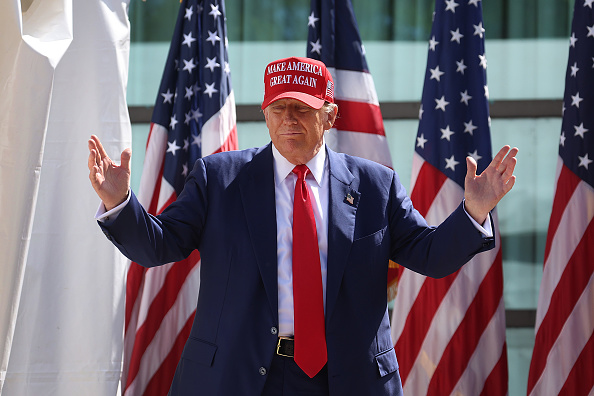
Donald Trump ’s election victory powered the Dow Jones Industrial Average to its biggest gain in two years, with a broad market rally lifting shares of banks, industrial companies and small-cap firms that are expected to benefit from continued economic expansion.
The gains were widely distributed as Wall Street bet that Trump’s promises of deregulation and tax cuts will further ignite an economy that already has posted strong gains in recent years. But sectors that were expected to benefit from Democratic policies, such as electric-vehicle companies and clean-energy related industries, declined sharply.
The promise of four years of Republican rule drove the latest rise in Treasury yields, reflecting expectations of stronger growth and inflation, while gold prices fell as fears that the election results would be contested and spark social unrest weren’t realised.
“The markets are now trading full-on Trump trade,” said Stephen Dainton , a senior executive at Barclays who oversees the lender’s investment bank including its large trading division.
Big winners included banks, which investors bet were poised to benefit from reduced regulation and a fresh acceleration in growth. Shares of JPMorgan Chase , the nation’s largest lender, climbed 11% to a new record. Wells Fargo and Goldman Sachs both rose more than 12%.
The prospect of lighter regulation and protective tariffs helped drive gains in industrials, with equipment maker Caterpillar rising more than 8% to a new all-time high and 3M adding 5%. Domestic steelmakers Nucor and Steel Dynamics gained 16% and 13%, respectively. Railroads, including Norfolk Southern and CSX , surged.
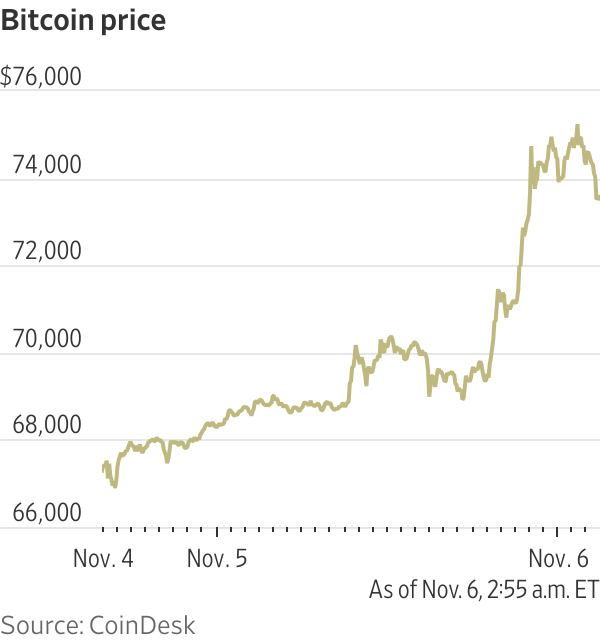
Bitcoin rose as much as 9% and flirted with $75,000, topping a previous record from March. Trump has said that he wants to make the U.S. the “crypto capital of the planet” and has pledged to create a “strategic bitcoin reserve.”
At the same time, traders also sought out companies and assets they expect to suffer during a second Trump administration.
Fears of trade wars drove down shares of ocean freight firms, including Denmark’s A.P. Moller-Maersk and Germany’s Hapag-Lloyd . Copper prices had their worst day in more than two years, dropping 5.1% as metals traders in New York reconsidered demand forecasts that hinge on the Chinese economy and the clean-energy boom.
Investors’ belief that Trump may break with the Biden administration’s push into renewable energy and electric vehicles hit companies as far away as South Korea. LG Energy Solution fell roughly 7%, as did other local EV battery makers, and Hanwha Solutions, which makes solar panels, dropped by more than 8%. In the U.S., First Solar fell 11% while Enphase Energy lost 17%.
Shares of Tesla , the electric-vehicle maker helmed by Trump ally and donor Elon Musk , bucked the trend, climbing 15%.
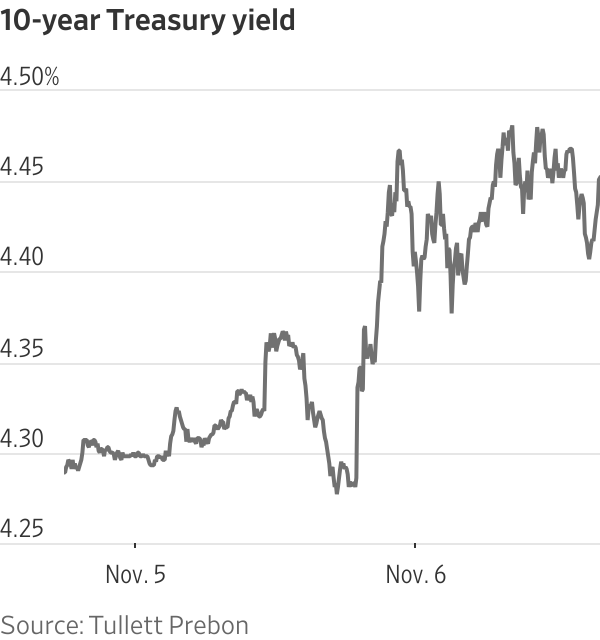
Investors sold bonds, driving yields higher and widening the gap between yields on ordinary Treasurys and those on inflation-protected Treasurys. That is a sign they think that the policies of a second Trump term could put upward pressure on inflation.
Many investors also believe that Trump’s tax-cut-heavy policies will add to the deficit, with the threat of a larger supply of Treasurys helping push down bond prices. The yield on the 10-year Treasury topped 4.4% for the first time since July.
That hit firms and investments that are sensitive to higher bond yields. The S&P 500’s consumer-staples sector declined 1.7% and the utilities segment lost 0.6% The real-estate sector sank 3.4%. The country’s largest home builder, D.R. Horton , dropped nearly 5% and Zillow Group fell about 7%.
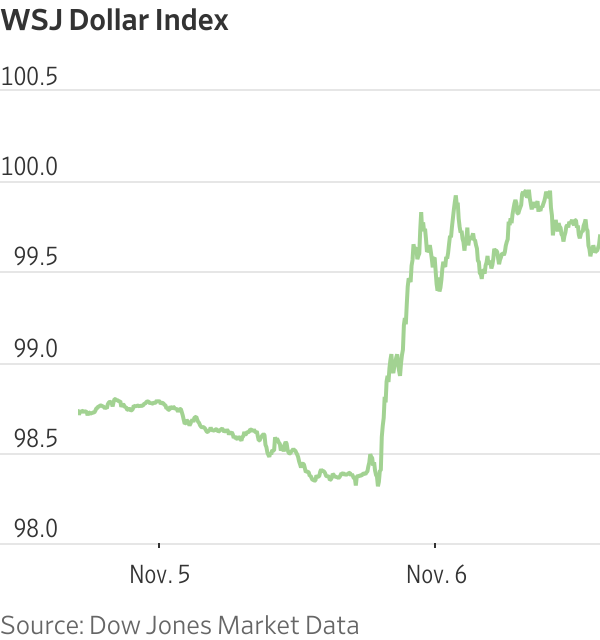
Surging yields intensified a climb in the U.S. dollar, which was also boosted by the prospect of rising tariffs. Economists say tariffs can lift the U.S. currency by hurting the economies of foreign countries and discouraging Americans from spending on imported goods.
The WSJ Dollar Index, which measures the U.S. dollar against a basket of 16 currencies, rose around 1.3%. The Mexican peso lost as much as 3.4% against the dollar to its lowest level since August 2022, according to Dow Jones Market Data, before recovering. Trump recently said he could impose 200% tariffs on vehicles made in the country. The potential for tariffs also drove down the Chinese yuan.
Early wins by Trump in key states assuaged fears that it could take days or weeks for the election to be called. The Cboe Volatility Index—known as the VIX, or the market’s fear gauge—plunged to its lowest level since late September.
The relative calm had investors hoping more gains lie ahead. The S&P 500 had already risen 21% through Election Day, its best performance in a presidential election year since 1936, when Franklin Roosevelt was in office. The Dow Jones Industrial Average was up 12%, its best election-year performance since 1996, when Bill Clinton was in the White House.
“There’s a lot of relief that there’s a clear-cut outcome and that markets can move on to things that are quite frankly more important than who sits in the White House,” said Ross Mayfield, investment strategist at Baird.
 Copyright 2020, Dow Jones & Company, Inc. All Rights Reserved Worldwide. LEARN MORE





From making unpopular decisions to learning when to listen, leaders from five businesses reveal what nobody prepared them for — and how running a company has challenged their expectations.

Technology and semiconductor shares fell sharply as investors questioned the debt financing the AI infrastructure boom and confronted higher rates and Chinese competition.

Technology and semiconductor shares fell sharply as investors questioned the debt financing the AI infrastructure boom and confronted higher rates and Chinese competition.
4 minA sharp technology sell-off has exposed a new anxiety on global markets: whether the enormous borrowing behind the artificial-intelligence infrastructure boom can generate sufficient returns as interest rates rise and Chinese competition intensifies.
The artificial-intelligence investment boom has powered technology shares, semiconductor manufacturers and data-centre operators to extraordinary heights. Last week, investors were given a reminder that much of this expansion is being built with borrowed money.
The technology-heavy Nasdaq Composite fell 4.5 per cent over the week ended October 16, its weakest performance since late June. Semiconductor shares suffered an even deeper correction, with the Philadelphia Semiconductor Index losing about 11.4 per cent.
The selling spread quickly through global markets. Micron Technology fell 14.6 per cent over the week, while South Korea’s Samsung Electronics and SK Hynix dropped approximately 18 per cent and 24 per cent respectively.
This was more than a routine bout of profit-taking. Investors were reassessing three interconnected risks: higher interest rates, the rapidly expanding debt burden attached to AI infrastructure and the prospect of stronger competition from Chinese memory-chip manufacturers.
The debt behind the AI build-out
Artificial intelligence requires a physical infrastructure network of enormous scale. Data centres must be built, advanced processors purchased, power supplies secured and cooling systems installed before customers begin generating meaningful revenue from them.
Technology companies are increasingly supplementing their own cash with corporate bonds, syndicated loans, equipment leases, private credit and project-level financing.
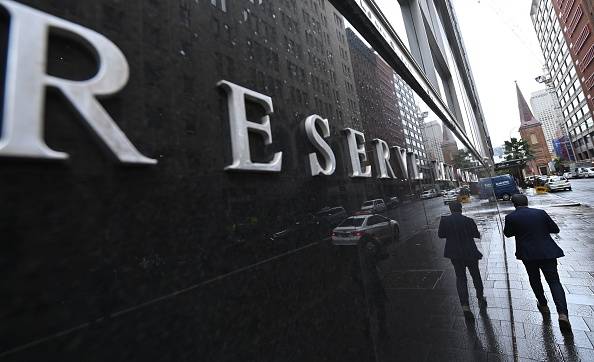
JPMorgan describes the emerging funding model as a combination of conventional corporate borrowing and project finance tied to individual data-centre assets. In Australia, the Reserve Bank estimates that syndicated loans accounted for approximately three-quarters of data-centre financing during 2025 and 2026 to date.
The numbers are becoming large enough to affect broader credit markets. The Federal Reserve Bank of Dallas has cited Wall Street estimates suggesting AI-related investment-grade bond issuance could approach US$300 billion in 2026 alone.
That borrowing is not automatically problematic. Debt can be an efficient way to finance long-lived infrastructure when future revenue is sufficiently predictable. The concern is that AI technology, customer demand and computing economics are changing much faster than the repayment schedules attached to the assets.
A data centre financed today may carry debt for years. Investors must therefore make assumptions about future utilisation rates, electricity prices, chip performance, customer concentration and the amount businesses will ultimately pay for AI computing.
When interest rates rise, those assumptions become less forgiving.
Inflation changes the calculation
September’s US inflation data intensified the pressure. Consumer prices increased 3.7 per cent over the year, ahead of market expectations and up from 3.4 per cent in August.
The hotter reading reduced confidence that interest rates would fall quickly and pushed bond yields higher. That matters particularly for companies whose valuations depend on profits expected well into the future, as well as highly leveraged infrastructure operators that may need to refinance.
CoreWeave has emerged as a closely watched test case. The specialist cloud-computing company has accumulated substantial debt and lease obligations to build AI capacity, while relying on a concentrated group of large technology customers.
Its shares fell sharply during the sell-off, while the cost of insuring its debt against default climbed. CoreWeave has argued that its contracted backlog more than covers its obligations and that financial markets do not always understand its business model. Nevertheless, its securities have become a proxy for investor confidence in debt-funded AI infrastructure.
Oracle, another major investor in AI computing capacity, fell 8.8 per cent in Friday trading, while CoreWeave dropped 15.5 per cent.
The question is shifting from how much AI infrastructure can be built to how profitably it can be operated.
China adds another source of pressure
Interest rates were not the only catalyst. Reports of advances by Chinese memory-chip producer ChangXin Memory Technologies raised concerns that lower-cost Chinese products could increase competition across the global semiconductor industry.
Memory chips are essential to AI systems, but the industry is historically cyclical. Periods of tight supply and high pricing can encourage rapid investment, eventually producing oversupply and falling margins.
The prospect of a well-funded Chinese competitor expanding its technological capabilities unsettled investors in Samsung, SK Hynix and Micron. It also demonstrated that AI-related demand does not insulate chipmakers from conventional competitive pressures.
That combination—slower rate cuts, more expensive financing and potentially cheaper supply—challenged the assumption that every company exposed to AI would enjoy continually expanding margins.
A reset rather than the end of the boom
The sell-off does not establish that the AI boom is ending. Demand for computing power remains strong, the largest technology companies continue to generate formidable cash flows and many infrastructure projects are backed by long-term customer contracts.
What has changed is the market’s willingness to overlook the price and financing structure of that growth.
The most resilient companies are likely to be those able to fund investment from operating cash flow, secure long-duration customers and demonstrate that new capacity will earn returns comfortably above its financing costs.
More speculative operators may face greater scrutiny, particularly where debt is expensive, customers are concentrated or expected revenue depends on demand that has not yet materialised.
For Australian investors, the lesson extends beyond US technology shares. Local data-centre operators, infrastructure funds, electricity suppliers and property groups are increasingly exposed to the same investment cycle.
Artificial intelligence may remain one of the defining growth themes of the decade. But last week’s correction showed that enthusiasm for the technology does not eliminate financial discipline.
The next stage of the AI boom will be judged not only by computing power, model performance or demand for chips, but by something more traditional: whether the assets being financed can generate enough cash to repay the money borrowed to build them.
Fact box
Nasdaq Composite: Down 4.5 per cent for the week ended October 16, 2026
Philadelphia Semiconductor Index: Down approximately 11.4 per cent
Micron Technology: Down approximately 14.6 per cent
Samsung Electronics: Down approximately 18 per cent
SK Hynix: Down approximately 24 per cent
US September inflation: 3.7 per cent annually
Estimated 2026 AI-related investment-grade issuance: Approximately US$300 billion

From office parties to NYE fireworks, here are the bottles that deserve pride of place in the ice bucket this season.

A 30-metre masterpiece unveiled in Monaco brings Lamborghini’s supercar drama to the high seas, powered by 7,600 horsepower and unmistakable Italian design.