


Workers’ Pay Globally Hasn’t Kept Up With Inflation
Decline in purchasing power could reverse this year if prices rise more slowly

 4 min
4 min
Wage growth across advanced economies is plateauing or declining from high levels. For central banks, it is good news: There are no signs of a spiral in which wages push up prices, which push up wages again. That makes it more likely inflation could decline without a significant increase in unemployment.
For workers, though, it is less positive. Wages rose faster last year than in the previous two years, but not as much as prices across major advanced economies, according to projections by the International Labour Organization. Workers’ purchasing power—their average inflation-adjusted wage—was lower last year than in 2019, before the pandemic, according to the report. So despite strong demand for workers and ultralow unemployment, labor’s share of economic output shrank in many advanced economies.
In the U.S., nominal wage growth—meaning unadjusted for inflation—has slowed sharply since the middle of last year, according to a variety of measures. Average hourly earnings for private-sector nonfarm workers rose 4.4% in the 12 months through January, down from 5.6% last March and less than the 6.4% rise in consumer prices in the year through January.
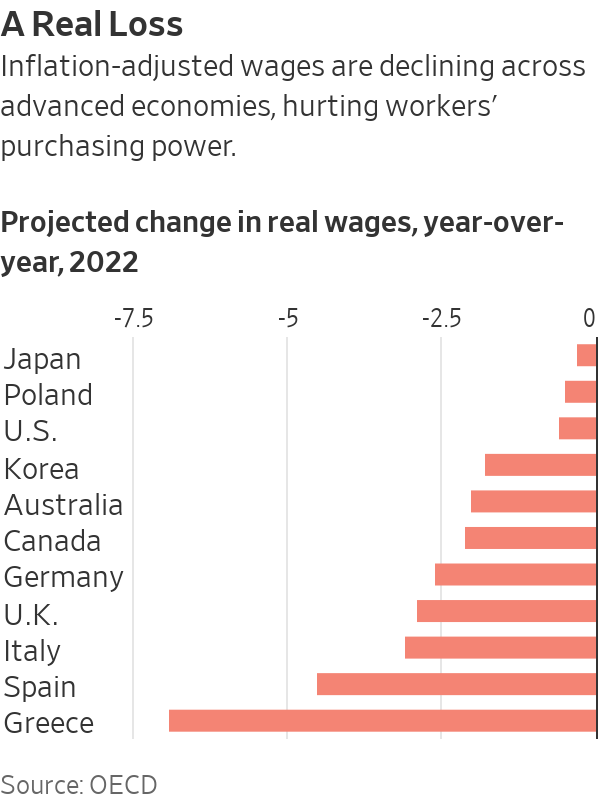
In Europe, average wage growth across six countries declined to 4.9% in December from 5.2% in November, according to a report by Ireland’s central bank and the recruitment company Indeed, which tracks advertised wages across millions of online job ads. Inflation in the eurozone ended the year at 9.2%.
In Canada, central bank chief Tiff Macklem highlighted easing wage growth to explain the bank’s recent decision to pause interest-rate increases after raising its key rate to 4.5%, the highest level in 15 years.
“Wage growth is currently running between 4% and 5% and appears to have plateaued within that range… The risk of a wage-price spiral has diminished,” Mr. Macklem said.
Economists have noted that pay growth tends to lag, not lead, inflation as workers and employers adjust pay expectations to the prices they have experienced. Thus, the recent decline in pay growth might reflect, with a lag, the fact inflation peaked around summer and fall of last year in major economies like the U.S. and eurozone and has since declined, as energy prices fell sharply and global supply-chain pressures eased.
Why, though, did wages never catch up with inflation in the first place? One reason is that wages tend to be sticky, changing relatively slowly and sluggishly—over months and years—while prices can change more rapidly. Firms might be wary of raising wages aggressively since cutting them later would be bad for morale.
Now, slowing economic growth and the threat of layoffs might be tempering workers’ demands, said Andrea Garnero, an economist with the Organization for Economic Cooperation and Development. Labor unions in Europe have grown more concerned about job security than wages, he said.
Workers’ pay demands have been reasonable in part because their incomes were supported by government aid during the pandemic and energy crisis, said Gabriel Makhlouf, governor of Ireland’s central bank. “People understand that they can make things worse if they require the wrong [pay] deal,” he said in an interview.
Crucially, the number of workers, which shrank in the first months of the pandemic, is rebounding in many advanced economies, helping to ease shortages.
Some workers who left the labor force during the pandemic are being tempted back as pandemic savings dwindle and are eroded by inflation. Almost 83% of Americans ages 25-54 are working or actively looking for work, roughly back to the pre pandemic rate, according to the U.S. Labor Department. About 86.5% of Europeans ages 25-54 have jobs or are actively searching, 1 percentage point above prepandemic levels. The U.K. stands out for a decline in its labor-force participation coupled with unusually strong wage growth, suggesting that a shortage of workers could be driving pay higher.
Immigration has also rebounded strongly in recent months, hitting record levels in Canada, Spain and Germany as some governments try to make up for shortfalls during the pandemic.
In the U.S., net international migration added more than a million people to the population in the year through mid-2022, the Census Bureau said. Migrant workers could have helped fuel January’s robust 517,000 increase in nonfarm payrolls while keeping wage inflation moderate, said Torsten Slok, chief economist at Apollo Global Management. The same forces could be at play in Europe, he said.
History suggests that workers often fail to claw back losses from high inflation. In the U.S., periods of high inflation were, in general, periods of lower real-wage growth, according to research by the Federal Reserve Bank of St. Louis. High inflation in Australia in the 1970s and 1980s led to real income losses for workers, according to the country’s central bank.
But there are reasons to think real wages might recover soon. Wage growth remains around its fastest in at least a decade across a range of advanced economies. It could stay elevated as wage bargaining proceeds.
Absent a deep recession, unemployment could stay low enough to preserve some bargaining power for workers. The labor supply is being constrained by aging populations across advanced economies and increased worker absences due to illness, often Covid-19.
And markets are betting inflation will fall rapidly this year across advanced economies. If so, it could well fall below wage growth, so real wages would rise—along with workers’ share of the economic pie.
 Copyright 2020, Dow Jones & Company, Inc. All Rights Reserved Worldwide. LEARN MORE




Australia’s housing market rebounded sharply in 2025, with lower-value suburbs and resource regions driving growth as rate cuts, tight supply and renewed competition reshaped the year.

From Tokyo backstreets to quiet coastal towns and off-grid cabins, top executives reveal where they holiday and why stepping away makes the grind worthwhile.


Capital Haus has snapped up Adelaide stalwart Baker Young, lifting its funds under management beyond AUD$1 billion and signalling a generational shift in the advice industry.
3 min
Capital Haus has moved to expand its national presence with the acquisition of Adelaide advisory firm Baker Young, one of Australia’s longest-standing private wealth practices.
The deal will see the combined group’s funds under management exceed AUD$1 billion, as adviser numbers and client coverage grow across the country.
Founded more than 40 years ago by Alan Young and David Baker, Baker Young today serves over 6,000 clients and manages AUD$700 million in assets.
Under the agreement, the Baker Young brand will be retained, and senior principals including Young and Baker will continue in active advisory roles.
Capital Haus will also migrate its existing clients to the refreshed ‘Baker Young, a Capital Haus company’ banner, which becomes its flagship advisory business.
A new offering for ultra-high-net-worth clients, Baker Young Private, will be introduced, providing access to wholesale opportunities, global private credit financing and capital raises.
Both firms’ clients will continue working with their current advisers, while gaining access to broader group-level capability, including global research, multi-asset solutions and cross-border services. Baker Young will also gain upgraded institutional-grade infrastructure and portfolio management systems.
The acquisition adds further momentum to Capital Haus’ expansion. Established in Sydney in 2019, the company has since launched offices in Dubai and Zurich and acquired practices in Townsville and Bateman’s Bay.
With the addition of Baker Young’s team, plus new managers from RiverX Investment Management and Active Super, the group now employs 41 advisers and support staff.
Brendan Gow, Founder and CEO of Capital Haus Group, said: “Baker Young has been a cornerstone of South Australia’s advice community for four decades, built on deep relationships and trust. We feel privileged to be the next custodian of that legacy.
“By moving our existing client base across to the Baker Young brand, as well as launching the new Baker Young Private service, this deal represents more than just a passing-the-torch moment. We’re combining heritage and innovation to set a new standard for financial advice at a time when the industry needs it most.”
The acquisition lands at a pivotal moment for the sector. Adviser numbers have halved since 2018, falling from around 28,900 to fewer than 15,300 as at September 2025, even as demand surges.
More than 10.2 million Australian adults were seeking financial advice in 2024, driven in part by intergenerational wealth transfer and growing expectations from Millennials and Gen Z for both trusted relationships and digitally enabled service.

Alan Young, Co-Founder and Joint MD of Baker Young, said: “For 40 years, our focus has been simple: put clients first and build relationships that span generations. Capital Haus shares that philosophy.
“We are planning for the long term – for our clients, our team and our brand. Becoming part of the Capital Haus Group means our legacy will endure, while also providing stability for clients, as well as access to exciting new opportunities. It is the right succession step for our practice and a positive evolution for our clients.”
David Baker, Co-Founder and Joint MD, added: “We’ve spent four decades building Baker Young on a foundation of trust, personalised service, and consistent performance. We’re energised by the shared vision Capital Haus is pursuing and we’re proud to be part of it.”
Gow said: “We believe the future of advice belongs to firms that can combine old-fashioned relationship banking with modern, global wealth capabilities. By bringing Baker Young into the Capital Haus family, we’re preserving one of Australia’s great advisory brands while building a platform that can serve the next generation of investors.”

An opulent Ryde home, packed with cinema, pool, sauna and more, is hitting the auction block with a $1 reserve.

Now complete, Ophora at Tallawong offers luxury finishes, 10-year defect insurance and standout value from $475,000.