How to Make Your Phone Last Forever: 6 Simple Tips
OK, maybe not ‘forever,’ but the average American phone is only used for 2½ years. This guide could help you keep yours working a lot longer.

 3 min
3 min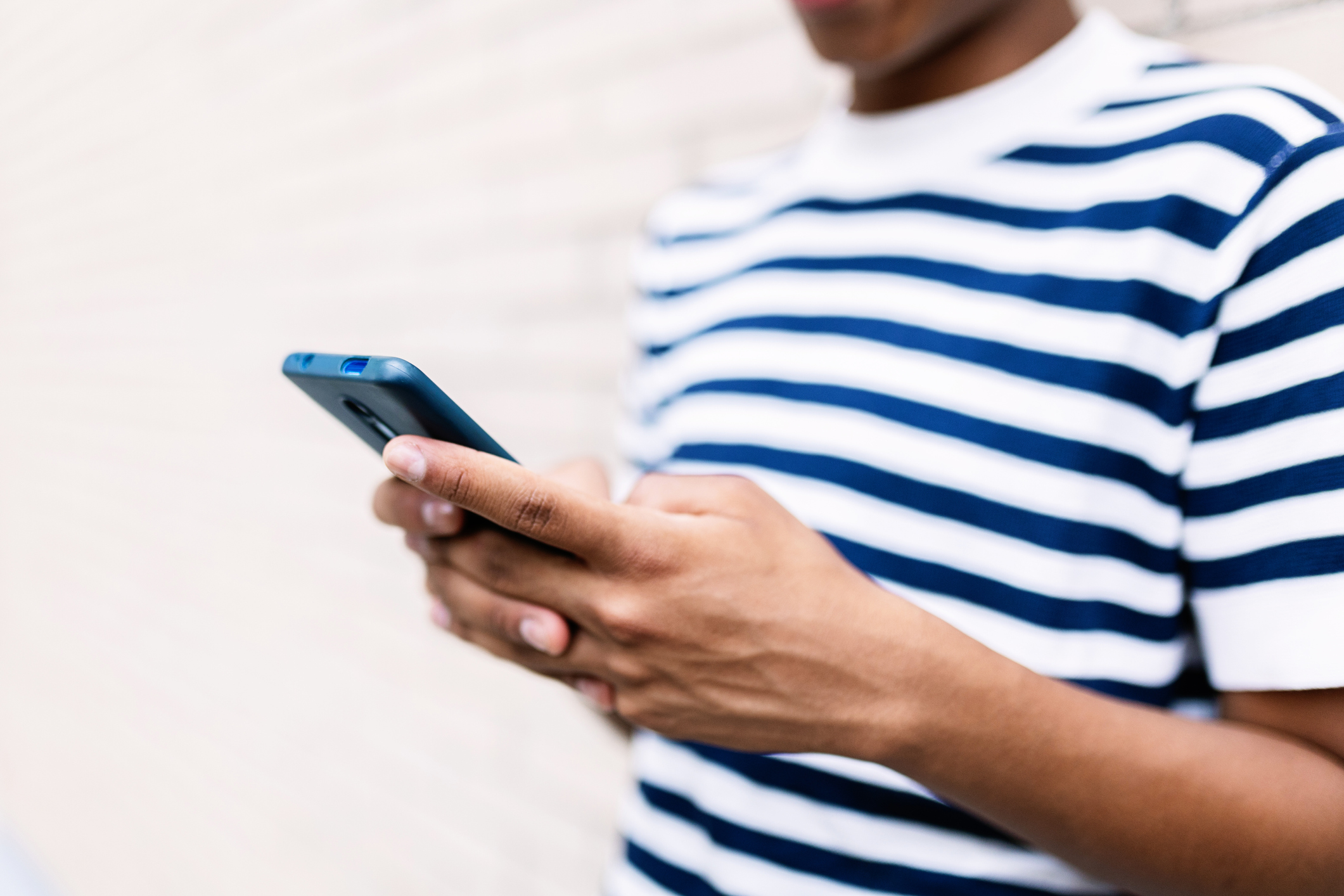
THE MARS rover Opportunity, launched in 2004, was only designed to complete a 90-day mission. But thanks to the efforts of many engineers and scientists, it wasn’t until 2019, 15 years later, that it finally stopped sending updates to NASA.
The more these scientists worked on the device, the more connected they felt to it, says Janet Vertesi, a sociologist of science and technology at Princeton University whose research included NASA’s rover programs. After all, she said, “you don’t just go to the Genius bar and get another one.”
Her reference to Apple’s Genius bar is telling: No matter how connected we get to our phones, most people accept that they’ll soon seem obsolete. The average phone in America is only used for around 2½ years, according to data published by intelligence platform Statista.
But a smartphone can last much longer. I should know. I used a Pixel 2, which came out in October 2017, as my primary phone until this summer. I loved how well the small phone fit in my hand, was happy enough with the photos it took and appreciated the speedy Android apps. My friends occasionally teased me for using the “dated” gadget (“Aren’t you a tech journalist?”). Unfortunately, it stopped receiving software updates this fall. It was time to shop for a new phone.
I ended up getting the third-generation iPhone SE from 2022. I like its smaller size, and that Apple promises it will get software updates for at least five years. To try to keep it for longer, I reached out to experts for advice.
Save Your Phone’s Life: Easy-to-Follow Tips to Keep It Going
Tip 1: Check for updates.
Your phone stores info about every aspect of your life. Without security updates, it’s all at risk, says Thorin Klosowski, a security and privacy activist at the Electronic Frontier Foundation, a digital rights advocacy organisation. Apple offers software upgrades for at least five years and security updates for longer. This year’s Google Pixel eight will get updates through 2030. Samsung promises security updates for four years minimum.
Tip 2: Put a case on it.
Every expert I spoke with said that getting a case and a screen protector are the most important steps to maintaining a phone’s life economically. Investing in this combo rarely exceeds $50, while repairing your screen can top $200.
Tip 3: Clean your filthy, disgusting charge port.
If you’ve ever had trouble getting your phone to charge, even with endless cord fiddling, you might have thought it kaput. But the port itself, whether Lightning or USB-C, might not be broken. Try gently inserting a straightened-out paper clip along its sides to see if it’s full of pocket lint and random dust. (A can of compressed air works too.) Then, use a lint plug, a removable piece of rubber that can sit in your port, to prevent more buildup.
Tip 4: Monitor your battery health.
“Many problems that appear to be defects in [a] phone are really problems with dying batteries,” said Gay Gordon-Byrne, executive director of the Repair Association, a New York-based trade group that advocates for right-to-repair laws. You can check your battery’s health in the settings menu on both Apple or Android phones. If your iPhone says your battery’s “Maximum Capacity” is 80% or less under “Battery Health,” it’s probably time to replace it.
Tip 5: Know your repair options.
If you do need to replace a battery or screen, don’t accidentally overpay to fix it. Apple has a tool on its website that will quickly estimate the cost of common repairs for your specific phone. (It says it will cost $69 to repair the battery on my new SE.) You can maybe get things fixed cheaper at local shops, but there might be quirks. After a non-Apple repair person replaces an iPhone battery, for example, your phone might send a warning it’s “unable to verify” whether it has a “genuine Apple battery.”
Tip 6: If all else fails, repurpose.
When your phone’s maker declares it obsolete, and stops sending software and security updates, don’t just accept the death sentence. Compromise on some of its capabilities. Start, Klosowski says, with a factory reset, and update your OS as much as you can. Then, you can download apps that will let your phone replace or augment your primary devices. It can be a dedicated alarm clock, smart home hub, remote control, digital picture frame, or even an extra camera for your home security system.
 Copyright 2020, Dow Jones & Company, Inc. All Rights Reserved Worldwide. LEARN MORE




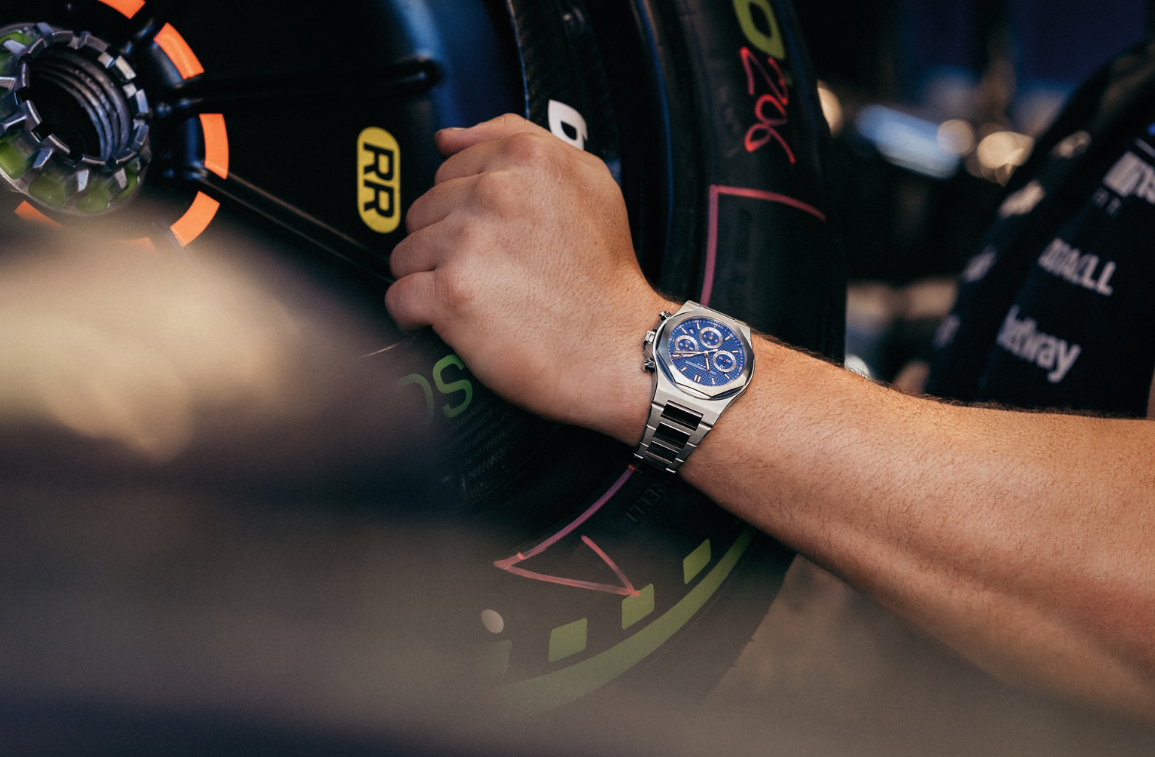
The Swiss watchmaker’s first collaboration with Atlassian Williams F1 Team produces two sporting Laureato models inspired by the team’s 2026 racing car.
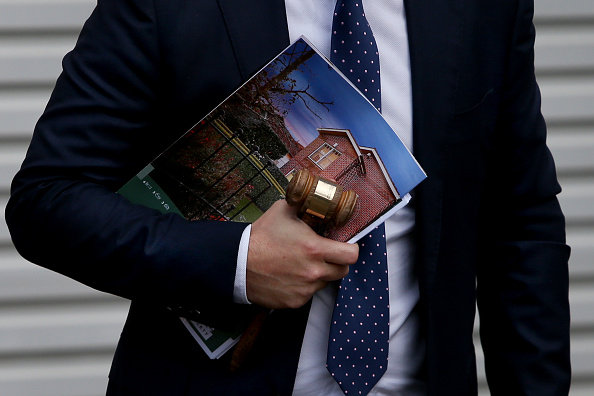
Victorian auction buyers will soon receive a piece of information that has traditionally been withheld until bidding reaches it: the vendor’s reserve price. Under new property-sale and underquoting laws, agents must publish the agreed reserve at least seven days before an auction or fixed-date sale. Most changes begin on 1 October 2026 and apply to …
Continue reading “Victoria’s New Auction Rules Will Force Reserve Prices Into the Open”

The Swiss watchmaker’s first collaboration with Atlassian Williams F1 Team produces two sporting Laureato models inspired by the team’s 2026 racing car.
3 minGirard-Perregaux has revealed the first watches created through its partnership with Atlassian Williams F1 Team, bringing the British racing team’s colours to one of Switzerland’s most recognisable integrated-bracelet designs.
The collaboration comprises two 42mm steel watches: the time-and-date Laureato Williams Edition and the more technical Laureato Chronograph Williams Edition.
Both retain the familiar architecture of the Laureato, including its octagonal bezel, integrated bracelet and mix of polished and satin-finished surfaces. The influence of Williams is comparatively restrained, appearing through colour, discreet branding and details inspired by the team’s current Formula 1 car.
It is a welcome departure from the oversized logos and literal automotive references that can characterise motorsport watches.
The Williams FW48 inspires the dial
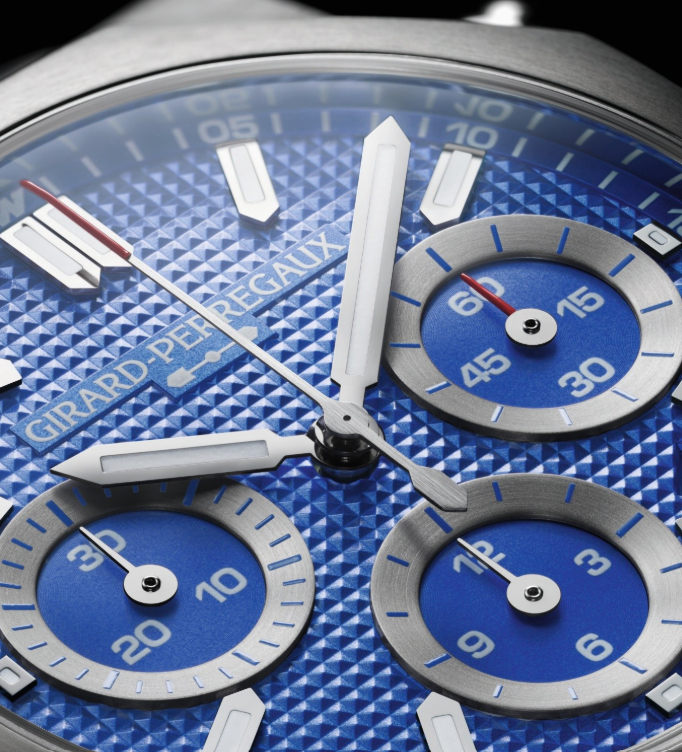
The centrepiece of both models is a blue Clous de Paris dial informed by the livery of the Williams FW48, the car being campaigned by the team during the 2026 Formula 1 season.
A small Williams “W” replaces the conventional marker at 12 o’clock, while the team emblem appears on the sapphire crystal caseback. Red accents echo the keyline used on the FW48 without overwhelming the established Laureato design.
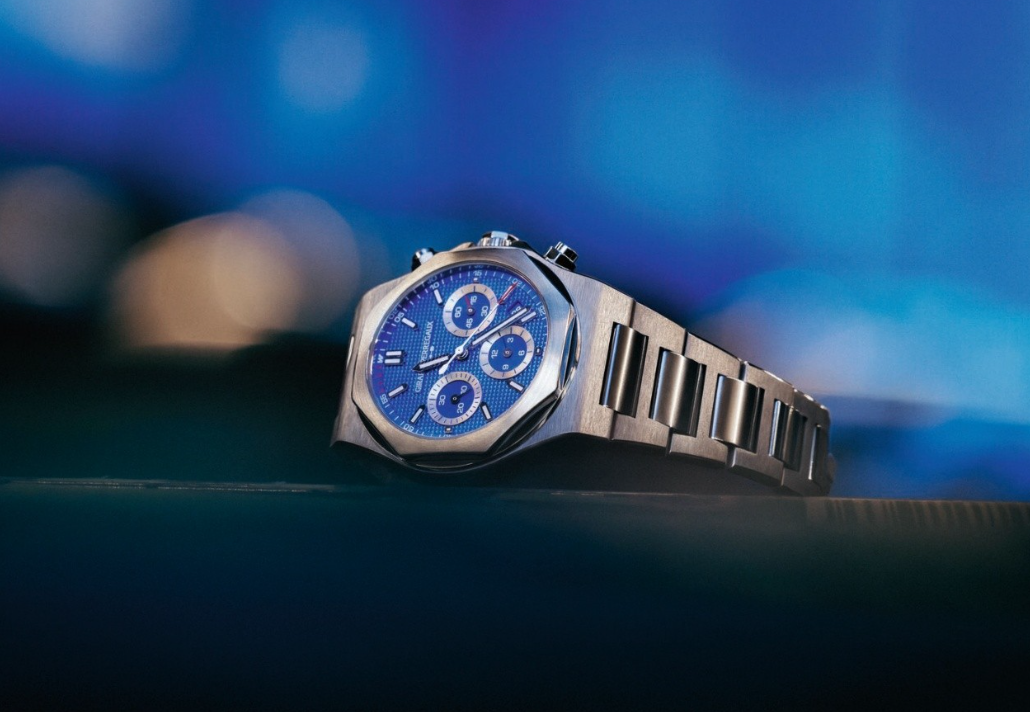
The three-hand model offers the quieter interpretation. Baton-shaped, rhodium-plated hands and hour markers are filled with white-emitting luminescent material, while a date window sits at three o’clock.
The chronograph creates a more obvious connection with motorsport. Three subdials are framed by rhodium-plated rings, with red appearing on the small-seconds hand and the tip of the central chronograph seconds hand.
Both watches measure 42mm across and are water resistant to 100 metres. The standard Laureato has a case thickness of 10.68mm, while the additional mechanics of the chronograph increase its profile to 12.16mm.
Two in-house automatic movements
The Laureato Williams Edition is powered by Girard-Perregaux’s self-winding GP01800 calibre. The movement provides hours, minutes, central seconds and the date, with a minimum power reserve of 54 hours.
The Laureato Chronograph Williams Edition uses the automatic GP03300 calibre, which combines its chronograph functions with a date display and offers a minimum power reserve of 46 hours.
Both movements operate at 28,800 vibrations per hour and can be viewed through their sapphire crystal casebacks.
Their decoration provides a more traditional counterpoint to the Formula 1 association. Finishing techniques include Côtes de Genève, circular graining, bevelling, mirror polishing, satin finishing, engraving and snailing.
The result is less about reproducing the appearance of a racing car than identifying the common ground between two mechanical disciplines: precision, incremental development and the considerable work hidden beneath the finished product.
Parallel histories
The timing of the partnership draws attention to the remarkably similar ages of its two protagonists.
Girard-Perregaux introduced the original Laureato in 1975, establishing an integrated-bracelet sports watch with a distinctive octagonal bezel. Williams entered Formula 1 two years later in 1977.
Both have evolved continuously across the five decades since. The Laureato has moved through different sizes, materials and complications, while retaining its central design language. Williams, meanwhile, has remained one of Formula 1’s most historically significant teams.
That gives the collaboration greater credibility than a simple licensing exercise. Girard-Perregaux and Williams are not being connected solely through the familiar language of speed. Their stronger link is a shared dependence on engineering, testing and the accumulation of specialist knowledge.
The watches are described as the beginning of a longer collaboration, suggesting further Williams editions may follow.
Girard-Perregaux’s international website lists the Laureato Williams Edition at US$16,200 and the Laureato Chronograph Williams Edition at US$20,900. Australian pricing has not been announced.
Specifications
Girard-Perregaux Laureato Williams Edition 42mm
Reference: 81010-11-3680-1GM
Case: Steel
Diameter: 42mm
Thickness: 10.68mm
Crystal: Anti-reflective sapphire crystal
Dial: Blue Clous de Paris pattern
Movement: Automatic GP01800
Functions: Hours, minutes, central seconds and date
Power reserve: Minimum 54 hours
Water resistance: 100 metres
Bracelet: Integrated steel bracelet with triple-folding clasp
International price: US$16,200
Girard-Perregaux Laureato Chronograph Williams Edition 42mm
Reference: 81020-11-3681-1GM
Case: 904L steel
Diameter: 42mm
Thickness: 12.16mm
Crystal: Anti-reflective sapphire crystal
Dial: Blue Clous de Paris pattern with three chronograph counters
Movement: Automatic GP03300
Functions: Chronograph, hours, minutes, small seconds and date
Power reserve: Minimum 46 hours
Water resistance: 100 metres
Bracelet: Integrated 904L steel bracelet with triple-folding clasp
International price: US$20,900

The pandemic-fuelled love affair with casual footwear is fading, with Bank of America warning the downturn shows no sign of easing.
When the Writers Festival was called off and the skies refused to clear, one weekend away turned into a rare lesson in slowing down, ice baths included.