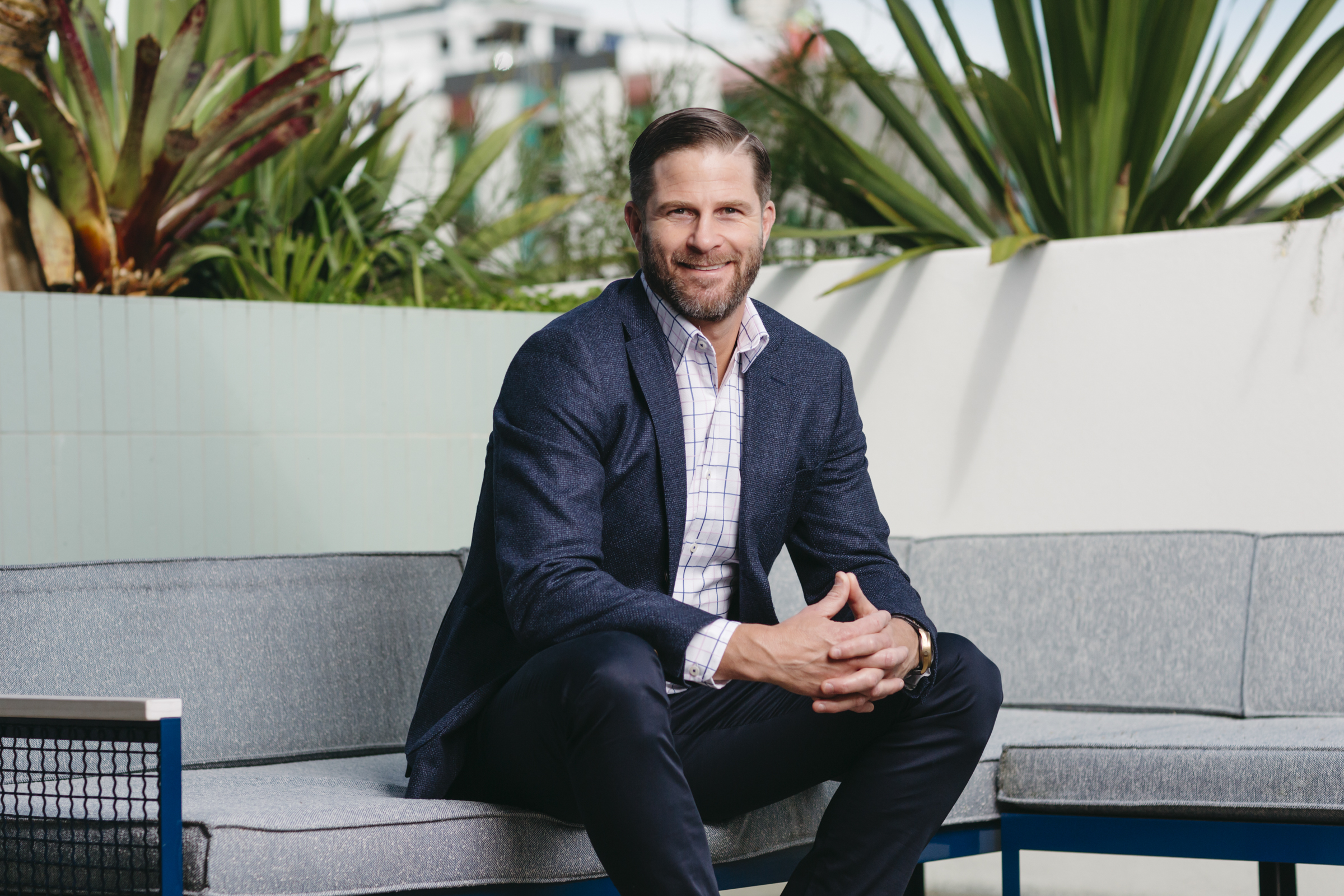
The computing revolution investors cannot ignore
Quantum computing is moving from theory to real-world investment. Professor David Reilly says it could reshape finance, security and global technology infrastructure.
 3 min
3 min
For decades, the world’s computing power has quietly expanded at an astonishing pace.
From the first transistor developed at Bell Labs in 1947 to modern processors containing billions and even trillions of transistors, each generation of technology has been faster, smaller and more powerful than the last.
But according to quantum physicist and technology entrepreneur David Reilly, that era of effortless progress is beginning to slow.
Reilly, CEO of Sydney-based Emergence Quantum and Professor of Physics at the University of Sydney, says the computing infrastructure underpinning modern economies is approaching fundamental physical limits.
And that could have enormous implications for finance, artificial intelligence and global investment.
Speaking at an industry event organised by Kanebridge International, Reilly said many critical parts of modern society depend on computing and the infrastructure used to process information.
The slowdown behind the tech boom
For years, the technology industry relied on a steady improvement known as Moore’s Law, where the number of transistors on a chip doubled roughly every two years.
More transistors meant more computing power, allowing faster software, smarter devices and ever-larger data systems.
Today, however, those gains are slowing.
“It feels to me very innate that I’m going to just find that next year there’s going to be another breakthrough,” Reilly said.
“But if you look at the data…there’s a slowing down, a roll off in performance that started some 10, 20 years ago.”
Rather than making chips dramatically faster, manufacturers are now largely increasing computing capacity by packing more transistors onto each processor.
The approach works, but it comes with growing complexity, higher costs and increasing energy demands.
The brute-force race for AI
That challenge is already visible in the massive data centres being built to support artificial intelligence.
In the race to dominate AI, companies are constructing vast computing facilities that consume huge amounts of electricity and water. Reilly described this expansion as a “brute force” approach driven by the global competition to develop advanced AI systems.
Yet the demand for computing power continues to accelerate.
Artificial intelligence, advanced robotics, healthcare research, pharmaceuticals and cybersecurity all require far more processing capacity than today’s systems can easily deliver.
The question now facing the technology sector is whether traditional computing can keep up.
Enter quantum computing
That is where quantum computing enters the conversation.
Unlike conventional computers, which process information using binary switches that represent ones and zeros, quantum computers exploit the unusual behaviour of particles at the atomic scale.
Reilly describes them as a fundamentally different type of machine.
“So a quantum computer is a wave computer,” he said.
Instead of processing information through simple on-off switches, quantum systems can use wave-like properties of particles to process many possible outcomes simultaneously.
Those waves can interact in complex ways, reinforcing correct solutions while cancelling out incorrect ones. In theory, this allows quantum systems to tackle certain types of problems dramatically faster than classical computers.
What it could mean for finance
The concept may sound abstract, but its potential applications are significant.
Quantum computers are expected to transform areas such as materials science, chemical modelling and pharmaceutical development.
They could also help solve complex optimisation problems in logistics, finance and risk management.
For financial institutions in particular, the technology could offer new tools for detecting fraud, analysing market behaviour and optimising portfolios.
But the shift will not happen overnight.
“One message to take away is that quantum is not going to suddenly solve all of your problems,” Reilly said.
Instead, he said quantum systems will likely complement existing computing technologies as part of a broader and more diverse computing ecosystem.
Why data centres may soon “go cold”
One key change already emerging is how computing systems are physically designed.
Many next-generation technologies, including quantum processors, operate far more efficiently at extremely low temperatures. As a result, future data centres may rely heavily on cryogenic cooling systems to manage heat and energy consumption.
Reilly believes that the shift will gradually reshape the computing industry.
“Over the next five years, you’re going to see data centres go cold,” he said.
“And as that happens, they almost drag with them new compute paradigms.”
Emergence Quantum, the company he co-founded, is focused on developing technologies to support that transition, including cryogenic electronics and integrated hardware platforms designed for quantum computing and energy-efficient systems.
A new technological era
For investors and businesses, the technology remains in its early stages. But the scale of global interest is growing rapidly.
Governments, research institutions and technology companies are investing heavily in quantum research, betting it could become a foundational technology for the next generation of computing.
For Reilly, the moment feels similar to earlier technological turning points.
In the 19th century, new discoveries in thermodynamics helped drive the development of steam engines and the Industrial Revolution. In the 20th century, advances in electromagnetism led to radio, television and eventually the internet.
Quantum physics, he suggests, could represent the next chapter in that story.
“Today we have, as a society, in our hands new physics that we’re just beginning to figure out what to do with,” Reilly said.
“But I think it’s an exciting time to be alive and watch what happens over the coming decades.”

Two coming 2027 models – the first of the “Neue Klasse” cars coming to the U.S. early next year – have been revealed.

A&K Sanctuary unveils Kitirua Plains Lodge, a sustainability-focused luxury property shaped by landscape, local craft and contemporary safari architecture.


The lunar flyby would be the deepest humans have traveled in space in decades.
4 min
It’s go time for the highest-stakes mission at NASA in more than 50 years.
On April 1, the agency is set to launch four astronauts around the moon, the deepest human spaceflight since the final Apollo lunar landing in 1972.
The launch window for Artemis II , as the mission is called, opens at 6:24 p.m. ET.
National Aeronautics and Space Administration teams have been preparing the vehicles to depart from Florida’s Kennedy Space Center on the planned roughly 10-day trip. Crew members have trained for years for this moment.
Reid Wiseman, the NASA astronaut serving as mission commander, said he doesn’t fear taking the voyage. A widower, he does worry at times about what he is putting his daughters through.
“I could have a very comfortable life for them,” Wiseman said in an interview last September.
“But I’m also a human, and I see the spirit in their eyes that is burning in my soul too. And so we’ve just got to never stop going.”
Wiseman’s crewmates on Artemis II are NASA’s Victor Glover and Christina Koch, as well as Canadian Space Agency astronaut Jeremy Hansen.

What are the goals for Artemis II?
The biggest one: Safely fly the crew on vehicles that have never carried astronauts before.
The towering Space Launch System rocket has the job of lofting a vehicle called Orion into space and on its way to the moon.
Orion is designed to carry the crew around the moon and back. Myriad systems on the ship—life support, communications, navigation—will be tested with the astronauts on board.
SLS and Orion don’t have much flight experience. The vehicles last flew in 2022, when the agency completed its uncrewed Artemis I mission .
How is the mission expected to unfold?
Artemis II will begin when SLS takes off from a launchpad in Florida with Orion stacked on top of it.
The so-called upper stage of SLS will later separate from the main part of the rocket with Orion attached, and use its engine to set up the latter vehicle for a push to the moon.
After Orion separates from the upper stage, it will conduct what is called a translunar injection—the engine firing that commits Orion to soaring out to the moon. It will fly to the moon over the course of a few days and travel around its far side.
Orion will face a tough return home after speeding through space. As it hits Earth’s atmosphere, Orion will be flying at 25,000 miles an hour and face temperatures of 5,000 degrees as it slows down. The capsule is designed to land under parachutes in the Pacific Ocean, not far from San Diego.

Is it possible Artemis II will be delayed?
Yes.
For safety reasons, the agency won’t launch if certain tough weather conditions roll through the Cape Canaveral, Fla., area. Delays caused by technical problems are possible, too. NASA has other dates identified for the mission if it doesn’t begin April 1.
Who are the astronauts flying on Artemis II?
The crew will be led by Wiseman, a retired Navy pilot who completed military deployments before joining NASA’s astronaut corps. He traveled to the International Space Station in 2014.
Two other astronauts will represent NASA during the mission: Glover, an experienced Navy pilot, and Koch, who began her career as an electrical engineer for the agency and once spent a year at a research station in the South Pole. Both have traveled to the space station before.
Hansen is a military pilot who joined Canada’s astronaut corps in 2009. He will be making his first trip to space.
Koch’s participation in Artemis II will mark the first time a woman has flown beyond orbits near Earth. Glover and Hansen will be the first African-American and non-American astronauts, respectively, to do the same.
What will the astronauts do during the flight?
The astronauts will evaluate how Orion flies, practice emergency procedures and capture images of the far side of the moon for scientific and exploration purposes (they may become the first humans to see parts of the far side of the lunar surface). Health-tracking projects of the astronauts are designed to inform future missions.
Those efforts will play out in Orion’s crew module, which has about two minivans worth of living area.
On board, the astronauts will spend about 30 minutes a day exercising, using a device that allows them to do dead lifts, rowing and more. Sleep will come in eight-hour stretches in hammocks.
There is a custom-made warmer for meals, with beef brisket and veggie quiche on the menu.
Each astronaut is permitted two flavored beverages a day, including coffee. The crew will hold one hourlong shared meal each day.
The Universal Waste Management System—that’s the toilet—uses air flow to pull fluid and solid waste away into containers.
What happens after Artemis II?
Assuming it goes well, NASA will march on to Artemis III, scheduled for next year. During that operation, NASA plans to launch Orion with crew members on board and have the ship practice docking with lunar-lander vehicles that Elon Musk’s SpaceX and Jeff Bezos’ Blue Origin have been developing. The rendezvous operations will occur relatively close to Earth.
NASA hopes that its contractors and the agency itself are ready to attempt one or more lunar landing missions in 2028. Many current and former spaceflight officials are skeptical that timeline is feasible.

With two waterfronts, bushland surrounds and a $35 million price tag, this Belongil Beach retreat could become Byron’s most expensive home ever.

A survey of people with at least $1 million in investable assets found women in their 30s and 40s look nothing like older generations in terms of assets and priorities