Sylvester Stallone Sells His Knockout Watch Collection, Including the Most Valuable Modern Timepiece Sold in Sotheby’s History

 3 min
3 min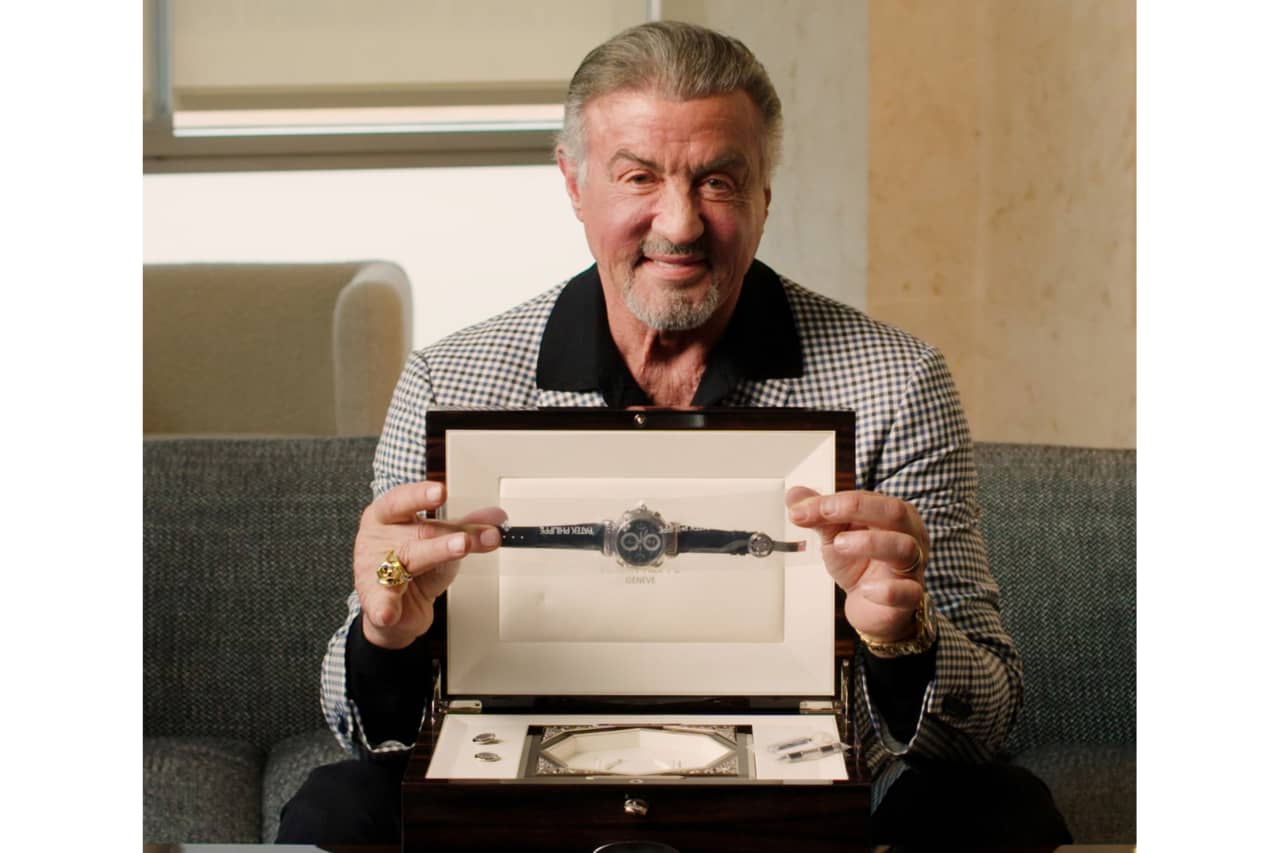
Sylvester Stallone’s legacy as one of the most notable watch collectors of the 21st century was cemented in New York this week, as 11 of the actor’s timepieces sold for US$6.7 million—beating its presale estimate—at Sotheby’s.
The highlight of the sale was the Academy Award winner’s Patek Philippe Grandmaster Chime, which sold for US$5.4 million (surpassing its pre-sale estimate of US$2.5 million to US$5 million), a result that set a pair of benchmarks for the auctioneer. It’s the third-most valuable wristwatch sold in Sotheby’s history, and marks a record for a modern watch sold by Sotheby’s, topping the US$4.5 million sale of a Richard Mille Reference RM53-02 last October.
“The sale of the Patek Philippe Grandmaster Chime was an unrepeatable celebration, not only of a masterpiece by the most revered Swiss-watchmakers of technical excellence, but also of the legendary icon that is Sylvester Stallone, who has been a deeply influential and admired collector for many decades,” Geoff Hess, Sotheby’s head of watches, Americas, said in a statement.
On Wednesday, more than 100 attendees filled Sotheby’s saleroom, and once the Grandmaster Chime (Reference 6300G-010) hit the block, a four-minute bidding war ensued among five bidders, according to the auction house. In the end, the watch was sold to a private collector from Asia. ( Stallone paid US$2.2 million for the watch in 2021. )

Sotheby’s
“To feel the pulse of collectors racing with excitement in pursuit of absolute top-caliber material was tremendous, and an homage to the art of collecting at the highest level,” Hess said.
Considered to be a holy grail among followers of haute horology, the Grandmaster Chime was the result of a project initiated by Philippe Stern in 2007 to create the most intricate wristwatch in the brand’s history. The development, production, and assembly spanned 100,000 hours, according to Sotheby’s.
Stallone’s Grandmaster Chime was the first example of the model to appear at auction, aside from one specifically created for, and sold at, a Christie’s charity auction in November 2019 for CHF 31 million (US$35 million) . It remains the highest price for a watch ever sold at auction.
Hess himself went home with one of Stallone’s watches, as the winner of a five-minute bidding battle for the actor’s olive green Patek Philippe Nautilus. The 2021 stainless steel watch featuring an olive-green dial and diamond-set bezel sold for US$492,000, exceeding its pre-sale estimate of US$400,000.

Sotheby’s
Stallone’s collection, assembled over the course of more than 20 years, also included timepieces from Rolex, Audemars Piguet, and Piaget, as well as unique and screen-worn watches from Panerai.
Other highlights included the actor’s Audemars Piguet Royal Oak Tourbillon (Reference 26730OR.OO.1320OR.01)—a gorgeous piece created for the 50th anniversary of the Swiss watchmaker’s Royal Oak collection in 2022. It sold for US$228,000, exceeding its pre-sale high estimate of US$200,000; and a Panerai Luminor Submersible (Reference PAM00382) worn by Stallone in the 2012 film The Expendables 2 that sold to an online buyer for US$96,000, blowing past its pre-sale estimate of US$30,000 to US$60,000.
“I enjoy the collecting process like so many others in this passionate community, who don’t just see watches as an accessory, but admire them for their history, craftsmanship, artistry—but most importantly—how they make them feel,” Stallone said in a statement when the sale was announced. “Looking at these watches, I feel truly lucky to have owned them; they serve as a reminder that hard work pays off.”
 Copyright 2020, Dow Jones & Company, Inc. All Rights Reserved Worldwide. LEARN MORE





Australian shares fell on Thursday as Wall Street weakness, rising oil and persistent rate concerns weighed on most of the market. The S&P/ASX 200 declined 0.72 per cent to 8,702. The All Ordinaries lost 0.66 per cent to finish at 8,897. Mining stocks were hit particularly hard, while real estate also dragged on the index. …
Continue reading “ASX falls 0.7 per cent as miners and property stocks retreat”

Borrowers cannot control the Reserve Bank, but they can control how exposed their household budget is to its next decision. The RBA meets on 29 September with inflation concerns still elevated and major-bank economists increasingly bringing forward their rate-rise calls. Fixed mortgage rates have also been moving, reducing the value of waiting for perfect certainty. …
Continue reading “What mortgage holders should do before the next RBA decision”
 2 min
2 minAustralian shares fell on Thursday as Wall Street weakness, rising oil and persistent rate concerns weighed on most of the market.
The S&P/ASX 200 declined 0.72 per cent to 8,702. The All Ordinaries lost 0.66 per cent to finish at 8,897. Mining stocks were hit particularly hard, while real estate also dragged on the index.
Energy was the notable exception, gaining more than one per cent as Brent crude traded above US$103 a barrel. Oil had moved higher amid uncertainty surrounding potential US diesel-export restrictions and broader geopolitical supply risks. The move supported energy producers but renewed concern about inflation inputs across transport and the wider economy.
Gold shares were weak even as spot bullion remained historically elevated. The All Ordinaries Gold index fell about 2.25 per cent, showing that equity performance can diverge from the commodity because of valuation, currency, operating and company-specific factors.
Zip was a prominent loser, falling 11.38 per cent after the company reported short sales after the previous close. Nine Entertainment also weakened after UBS analysts warned of near-term revenue challenges associated with its advertising-supported subscription tier.
Premier Investments led larger winners despite caution about the retail environment. Breville, in which Premier owns a significant stake, also appeared among leading movers. In the broader ASX 300 screen, Myer gained 11.43 per cent and MAAS Group rose 7.93 per cent, while Lotus Resources fell 10.53 per cent. These percentage moves should be checked against company announcements and trading liquidity before attributing causes.
The Australian dollar was broadly flat at US70.38 cents. Spot gold was around US$4,280 an ounce, Brent crude approximately US$103.08 a barrel and iron ore near US$96.90 a tonne late in the session.
The rate outlook remains the central domestic catalyst. Labour-market weakness has not eliminated the possibility of an RBA increase next week, leaving banks, listed property and other rate-sensitive sectors exposed to changing expectations.
Market dashboard
S&P/ASX 200: 8,702, down 0.72 per cent.
All Ordinaries: 8,897, down 0.66 per cent.
Best sector: Energy, up more than one per cent.
Weakest areas: Real estate and materials were the major drags; confirm final sector percentages before publication.
Material winner: Premier Investments led the large-company gainers. Confirm its final closing move from the ASX before publication.
Material loser: Zip, down 11.38 per cent.
ASX 300 percentage leader: Myer, up 11.43 per cent.
ASX 300 percentage laggard: Zip, down 11.38 per cent.
AUD/USD: Approximately US$0.7038, broadly flat.

A&K Sanctuary unveils Kitirua Plains Lodge, a sustainability-focused luxury property shaped by landscape, local craft and contemporary safari architecture.

International AI strategist Justin Kabbani will headline the Kanebridge Property Summit in Sydney on June 18, with tickets selling fast.