


China Slips Into Deflation in Warning Sign for World Economy
The lifting of Covid-19 pandemic curbs has been followed by an unusual bout of falling consumer prices instead of a surge

 5 min

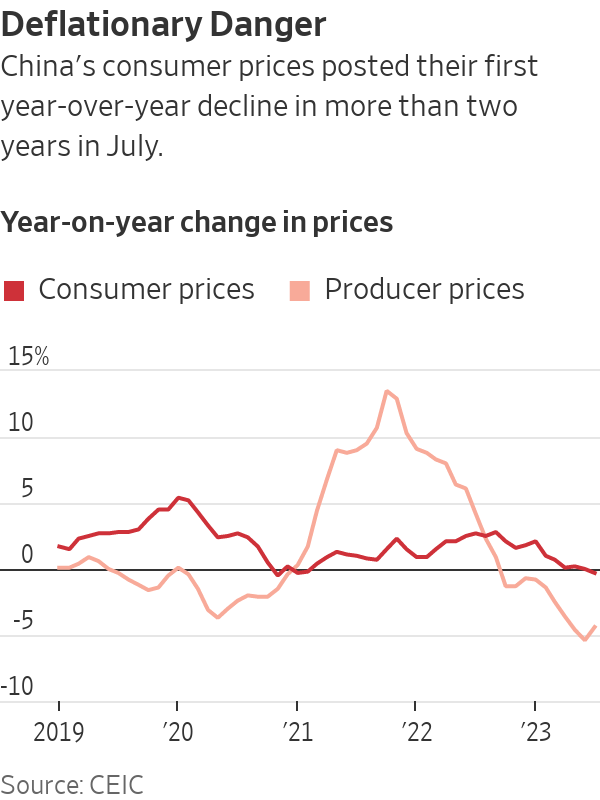
HONG KONG—China’s consumer prices tipped into deflationary territory in July for the first time in two years, as a deepening economic malaise in the world’s second-largest economy enters a potentially dangerous new phase.
The data released Wednesday adds to a darkening picture for China, where the economic recovery has been losing momentum because of a host of problems. A drop in exports is accelerating, youth unemployment has hit record highs and the housing market is mired in a protracted downturn.
Now, the country is suffering an unusual bout of falling prices on a range of goods, from commodities such as steel and coal to daily essentials and consumer products such as vegetables and home appliances. It is the opposite of what happened in most of the rest of the world when Covid-19 restrictions eased, with many countries still trying to tame inflation.
Chinese consumer prices fell 0.3% in July compared with a year earlier. This could be transitory, however. Stripping out volatile food and energy prices, so-called core inflation rose to 0.8% in July, the highest level since January, from 0.4% in June.
The danger is that if the expectation of falling prices becomes entrenched, it could further sap demand, exacerbate debt burdens and even lock the economy into a trap that will be hard to escape using the stimulus measures Chinese policy makers have traditionally turned to.
Deflation is particularly risky for countries with high debt burdens such as China, since it will add to debt servicing costs for borrowers and likely prompt them to spend and invest less.
China’s total debt reached nearly three times the size of its gross domestic product in 2022, higher than that in the U.S., according to the Bank for International Settlements.
“The reality looks increasingly grim,” said Eswar Prasad, a Cornell University economist who once headed the International Monetary Fund’s China division. “The government’s approach of downplaying the risks of deflation and stalling growth could backfire and make it even harder to pull the economy out of its downward spiral.”
For now, Chinese policy makers say they are sanguine about falling prices, dismissing suggestions that deflation is here to stay.
Dong Lijuan, a statistician at China’s National Bureau of Statistics, on Wednesday said consumer prices will likely rebound gradually later this year as the high base effect begins to fade.
China’s predicament stands in contrast to those of the U.S. and other Western countries, where soaring inflation prompted central banks, including the Federal Reserve, to raise interest rates in an effort to cool growth without triggering a recession.
In the U.S., consumer prices rose 3% in June compared with a year earlier, the slowest pace of increase in more than two years, while annual inflation in the European Union stood at 6.4%, easing from 7.1% in May.
Falling prices in China may help ease inflationary pressure elsewhere around the globe, as Chinese exports become cheaper. They also pose a risk: a flood of low-price Chinese-made goods could hurt foreign competitors and lead to job losses in developed countries.
For China, the absence of inflation reflects an imbalance in the economy characterised by ample supply and dormant domestic demand, which economists say is partly the result of Beijing’s paltry social security support for households.
Wang Lei, who works at a video gaming company in Beijing, said his and his wife’s overall expenditures have fallen compared with last year’s. Seeing colleagues and friends get laid off spooked him into reining in any unnecessary expenditures, apart from renovating an apartment that he purchased two years ago.
“It’s better to save more and be cautious now,” said 40-year-old Wang. “The economic outlook is not certain.”
China’s central bank has trimmed interest rates several times this year, but fiscal and monetary policy makers haven’t launched any larger-scale stimulus measures, in part because of constraints such as elevated debt levels.
Prices charged at the factory gate, which have been contracting on a year-over-year basis since last October, fell 4.4% in July from a year earlier, narrowing from June’s 5.4% decline, according to data published by China’s National Bureau of Statistics on Wednesday.
But it was the consumer-price reading, which has remained positive even as producer prices turned negative, that marked the bigger shift.
After flatlining in June, last month’s 0.3% decrease in consumer prices represents the first negative print since February 2021, when the reading was thrown off by year-over-year comparisons to the early days of the pandemic when supply chains and food prices were in disarray.
Apart from a single month in the first year of the pandemic, both consumer and producer prices haven’t been in deflationary territory at the same time since 2009, at the depths of the global financial crisis.
July’s negative consumer inflation result was mainly driven by a drop in food prices from a year earlier, when food prices were pushed up by extreme weather conditions, a spokeswoman for China’s statistics bureau said Wednesday. Prices of pork, a staple of Chinese dinner tables, plunged 26% in July from a year earlier. Vegetable prices also fell last month.
Even so, consumer inflation isn’t likely to pick up much this year, economists say. The reason is consumer confidence, or rather the lack of it, as households continue to feel the lingering impact of three years of Covid uncertainty, regulatory uncertainty and ongoing concern about the health of the property market. The real-estate sector, one of China’s main drivers of growth for decades, is in a deep funk, with fresh worries stoked this week by default concerns around one of China’s biggest property developers.
Unlike many countries in the West, where government cash handouts to consumers during the pandemic fuelled a spending boom on physical goods such as furniture and personal electronics, Beijing so far has offered no such direct support to its households.
On top of that, a renewed downturn in the housing market has curbed Chinese consumers’ appetite for consumption, since many households have treated apartment units as their main store of wealth, and are highly sensitive to fluctuations in home prices, said Wei Yao, chief China economist at Société Générale.
“The problem is there’s no obvious driver to power recovery at the moment,” she said.
Even if consumer prices begin to pick up again, Chinese factory owners and exporters are likely to struggle with pricing power for some time, eroding their profit margins and hurting their willingness to expand production or hire more workers.
While producer price deflation eased in July, the 4.4% drop was worse than 4.1% expected by economists polled by the Journal.
During the pandemic, many factories in China ramped up production to accommodate a surge of overseas orders. Now, as demand in the West fades, producers of automobiles, consumer goods and other products are being saddled with excess inventory, forcing many to slash prices to reduce stockpiles.
One manufacturer of robot vacuum cleaners based in the southern Chinese city of Shenzhen is looking to sell more overseas, in part because domestic rivals are offering cheaper options and the sluggish recovery in consumer demand has eroded sales at home, according to a company executive.
The ultimate challenge for Chinese policy makers is how to forestall a self-reinforcing spiral in which a fall in prices leads to reduced production, lower wages and suppressed demand.
Economists expect China’s central bank to lower interest rates further in the coming months, though many are skeptical that such moves alone can dispel deflationary pressures.
That is because confidence among businesses and households has been slow to recover, resulting in limited appetite for them to invest and spend more. Such an environment renders moderate stimulus measures largely ineffective, argues Arthur Budaghyan, chief emerging markets strategist at BCA Research.
“The Chinese government has to do something very big to confront deflation,” he said. “I don’t think they’ve done enough yet.”
—Grace Zhu and Xiao Xiao in Beijing contributed to this article.
 Copyright 2020, Dow Jones & Company, Inc. All Rights Reserved Worldwide. LEARN MORE



From making unpopular decisions to learning when to listen, leaders from five businesses reveal what nobody prepared them for — and how running a company has challenged their expectations.
Technology and semiconductor shares fell sharply as investors questioned the debt financing the AI infrastructure boom and confronted higher rates and Chinese competition.

Elon Musk is exploring a potential merger between Tesla and SpaceX, a deal that could reshape the future of AI, robotics, autonomous vehicles and space technology. With a combined valuation potentially reaching $3.5 trillion, the move could bring Musk’s vision of an interconnected technology ecosystem closer to reality, although a deal remains uncertain.
5 min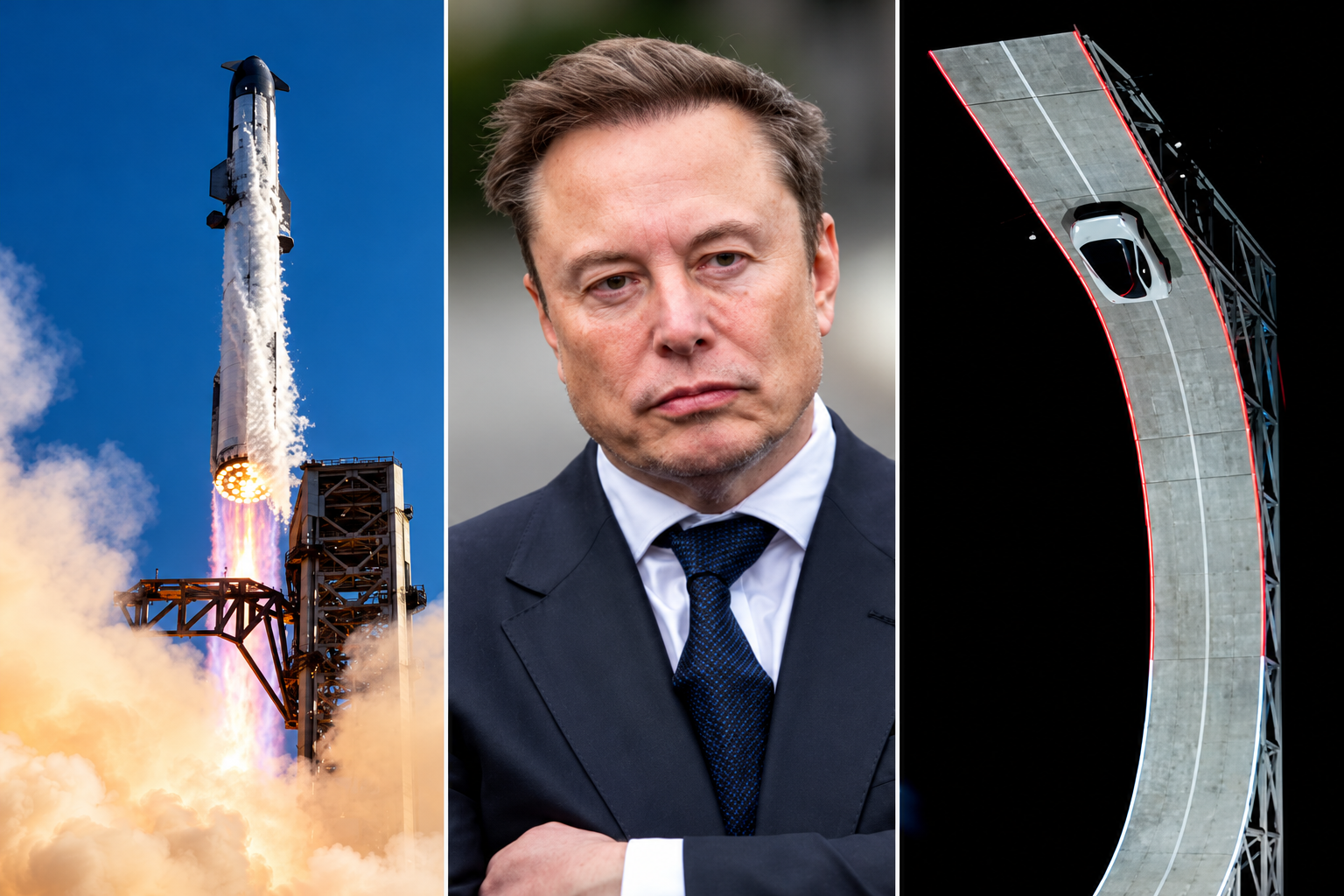
Elon Musk has engineered ties between Tesla TSLA 3.41%increase; up pointing triangle and SpaceX SPCX 7.79%increase; up pointing triangle that are hard to break, and now he wants to fuse them together permanently.
Musk has run both Tesla and SpaceX concurrently over the past two decades, using a schedule that dictated which days he spent focused on each business.
The companies have often shared resources and personnel, signaling their close ties. Last year, SpaceX looked into creating a spacesuit for Tesla’s humanoid robot Optimus, a person familiar with the matter said. Tesla last week showed off its new Roadster, a vehicle featuring SpaceX rocket thrusters that it hopes to soon bring to market.
And in recent months, Musk has repositioned both companies by expanding beyond their core operations toward a shared mission centered on artificial intelligence.
The world’s richest man on Tuesday signaled his interest in tying up SpaceX and Tesla, marking what would be the biggest corporate merger of all time. Because he serves as chief executive of SpaceX and Tesla, Musk said committees of independent directors at both companies are evaluating a possible deal, adding that a transaction might not come to fruition.
The committees will likely evaluate, with lawyers and bankers, how each company would fare in a potential deal and how a deal might best be structured. They then present their conclusions to their respective boards, who typically vote on whether to proceed.
“It’s an odd Kabuki dance where two groups of people are talking and I can’t be in the conversation,” Musk told SpaceX investors on Tuesday in response to an analyst’s question about a potential deal.
For Musk, the merger supports his vision of a world full of autonomous cars, humanoid robots and weekly rocket launches, as well as the data centers and satellites required to keep the whole thing running.
Some investors and analysts said they expect a transaction would be structured as an all-stock deal, with SpaceX potentially paying a modest premium for Tesla shares.
SpaceX, which has a market value of about $2 trillion, said it is seeing sharp growth in revenue across its businesses, which include operating data centers, launching rockets and operating satellite networks such as the internet service Starlink. Tesla is valued at about $1.5 trillion and is expanding its operations beyond its automotive and energy business. Shares in both companies traded higher following the news Tuesday.
Musk’s substantial ownership stakes in both companies, along with voting control at SpaceX, has enabled him to set the deal in motion. Analysts and investors said the deal will probably face regulatory scrutiny internationally, though some see Musk’s close relationship with the Trump administration as an asset to getting approval.
Blurred lines
The companies haven’t said which directors are on the special committees evaluating a potential deal. Several SpaceX and Tesla board members have either personal or business ties to Musk. And like Musk, venture capitalist Ira Ehrenpreis sits on both boards.
In a filing this week, Tesla outlined millions of dollars in business agreements with SpaceX and its subsidiaries last year, including $143 million in car sales to SpaceX, $3.3 million in advertising that it bought on the social-media platform X and $430 million in revenue from the sale of Megapack batteries for SpaceX’s data centers.
The companies also split the cost of resources including the use of Musk’s SpaceX jet and the bill for his personal security, which he runs through a private company.
Employees at both companies routinely move between companies to work on special projects, and some executives have dual roles, including Charles Kuehmann, vice president of materials engineering at both SpaceX and Tesla, and Ashok Elluswamy, the vice president of AI software at Tesla who runs a joint venture with SpaceX called Digital Optimus.
Over the years, Musk has launched new startups within his empire, including brain-implant company Neuralink, underground-tunnel developer the Boring Company and xAI, the AI startup that merged with SpaceX in February.
It is that AI business that Musk thinks can serve a market worth tens of trillions of dollars, justifying the need for a merger.
The business case goes like this: Tesla is developing robotaxis and robots, which it calls “physical AI.” SpaceX is working on the back end of physical AI: the data-center capacity and internet connection required for those robotaxis and robots to operate continuously.
“I don’t see what the value of Tesla is if it’s not merged with SpaceX,” said investment adviser Ross Gerber, a former Tesla bull turned critic invested in both companies. “If they don’t merge, the brains of everything that runs Tesla is owned by another company.”
On top of it all, both companies face constraints on the supply chains they need to make this world a reality, particularly when it comes to chips. To address this, Musk earlier this year announced a joint venture between Tesla, SpaceX and Intel to design and manufacture chips in Texas. “The most epic chip-building exercise by far,” he has said.
Musk at the wheel
For Musk, a merger would also solve two problems: demands on his attention and his lack of control at Tesla.
Tesla for years was Musk’s only public company, a status that came with greater scrutiny. There, Musk reports to a public board, as well as individual investors who make up around 30% of Tesla’s voting power, according to FactSet.
The question of Musk’s attention became a particular focus for investors and the board in recent years after he acquired Twitter in 2022 and launched xAI in 2023, and again in 2025 as he spent time in Washington, D.C., running the Department of Government Efficiency in the early months of President Trump’s second term.
As Tesla’s car business suffered in 2025, Musk threatened to take his AI ambitions outside the company if he wasn’t granted 25% voting control. Last November, Tesla shareholders approved a new pay package for Musk, which created a path for him to vastly expand his stake.
As of Sept. 30, Musk owned a roughly 20% stake in Tesla, according to the company’s proxy filing.
The SpaceX IPO gave Musk a different path. When SpaceX went public in June, the deal’s structure enabled him to have more than 80% voting power at the company—so much that he can’t be fired and decisions can’t be made without his support.
If SpaceX acquires Tesla, he will likely stay in control.

A survey of people with at least $1 million in investable assets found women in their 30s and 40s look nothing like older generations in terms of assets and priorities

Paine Schwartz joins BERO as a new investor as the year-old company seeks to triple sales.