


How Lego Is Getting More Adults to Tinker With Their Toy Bricks
LEGO is expanding beyond its traditional audience by tapping into people’s passions, from flowers and gaming to music and Formula One, through creative products, immersive experiences and social-first marketing. The strategy is paying off, with revenue rising 21% in the first half of the year to a record DKK 41.9 billion.

 5 min

Lego’s core audience was once young boys. But in recent years the world’s largest toy maker has expanded its reach, attracting more adults, teenagers and girls.
At the center of this expansion has been a strategy to tap in to people’s interests and hobbies—the Danish toy-brick maker calls them “passions”—many of which cross demographic boundaries. These include personal preoccupations like bonsai trees and golden retrievers, celebrities such as pop star Olivia Rodrigo and mega events like Formula One and the World Cup.
That has led to new types of building sets, including more sophisticated models that adults can display on their coffee tables, and a shift in marketing strategy, with Lego pouring money into experiences and social-media skits aimed at fans.
For Formula One watchers, Lego built life-size, drivable replicas of the teams’ race cars, which drivers took around the circuit at last year’s Miami Grand Prix. To reach gaming fans, Lego in August showed up at the Gamescom trade event in Cologne, Germany, with a giant Minecraft Lego chicken that visitors could sit on.
“We go not just for the people who are there, but because the types of things that we create become big social-media engagement,” says Julia Goldin, Lego’s chief product and marketing officer.
The strategy has helped spur growth. In the first half of this year, privately held Lego’s revenue rose 21% from the year-earlier period to a record 41.9 billion Danish kroner ($6.27 billion), while net profit climbed 32% to 8.6 billion kroner.
The Wall Street Journal spoke to Goldin about how the company researches people’s passions and turns these into products and marketing campaigns.
Edited excerpts follow:
Beyond demographics
WSJ: Adults have become a big focus for Lego—what’s behind that?
JULIA GOLDIN: Over the past eight years, we said there was a bigger opportunity with adults—not just people who are super-high-affinity fans, but people who maybe built a long time ago or had never built with bricks before—by giving them the things they would love to build now.
We approached adults from a passion-point perspective from the very beginning. We said we need to understand what they’re into. So, we looked at men, we looked at women, we looked at what their big interests were, what types of things they like to collect, what types of things they wanted to display in their rooms, etc. Now you can put Gustav Klimt’s “The Kiss” on your wall, or if you’re into animals, some cute floating sea otters. And then gamers who love a bit of ’80s or ’90s nostalgia can build and display the Game Boy.
We are now seeing strong growth with both adults and kids.
WSJ: How do you find out about people’s interests?
GOLDIN: We do a lot of trend-seeking and social listening. We look at viewership of various programs, behaviors, what’s trending socially. Then we dive quite deeply into these interests through primary research, ethnographic research and interviews.
AI has helped us ramp this up. There are tools where you can ask, with the right prompts: “People who are passionate about F1, what are they talking about? What are the latest conversations on Reddit?”
WSJ: Lego flower bouquets and trees are among the company’s most popular sets. How and when did that come about?
GOLDIN: When we started to talk seriously about adults, we could see that some people were into gardening and flowers. We launched the first flower bouquet in 2021 and completely underestimated how successful it would be. We started with the 18-plus age group because we thought that’s where the sweet spot is. But we realized that younger girls, especially teens, really love to build Lego flowers so we expanded the range.
You might think botanicals are women and F1 cars are men. But that’s why we talk about interests and not just gender and demographics. Yes, botanicals have a huge following among women and teenage girls, but bonsai trees are one of the top 10 products for men and teen boys. Speed Champions F1 cars show up in the top 10 for teen girls. I thought most of Olivia Rodrigo’s following would be girls, but my 16-year-old son asked me for two sets because his friends are massively into her.
That’s why we don’t market to a demographic. You can never be assumptive about how that breaks down in terms of gender.
WSJ: How has this shift in thinking changed your products and marketing?
GOLDIN: F1 is a great example. In the past, we might have started with a partnership with a team and a great Lego car for people to build. But we understand that it’s a multigenerational passion and different people are in it for different things. Some people love the cars, some collect, some follow the actual sport of racing, and some have tremendous passion for the drivers and their teams. That is why our F1 portfolio spans everything from Duplo [bricks] for toddlers to detailed display models and driver helmets for older fans.
But then we ask ourselves: What can we do to go beyond the products, to give fans Lego brand experiences that they would never expect? That’s why in Miami last year we built 10 full-size Lego Formula One cars, with nearly 400,000 bricks in each, and put all 20 drivers in them for the driver’s parade. Everyone assumed they were static models, until the drivers started lapping the circuit and we saw a tremendous amount of excitement and social media buzz. We generated something like two, three billion views.
WSJ: Do social-media views of a marketing event translate into significant sales of Lego sets tied to these campaigns?
GOLDIN: Yeah, of course. We don’t share data, but I can tell you they’re some of our most successful products.
‘She Built That’
WSJ: You say Lego is growing particularly strongly with girls. What is driving that?
GOLDIN: We used to have only Lego Friends as the one big line for girls, and some Disney products like “Frozen.” But rather than looking at toy categories that were selling to girls, like dolls, and trying to replicate that, we really worked to understand what girls are into.
We realized girls are super into pets and creatures, nature and flowers, socializing and music. We expanded significantly around those areas with botanicals, animals, K-pop and Olivia Rodrigo.
We also did the “She Built That” campaign, very strongly saying girls can build just as well as boys. I’ve heard for a long time that “girls don’t like to build because moms don’t,” but that’s just not true. We’re showing them things they really love to build, and that’s why it works.
WSJ: Why do you think adults, teens and others are turning to Lego more nowadays?
GOLDIN: There’s an overriding sense of lack of purposefulness and this drowning in content that you’re constantly being fed. Three hours have gone by and you’ve just been scrolling through feeds of reels. People are getting really tired. They want to actively do something that’s more purposeful and lasting.
When they build with Lego sets, they say they feel creative. They want to do something they can be proud of—where they can say, “Wow, I did this.”
 Copyright 2020, Dow Jones & Company, Inc. All Rights Reserved Worldwide. LEARN MORE



A Sydney couple has paid $15.5 million for the Grand Penthouse at Marquee’s $285 million La Belle Residences beachfront development which is nearing completion at Palm Beach, eclipsing the record for an off-the-plan apartment sale on the southern Gold Coast. The sprawling single level 640 sqm beachfront residence, with sweeping views of the Gold Coast …
Continue reading “$15.5m La Belle Penthouse eclipses southern Gold Coast record”

On the owner’s deck, a 20-metre swimming pool incorporates Feadship’s patented ContraWave technology and extends indoors as a suspended, glass-bottomed infinity pool.
A new study models a potential $80.6 billion lift in Australian GDP after a decade, as national testing shows a decline in Year 10 digital literacy.
2 min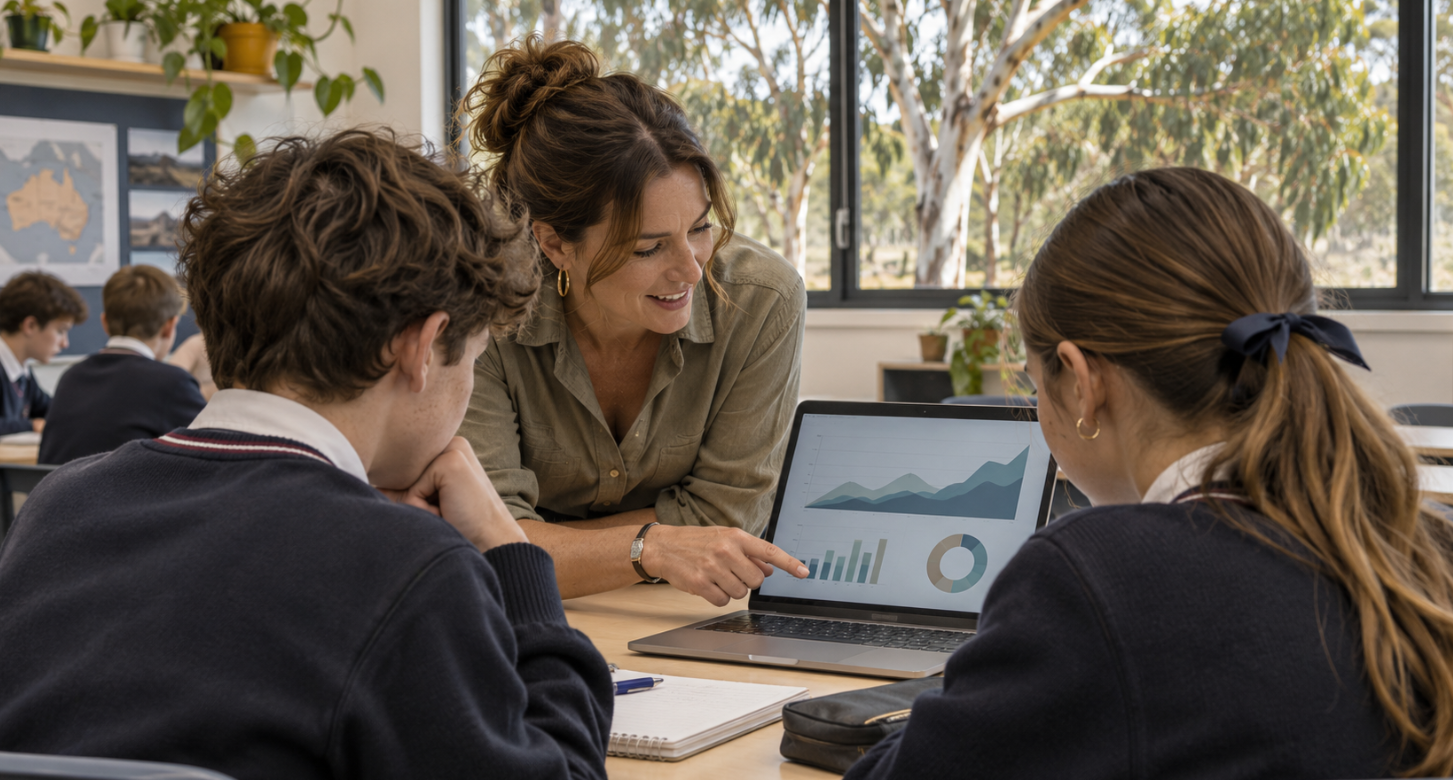
Australia trails Singapore and Malta in a new Commonwealth index, while national testing shows fewer than four in 10 Year 10 students meet the standard for digital literacy.
Australia has ranked third among 56 Commonwealth countries for youth AI readiness, with researchers estimating that artificial intelligence could lift the level of Australian GDP by $80.6 billion after a decade under their middle scenario.
The Ayre Think Tank released the index at the Commonwealth Heads of Government Meeting in Antigua and Barbuda. Australia scored 71 out of 100, behind Singapore on 77.6 and Malta on 75. The United Kingdom followed closely on 70.8, with Canada fifth on 70.2. Only 15 countries reached the study’s benchmark of 53.
What the $80.6 billion figure measures
The researchers applied International Monetary Fund estimates for broad groups of economies to Australia’s 2025 GDP. The resulting scenarios put the potential lift in Australian GDP after 10 years at between $40.9 billion and $120.3 billion, with $80.6 billion representing the midpoint.
The figures describe how much larger the economy could be at the end of the period under each scenario. They represent a change in the level of GDP in year 10.
Digital literacy falls as schools roll out AI tools
Australia scored 8.7 out of 10 for access to technology and 7.5 for digital, data, media and AI capability. Separate national testing found that 37 per cent of Year 10 students met the proficient standard for information and communications technology literacy in 2025, down from 46 per cent in 2022. About one in 10 students reported receiving substantial teaching on AI-related tasks. National assessment results
The report points to two state initiatives aimed at building those skills. Queensland began rolling out an AI education platform in state schools in 2026, while Victoria introduced free specialist training for workers looking to develop AI skills or move into related roles.
The index draws on 1,128 sources and examines the conditions facing people aged 15 to 29, including access to technology, education and pathways into work. Australia had usable data for 76 of the 102 indicators used in the rankings. The researchers found too little comparable evidence to score an eighth area covering critical judgement and people’s ability to exercise control over AI systems.
Professor C. Justin Robinson, campus principal of the University of the West Indies’ Five Islands Campus, said young people should be equipped to question and improve AI tools and supported in building alternatives suited to their needs.
The report calls for affordable access to technology, more practical education and stronger links between training, employment and entrepreneurship. It also urges governments and educators to support AI tools suited to local languages and give young people ways to challenge automated decisions.

Singapore’s Formula 1 weekend has always looked different. Held beneath floodlights on the Marina Bay Street Circuit, the race transforms the city into a nocturnal spectacle of speed, heat and saturated colour. It is this distinctive atmosphere — and one of Singapore’s most important natural symbols — that has shaped IWC Schaffhausen’s latest motorsport-inspired watch. …
Continue reading “IWC’s purple Formula 1 chronograph pays tribute to Singapore after dark”
On the owner’s deck, a 20-metre swimming pool incorporates Feadship’s patented ContraWave technology and extends indoors as a suspended, glass-bottomed infinity pool.