





The Most Stylish Guys You Know Are Getting Everything Tailored (Even T-shirts)
Think tailoring is just for suits? Hardly: Getting casual items tweaked to fit perfectly might be the ultimate style hack.

 3 min
3 min
SOMETIMES WHEN Evan Glick, who’s cursed with a “fairly short torso,” tries on T-shirts in stores, “it just looks like I’m wearing a summer dress.” But if you spotted the 32-year-old Brooklyn data engineer in the street, you’d never mistake his top for a frock. Last summer, he began taking his tees and shorts to get tailored at his local wash and fold, for $15 a pop. Now everything fits snugly. “I don’t have to be disappointed with a too-big shirt,” he said.
A tailored T-shirt? Many men reserve tailoring for pricey, special-occasion suits. But in-the-know guys are turning to local, low-key tailors—with no hint of stuffy Savile Row—to tweak casual items from jeans to swim trunks. The move neatly solves an oft-ignored problem: Most off-the-rack clothes fit guys imperfectly. Men can easily look disheveled in too-long jeans or toothpick-armed in polos with gaping sleeves.
It’s Not Just for the Rich
For less money and effort than you’d think, a smarter-looking wardrobe awaits. Getting casual items tailored is “like a cheat code,” said Jermaine Crawford, 30, a Los Angeles actor who has all his jeans nipped at the waist because he finds belts bothersome.
But even men less hostile to belts are seeking help. Over the past two years, Yamil Vaca, founder of Manhattan’s Flatiron Tailor Shop, has noticed more guys bringing in casual items. Most commonly submitted for surgery: tees that billow, jeans that puddle on the floor and running shirts that run too roomy. Men with ill-fitting pajama sets also want his services. Vaca’s prices start at around $20 for abbreviating a pair of pants, and often just one, 5-minute fitting is required. Usually the tweaked item can be picked up in 24 hours if needed (the industry standard is about 3-7 days).
Less? Yep. More? Sure.
In many cases, said Vaca, guys with newly rigorous workout regimens want more-fitted clothes to better flaunt their physiques. But a good tailor can magically make items bigger too. A client of New York personal stylist Turner Allen recently lamented the too-short sleeves on a chore jacket. So a clever tailor stole fabric from its back to lengthen them. Allen doubts most men “would know you could do that, but it made all the difference.”
One particularly egregious issue any good tailor can easily fix? Overly roomy shirt sleeves that make men’s arms look spindly. L.A. style consultant Andrew Weitz said he’s always having clients’ sleeves narrowed. Recently, one guy’s knit polo with short but cavernous sleeves got the treatment and suddenly he looked like he’d been eating his spinach. “Now it hugs his biceps and gives him that [defined] arm shape,” said Weitz.
Weitz also finds swim shorts often disappoint off-the-rack. “A lot of guys feel they’re a little too long,” he said, so they’ll get an inch or so snipped off. Flashing more thigh gives the illusion of longer, leaner legs, he said. Swim shorts should hit at about mid-quad, he added.
L.A. stylist Ugo Mozie seeks out tailoring to alter garments more dramatically. He once tasked his tailor with transforming a women’s trench-coat dress into a men’s jacket. For less statuesque clients, he has shirts, T-shirts and tank tops all hewed to right below the waist. That length works on shorter guys, said Mozie—it suggests “a longer frame.”
How to Ease In Gradually
Whether you’re after a startling chop or a subtle tweak, you’ll need a trustworthy tailor. Beyond checking reviews, experts suggest first testing a new tailor with an easy alteration, like hemming some pants. “If you’re happy with that, you can take a shirt to be slimmed, and then a blazer to be altered,” said Allen. “Start small and go from there.” Snip by snip, let the style upgrade begin.
They Got What Tailored?
Insiders report on some of the unlikely items that men have been getting tweaked
1. Sportswear
Billowing running tops and Lycra cycling tights in need of extra tightening are a common sight at Manhattan’s Flatiron Tailor Shop, said Vaca.
2. Swimwear
Lots of guys find swim trunks a little too long off-the-rack, said Weitz. He’ll ask a tailor to slice about an inch off. Result: Guys’ legs look longer (and they can sun their thighs).
3. Casual slacks
Mozie’s hot tip to achieve a louche pant cut? Buy a wide-leg pair in a slightly too-big size and get the waist and upper thigh taken in. This, he said, achieves the ideal relaxed shape.
4. Pajamas
Vaca has been seeing more sleepwear drift into his shop—especially pajama sets that men want either lengthened or trimmed. “I guess guys want to feel stylish right before they go to bed.”
5. Workwear
Allen recently had the sleeves of a chore jacket lengthened for a long-limbed client whose wrists were awkwardly sticking out.
6. Knitwear
When a knit polo or a sweater is too voluminous, Weitz will have a tailor “take in the body.” Even if it’s meant to be an oversize design, too many guys end up swimming in their sweaters, he said. It shouldn’t wear you, he added.
 Copyright 2020, Dow Jones & Company, Inc. All Rights Reserved Worldwide. LEARN MORE




From making unpopular decisions to learning when to listen, leaders from five businesses reveal what nobody prepared them for — and how running a company has challenged their expectations.

Technology and semiconductor shares fell sharply as investors questioned the debt financing the AI infrastructure boom and confronted higher rates and Chinese competition.

Elon Musk is exploring a potential merger between Tesla and SpaceX, a deal that could reshape the future of AI, robotics, autonomous vehicles and space technology. With a combined valuation potentially reaching $3.5 trillion, the move could bring Musk’s vision of an interconnected technology ecosystem closer to reality, although a deal remains uncertain.
5 min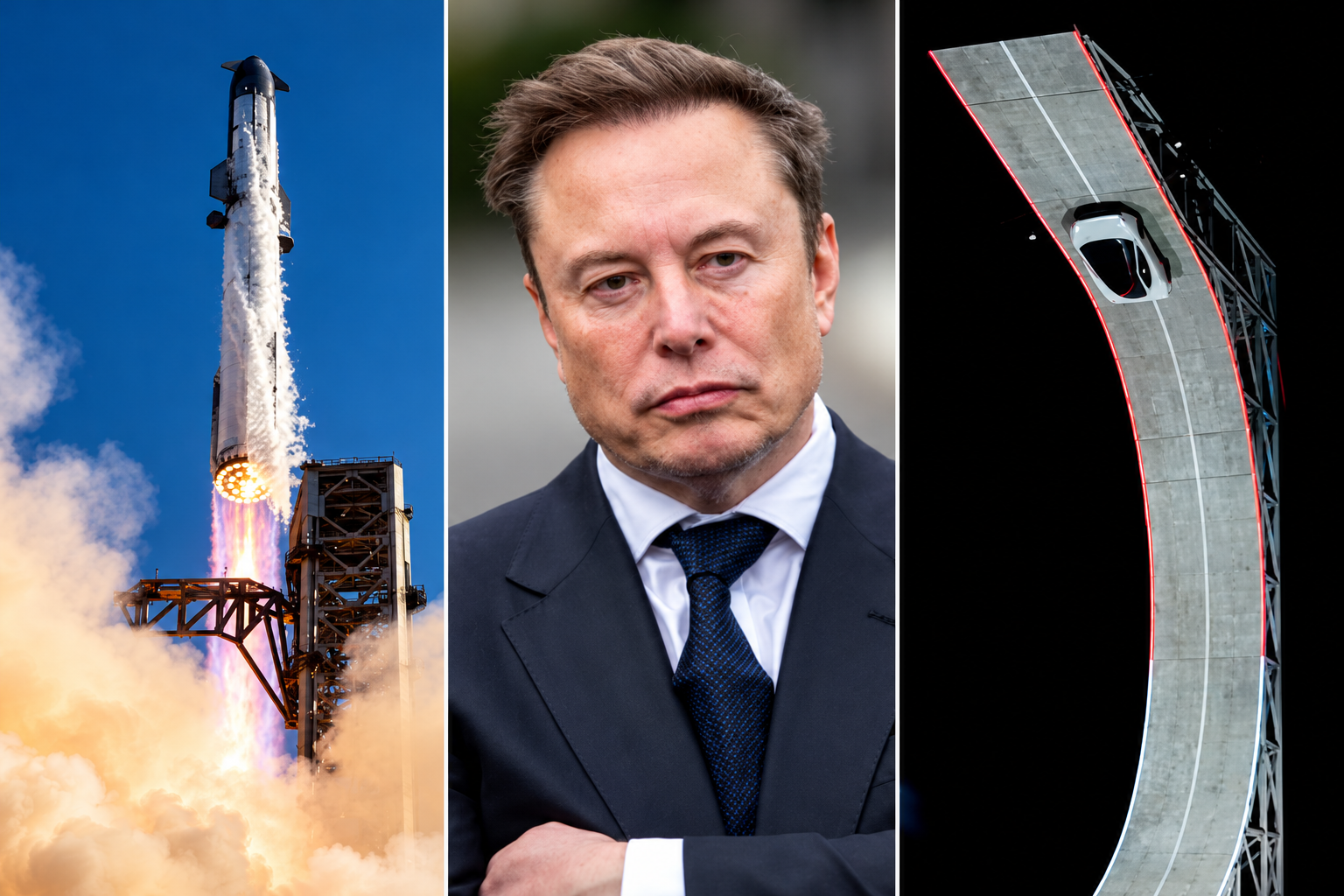
Elon Musk has engineered ties between Tesla TSLA 3.41%increase; up pointing triangle and SpaceX SPCX 7.79%increase; up pointing triangle that are hard to break, and now he wants to fuse them together permanently.
Musk has run both Tesla and SpaceX concurrently over the past two decades, using a schedule that dictated which days he spent focused on each business.
The companies have often shared resources and personnel, signaling their close ties. Last year, SpaceX looked into creating a spacesuit for Tesla’s humanoid robot Optimus, a person familiar with the matter said. Tesla last week showed off its new Roadster, a vehicle featuring SpaceX rocket thrusters that it hopes to soon bring to market.
And in recent months, Musk has repositioned both companies by expanding beyond their core operations toward a shared mission centered on artificial intelligence.
The world’s richest man on Tuesday signaled his interest in tying up SpaceX and Tesla, marking what would be the biggest corporate merger of all time. Because he serves as chief executive of SpaceX and Tesla, Musk said committees of independent directors at both companies are evaluating a possible deal, adding that a transaction might not come to fruition.
The committees will likely evaluate, with lawyers and bankers, how each company would fare in a potential deal and how a deal might best be structured. They then present their conclusions to their respective boards, who typically vote on whether to proceed.
“It’s an odd Kabuki dance where two groups of people are talking and I can’t be in the conversation,” Musk told SpaceX investors on Tuesday in response to an analyst’s question about a potential deal.
For Musk, the merger supports his vision of a world full of autonomous cars, humanoid robots and weekly rocket launches, as well as the data centers and satellites required to keep the whole thing running.
Some investors and analysts said they expect a transaction would be structured as an all-stock deal, with SpaceX potentially paying a modest premium for Tesla shares.
SpaceX, which has a market value of about $2 trillion, said it is seeing sharp growth in revenue across its businesses, which include operating data centers, launching rockets and operating satellite networks such as the internet service Starlink. Tesla is valued at about $1.5 trillion and is expanding its operations beyond its automotive and energy business. Shares in both companies traded higher following the news Tuesday.
Musk’s substantial ownership stakes in both companies, along with voting control at SpaceX, has enabled him to set the deal in motion. Analysts and investors said the deal will probably face regulatory scrutiny internationally, though some see Musk’s close relationship with the Trump administration as an asset to getting approval.
Blurred lines
The companies haven’t said which directors are on the special committees evaluating a potential deal. Several SpaceX and Tesla board members have either personal or business ties to Musk. And like Musk, venture capitalist Ira Ehrenpreis sits on both boards.
In a filing this week, Tesla outlined millions of dollars in business agreements with SpaceX and its subsidiaries last year, including $143 million in car sales to SpaceX, $3.3 million in advertising that it bought on the social-media platform X and $430 million in revenue from the sale of Megapack batteries for SpaceX’s data centers.
The companies also split the cost of resources including the use of Musk’s SpaceX jet and the bill for his personal security, which he runs through a private company.
Employees at both companies routinely move between companies to work on special projects, and some executives have dual roles, including Charles Kuehmann, vice president of materials engineering at both SpaceX and Tesla, and Ashok Elluswamy, the vice president of AI software at Tesla who runs a joint venture with SpaceX called Digital Optimus.
Over the years, Musk has launched new startups within his empire, including brain-implant company Neuralink, underground-tunnel developer the Boring Company and xAI, the AI startup that merged with SpaceX in February.
It is that AI business that Musk thinks can serve a market worth tens of trillions of dollars, justifying the need for a merger.
The business case goes like this: Tesla is developing robotaxis and robots, which it calls “physical AI.” SpaceX is working on the back end of physical AI: the data-center capacity and internet connection required for those robotaxis and robots to operate continuously.
“I don’t see what the value of Tesla is if it’s not merged with SpaceX,” said investment adviser Ross Gerber, a former Tesla bull turned critic invested in both companies. “If they don’t merge, the brains of everything that runs Tesla is owned by another company.”
On top of it all, both companies face constraints on the supply chains they need to make this world a reality, particularly when it comes to chips. To address this, Musk earlier this year announced a joint venture between Tesla, SpaceX and Intel to design and manufacture chips in Texas. “The most epic chip-building exercise by far,” he has said.
Musk at the wheel
For Musk, a merger would also solve two problems: demands on his attention and his lack of control at Tesla.
Tesla for years was Musk’s only public company, a status that came with greater scrutiny. There, Musk reports to a public board, as well as individual investors who make up around 30% of Tesla’s voting power, according to FactSet.
The question of Musk’s attention became a particular focus for investors and the board in recent years after he acquired Twitter in 2022 and launched xAI in 2023, and again in 2025 as he spent time in Washington, D.C., running the Department of Government Efficiency in the early months of President Trump’s second term.
As Tesla’s car business suffered in 2025, Musk threatened to take his AI ambitions outside the company if he wasn’t granted 25% voting control. Last November, Tesla shareholders approved a new pay package for Musk, which created a path for him to vastly expand his stake.
As of Sept. 30, Musk owned a roughly 20% stake in Tesla, according to the company’s proxy filing.
The SpaceX IPO gave Musk a different path. When SpaceX went public in June, the deal’s structure enabled him to have more than 80% voting power at the company—so much that he can’t be fired and decisions can’t be made without his support.
If SpaceX acquires Tesla, he will likely stay in control.

Hand-built in Melbourne and limited to just 10 cars a year, the Zeigler/Bailey Z/B 4.4 is reshaping what a modern collector car can be.

Parts for iPhones to cost more owing to surging demand from AI companies.


