American Finance Has Left Europe In the Dust. The Tables Aren’t Turning.
Restoring the competitiveness of European banks and asset managers can’t be achieved by tweaking regulations

 3 min
3 min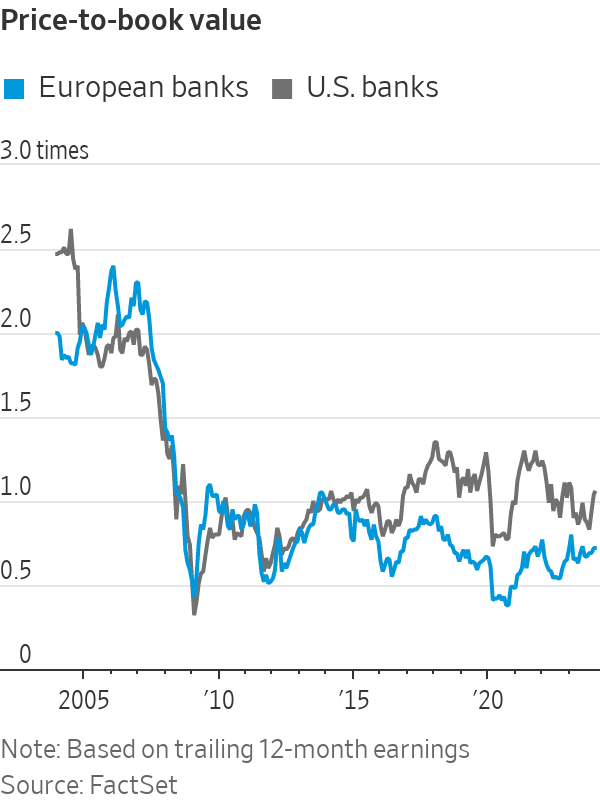
After a decade and a half of seeing the U.S. economy pull ahead thanks to its outsize technology sector, European politicians are desperate to fight back in emerging industries such as green energy. One challenge they face is that America also keeps pulling ahead in the business of financing the investments required.
On Thursday, Luxembourg for Finance—a public-private partnership that seeks to promote the financial industry in the low-tax city state—published a report detailing the different ways in which European banks and asset managers might regain an edge relative to U.S. and Asian peers.
This is part of an effort by officials across the European Union to give firms a break. “Old economy” industries such as car manufacturing face rising competition from China and higher energy costs since Russia invaded Ukraine. The U.S. Inflation Reduction Act also has drawn investment across the Atlantic. Last year, the European Commission tasked former Italian prime ministers Mario Draghi and Enrico Letta with drafting a report on European competitiveness.
Luxembourg for Finance Chief Executive Nicolas Mackel echoes a common refrain: “Europe can take the lead in financial services when we eliminate fragmentation.” His report points out that the return on equity of European banks has bounced back in recent years. But it also showcases the gulf that has opened up relative to U.S. financial firms.
European lenders’ return on equity is now around 8%, compared with 12% across the Atlantic and 10% in Asia, in part as a result of stricter regulations following the 2008 banking crisis. Most European banks trade below book value on the stock market, having returned a negative 14% to investors since the April 2009 trough. Large American banks trade above book value and have gained 113%.
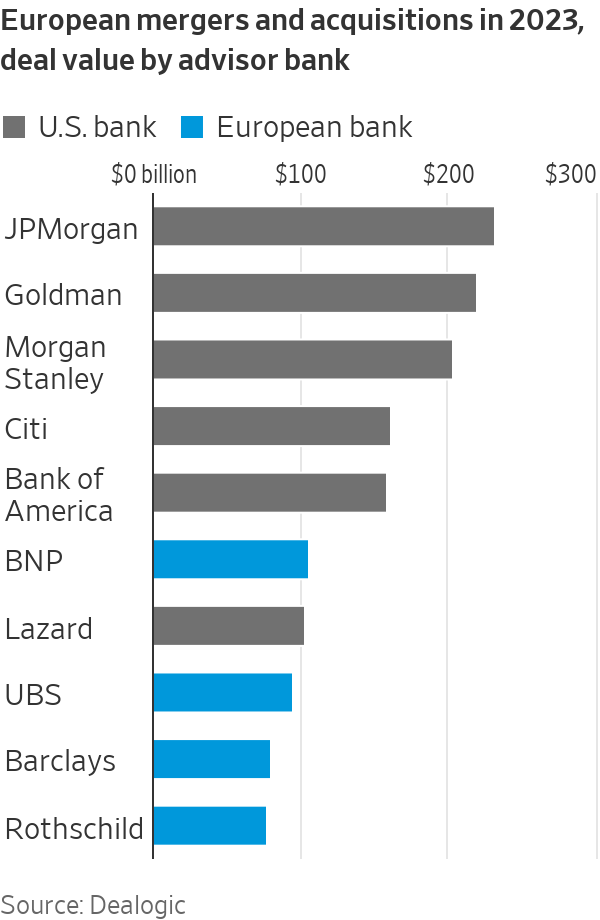
In services particularly exposed to international competition, American banks dominate in Europe too: In 2023, they took the top five positions for mergers and acquisitions deals, Dealogic data shows, with France’s BNP Paribas coming in sixth, and the top six spots for issuing equity.
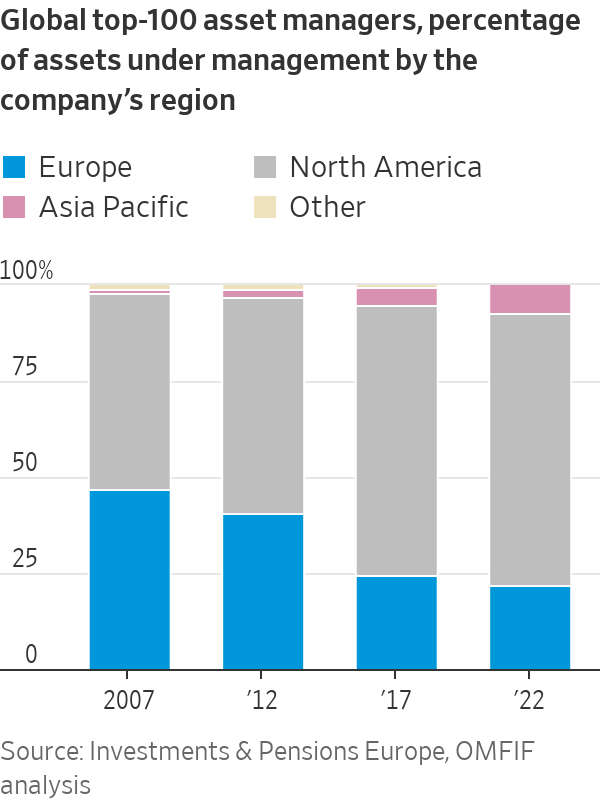
And this isn’t just about banks. In 2007, top European and U.S. asset managers roughly split the global market between them. By 2022, European fund managers had just 22% of total assets under supervision, with only France’s Amundi playing in the big leagues. This reflects their failure to jump on the train of low-fee passive investment as effectively as U.S. giants such as Vanguard and BlackRock. Ironically, the latter’s dominance in exchange-traded funds resulted from its acquisition of iShares from Britain’s Barclays in 2009.
European officials are taking some useful steps. They admitted in 2022 that a directive aimed at harmonising securities markets, known as Mifid 2, has done more harm than good, and have agreed to amend it. New EU-wide savings products give pensioners greater choice, and might help address the lack of sophistication that characterises European individual investors relative to Americans used to managing 401(k)s. Stringent constraints on what asset managers can offer are being relaxed, and the rules governing sustainable finance—where Europe has an edge—are being clarified.
Meanwhile, the fallout from last year’s Silicon Valley Bank debacle will bring U.S. regulation closer to Europe’s.
Such rule changes might narrow the gap, as investors have recognised: The stock-market discount at which European lenders trade compared with American ones has shrunk over the past three years. But it is hard to see the tables fundamentally turning. In the digital era, economies of scale are even more powerful. The European Union comprises many countries with different languages, whose firms and investors have local financial relationships and strong home biases. The obstacles to eliminating fragmentation are huge.
If Europe can’t compete with America’s private financial muscle, it is doubly problematic that its efforts to mobilize industrial investment through the public sector have been meek compared with the U.S. Inflation Reduction Act. Promoting more sustainability-minded funds isn’t an adequate fix.
 Copyright 2020, Dow Jones & Company, Inc. All Rights Reserved Worldwide. LEARN MORE





BNW Developments has established a Sydney presence, joining Arada and Sobha Realty among the growing number of UAE developers pursuing Australian buyers and development opportunities.

Australian shares fell on Thursday as Wall Street weakness, rising oil and persistent rate concerns weighed on most of the market. The S&P/ASX 200 declined 0.72 per cent to 8,702. The All Ordinaries lost 0.66 per cent to finish at 8,897. Mining stocks were hit particularly hard, while real estate also dragged on the index. …
Continue reading “ASX falls 0.7 per cent as miners and property stocks retreat”

 2 min
2 minAustralian shares fell on Thursday as Wall Street weakness, rising oil and persistent rate concerns weighed on most of the market.
The S&P/ASX 200 declined 0.72 per cent to 8,702. The All Ordinaries lost 0.66 per cent to finish at 8,897. Mining stocks were hit particularly hard, while real estate also dragged on the index.
Energy was the notable exception, gaining more than one per cent as Brent crude traded above US$103 a barrel. Oil had moved higher amid uncertainty surrounding potential US diesel-export restrictions and broader geopolitical supply risks. The move supported energy producers but renewed concern about inflation inputs across transport and the wider economy.
Gold shares were weak even as spot bullion remained historically elevated. The All Ordinaries Gold index fell about 2.25 per cent, showing that equity performance can diverge from the commodity because of valuation, currency, operating and company-specific factors.
Zip was a prominent loser, falling 11.38 per cent after the company reported short sales after the previous close. Nine Entertainment also weakened after UBS analysts warned of near-term revenue challenges associated with its advertising-supported subscription tier.
Premier Investments led larger winners despite caution about the retail environment. Breville, in which Premier owns a significant stake, also appeared among leading movers. In the broader ASX 300 screen, Myer gained 11.43 per cent and MAAS Group rose 7.93 per cent, while Lotus Resources fell 10.53 per cent. These percentage moves should be checked against company announcements and trading liquidity before attributing causes.
The Australian dollar was broadly flat at US70.38 cents. Spot gold was around US$4,280 an ounce, Brent crude approximately US$103.08 a barrel and iron ore near US$96.90 a tonne late in the session.
The rate outlook remains the central domestic catalyst. Labour-market weakness has not eliminated the possibility of an RBA increase next week, leaving banks, listed property and other rate-sensitive sectors exposed to changing expectations.
Market dashboard
S&P/ASX 200: 8,702, down 0.72 per cent.
All Ordinaries: 8,897, down 0.66 per cent.
Best sector: Energy, up more than one per cent.
Weakest areas: Real estate and materials were the major drags; confirm final sector percentages before publication.
Material winner: Premier Investments led the large-company gainers. Confirm its final closing move from the ASX before publication.
Material loser: Zip, down 11.38 per cent.
ASX 300 percentage leader: Myer, up 11.43 per cent.
ASX 300 percentage laggard: Zip, down 11.38 per cent.
AUD/USD: Approximately US$0.7038, broadly flat.

On October 2, acclaimed chef Dan Arnold will host an exclusive evening, unveiling a Michelin-inspired menu in a rare masterclass of food, storytelling and flavour.

Records keep falling in 2025 as harbourfront, beachfront and blue-chip estates crowd the top of the market.