





Are Pearls Too Old-Fashioned for 2024? Not if You Wear Them This Way.
The classic pearl necklace was a Barbara Bush staple. New designs, and freshwater varieties, are making the look anything but stuffy.

 3 min
3 min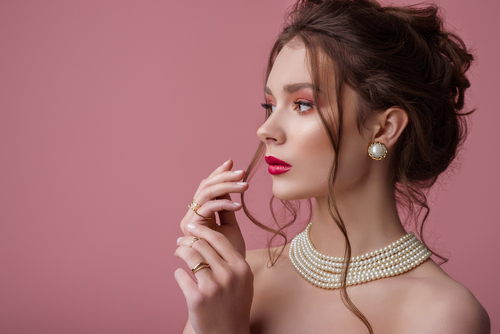
It takes marine pearls about two years to develop in their shells. It took Bonnie Fraker about two seconds to declare why she wouldn’t wear them around her neck. “A pearl necklace makes me look dated,” said the retired Manhattan teacher, 73. “Perhaps there’s such a thing as ‘too classic.’”
Still, pearls persist. Ask Leigh Batnick Plessner, chief creative officer at Catbird, the Brooklyn fine-jewellery label that counts Meghan Markle and Taylor Swift as fans. “Pearl necklaces are still in demand,” she said. “But the appetite has really changed from traditional necklaces to more surprising takes.”
The traditional strand has long signified opulence and power. Julius Caesar commanded that only aristocrats could wear the gem during his reign. Figures as diverse as Marie Antoinette and the Yongzheng Emperor of the Qing Dynasty coveted the strands. In the 20th century, stateswomen like Queen Elizabeth II and Mamie Eisenhower wore them to official events. By the 1980s, punks paired pearls with their spiked collars to subvert yuppie style. Still, pearls were most associated with formidable women like Margaret Thatcher and Barbara Bush, along with the preppy clique in the 1988 film “Heathers.”
Instead of stringing the old-school pearl necklace along, many of today’s brands make pearl chokers, sometimes with smaller “baby” pearls that sit at mid-neck instead of resting on clavicles. Dior’s Couture runway in Paris featured pearl chokers; California designer Sophie Buhai makes hers with a black satin-cotton cord and single central pearl. The style “looks more modern,” said June Ambrose, a creative director and costume designer for stars like Mary J. Blige and Ciara. Ambrose wears pearls from both thrift stores and Valentino.
Also popular: freshwater pearls, uniquely shaped instead of uniformly round. Once considered the messy stepsister of marine pearls, the gems look like smeared blobs of ivory glitter—in other words, odd enough for the fashion world to swoon. “I like the individualism of them,” said Simone Rocha, the designer whose recent couture line for Jean Paul Gaultier included gowns that subbed in strands of iridescent baroque pearls for typical satin straps. Off the runway, some women flaunt them as a way to look sophisticated but not uptight. “They feel a bit more rebellious,” noted Taffy Msipa, 28, an interior creative director in Bath, U.K., who wears her Monica Vinader freshwater pearl necklace with slouchy suits. “I like how they let me look elegant, but elegant in my way.”
There’s also the “half-and-half,” an industry term for a necklace that’s half pearls and half something else. On the recent Cannes red carpet, actress Michelle Yeoh, 69, wore Mikimoto’s version with cultured pearls on one side and a spray of diamonds, inlaid with white gold, on the other.
After Yeoh’s appearance, Instagram fans lauded the look with comments like “Not your grandmama’s pearls!” and “weird but amazing,” while searches for “half and half necklace” spiked 30% on Google Trends. A gold-and-pearl version of the style popped up in the “Mean Girls” movie remake, while pop star Dua Lipa has sported Vivienne Westwood’s pearl-and-rhinestone collar.
Don’t want to part with your classic strand of marine pearls? Dallas-based therapist Katie-Beth Crumrine, 23, had her vintage double-loop necklace shortened to a collar-length one. She wears it with linen Madewell tops and jeans. “It helps elevate my look,” she said. “But isn’t snobby.” Mixing pearls with casual pieces like ceramic beads can also keep them current. Meanwhile, the creative director Ambrose tells famous clientele to pair pearls with minimal makeup, because “a pearl necklace and a bare face is chic; a pearl necklace, a full face of makeup and a red lip is really trying.”
Some modern pearl looks eschew necks altogether. See the pearl-strung friendship bracelets by Vinader, and Rocha’s irregular pearl earrings. (“I like it when they’re kind of odd and not matching,” she said.) According to jewellery designer Plessner, varied interpretations have become the point. “Pearls are kind of like a Rorschach test for your fashion personality,” she explained. “You want to be weird or ethereal or powerful? There’s a pearl look for that.”
Are Pearls Too Old-Fashioned? We Asked NYC Women.
“They’re more classy than old-fashioned. They remind me of Jackie O. But would I wear them right now? No. Maybe when I’m older.” —Brittany Bower, 29, Hospital Nurse
“No! I wear my pearls a lot, actually. I really like the weight of how they feel on my neck.” —Tara Rubin, 69, Casting Director
“Yes, but in a nice way. They remind me of my great grandmother, Nita. She used to wear them. She used to let me play with them, which I loved. I don’t think I’d wear them now, though.” —Sydney Willard, 29, Barista
“Nothing’s old-fashioned in 2024! I would wear pearls today, but, like, with a sweatshirt.” —Asia Harris, 24, Student
“I used to think they were kind of old-fashioned, like in ‘The Crown’, and then I started wearing them to the gym with a black workout tank. I have never felt more like a cool New York girl.” —Tara Strahl, 42, Library Consultant
 Copyright 2020, Dow Jones & Company, Inc. All Rights Reserved Worldwide. LEARN MORE





From making unpopular decisions to learning when to listen, leaders from five businesses reveal what nobody prepared them for — and how running a company has challenged their expectations.

Technology and semiconductor shares fell sharply as investors questioned the debt financing the AI infrastructure boom and confronted higher rates and Chinese competition.
Elon Musk is exploring a potential merger between Tesla and SpaceX, a deal that could reshape the future of AI, robotics, autonomous vehicles and space technology. With a combined valuation potentially reaching $3.5 trillion, the move could bring Musk’s vision of an interconnected technology ecosystem closer to reality, although a deal remains uncertain.
5 min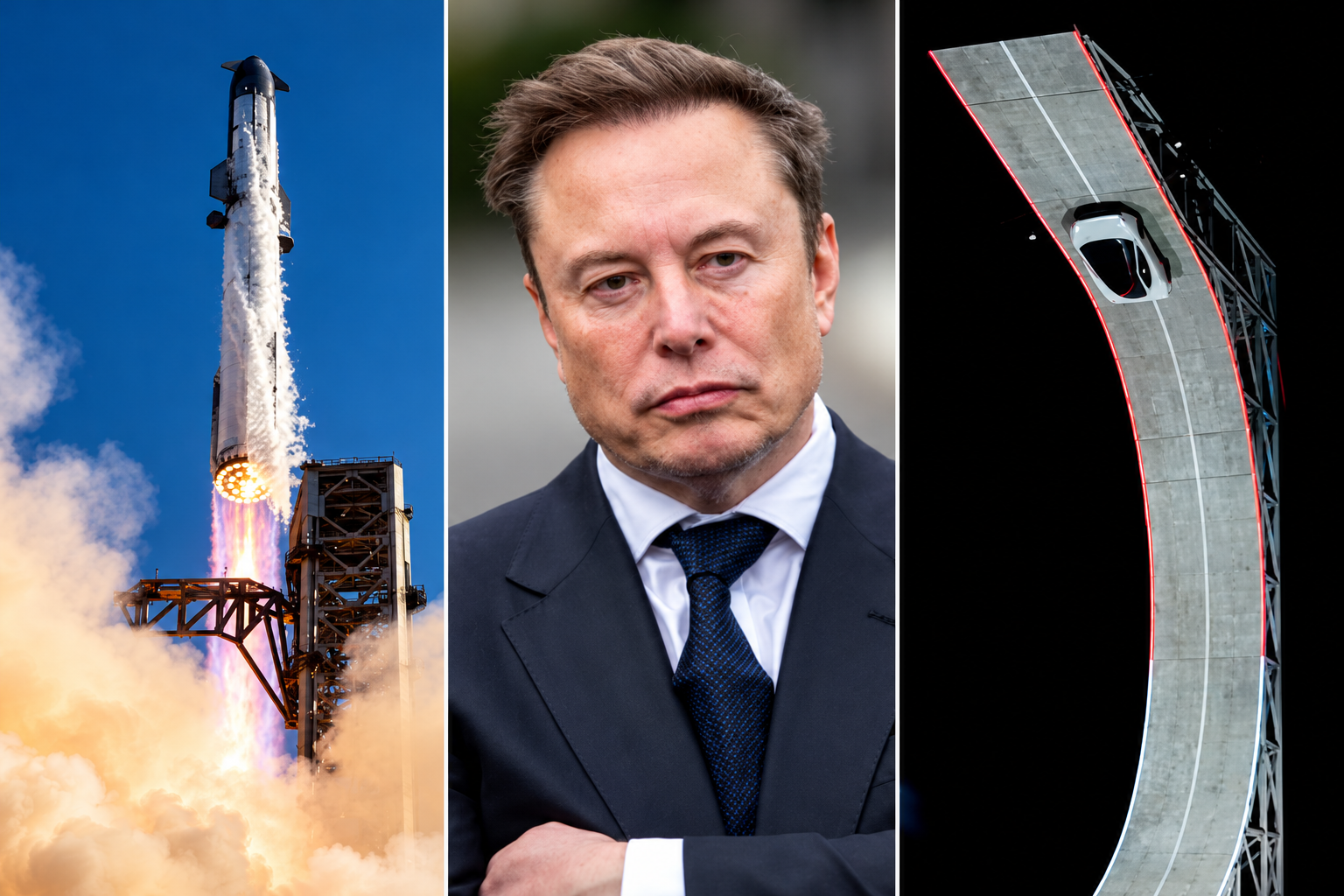
Elon Musk has engineered ties between Tesla TSLA 3.41%increase; up pointing triangle and SpaceX SPCX 7.79%increase; up pointing triangle that are hard to break, and now he wants to fuse them together permanently.
Musk has run both Tesla and SpaceX concurrently over the past two decades, using a schedule that dictated which days he spent focused on each business.
The companies have often shared resources and personnel, signaling their close ties. Last year, SpaceX looked into creating a spacesuit for Tesla’s humanoid robot Optimus, a person familiar with the matter said. Tesla last week showed off its new Roadster, a vehicle featuring SpaceX rocket thrusters that it hopes to soon bring to market.
And in recent months, Musk has repositioned both companies by expanding beyond their core operations toward a shared mission centered on artificial intelligence.
The world’s richest man on Tuesday signaled his interest in tying up SpaceX and Tesla, marking what would be the biggest corporate merger of all time. Because he serves as chief executive of SpaceX and Tesla, Musk said committees of independent directors at both companies are evaluating a possible deal, adding that a transaction might not come to fruition.
The committees will likely evaluate, with lawyers and bankers, how each company would fare in a potential deal and how a deal might best be structured. They then present their conclusions to their respective boards, who typically vote on whether to proceed.
“It’s an odd Kabuki dance where two groups of people are talking and I can’t be in the conversation,” Musk told SpaceX investors on Tuesday in response to an analyst’s question about a potential deal.
For Musk, the merger supports his vision of a world full of autonomous cars, humanoid robots and weekly rocket launches, as well as the data centers and satellites required to keep the whole thing running.
Some investors and analysts said they expect a transaction would be structured as an all-stock deal, with SpaceX potentially paying a modest premium for Tesla shares.
SpaceX, which has a market value of about $2 trillion, said it is seeing sharp growth in revenue across its businesses, which include operating data centers, launching rockets and operating satellite networks such as the internet service Starlink. Tesla is valued at about $1.5 trillion and is expanding its operations beyond its automotive and energy business. Shares in both companies traded higher following the news Tuesday.
Musk’s substantial ownership stakes in both companies, along with voting control at SpaceX, has enabled him to set the deal in motion. Analysts and investors said the deal will probably face regulatory scrutiny internationally, though some see Musk’s close relationship with the Trump administration as an asset to getting approval.
Blurred lines
The companies haven’t said which directors are on the special committees evaluating a potential deal. Several SpaceX and Tesla board members have either personal or business ties to Musk. And like Musk, venture capitalist Ira Ehrenpreis sits on both boards.
In a filing this week, Tesla outlined millions of dollars in business agreements with SpaceX and its subsidiaries last year, including $143 million in car sales to SpaceX, $3.3 million in advertising that it bought on the social-media platform X and $430 million in revenue from the sale of Megapack batteries for SpaceX’s data centers.
The companies also split the cost of resources including the use of Musk’s SpaceX jet and the bill for his personal security, which he runs through a private company.
Employees at both companies routinely move between companies to work on special projects, and some executives have dual roles, including Charles Kuehmann, vice president of materials engineering at both SpaceX and Tesla, and Ashok Elluswamy, the vice president of AI software at Tesla who runs a joint venture with SpaceX called Digital Optimus.
Over the years, Musk has launched new startups within his empire, including brain-implant company Neuralink, underground-tunnel developer the Boring Company and xAI, the AI startup that merged with SpaceX in February.
It is that AI business that Musk thinks can serve a market worth tens of trillions of dollars, justifying the need for a merger.
The business case goes like this: Tesla is developing robotaxis and robots, which it calls “physical AI.” SpaceX is working on the back end of physical AI: the data-center capacity and internet connection required for those robotaxis and robots to operate continuously.
“I don’t see what the value of Tesla is if it’s not merged with SpaceX,” said investment adviser Ross Gerber, a former Tesla bull turned critic invested in both companies. “If they don’t merge, the brains of everything that runs Tesla is owned by another company.”
On top of it all, both companies face constraints on the supply chains they need to make this world a reality, particularly when it comes to chips. To address this, Musk earlier this year announced a joint venture between Tesla, SpaceX and Intel to design and manufacture chips in Texas. “The most epic chip-building exercise by far,” he has said.
Musk at the wheel
For Musk, a merger would also solve two problems: demands on his attention and his lack of control at Tesla.
Tesla for years was Musk’s only public company, a status that came with greater scrutiny. There, Musk reports to a public board, as well as individual investors who make up around 30% of Tesla’s voting power, according to FactSet.
The question of Musk’s attention became a particular focus for investors and the board in recent years after he acquired Twitter in 2022 and launched xAI in 2023, and again in 2025 as he spent time in Washington, D.C., running the Department of Government Efficiency in the early months of President Trump’s second term.
As Tesla’s car business suffered in 2025, Musk threatened to take his AI ambitions outside the company if he wasn’t granted 25% voting control. Last November, Tesla shareholders approved a new pay package for Musk, which created a path for him to vastly expand his stake.
As of Sept. 30, Musk owned a roughly 20% stake in Tesla, according to the company’s proxy filing.
The SpaceX IPO gave Musk a different path. When SpaceX went public in June, the deal’s structure enabled him to have more than 80% voting power at the company—so much that he can’t be fired and decisions can’t be made without his support.
If SpaceX acquires Tesla, he will likely stay in control.
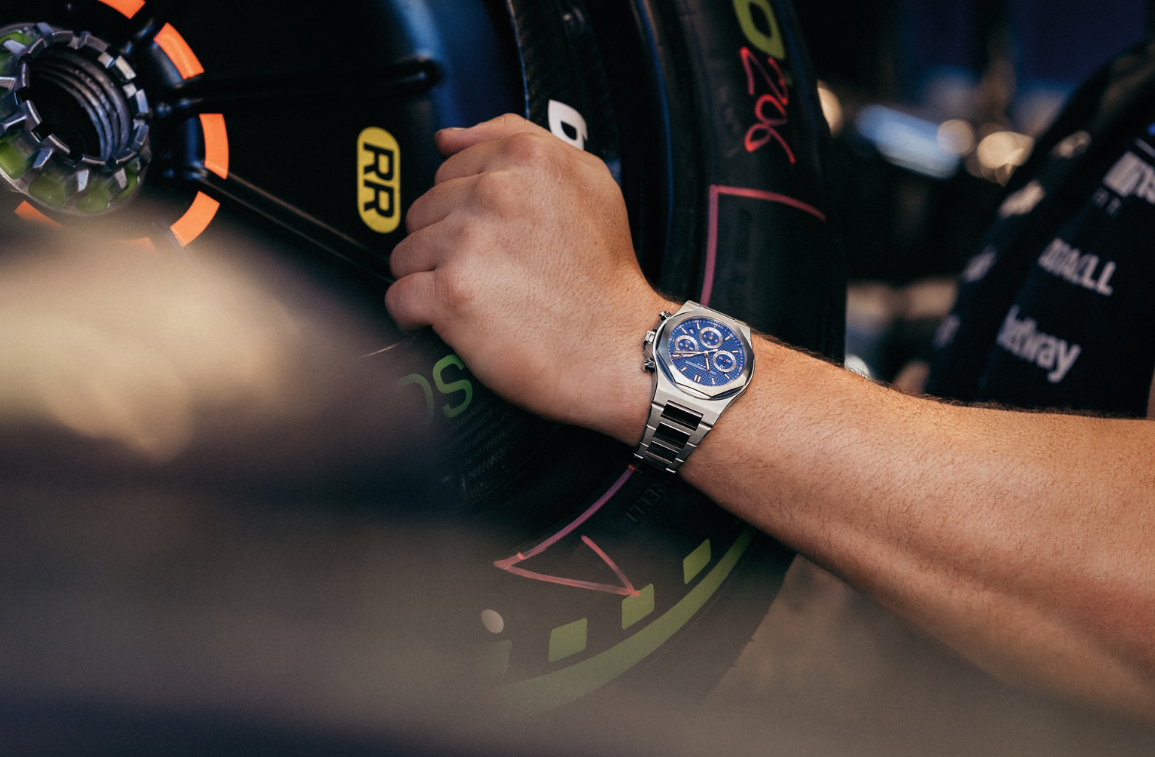
The Swiss watchmaker’s first collaboration with Atlassian Williams F1 Team produces two sporting Laureato models inspired by the team’s 2026 racing car.

From citrus oils to warming spices, the classic G&T is being reimagined at home as a more thoughtful, seasonal ritual for modern entertaining.


