Is ‘Rizz’ the Secret to Getting Ahead at Work?
Whether you call it charisma, charm or magnetism, some people seem like naturals. Good news: It can be learned.

 4 min
4 min
Great leaders have it. Gen Z has a new word for it. Can the rest of us learn it?
Charisma—or rizz , as current teenage slang has anointed it—can feel like an ephemeral gift some are just born with. The chosen among us network and chitchat, exuding warmth as they effortlessly hold court. Then there’s everyone else, agonising over exclamation points in email drafts and internally replaying that joke they made in the meeting, wondering if it hit.
“Well, this is awkward,” Mike Rizzo, the head of a community for marketing operations professionals, says of rizz being crowned 2023 word of the year by the publisher of the Oxford English Dictionary. It’s so close to his last name, but so far from how he sees himself. He sometimes gets sweaty palms before hosting webinars.
Who could blame us for obsessing over charisma, or lack thereof? It can lubricate social interactions, win us friends, and score promotions . It’s also possible to cultivate, assures Charles Duhigg, the author of a book about people he dubs super communicators.
At its heart, charisma isn’t about some grand performance. It’s a state we elicit in other people, Duhigg says. It’s about fostering connection and making our conversation partners feel they’re the charming—or interesting or funny—ones.
The key is to ask deeper, though not prying, questions that invite meaningful and revealing responses, Duhigg says. And match the other person’s vibes. Maybe they want to talk about emotions, the joy they felt watching their kid graduate from high school last weekend. Or maybe they’re just after straight-up logistics and want you to quickly tell them exactly how the team is going to turn around that presentation by tomorrow.
You might be hired into a company for your skill set, Duhigg says, but your ability to communicate and earn people’s trust propels you up the ladder: “That is leadership.”
Approachable and relatable
In reporting this column, I was surprised to hear many executives and professionals I find breezily confident and pleasantly chatty confess it wasn’t something that came naturally. They had to work on it.
Dave MacLennan , who served as chief executive of agricultural giant Cargill for nearly a decade, started by leaning into a nickname: DMac, first bestowed upon him in a C-suite meeting where half the executives were named Dave.
He liked the informality of it. The further he ascended up the corporate hierarchy, the more he strove to be approachable and relatable.
Employees “need a reason to follow you,” he says. “One of the reasons they’re going to follow you is that they feel they know you.”
He makes a point to remember the details and dates of people’s lives, such as colleagues’ birthdays. After making his acquaintance, in a meeting years ago at The Wall Street Journal’s offices, I was shocked to receive an email from his address months later. Subject line: You , a heading so compelling I still recall it. He went on to say he remembered I was due with my first child any day now and just wanted to say good luck.
“So many people say, ‘Oh, I don’t have a good memory for that,’” he says. Prioritise remembering, making notes on your phone if you need, he says.
Now a board member and an executive coach, MacLennan sent hundreds of handwritten notes during his tenure. He’d reach out to midlevel managers who’d just gotten a promotion, or engineers who showed him around meat-processing plants. He’d pen words of thanks or congratulations. And he’d address the envelopes himself.
“Your handwriting is a very personal thing about you,” he says. “Think about it. Twenty seconds. It makes such an impact.”
Everyone’s important
Doling out your charm selectively will backfire, says Carla Harris , a Morgan Stanley executive. She chats up the woman cleaning the office, the receptionist at her doctor’s, the guy waiting alongside her for the elevator.
“Don’t be confused,” she tells young bankers. Executive assistants are often the most powerful people in the building, and you never know how someone can help—or hurt—you down the line.
Harris once spent a year mentoring a junior worker in another department, not expecting anything in return. One day, Harris randomly mentioned she faced an uphill battle in meeting with a new client. Oh!, the 24-year-old said. Turns out, the client was her friend. She made the call right there, setting up Harris for a work win.
In the office, stop staring at your phone, Harris advises, and notice the people around you. Ask for their names. Push yourself to start a conversation with three random people every day.
Charisma for introverts
You can’t will yourself to be a bubbly extrovert, but you can find your own brand of charisma, says Vanessa Van Edwards, a communications trainer and author of a book about charismatic communication.
For introverted clients, she recommends using nonverbal cues. A slow triple nod shows people you’re listening. Placing your hands in the steeple position, together and facing up, denotes that you’re calm and present.
Try coming up with one question you’re known for. Not a canned, hokey ice-breaker, but something casual and simple that reflects your actual interests. One of her clients, a bookish executive struggling with uncomfortable, halting starts to his meetings, began kicking things off by asking “Reading anything good?”
Embracing your stumbles
Charisma starts with confidence. It’s not that captivating people don’t occasionally mispronounce a word or spill their coffee, says Henna Pryor, who wrote a book about embracing awkwardness at work. They just have a faster comeback rate than the rest of us. They call out the stumble instead of trying to hide it, make a small joke, and move on.
Being perfectly polished all the time is not only exhausting, it’s impossible. We know this, which is why appearing flawless can come off as fake. We like people who seem human, Pryor says.
Our most admired colleagues are often the ones who are good at their jobs and can laugh at themselves too, who occasionally trip or flub just like us.
“It creates this little moment of warmth,” she says, “that we actually find almost like a relief.”
 Copyright 2020, Dow Jones & Company, Inc. All Rights Reserved Worldwide. LEARN MORE




From making unpopular decisions to learning when to listen, leaders from five businesses reveal what nobody prepared them for — and how running a company has challenged their expectations.

Technology and semiconductor shares fell sharply as investors questioned the debt financing the AI infrastructure boom and confronted higher rates and Chinese competition.

Elon Musk is exploring a potential merger between Tesla and SpaceX, a deal that could reshape the future of AI, robotics, autonomous vehicles and space technology. With a combined valuation potentially reaching $3.5 trillion, the move could bring Musk’s vision of an interconnected technology ecosystem closer to reality, although a deal remains uncertain.
5 min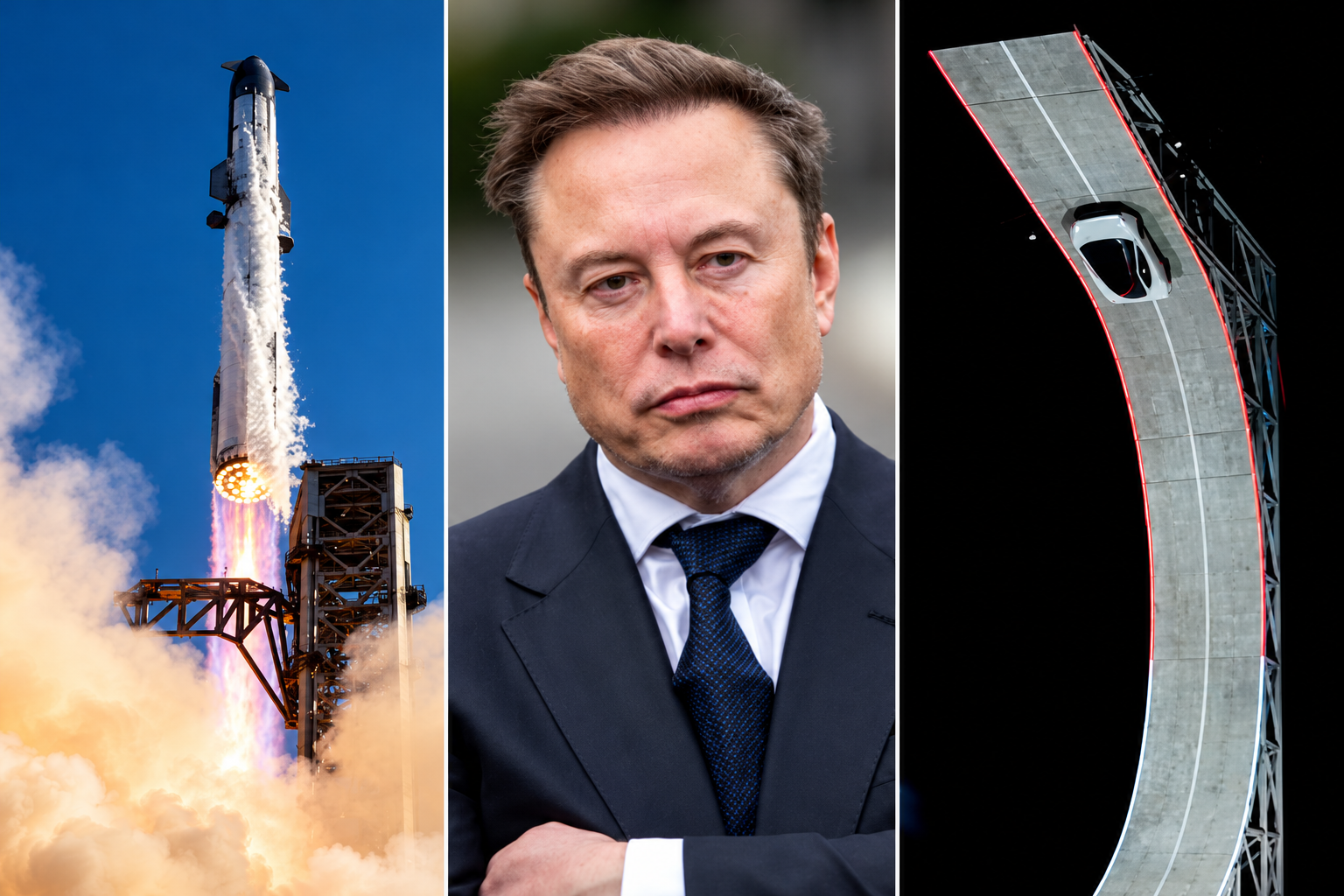
Elon Musk has engineered ties between Tesla TSLA 3.41%increase; up pointing triangle and SpaceX SPCX 7.79%increase; up pointing triangle that are hard to break, and now he wants to fuse them together permanently.
Musk has run both Tesla and SpaceX concurrently over the past two decades, using a schedule that dictated which days he spent focused on each business.
The companies have often shared resources and personnel, signaling their close ties. Last year, SpaceX looked into creating a spacesuit for Tesla’s humanoid robot Optimus, a person familiar with the matter said. Tesla last week showed off its new Roadster, a vehicle featuring SpaceX rocket thrusters that it hopes to soon bring to market.
And in recent months, Musk has repositioned both companies by expanding beyond their core operations toward a shared mission centered on artificial intelligence.
The world’s richest man on Tuesday signaled his interest in tying up SpaceX and Tesla, marking what would be the biggest corporate merger of all time. Because he serves as chief executive of SpaceX and Tesla, Musk said committees of independent directors at both companies are evaluating a possible deal, adding that a transaction might not come to fruition.
The committees will likely evaluate, with lawyers and bankers, how each company would fare in a potential deal and how a deal might best be structured. They then present their conclusions to their respective boards, who typically vote on whether to proceed.
“It’s an odd Kabuki dance where two groups of people are talking and I can’t be in the conversation,” Musk told SpaceX investors on Tuesday in response to an analyst’s question about a potential deal.
For Musk, the merger supports his vision of a world full of autonomous cars, humanoid robots and weekly rocket launches, as well as the data centers and satellites required to keep the whole thing running.
Some investors and analysts said they expect a transaction would be structured as an all-stock deal, with SpaceX potentially paying a modest premium for Tesla shares.
SpaceX, which has a market value of about $2 trillion, said it is seeing sharp growth in revenue across its businesses, which include operating data centers, launching rockets and operating satellite networks such as the internet service Starlink. Tesla is valued at about $1.5 trillion and is expanding its operations beyond its automotive and energy business. Shares in both companies traded higher following the news Tuesday.
Musk’s substantial ownership stakes in both companies, along with voting control at SpaceX, has enabled him to set the deal in motion. Analysts and investors said the deal will probably face regulatory scrutiny internationally, though some see Musk’s close relationship with the Trump administration as an asset to getting approval.
Blurred lines
The companies haven’t said which directors are on the special committees evaluating a potential deal. Several SpaceX and Tesla board members have either personal or business ties to Musk. And like Musk, venture capitalist Ira Ehrenpreis sits on both boards.
In a filing this week, Tesla outlined millions of dollars in business agreements with SpaceX and its subsidiaries last year, including $143 million in car sales to SpaceX, $3.3 million in advertising that it bought on the social-media platform X and $430 million in revenue from the sale of Megapack batteries for SpaceX’s data centers.
The companies also split the cost of resources including the use of Musk’s SpaceX jet and the bill for his personal security, which he runs through a private company.
Employees at both companies routinely move between companies to work on special projects, and some executives have dual roles, including Charles Kuehmann, vice president of materials engineering at both SpaceX and Tesla, and Ashok Elluswamy, the vice president of AI software at Tesla who runs a joint venture with SpaceX called Digital Optimus.
Over the years, Musk has launched new startups within his empire, including brain-implant company Neuralink, underground-tunnel developer the Boring Company and xAI, the AI startup that merged with SpaceX in February.
It is that AI business that Musk thinks can serve a market worth tens of trillions of dollars, justifying the need for a merger.
The business case goes like this: Tesla is developing robotaxis and robots, which it calls “physical AI.” SpaceX is working on the back end of physical AI: the data-center capacity and internet connection required for those robotaxis and robots to operate continuously.
“I don’t see what the value of Tesla is if it’s not merged with SpaceX,” said investment adviser Ross Gerber, a former Tesla bull turned critic invested in both companies. “If they don’t merge, the brains of everything that runs Tesla is owned by another company.”
On top of it all, both companies face constraints on the supply chains they need to make this world a reality, particularly when it comes to chips. To address this, Musk earlier this year announced a joint venture between Tesla, SpaceX and Intel to design and manufacture chips in Texas. “The most epic chip-building exercise by far,” he has said.
Musk at the wheel
For Musk, a merger would also solve two problems: demands on his attention and his lack of control at Tesla.
Tesla for years was Musk’s only public company, a status that came with greater scrutiny. There, Musk reports to a public board, as well as individual investors who make up around 30% of Tesla’s voting power, according to FactSet.
The question of Musk’s attention became a particular focus for investors and the board in recent years after he acquired Twitter in 2022 and launched xAI in 2023, and again in 2025 as he spent time in Washington, D.C., running the Department of Government Efficiency in the early months of President Trump’s second term.
As Tesla’s car business suffered in 2025, Musk threatened to take his AI ambitions outside the company if he wasn’t granted 25% voting control. Last November, Tesla shareholders approved a new pay package for Musk, which created a path for him to vastly expand his stake.
As of Sept. 30, Musk owned a roughly 20% stake in Tesla, according to the company’s proxy filing.
The SpaceX IPO gave Musk a different path. When SpaceX went public in June, the deal’s structure enabled him to have more than 80% voting power at the company—so much that he can’t be fired and decisions can’t be made without his support.
If SpaceX acquires Tesla, he will likely stay in control.

The sports-car maker delivered 279,449 cars last year, down from 310,718 in 2024.

A survey of people with at least $1 million in investable assets found women in their 30s and 40s look nothing like older generations in terms of assets and priorities