Bentley’s 2023 Continental GTC Speed: A Cheetah in a Lion Suit

 4 min
4 min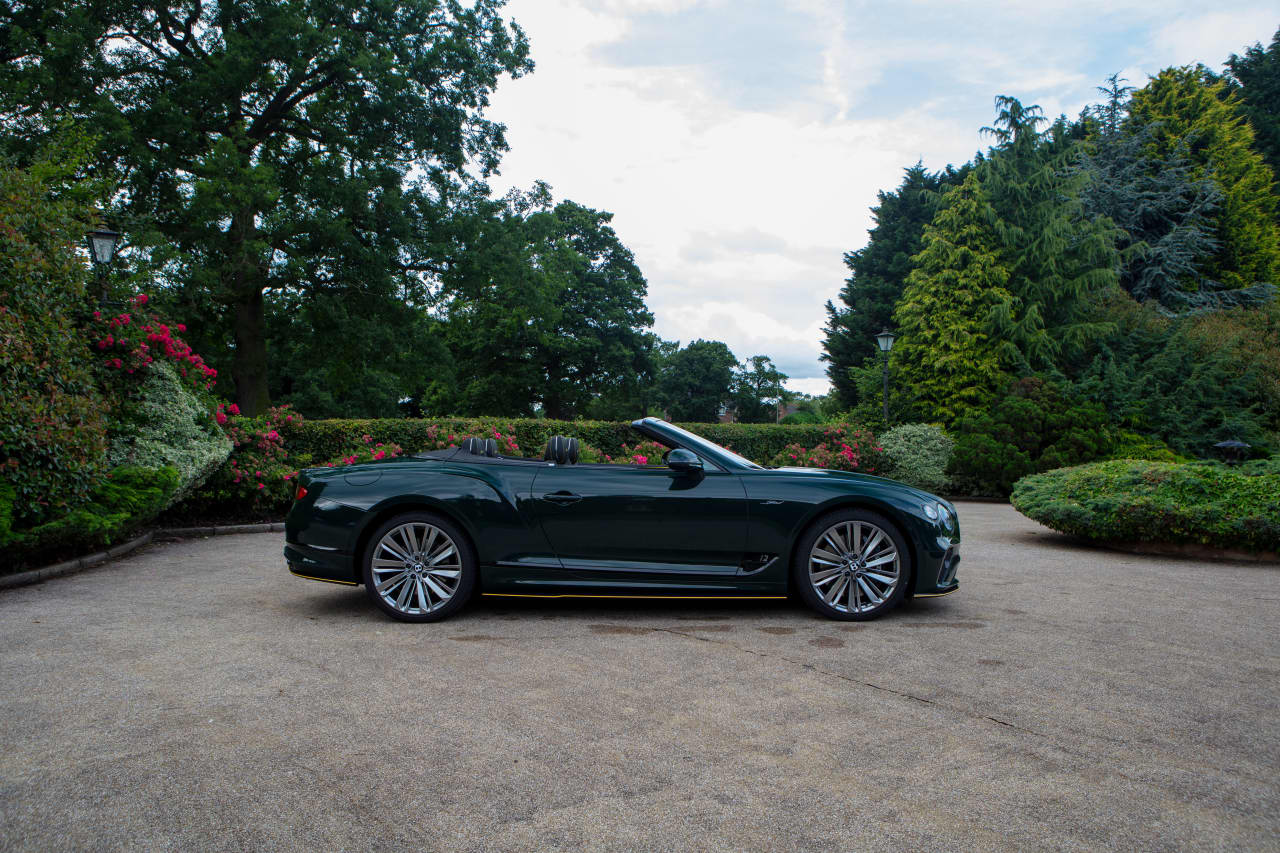
To most driving enthusiasts, there is nothing as pleasurable as a warm day tooling round country roads in a ragtop. The smell of freshly mown lawns wafts in your nostrils; the sun’s rays bathe the atmosphere in warm tones. It doesn’t get much better.
Well, actually it does. Make the car a Bentley Continental GT. Glutton for more fun? Make that Bentley a convertible, or GTC Speed. Recently, Penta had the opportunity to wend our way around Sullivan County, New York, and put a GTC Speed through its paces.
The Drive
Given its weight, at roughly 4,800 pounds, it is no surprise that it offers a solid feel and holds the road without much effort. The GTC Speed feels a bit like a land yacht, but in a good sense. That is, when you climb aboard you know right away that you’re in for a treat and that the ride could take you anywhere. And like the U.S. Navy, the GTC Speed (standard MSRP US$317,000) projects power.
The car we drove was priced at US$379,00 because it was ladled with cushy options like a custom-made sound system, so that you can share your musical faves with your neighbours; 22-inch wheels for better grip and handling; and a high-gloss fibre finish, among many other accoutrements. A king’s ransom? Yes. However, the Bentley is often measured against the Ferrari Roma or the Mercedes Benz S65 AMG. That’s rarefied competitive air. The engineers in Crewe, England, pride themselves on making sure this GTC is capable of taking you on a long drive comfortably at 90 mph as well as on a quick run to the local grocery store. Think of a cheetah in a lion’s suit, and you get the picture.
It tops out at 208 mph, in case you need a latte really quickly. We took it to 161 mph in sport mode for a few moments and enjoyed a marvellous and mischievous thrill ride, and no smokies with radar guns. For obvious reasons, what interstate we managed this is a top business secret. [But don’t try this at home!] And if you love big engines, note that next year’s models will be the last with such W-12 muscle, part of a greener Bentley, as Penta has previously reported.
The Specs
The vast hood hides a 6.0-litre, twin-turbocharged W12 engine, a monster that delivers bold power as well more graceful manoeuvring than otherwise might be expected from such a heavy car. The horsepower is rated at 650 and the car obtains gas mileage of 15 city and 22 highway. Bentley says it will do 0 to 60 mph in 3.6 seconds. Other Bentley Continental GTs are available with a V8 engine, for those more concerned about the environment.
The Bentley GTC Speed offers four driving modes: Comfort mode is a likeable combination of a speedy roadster that will take you to 100 mph, before you even notice. Call it relaxed cruising.
Move to Sport mode and the GTC does its unique version of a squat thrust, and off you go. Sport mode optimises the engine, transmission, and suspension to boost dynamic ability, and when engaged, it should be immediately felt by the driver. And the engine, normally quiescent, begins to roar through the two exhausts in the rear. The other modes are Bentley, a combo of sport and comfort, and Custom. The chassis system features rear-wheel steering, which improves cornering at speed.
Vito Racanelli
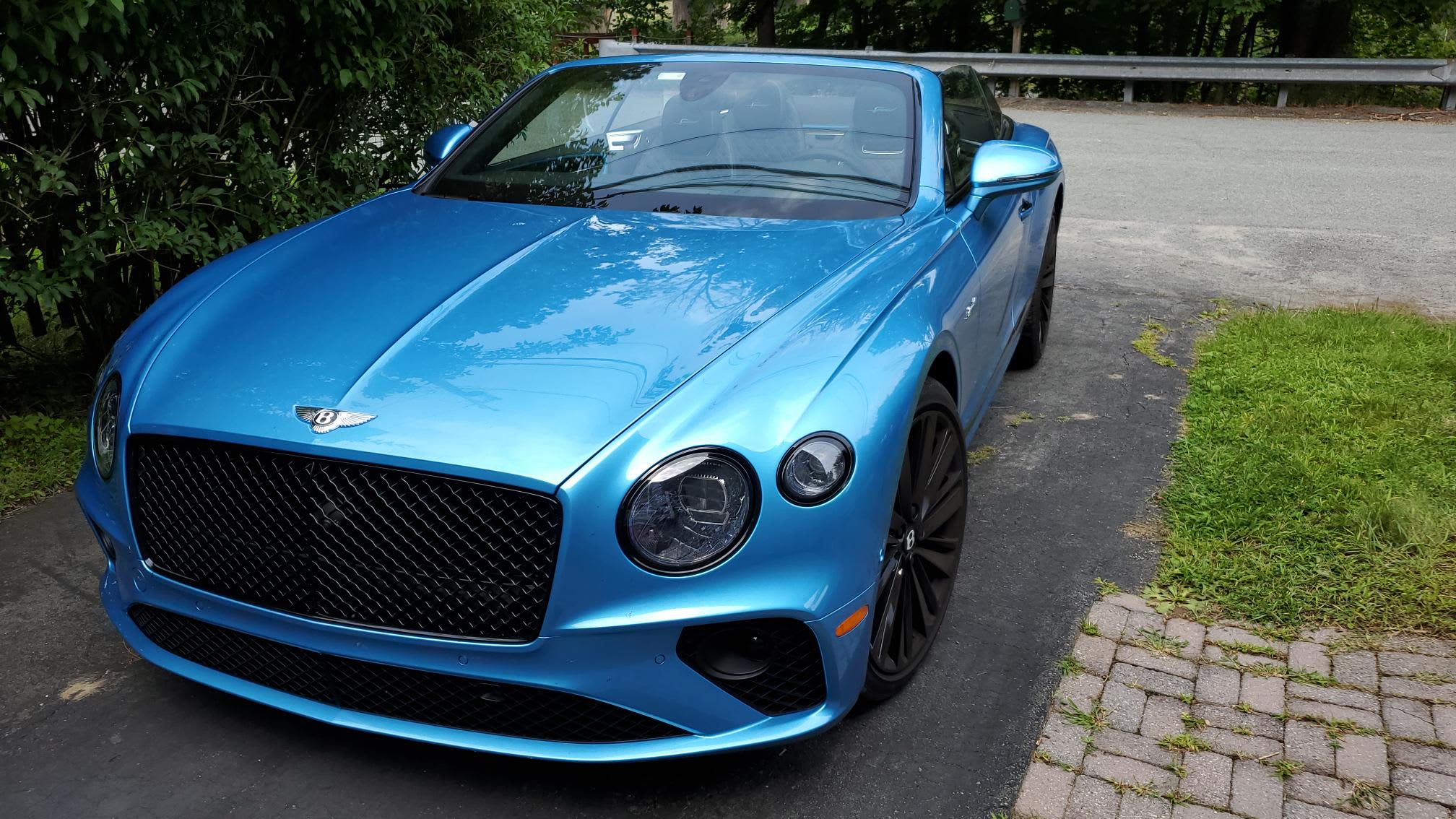
From the front, back, or side it’s a handsome car, and certainly gets its share of acknowledging looks from pedestrians. The Bentley GTC driver quickly learns to recognise the envy of onlookers and other drivers. The colour of the model we drove is called Kingfisher. We plebs would say it was a sweet shade of light blue. OK, Kingfisher, if you must. The GT hardtop is just US$259,000 before options but we recommend the GTC Speed convertible, unless you live way up North. The Bentley line up consists of a range of GT and GTC models that can be customised for engine size and hp; convertibles and hardtops; and colours, etc., among other accoutrements.
The Cabin
In a few words, luxurious and spacious for the front two passengers, but little room for others in the back seat. It’s a GT 2+2, typical in that the back seats are negligible for humans. As we tested a convertible, we shoehorned a 6-footer into the back seat with the top down, but the advantage of being able to lick your knees was somehow lost on our uncomfortable passenger. Best to keep the backseats to dogs or children.
What’s Not to Like
Penta has noted in other expensive luxury sports competitors to Bentley: the invasion of plastic in the cabin. Yes, it lightens the car’s weight, improves performance, yadda, yadda, yadda. But even a little is a lot for cars at this price level. This Bentley does have plastic here and there in the cabin. Not a lot, but really, one might expect control knobs made of gold in this price range. And the gasoline tank dial could be bigger and better placed, but you get used to it. Maybe you don’t want to see, or care, for that matter.
At the end of a long summer’s day driving the GTC Speed, you feel as if you are in a fast and mobile Four Season’s Suite.
 Copyright 2020, Dow Jones & Company, Inc. All Rights Reserved Worldwide. LEARN MORE





From making unpopular decisions to learning when to listen, leaders from five businesses reveal what nobody prepared them for — and how running a company has challenged their expectations.

Technology and semiconductor shares fell sharply as investors questioned the debt financing the AI infrastructure boom and confronted higher rates and Chinese competition.
Elon Musk is exploring a potential merger between Tesla and SpaceX, a deal that could reshape the future of AI, robotics, autonomous vehicles and space technology. With a combined valuation potentially reaching $3.5 trillion, the move could bring Musk’s vision of an interconnected technology ecosystem closer to reality, although a deal remains uncertain.
5 min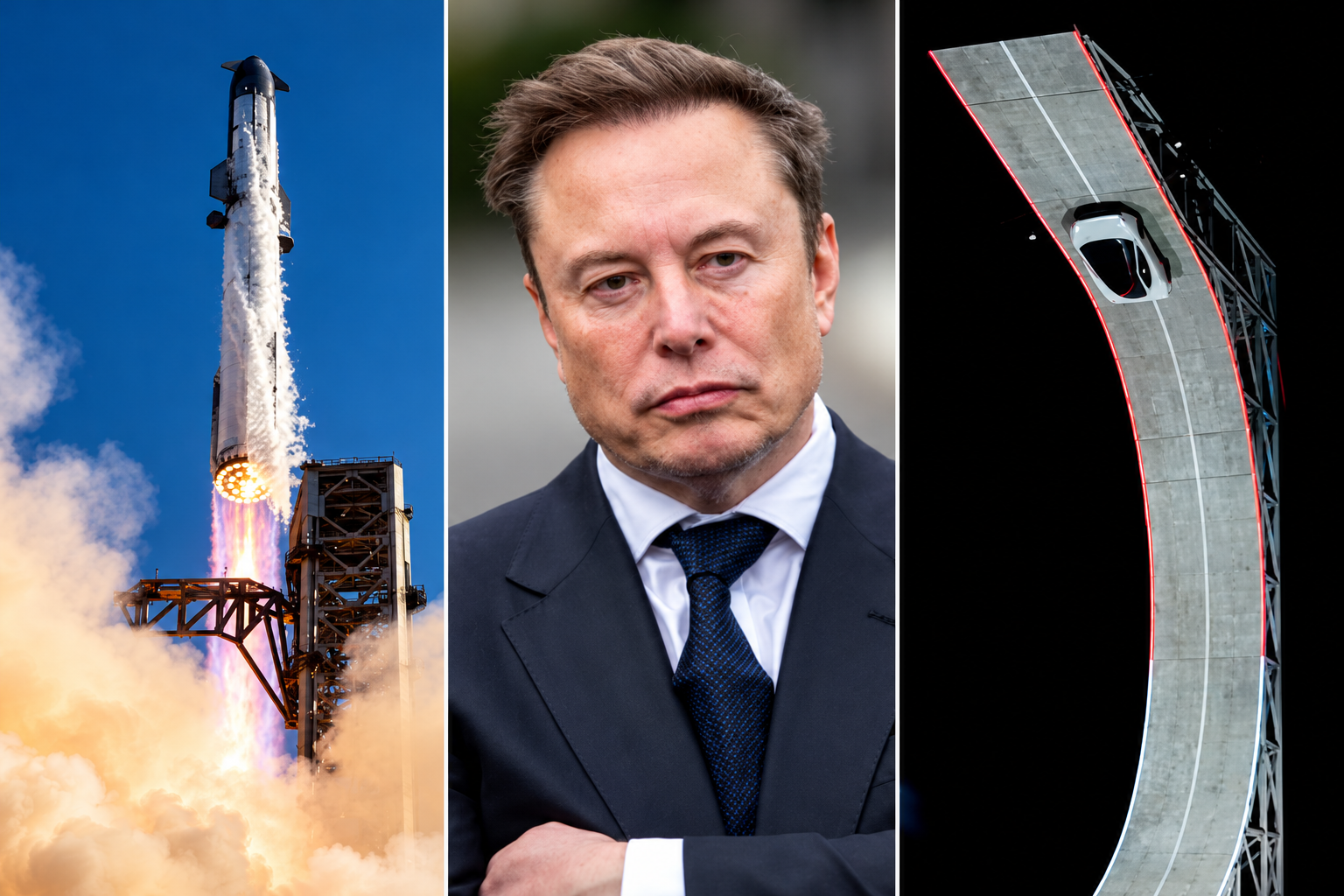
Elon Musk has engineered ties between Tesla TSLA 3.41%increase; up pointing triangle and SpaceX SPCX 7.79%increase; up pointing triangle that are hard to break, and now he wants to fuse them together permanently.
Musk has run both Tesla and SpaceX concurrently over the past two decades, using a schedule that dictated which days he spent focused on each business.
The companies have often shared resources and personnel, signaling their close ties. Last year, SpaceX looked into creating a spacesuit for Tesla’s humanoid robot Optimus, a person familiar with the matter said. Tesla last week showed off its new Roadster, a vehicle featuring SpaceX rocket thrusters that it hopes to soon bring to market.
And in recent months, Musk has repositioned both companies by expanding beyond their core operations toward a shared mission centered on artificial intelligence.
The world’s richest man on Tuesday signaled his interest in tying up SpaceX and Tesla, marking what would be the biggest corporate merger of all time. Because he serves as chief executive of SpaceX and Tesla, Musk said committees of independent directors at both companies are evaluating a possible deal, adding that a transaction might not come to fruition.
The committees will likely evaluate, with lawyers and bankers, how each company would fare in a potential deal and how a deal might best be structured. They then present their conclusions to their respective boards, who typically vote on whether to proceed.
“It’s an odd Kabuki dance where two groups of people are talking and I can’t be in the conversation,” Musk told SpaceX investors on Tuesday in response to an analyst’s question about a potential deal.
For Musk, the merger supports his vision of a world full of autonomous cars, humanoid robots and weekly rocket launches, as well as the data centers and satellites required to keep the whole thing running.
Some investors and analysts said they expect a transaction would be structured as an all-stock deal, with SpaceX potentially paying a modest premium for Tesla shares.
SpaceX, which has a market value of about $2 trillion, said it is seeing sharp growth in revenue across its businesses, which include operating data centers, launching rockets and operating satellite networks such as the internet service Starlink. Tesla is valued at about $1.5 trillion and is expanding its operations beyond its automotive and energy business. Shares in both companies traded higher following the news Tuesday.
Musk’s substantial ownership stakes in both companies, along with voting control at SpaceX, has enabled him to set the deal in motion. Analysts and investors said the deal will probably face regulatory scrutiny internationally, though some see Musk’s close relationship with the Trump administration as an asset to getting approval.
Blurred lines
The companies haven’t said which directors are on the special committees evaluating a potential deal. Several SpaceX and Tesla board members have either personal or business ties to Musk. And like Musk, venture capitalist Ira Ehrenpreis sits on both boards.
In a filing this week, Tesla outlined millions of dollars in business agreements with SpaceX and its subsidiaries last year, including $143 million in car sales to SpaceX, $3.3 million in advertising that it bought on the social-media platform X and $430 million in revenue from the sale of Megapack batteries for SpaceX’s data centers.
The companies also split the cost of resources including the use of Musk’s SpaceX jet and the bill for his personal security, which he runs through a private company.
Employees at both companies routinely move between companies to work on special projects, and some executives have dual roles, including Charles Kuehmann, vice president of materials engineering at both SpaceX and Tesla, and Ashok Elluswamy, the vice president of AI software at Tesla who runs a joint venture with SpaceX called Digital Optimus.
Over the years, Musk has launched new startups within his empire, including brain-implant company Neuralink, underground-tunnel developer the Boring Company and xAI, the AI startup that merged with SpaceX in February.
It is that AI business that Musk thinks can serve a market worth tens of trillions of dollars, justifying the need for a merger.
The business case goes like this: Tesla is developing robotaxis and robots, which it calls “physical AI.” SpaceX is working on the back end of physical AI: the data-center capacity and internet connection required for those robotaxis and robots to operate continuously.
“I don’t see what the value of Tesla is if it’s not merged with SpaceX,” said investment adviser Ross Gerber, a former Tesla bull turned critic invested in both companies. “If they don’t merge, the brains of everything that runs Tesla is owned by another company.”
On top of it all, both companies face constraints on the supply chains they need to make this world a reality, particularly when it comes to chips. To address this, Musk earlier this year announced a joint venture between Tesla, SpaceX and Intel to design and manufacture chips in Texas. “The most epic chip-building exercise by far,” he has said.
Musk at the wheel
For Musk, a merger would also solve two problems: demands on his attention and his lack of control at Tesla.
Tesla for years was Musk’s only public company, a status that came with greater scrutiny. There, Musk reports to a public board, as well as individual investors who make up around 30% of Tesla’s voting power, according to FactSet.
The question of Musk’s attention became a particular focus for investors and the board in recent years after he acquired Twitter in 2022 and launched xAI in 2023, and again in 2025 as he spent time in Washington, D.C., running the Department of Government Efficiency in the early months of President Trump’s second term.
As Tesla’s car business suffered in 2025, Musk threatened to take his AI ambitions outside the company if he wasn’t granted 25% voting control. Last November, Tesla shareholders approved a new pay package for Musk, which created a path for him to vastly expand his stake.
As of Sept. 30, Musk owned a roughly 20% stake in Tesla, according to the company’s proxy filing.
The SpaceX IPO gave Musk a different path. When SpaceX went public in June, the deal’s structure enabled him to have more than 80% voting power at the company—so much that he can’t be fired and decisions can’t be made without his support.
If SpaceX acquires Tesla, he will likely stay in control.
Scotch whisky expert, luxury hospitality strategist and Keeper of the Quaich inductee Ross Blainey is bringing a new philosophy of luxury experiences to Citizen Kanebridge.

A survey of people with at least $1 million in investable assets found women in their 30s and 40s look nothing like older generations in terms of assets and priorities