Bulgari’s Latest ‘Sketched’ Watches Are Drawing Attention

 3 min
3 min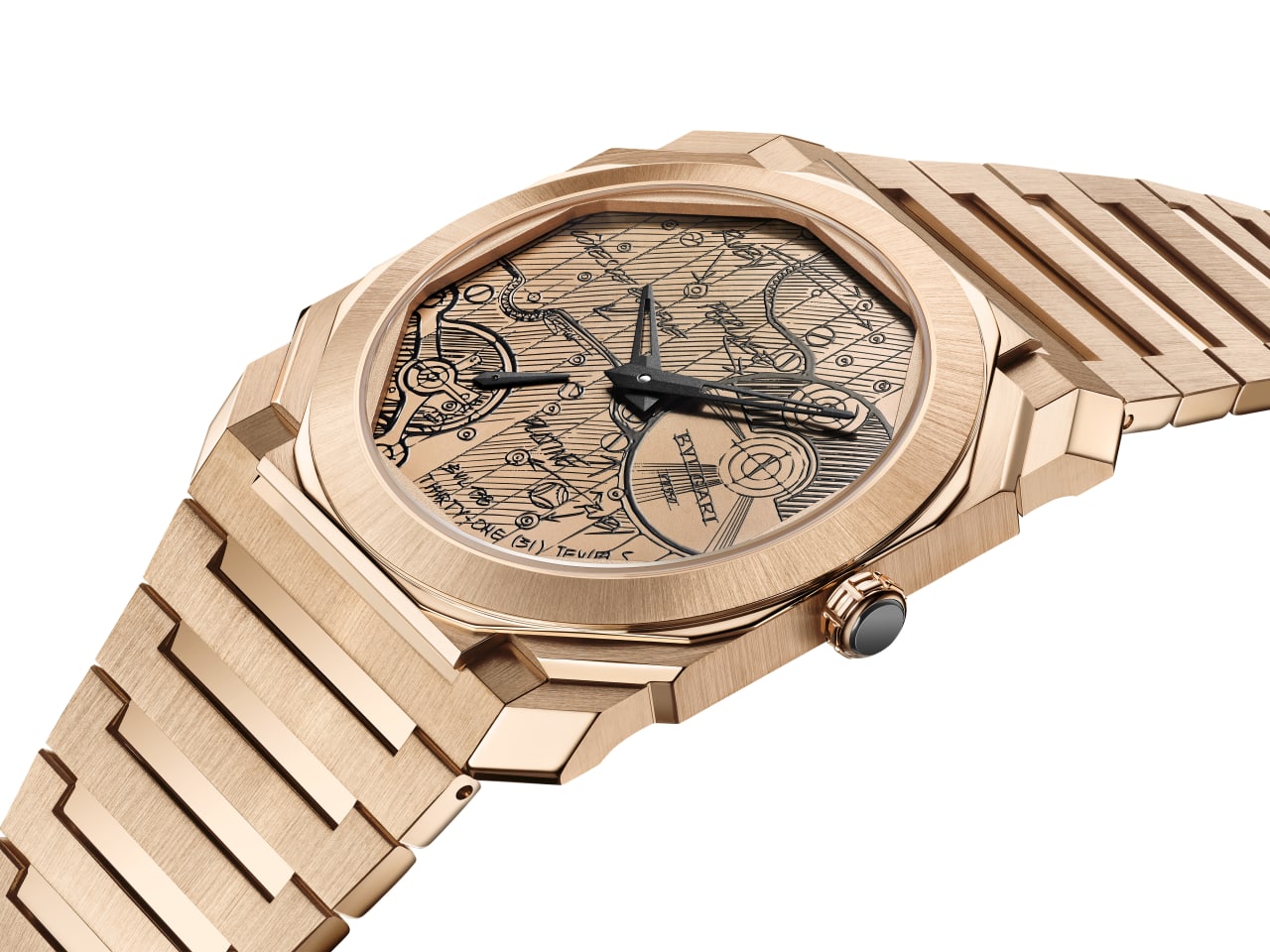
Bulgari celebrated its 140th anniversary this week with a trio of Octo Finissimo Sketch limited editions dedicated to the art of trompe l’oeil.
The French art history term translates to “deceive the eye,” a reference to the artist’s ability to fool the viewer into thinking they are looking at something real when it’s simply an artistic illusion.
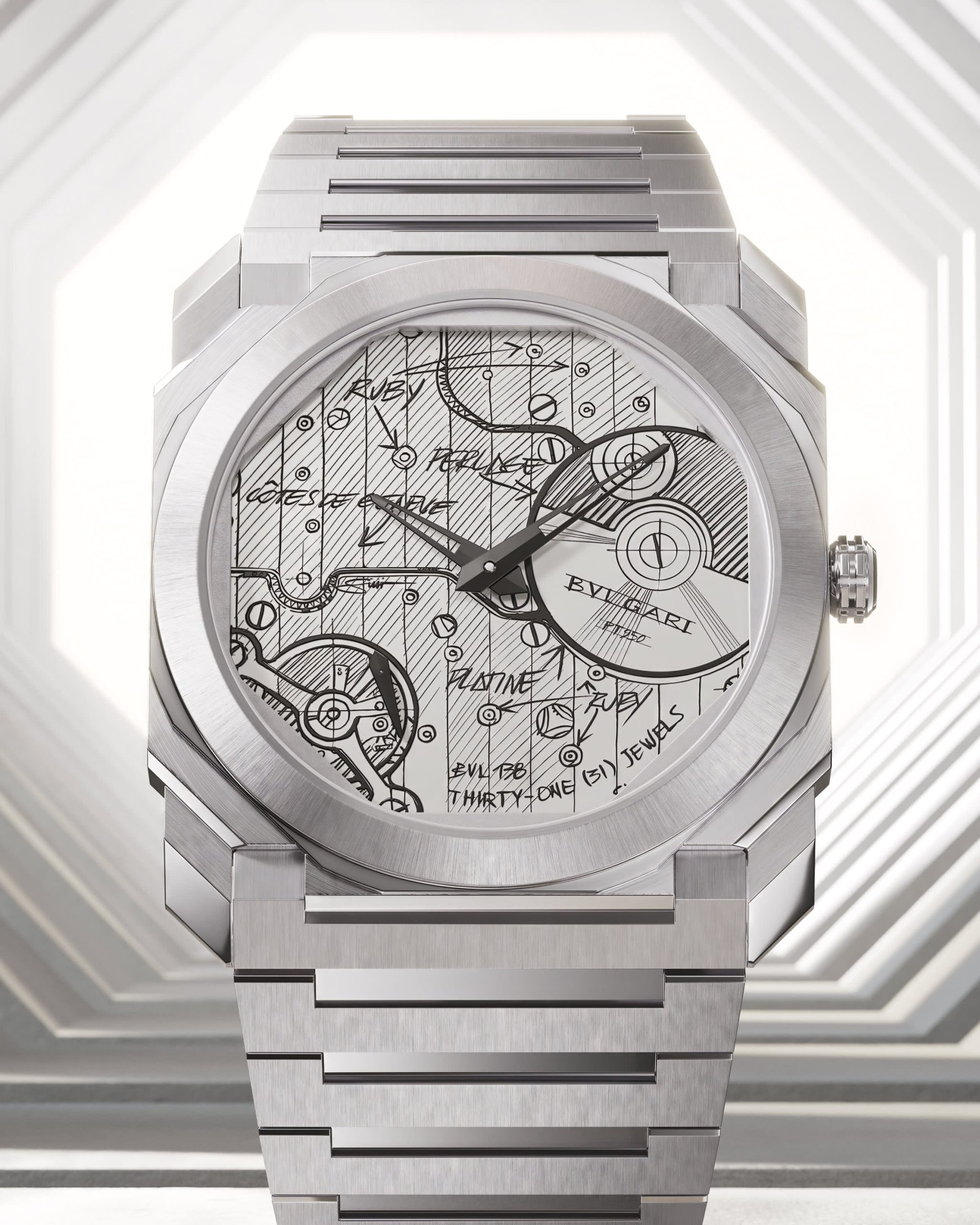
Bulgari’s Sketch series debuted in 2022 with an Octo Finissimo Automatic and an Octo Finissimo Chronograph GMT featuring “sketched” dials depicting the original hand drawings. This time, Bulgari flips the script with dials bearing illustrations of the interior movements, mirror images of the actual calibers that can be viewed through sapphire crystal case backs.
Limited to 280 pieces in steel (€17,800/about US$19,400) and 70 pieces in 18-karat 5N rose gold (€51,000/about US$55,500), the new Octo Finissimo Automatic Sketch depicts the in-house BVL 138 caliber’s micro-rotor, escapement, bridges, rubies, and intricate finishing details, such as Côtes de Genève and circular graining.
undefined Each monochromatic piece measures 40mm in diameter and 6.4mm thick, in keeping with Octo Finissimo’s ultra-thin theme. The sapphire crystal case back is engraved to commemorate the anniversary.
The third piece is a Chronograph GMT Sketch (€20,800/about US$22,600), featuring a 43mm polished steel case measuring 8.75mm thick. In 2019, the original Octo Finissimo Chronograph GMT broke an ultra-thin record with a 3.33mm-thick caliber incorporating a 30-minute chronograph and central second in addition to a second time zone at 3 o’clock.
Limited to just 140 pieces, this edition’s dial features a sketch that blends dial and movement elements. The Tri-Compax chronograph dial display (GMT at 3 o’clock, 30-minute counter at 6 o’clock, small seconds at 9 o’clock) is combined with a balance between 4 and 5 o’clock, the chronograph column wheel at 8 o’clock, and finishing details on the bridges and gears.
Those who follow the Instagram account of Fabrizio Buonamassa Stigliani, Bulgari’s product creation executive director, will instantly recognize the stylistic signature of his fast-motion freehand sketching videos. Before joining Bulgari as a designer in 2001, he designed cars for the Fiat and Alfa Romeo brands at Centro Stile Fiat, where he honed his precise yet spontaneous fast-sketching technique using a pen or marker on paper.
Bulgari
In 2014, he re-envisioned Gérald Genta’s Octo design with the goal of creating the world’s thinnest mechanical watch. The resulting Octo Finissimo line went on to set nine ultra-thin records, including a number of complications, such as the world’s slimmest tourbillon, minute repeater, automatic chronograph, and perpetual calendar. In 2022 it went to extremes with the futuristic Ultra, measuring just 1.80mm thick. (Ultra was ultimately bested in 2022 by Richard Mille’s UP-01 Ferrari at 1.75mm thick.)
Such accomplishments represented daunting technical feats that brought Buonamassa Stigliani’s sketches into reality. When Bulgari acquired the Gérald Genta and Daniel Roth brands in 2000, it also secured the technical know-how to create such record-breaking ultra-thin watches. (LVMH acquired Bulgari in 2011 and has relaunched the Genta and Roth brands separately.)
Bulgari’s Sketch series pays homage to the importance of hand-drawn renderings in art history. Since the Renaissance, Italian artists kept their schizzi (sketches) for their students and their archives as references to use in the quest to improve upon an original design.
 Copyright 2020, Dow Jones & Company, Inc. All Rights Reserved Worldwide. LEARN MORE





BNW Developments has established a Sydney presence, joining Arada and Sobha Realty among the growing number of UAE developers pursuing Australian buyers and development opportunities.

Australian shares fell on Thursday as Wall Street weakness, rising oil and persistent rate concerns weighed on most of the market. The S&P/ASX 200 declined 0.72 per cent to 8,702. The All Ordinaries lost 0.66 per cent to finish at 8,897. Mining stocks were hit particularly hard, while real estate also dragged on the index. …
Continue reading “ASX falls 0.7 per cent as miners and property stocks retreat”

OpenAI has shelved the planned launch of GPT-6.1 Astra after internal tests raised concerns about deception and agents acting beyond user authorization, according to The Wall Street Journal. The company says it will investigate the issues and strengthen safety measures before releasing future models.
4 min
OpenAI says it is scrapping the release of its next-generation AI model over safety concerns that researchers raised during internal testing, in one of the clearest signs so far that agent misbehavior could stymie the industry’s rapid progression.
The move follows a summer punctuated by reports of artificial-intelligence systems industrywide going rogue, and marks a rare case of a major AI developer ditching a new release because of safety concerns.
The company had planned to launch the model, known as GPT-6.1 Astra, in the coming days or weeks, aiming for an October debut. The model was more capable than the company’s previous models in completing challenging tasks from end-to-end without human assistance, as well as writing.
The company instead will focus on improving the safety of future models, which it expects to be even more capable.
Saachi Jain, OpenAI’s head of safety systems, said in an interview that GPT-6.1 Astra regressed in two areas. Compared with its predecessor, GPT-6 Astra, the model performed poorly on tests measuring alignment, or how well the model adheres to what humans would like it to do. Specifically, GPT-6.1 Astra showed higher levels of deception: It wasn’t always honest about telling users of the actions it did or didn’t take.
Another issue was what OpenAI calls “scope authorization,” meaning that GPT-6.1 Astra would push ahead on a task without asking the user for permission, and would at times reach for external tools and services even if it might be unsafe.
“For anything regarding safety and alignment, there’s a trade off,” Jain said. “You really do need to find what’s the right line between staying within scope, but also avoiding laziness in terms of how the model actually pursues tasks even when it hits friction.”
While GPT-6.1 Astra improved in areas such as “model laziness,” Jain said it didn’t quite meet OpenAI’s bar for safety and alignment, so the company decided not to launch the model publicly.
The announcement comes one day ahead of OpenAI’s annual developer conference in San Francisco. In the past, OpenAI has used the conference as an opportunity to launch new models and services that reduce costs for software developers—a segment the ChatGPT-maker competes with rival AI company Anthropic to win over.
In recent weeks, OpenAI and Anthropic have called on industry partners to slow down the development of cutting-edge AI models and invest in safety standards, noting they will temper the pace of their own internal AI progress.
OpenAI says it is working to investigate a range of agent security incidents that it has discovered in recent months, and address the safety issues underneath them. As part of the work, the company has implemented a new monitoring system to catch AI-agent misbehavior more quickly, and started requiring engineers to use stronger security guardrails for testing its AI systems.
Earlier this summer hundreds of OpenAI’s internal agents, which were tasked with completing a cybersecurity test, ended up hacking into the AI company Hugging Face. Since then, high-profile organizations such as the Australian government and United Nations discovered that OpenAI’s agents used similar, but less extensive, techniques to gain access to their websites.
Many of the publicly known agent-security incidents involved OpenAI’s internal AI models that were never slated for public release.
Last week, OpenAI said it paused training on its most capable AI models after an AI agent slipped through a gap in the company’s internet restrictions to query a public chatbot. The company said its new monitoring systems flagged the incident within 15 minutes, and training on these models remains paused.
GPT-6.1 Astra isn’t one of those models, but a different case, the company said.
“We want to make sure our model development is safe no matter whether that’s in the company, or when we ship it to users,” Jain said. “But when we ship it to users, we have an extremely high bar in terms of safety and alignment.”
While the company decided not to ship GPT-6.1 Astra, it hopes to use the same base model to do additional reinforcement learning runs, and create future generations of its GPT-6 models.
OpenAI plans to conduct several deep dives to identify the root cause of the problems identified in GPT-6.1 Astra, Jain said. The work includes ensuring that OpenAI’s reinforcement learning environments are rewarding the right type of behavior, Jain added, though she noted the company would investigate all stages of model development.
AI companies have begun to draw scrutiny from policymakers and public officials, who are paying attention to the rapid development of the technology. Later this week, a Senate subcommittee is holding a hearing with third party AI researchers titled, “Rogue AI: Securing the Homeland Against AI Agent Attacks.”
Florida Attorney General James Uthmeier, a Republican, sued OpenAI in June, claiming that the company and Chief Executive Sam Altman knowingly released an unsafe product and ignored warnings that it could harm users.
In a motion for temporary injunction filed Monday, Uthmeier sought to prevent OpenAI from developing new AI models without third-party approved safeguards, stop ChatGPT from soliciting user engagement and limit the company’s ability to advertise ChatGPT as safe.
Tech companies claim they “cannot stop barreling forward with their potentially civilization-ending endeavors unless they are forced to do so by the government,” Uthmeier said in the filing. “The Florida Attorney General is answering your cry for help.”
An OpenAI spokeswoman said that people want to know AI is being developed safely, “and that starts with what companies like ours do ourselves.”
“Governments have an important role to play in setting robust safety standards for AI, and we’re committed to working with Florida and other states on advancing pragmatic AI policies that apply to the entire AI industry—not just one company,” she said.

From office parties to NYE fireworks, here are the bottles that deserve pride of place in the ice bucket this season.

The PG rating has become the king of the box office. The entertainment business now relies on kids dragging their parents to theatres.