The Party’s Over for Coachella’s Glitziest Rental Mansions
This year, demand for high-end festival event rentals is down amid a glut of inventory, a shifting party scene and what some are calling a lacklustre lineup

 9 min
9 min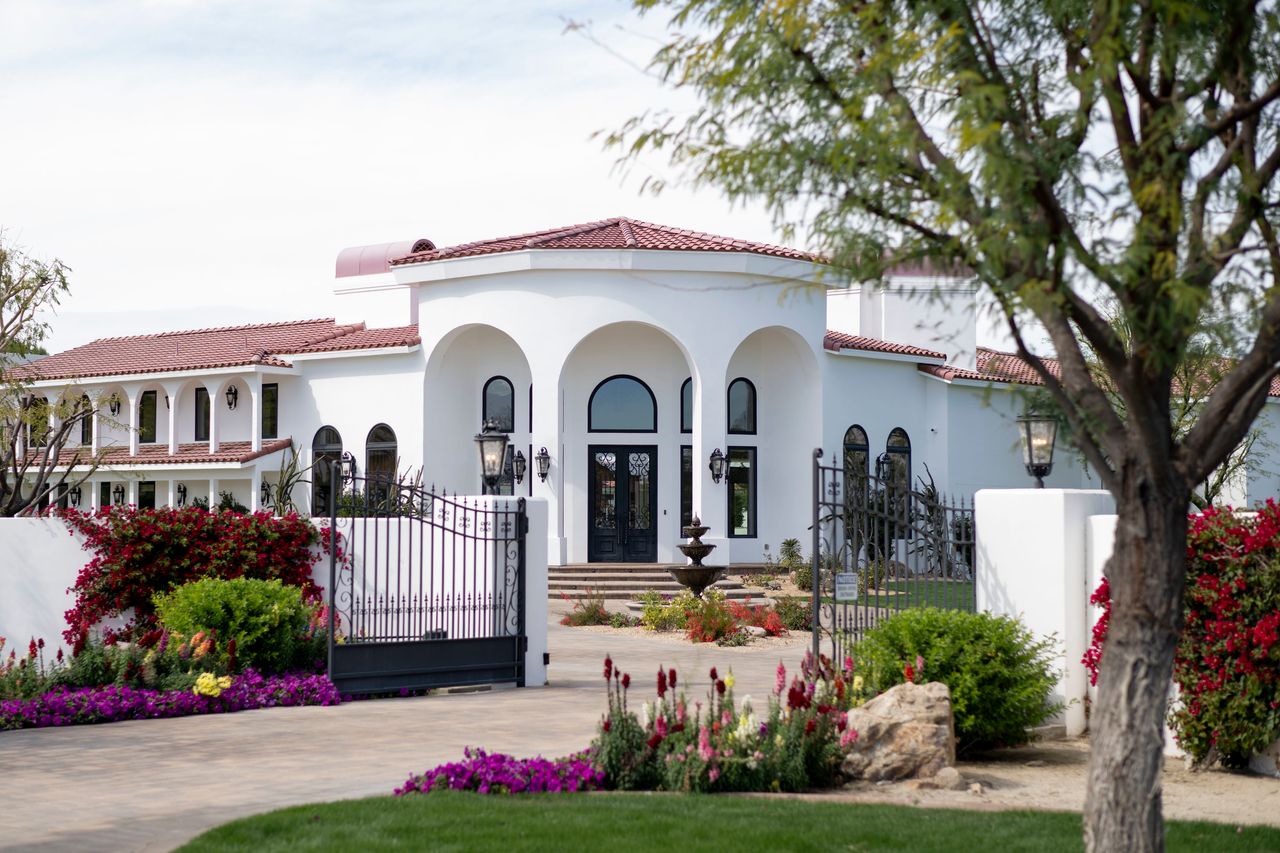
Kristina Morrison’s journey to a parallel universe started on a bus that navigated hot, dusty, desert roads, crossed through a gated community with drab cookie-cutter houses and stopped in front of an enormous, white Mediterranean-style mansion.
She walked through an archway dripping with silver beads that revealed a crystal clear blue swimming pool lined with palm trees, bright red flowers and large rocks. Beautiful people played putt-putt, danced to live DJs and drank lime-green margaritas on a vast green lawn decorated with stacks of pink and silver balls.
“Everything was so chic and elegant,” says Morrison, a model, actress and influencer, about the Clinique-hosted event that took place last April in Indio, Calif., during the first weekend of the Coachella Valley Music and Arts Festival.
The party was at an 8,900-square-foot custom-designed estate called Zenda, which rents for around $300,000 an event during the festival. Its owner, Miles Warner, who lives 140 miles away in Santa Monica, was initially going to buy a smaller place to rent out as an Airbnb when he wasn’t there golfing, but when he saw the prices Coachella events, which include parties and overnight guests, were commanding, he bought the nine-acre property in February 2022 for $5.8 million. He then invested around $700,000 to add bedrooms and convert a barn into a party space.
One Coachella weekend event can cover the estate’s expenses for a year, he says. “I’m just lucky it’s working. If it stopped working, it would get expensive quickly,” he says.
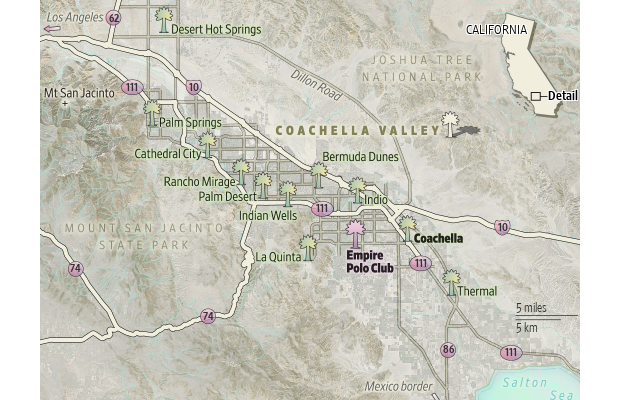
There has been a bloom of such rental mansions in Southern California’s Coachella Valley over the past few years. The annual festival, which will take place over the weekends of April 12-14 and April 19-21, brings roughly 120,000 people, most of them to an area that covers nine cities, including Palm Springs, Desert Hot Springs, Indio, Indian Wells, La Quinta, Coachella, Palm Desert, Rancho Mirage and Cathedral City, as well as unincorporated communities in Riverside County like Thermal and Bermuda Dunes.
But this year, rentals of these mansions are slowing down, causing some to reduce prices, according Kaylee Ricciardi, an LA-based luxury rental real-estate agent with AKG | Christie’s who represents a number of mansions. Current demand for all short-term rentals in the Coachella Valley is down 12% year over year for the first concert weekend, the most popular time span. Last year, 75% of demand for both weeks of the Coachella festival were already booked at this point, according to AirDNA.
This doesn’t bode well considering all that goes into these weekends. On the festival’s sidelines, companies hold invitation-only parties called “activations” to draw in influencers, some of whom are paid to attend. The goal is to create memorable moments, or “branded experiences” to ensure their products show up on TikTok and Instagram feeds. These swag-laden events take months to plan and involve elaborate sets and celebrity appearances. Mansions with amenities like lazy rivers, pickleball courts and infinity pools make for good backdrops.
As a result, the income brought in by all short-term rentals in the valley during the Coachella festival has grown significantly—up 30% in 2023 compared with 2019, according to an exclusive data analysis by short-term rental-analytics firm AirDNA. In the areas where many of these rental mansions are located, the growth over just the past year has been explosive: up 44% in Coachella and up 38% in Thermal.
The slowdown in bookings, some say, is due to a glut that is coming on the market, as more investors are buying, building and renovating massive properties to rent out. “There’s going to be empty houses this year,” says Zenda’s owner Warner. He says the “secret” (that there’s a lot of money to be made renting large estates for activations during Coachella) is out—and now it’s just a question of supply and demand. Zenda, where the Clinique party took place, finally rented out this year, months later than usual, and for a significantly lower rate since it’s just a group of festival goers and not for an event.
Some owners speculate that companies are cutting back because of the economy, but the production companies that are managing the activations say the festival is important. “It’s absolutely critical for brands,” says Zev Norotsky, whose L.A-based event planning company Enter is managing several parties this year.
Others attribute it to a lacklustre festival lineup, which features Lana Del Rey, the Creator, and Doja Cat. “It’s not Beyoncé,” (who headlined the festival in 2018) says Sean Breuner, the founder and CEO of a luxury-property management company AvantStay, which manages several of the large estates in the area, along with luxury homes across the country. Rumours continue to swirl that Taylor Swift will be there to support Del Rey, a good friend, and that she could even perform.
Breuner bought his own rental mansion, a 5,000-square-foot estate called Buena Vista on 38 acres, with partners for $5.25 million in 2021. He spent over a million dollars renovating it and adding amenities like a tennis court, a large pool and a lake with paddle boats and kayaks. As it did last year during Coachella, Buena Vista will again this year host an event for Kourtney Kardashian’s lifestyle brand Poosh—an adult sleep-away camp and party. The property rents for more than $150,000 for an event at this time, according to rental agents.
Tony Schubert, owner of Event Eleven, an LA-based event-production company, says prices for these rental mansions have become so high that he realised it would be more cost effective to just build his own compound. For the past two years his company rented an 8,500-square-foot Mediterranean-style mansion on 19 acres with a man-made lake, an infinity pool and a 4-acre polo field called Cavallo Ranch, which rents out for around $300,000, where he runs an event called Nylon House, hosted by Nylon Magazine.
A few months ago he bought a 20-acre date farm in Thermal, part of Riverside County close to the festival, with two dilapidated houses for $850,000. He plans to build a 4,000-square-foot house, a lazy river and six A-frame sleeping villas that should be ready for next year’s festival. “I was looking at estates for clients and couldn’t believe how much money they were getting,” he says.
The Madrid, which spans 10,000 square feet, has eight bedrooms, three guest casitas, a poolside bar, an airplane hangar, a tennis court and two pickleball courts, is part of a whole rental mansion gated subdivision, complete with a guard, in Bermuda Dunes, created by Rick Kay, who runs a San Clemente, Calif.-based ball-bearing manufacturing company. Kay initially bought a single 10,000-square-foot home for $1.6 million in a subdivision in 2006, but when he ran into an issue renting short term, he decided to buy up the other 10 lots and build individual 10,000-square-foot houses, at a cost of $5 million to $8 million each. “Everyone has vacation rentals but no one else has a vacation village,” says Kay.
These side events held during Coachella are crucial to the local economy, particularly in the more remote areas like Thermal, which doesn’t have many hotels and restaurants to reap the benefits from the festival, says Mark Tadros,. He rents out the packhouse, traditionally where the dates are packed, on the property of his date farm, Aziz Farms, for as high as $150,000 per event during Coachella.
Last year an event called Oasis in partnership with Liquid I.V. (an El Segundo, Calif.-based hydration drink company) took place at the packhouse, but this year, the packhouse isn’t rented. “We are taking a different approach,” says Kyle Nolan, the executive producer at Sturdy, a L.A.-based design studio and creative agency that runs the Oasis event and says he isn’t doing any events off the festival grounds this year.
“I certainly hope this isn’t the new normal. I just think it’s an off year,” says Tadros, who also sits on a community council in Riverside County that approves or denies permits for special events in parts of the unincorporated areas. He says the permitting process has become much stricter in recent years.
This year Indio “clarified” its definition of a “large event,” requiring a permit for any party with over 40 attendees held at an estate with overnight guests because some property owners weren’t compliant, says Indio marketing and public information officer Jessica Mediano. Indio also doesn’t allow properties within 1,000 feet of the festival grounds during a major music festival event (i.e. Coachella) to hold events.
One of the more renowned events, sponsored by online fashion retailer Revolve , is also cutting back this year, holding its party on just one day instead of two and opting for a Palm Springs hotel instead of a private mansion as in previous years. A Revolve spokesperson says it will “still host the same amount of guests, we have just simply changed the format to keep things fresh, exciting and elevated.”
Last year the Revolve affair was held at the Emerson Estate, an over 8,000-square-foot mansion on 20 acres in Indio that rents for $30,000 for weddings and goes up to the six figure range for events. Emerson Estate owner Diana Lazzarini says she put a lot of money into her property getting ready for the Revolve party, such as putting in gates and an area for VIP parking, in hopes that they would return. She says she had a few lowball offers, but her estate isn’t booked for the first weekend of Coachella this year because it wasn’t worth accepting the lower prices people were offering. “It’s a lot of liability, headache and risk,” she says.
The Madrid House, advertised by its owner Rick Kay as “the house that never sleeps,” is also changing course. Instead of big parties on Friday and Saturday nights, there will be private daytime events run by Enter around the pool featuring pickleball and fitness classes with partners like Paper Magazine, True Religion, Saint James Iced Tea and LaCroix. Kay says he thinks he could charge as much as $200,000 for big events, but he prefers the smaller sized parties, which pay around $40,000 for the Madrid, because they are less of a hassle. The lower price played a role in why he chose the Madrid, says Enter’s Norotsky.
Instead of building one big estate on multiple acres for big events, some investors are now building multiple individual ultraluxury homes where headliner musicians can stay and companies can host influencers at smaller parties that don’t require permits.
David Corso, whose Corso Marketing Group manages a Coachella event estate called Zenyara, just finished building his own rental mansion property he named Villa Rosa. Designed by the CEO of RH, Gary Friedman (a friend), the very modern, polished concrete and balsa wood house will host Coachella musicians and guests in a quieter, more intimate environment for $10,000 to $30,000 a night, depending on the season he says.
Claudio Bravo is taking a similar path. The luxury mansion rental company magnate just finished building a $50 million project with 16 short-term rental mansions. Each spans 6,500 square feet. They are right next to each other in a gated community on a 10-acre property in Indio, near the festival site, called Bravo Collection in Indio. This year 13 of the homes, which rent for around $100,000 apiece for a week during Coachella, will be rented by Guess Inc.
Jen and Chris Baldivid’s Folsom, Calif.-based Walker Land Company owns the Old Polo Estate, a former date farm on five acres they bought in 2017 for $925,000 and added a pool, pond, volleyball and pickleball courts and a two-hole golf course. They rent it out for $50,000-$400,000 for events that attract as many as 3,000 attendees during Coachella’s first weekend. Last year’s activation was sponsored by clothing company Darc Sport and included a 40-foot long tunnel with plastic skulls embedded into foam walls. It’s not rented for the first weekend of Coachella this year.
Starting this year, the Balvadids have a different sort of mansion that is almost fully booked until summer, including during Coachella, with smaller events, like dinners, and guests staying over. It’s well known in the architectural community because it was designed in 1959 by Midcentury Modernist Walter S. White. The structure of the house, including the metal parabolic roof that floats over the angular white structure, is untouched, but they knocked down a wall to make it more open, added three sleeping casitas, put in a pool that mimics the shape of the house and turned a carport into an outdoor entertainment area.
While demand for short-term rentals has slowed for the first weekend of the Coachella festival, it is higher this year for what’s called Stagecoach—the country music festival held the weekend after the two Coachella festival weekends, this year April 26-28. Demand is up 39% year-over-year, according to AirDNA. That is giving mansion owners hope that there will be expanding opportunities for event rentals beyond Coachella.
There are still more event mansions on the horizon. Drew MacLurg owns the Stallion Estate, a 7,000 square foot home on 5 acres he bought for $4 million in March 2022. He charges around $200,000 for an event for the first weekend of Coachella, but he didn’t get any interest for that this year so he is renting it to a private group for three nights for around $18,000, he says.
MacLurg put in about $1.6 million adding a 60-foot long pool with a waterslide, a decked-out game barn, a pickleball court and a nine-hole mini golf course. He is currently building a 7,000-square-foot house nearby that will have a lazy river and a bowling alley for event use.
Another is the Pond Estate, a 12,700-square-foot Hacienda-style mansion with indoor and outdoor swimming pools and two guesthouses (4,000 square feet and 2,000 square feet) on over 12 acres in South Palm Springs. Tom Ryan, the president and CEO of streaming at Paramount, bought the property, near a house he owned, for $8.38 million in June 2021 after stumbling on it with his wife. He says he was blown away by the beauty and history and is putting in a couple million dollars renovating and redecorating it, including creating a game room and entertaining spaces out of former garages, each 3,000 square feet. He plans to rent it out for weddings, private parties and during Coachella for events.
Ryan says he didn’t buy it as an investment to make as much profit as possible—he sees the event business more as helping offset costs for a property his family will own for generations. “It felt like a once in a lifetime opportunity,” says Ryan.
 Copyright 2020, Dow Jones & Company, Inc. All Rights Reserved Worldwide. LEARN MORE




On the owner’s deck, a 20-metre swimming pool incorporates Feadship’s patented ContraWave technology and extends indoors as a suspended, glass-bottomed infinity pool.

Automobili Lamborghini is turning its attention to something considerably more difficult to define: what makes Italian excellence uniquely Italian?

Mirvac’s 45-level Trielle has topped out at Yarra’s Edge, pairing riverfront apartments with wellness facilities, private dining and resident services.
3 min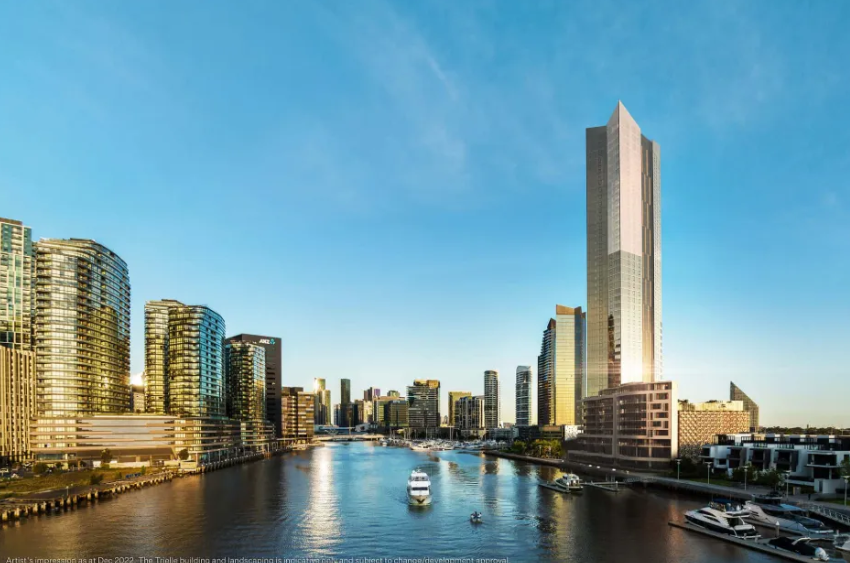
Mirvac has topped out Trielle at Melbourne’s Yarra’s Edge, with more than 70 per cent of the riverfront development sold and approximately 80 per cent of purchasers intending to make their apartment a home.
The figures, released on September 22, point to an owner-occupier audience for one of the precinct’s final residential towers. Mirvac began developing Yarra’s Edge in 2003, and its latest addition occupies one of the remaining absolute riverfront sites.
Mirvac CEO of Development Stuart Penklis said existing residents were among those moving up within the neighbourhood.
“Many purchasers already have a connection to Yarra’s Edge,” Mr Penklis said, describing buyers whose changing needs were encouraging an upgrade within the precinct.
“As one of the final residential towers within Yarra’s Edge, Trielle represents the culmination of more than two decades of creating one of Melbourne’s most established and sought-after waterfront communities,” Penklis said.
“Positioned on the Collins Street axis with absolute river frontage, Trielle offers residents a rare opportunity to enjoy sweeping views across the Yarra River, Melbourne skyline and Port Phillip Bay, while remaining seamlessly connected to the CBD. With Trielle now more than 70 per cent sold, we’re continuing to see strong demand from buyers seeking quality homes in established locations.”
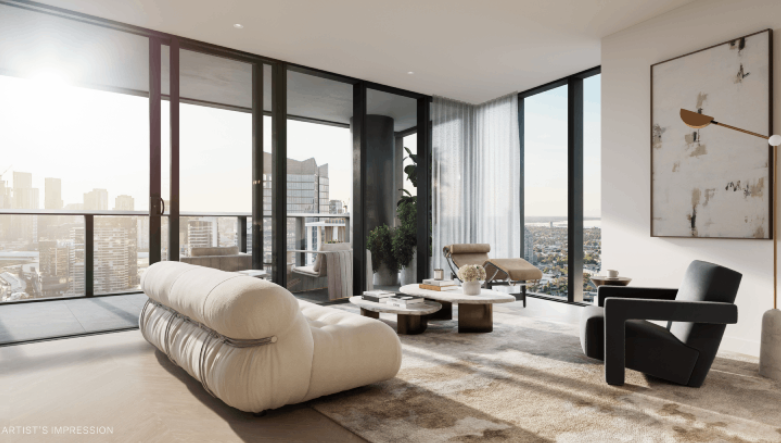
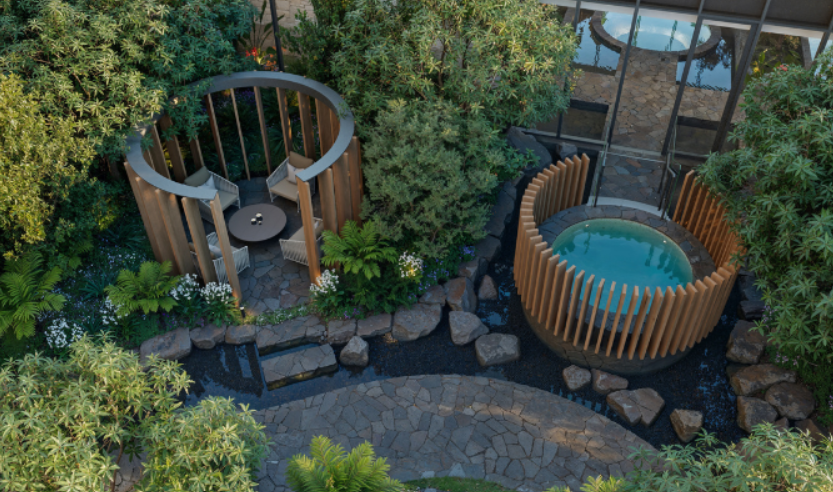
The developer also flagged a penthouse and sub-penthouse collection with larger layouts, premium finishes and broad outlooks. The planned wellness centrepiece, The Oasis, encompasses a 900-square-metre elevated urban rainforest.
Mirvac General Manager Residential Development Victoria Elysa Anderson said Trielle had resonated strongly with buyers seeking a rare lifestyle offering in Melbourne.
“Opportunities to secure a new luxury residence on a riverfront site of this calibre are incredibly rare, particularly within a community like Yarra’s Edge,” Anderson said.
“What makes Trielle unique is the combination of exceptional views, world-class residential facilities and the lifestyle that already exists around it. Residents are buying into a mature waterfront community with parks, promenades, dining, wellness and strong community connections already in place.”
The 45-level tower brings a substantial new presence to that waterfront. Its residential offering spans one-, two-, three- and four-bedroom apartments, with Signature, Prestige and Sub-Penthouse collections accommodating different household sizes. The north-facing position connects the apartments visually to the river and city beyond.
Seven storeys above the promenade, the planned Oasis combines planting and a running stream with a Scandinavian-inspired wellness club developed with spa specialist Naomi Gregory. Facilities include a 25-metre lap pool, hot magnesium pool, sauna, hydrotherapy, a gym, yoga and Pilates room, and treatment spaces.
The amenity extends beyond exercise. Residents will have access to The Biblioteca library and workspaces, ground-floor work pods, and The Salone piano lounge. A private Chef’s Table dining room offers a setting for larger gatherings, while a cinema, games room and sports lounge broaden the entertaining options. Concierge services and a dog-wash area support everyday routines.
Trielle comprises a collection of one, two, three and four-bedroom residences. Reflecting strong demand from owner occupiers, approximately 80 per cent of purchasers to date intend to live in their homes, highlighting the project’s appeal to those seeking a long-term waterfront lifestyle.
Mirvac has recently delivered The Albertine, a premium apartment development on the edge of Melbourne’s CBD, and is nearing completion of Prince & Parade in Brunswick, further strengthening its portfolio of thoughtfully designed apartment communities in some of Melbourne’s most sought-after urban locations.
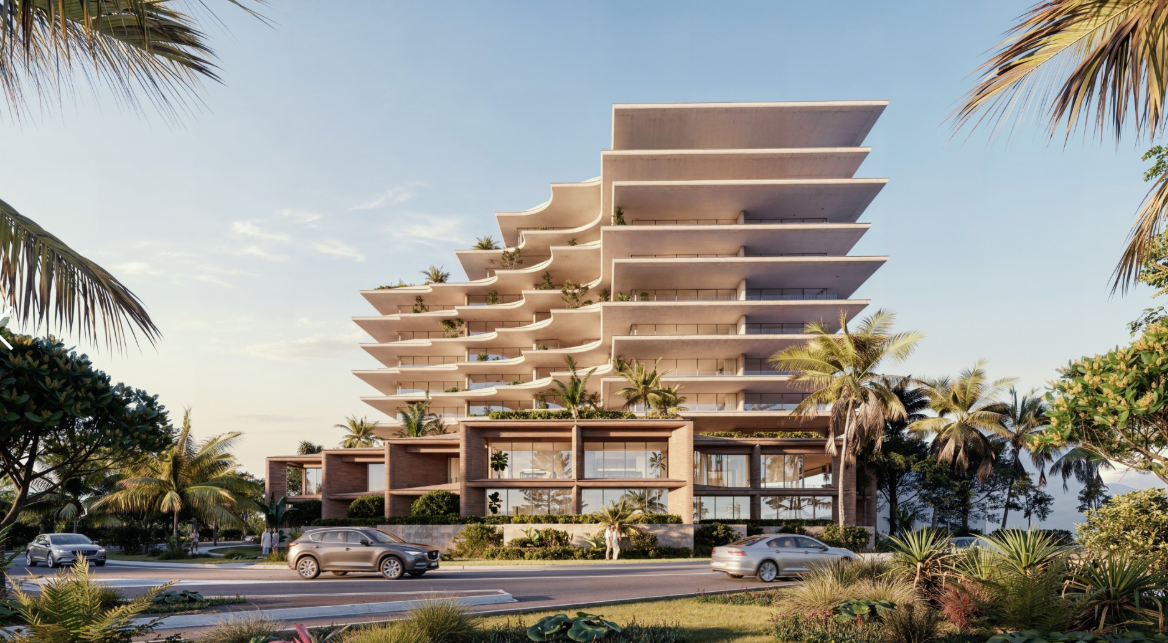
Queensland-based builder-developer MAYD has unveiled an exclusive first look at its anticipated ultra-luxury North Kirra mixed-use project as it lodges a minor amendment with the City of Gold Coast Council. The project sits across a 4,742sqm amalgamated landholding spanning seven parcels at 2–6 Pacific Parade and 27–33 Golden Four Drive, Bilinga, which MAYD secured in …
Continue reading “MAYD”s North Kirra Plans Unveiled Ahead of Early 2027 Launch”

Three-Michelin-starred chef Massimiliano Alajmo will host an intimate Mediterranean sailing aboard Crystal Serenity, redefining fine dining at sea.